

TL;DR:
- Regular foot exams are essential for early detection of silent issues like nerve damage and circulatory problems. They help prevent serious complications such as ulcers, infections, and amputations while maintaining mobility and independence. The recommended frequency varies based on individual risk factors, from once a year for healthy adults to every few weeks for high-risk patients.
A routine podiatric exam, commonly called a foot exam, is a clinical evaluation that checks circulation, nerve function, skin condition, and joint movement in your feet and ankles. Regular foot exams are the most reliable way to catch problems before they become serious. Nerve damage, circulatory disease, and structural issues like bunions or flat arches often develop without any pain at all. Many foot conditions develop silently, which means waiting for symptoms is a strategy that consistently leads to worse outcomes. Stridefootankle sees this pattern repeatedly in Las Vegas patients who arrive with advanced issues that a simple annual exam could have caught years earlier.
Why regular foot exams are a medical priority
Regular foot exams are defined as scheduled clinical evaluations performed by a podiatrist to assess the structural, vascular, and neurological health of the feet. They are not reserved for patients with existing foot pain. They are a preventive tool for every adult.

The core value of these exams is early detection. Feet often show early signs of systemic diseases, including kidney problems, arthritis, and peripheral artery disease, before those conditions produce symptoms elsewhere in the body. Swelling, color changes, and joint stiffness in the feet can signal conditions that require urgent attention far beyond the foot itself.
Podiatrists also use foot exams to prevent the most serious outcomes in at-risk patients. Regular exams significantly reduce the risk of infections, ulcers, and amputations through early detection and intervention. For patients with diabetes or peripheral neuropathy, this is not a minor benefit. It is the difference between keeping a limb and losing one.
The importance of foot exams extends to mobility and independence. Foot pain and instability are leading contributors to falls, reduced activity, and loss of independence in older adults. Catching a structural problem or circulatory issue early keeps you moving and living fully.
What happens during a professional foot exam?
A professional foot exam typically takes 30–60 minutes and covers far more ground than most patients expect. The appointment begins with a patient history review, where your podiatrist asks about symptoms, medical conditions, medications, and activity levels. This context shapes every assessment that follows.
The physical exam then moves through several distinct components:
- Gait analysis: Your podiatrist observes how you walk to identify abnormal movement patterns, uneven weight distribution, or compensatory mechanics that stress specific joints or tendons.
- Vascular assessment: The podiatrist checks circulation by feeling for pulses in the foot and ankle and looking for signs of poor blood flow, such as skin discoloration, hair loss on the toes, or slow-healing areas.
- Neurological testing: The 10g monofilament test is the standard tool for assessing protective sensation. A thin filament is pressed against specific points on the sole to determine whether you can feel it. Loss of sensation at these points signals neuropathy risk.
- Skin and nail inspection: The podiatrist checks for calluses, corns, cracks, fungal infections, ingrown toenails, and any open wounds or ulcers.
- Joint range of motion: Each major joint in the foot and ankle is moved through its range to detect stiffness, pain, or instability.
Routine podiatric procedures like callus removal and nail trimming performed during the exam are generally painless. Many patients are surprised by how comfortable the appointment actually is. You can learn more about what a general foot and ankle exam covers at Stridefootankle.
Pro Tip: Bring your most-worn pair of shoes to the appointment. Shoe wear patterns reveal biomechanical imbalances and pressure points that verbal history alone cannot capture.
How often should you get foot exams?
Exam frequency depends on your personal risk profile, and the difference between risk groups is significant. Here is how clinical guidance breaks it down:
- Healthy adults with no known risk factors: A baseline foot exam once per year is the standard recommendation. Annual exams establish a reference point so that changes are easy to identify over time.
- Patients with diabetes: Diabetic patients need exams every 3–6 months. Diabetes impairs circulation and nerve function, creating conditions where small wounds can progress to serious infections rapidly.
- High-risk individuals with active neuropathy, vascular disease, or a history of ulcers: Exams every 3–12 weeks are appropriate. At this frequency, a podiatrist can monitor wound healing, adjust footwear recommendations, and intervene before minor issues escalate.
- Older adults: Seniors benefit from at least annual exams, with more frequent visits if balance problems, arthritis, or reduced mobility are present. Preventive foot care reduces fall risk and hospital admissions by identifying modifiable risk factors early.
- Patients recovering from foot surgery or injury: Follow your podiatrist’s specific schedule, which may involve visits every few weeks during the recovery period.
A useful resource for building a broader health maintenance schedule is the patient health checklist from MedFiles.ai, which covers annual and periodic screenings across multiple health domains.
Pro Tip: Schedule your annual foot exam even when your feet feel completely fine. Nerve damage can mask warning signs, so the absence of pain does not confirm the absence of a problem.
What are the key benefits of regular foot exams?
Regular foot exams deliver benefits that reach well beyond the feet themselves. Understanding these benefits makes it easier to prioritize the appointment rather than postpone it.
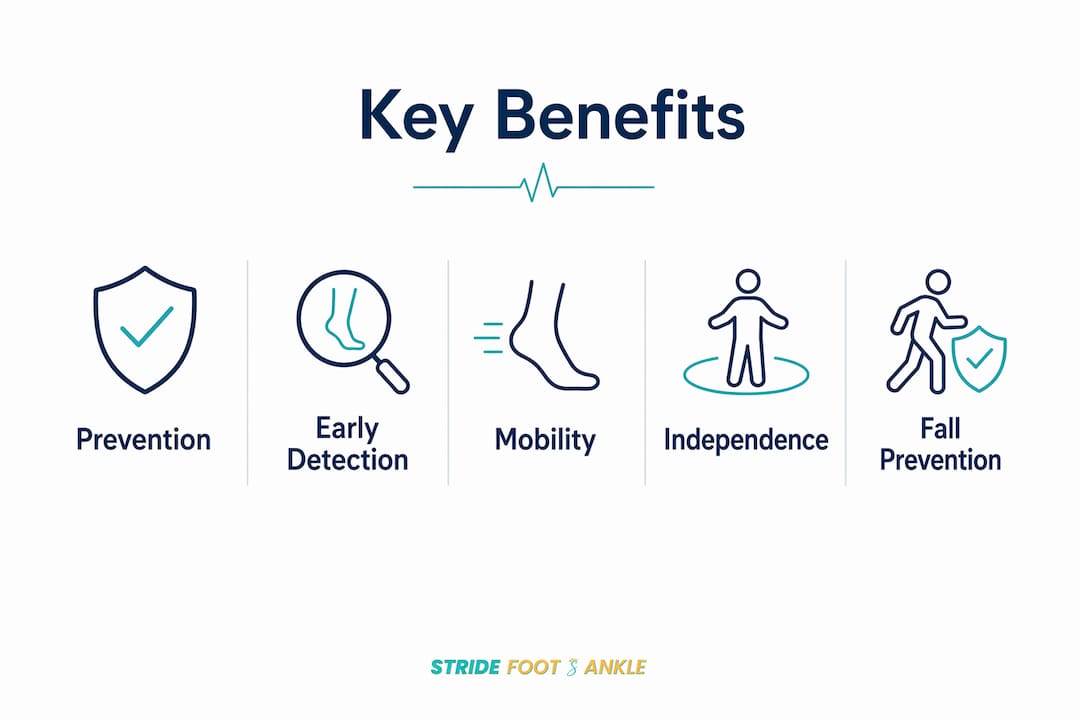
Prevention of ulcers, infections, and amputations
Foot ulcers are among the most serious and costly complications in patients with diabetes or vascular disease. They develop from undetected pressure points, minor wounds, or skin breakdown that goes unnoticed due to neuropathy. A podiatrist who examines your feet every few months catches these warning signs before they become open wounds. The preventive impact of regular exams on reducing long-term medical costs is well established. Avoiding a single hospitalization for a foot infection represents a significant financial and personal benefit. You can read more about ulcer prevention strategies for at-risk patients at Stridefootankle.
Early detection of systemic disease
The feet function as an early warning system for the entire body. Edema in the feet and ankles can indicate kidney failure or heart disease. Changes in skin color or temperature may reflect cardiovascular problems. Joint stiffness and swelling can be the first visible sign of rheumatoid arthritis. A podiatrist trained to recognize these patterns can refer you to the right specialist before a systemic condition becomes severe. This is one of the most underappreciated benefits of regular foot checkups for adults of all ages.
Mobility, balance, and fall prevention
Foot health directly controls your ability to walk, balance, and stay active. Foot instability increases fall risk, particularly in older adults, and falls are a leading cause of injury-related hospital admissions. A podiatrist can identify structural issues, recommend orthotics, and suggest footwear changes that improve stability before a fall occurs. For seniors, podiatry and mobility are closely linked, and regular exams are a direct investment in independence.
Early versus late detection: what the difference looks like
| Condition | Detected early | Detected late |
|---|---|---|
| Plantar fasciitis | Managed with stretching and orthotics | Chronic pain requiring injections or surgery |
| Peripheral neuropathy | Monitored, footwear adjusted, ulcer prevented | Ulcer, infection, possible amputation |
| Peripheral artery disease | Referred for vascular care, lifestyle changes | Limb-threatening ischemia |
| Ingrown toenail | Simple in-office removal | Infected wound requiring antibiotics or surgery |
| Bunion | Conservative management, custom orthotics | Surgical correction with extended recovery |
The pattern is consistent across conditions. Early detection keeps treatment simple, affordable, and conservative. Late detection forces more aggressive and costly interventions.
What practical steps maintain foot health between exams?
Professional exams are the foundation, but what you do between appointments determines how much ground you protect. Daily foot care habits reduce the risk of problems developing between visits.
- Inspect your feet daily. Look at the soles, between the toes, and around the heels. Use a mirror if needed. You are looking for redness, swelling, blisters, cuts, or any change in skin color or texture.
- Wash and dry thoroughly. Clean your feet with mild soap and warm water every day. Dry completely between the toes to prevent fungal infections, which thrive in moisture.
- Moisturize the right areas. Apply lotion to the heels and soles to prevent cracking. Avoid applying moisturizer between the toes, where excess moisture promotes fungal growth.
- Trim nails correctly. Cut nails straight across, not curved at the corners. Curved trimming is the primary cause of ingrown toenails. If you have difficulty trimming safely, a podiatrist can do it during your visit.
- Choose footwear carefully. Shoes should fit without pinching, have adequate arch support, and leave room for your toes to move. Replace shoes when the soles show uneven wear, which signals a biomechanical issue worth discussing at your next exam.
- Watch for warning signs. Numbness, tingling, persistent pain, color changes, or any wound that does not heal within a few days all require prompt attention. Foot numbness in particular should never be dismissed as normal.
Pro Tip: Add simple foot mobility exercises to your daily routine, such as toe spreads, ankle circles, and calf stretches. These improve circulation and joint flexibility. For a structured program, review foot mobility exercises from Stridefootankle.
Key Takeaways
Regular foot exams are the most effective way to prevent serious complications, detect systemic disease early, and maintain mobility across every stage of life.
| Point | Details |
|---|---|
| Exams catch silent problems | Nerve damage and circulatory disease often develop without pain, making scheduled exams essential. |
| Frequency matches risk level | Healthy adults need annual exams; diabetic or high-risk patients need visits every 3–12 weeks. |
| Feet signal systemic disease | Swelling, color changes, and joint stiffness can indicate kidney, heart, or vascular conditions. |
| Early detection saves limbs | Catching ulcers, neuropathy, and arterial disease early prevents amputations and major surgery. |
| Daily self-care extends protection | Daily inspection, proper nail care, and good footwear reduce risk between professional visits. |
What I’ve learned from watching patients delay their foot exams
Most patients who come to Stridefootankle with serious foot complications share one thing in common. They waited. They waited because their feet did not hurt. They waited because they assumed a foot exam was only for people with diabetes. They waited because it felt like a low priority compared to other health appointments.
That reasoning is understandable. It is also consistently wrong.
The patients who benefit most from foot exams are often the ones who feel the least urgency about scheduling one. A person with intact sensation feels no pain from a developing pressure ulcer. A patient with early peripheral artery disease may notice only mild fatigue in the legs during walks. These are the exact patients where a 30-minute exam changes the outcome dramatically.
What I find most encouraging is how simple the solution is. A foot exam is not invasive. It is not painful. It does not require preparation beyond bringing your everyday shoes. Yet the information it produces can redirect a patient’s entire care plan, catch a systemic disease before it becomes a crisis, and preserve mobility for years longer than it would otherwise last.
Foot health is not a niche concern. Your feet carry you through every activity you value. Treating their care as optional is a decision most patients eventually regret. Treating it as routine is one of the most practical things you can do for your long-term health.
— Ramil
Foot and ankle care at Stridefootankle
Stridefootankle provides comprehensive podiatric evaluations for patients across Las Vegas, led by Dr. Nahad Wassel, a board-certified foot and ankle specialist. Whether you need a baseline annual exam, a high-risk diabetic foot assessment, or care for an existing condition, the practice offers personalized care plans built around your specific health profile.

Dr. Wassel’s approach combines thorough clinical assessment with clear communication, so you leave every appointment understanding exactly what was found and what comes next. Stridefootankle’s general foot and ankle care services cover the full range of preventive and therapeutic podiatric needs. Schedule your exam and start protecting your feet before problems develop.
FAQ
What does a regular foot exam check for?
A foot exam checks circulation, nerve function, skin and nail health, joint range of motion, and gait. Podiatrists also look for early signs of systemic conditions like peripheral artery disease, arthritis, and kidney problems.
How often should you get a foot exam if you have diabetes?
Patients with diabetes should receive a foot exam every 3–6 months. Those with active neuropathy or a history of ulcers may need visits as frequently as every 3–12 weeks.
Can a foot exam detect problems even without symptoms?
Yes. Nerve damage can eliminate pain signals entirely, so serious problems like neuropathy and early ulcers develop without any discomfort. Scheduled exams catch these issues before they become visible or painful.
What are the signs you need a foot exam sooner than scheduled?
Numbness, tingling, persistent pain, any wound that does not heal within a few days, unusual swelling, or skin color changes all require prompt evaluation rather than waiting for a routine appointment.
Are foot exams painful?
Routine foot exams are generally painless. Procedures like callus removal and nail trimming involve minimal discomfort. Most patients find the appointment far more comfortable than they anticipated.
Recommended
- Why foot care matters: prevent pain, injuries, and complications – Stride Foot & Ankle – Dr. Nahad Wassel
- General Foot & Ankle Care – Stride Foot & Ankle
- How to Prevent Foot Ulcers: a Guide for At-Risk Patients – Stride Foot & Ankle – Dr. Nahad Wassel
- Why Choose a Foot Specialist for Expert Foot Care – Stride Foot & Ankle – Dr. Nahad Wassel
Recent Comments