

TL;DR:
- Proper foot alignment ensures even weight distribution and prevents strain on your joints. Misalignment increases the risk of pain, injuries, and conditions like plantar fasciitis. Combining targeted exercises with custom orthotics effectively improves foot posture and reduces overall body strain.
Foot alignment is defined as the positional relationship of the bones, joints, muscles, and tendons in your feet that determines how your body weight is distributed with every step. When that positioning is off, the effects travel upward through your knees, hips, and spine. Understanding what is foot alignment gives you a clear starting point for addressing foot pain, because misalignment is one of the most common and most overlooked causes of chronic discomfort. Clinical tools like the Foot Posture Index (FPI-6) now give podiatrists an objective way to measure and treat these problems.
What is foot alignment and how does it affect your body?
Foot alignment is the structural positioning of your foot’s bones and soft tissues that controls how weight spreads across your foot during standing, walking, and running. A well-aligned foot distributes load evenly from heel to toe, reducing stress on any single structure. When alignment shifts even slightly, that load concentrates in the wrong places, and pain follows.
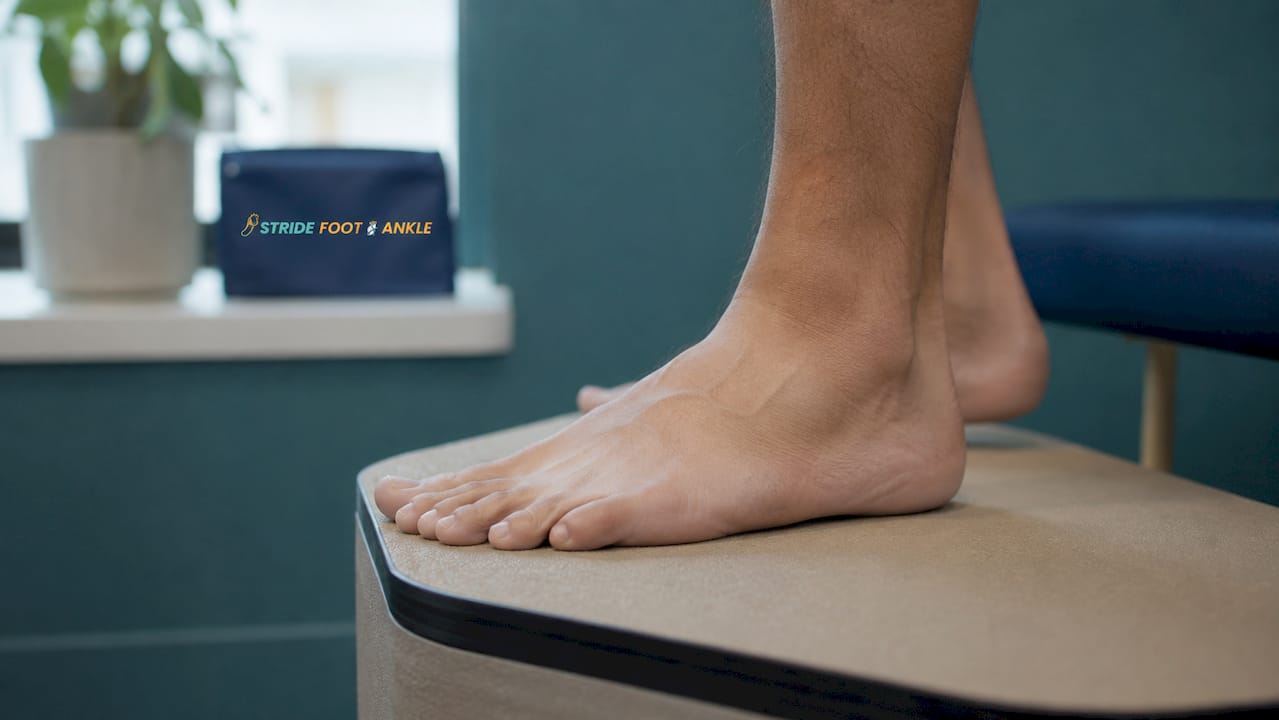
The clinical term you will hear most often is “foot posture,” which describes the static and dynamic position of the foot relative to the leg. Podiatrists use the Foot Posture Index (FPI-6) as a standardized tool to measure this posture objectively. A neutral foot scores near zero on the FPI-6 scale. Scores toward the negative end indicate a supinated (high-arched) foot, while scores toward the positive end indicate a pronated (flat) foot.
Proper alignment also supports your body’s posture from the ground up. Your feet are the foundation of your entire kinetic chain, meaning that the position of your foot directly influences the angle of your ankle, knee, hip, and lumbar spine. A foot that rolls inward or outward forces every joint above it to compensate. That compensation is where pain and injury begin.
How does misaligned feet cause pain and conditions like plantar fasciitis?
Misaligned feet change how force travels through your foot with every step, creating abnormal stress on tendons, ligaments, and joints. The two most common alignment problems are overpronation (the foot rolls inward) and supination (the foot rolls outward). Both alter the mechanics of walking in ways that accumulate damage over time.
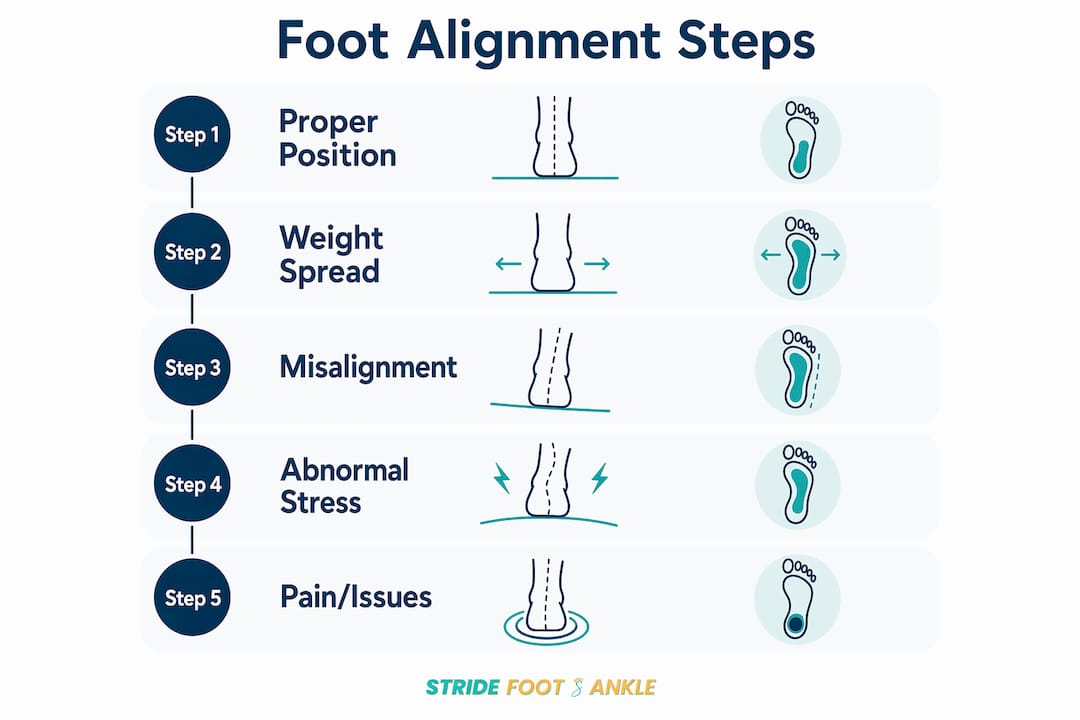
Overpronation causes inward ankle roll and internal knee rotation, placing abnormal stress on knee ligaments. That rotation also tilts the pelvis and compresses the lower back. Patients who overpronate often report knee pain or lower back ache before they ever notice a foot problem, which is why the foot connection gets missed.
Plantar fasciitis is the most direct consequence of poor foot alignment. About 10% of the population will develop plantar fasciitis over their lifetime, with alignment abnormalities identified as a major contributing factor. That statistic means roughly 1 in 10 people will experience this condition, and a significant portion of those cases trace back to a correctable positioning problem.
Improper foot alignment and excessive rearfoot eversion increase plantar fasciitis risk by 2.19 to 2.85 times compared to a neutrally aligned foot. That range of risk is not trivial. It means a patient with measurable alignment problems is more than twice as likely to develop one of the most painful and persistent foot conditions in podiatry.
The risk is especially high for people who spend long hours on their feet. Retail workers, nurses, and teachers who stand on hard floors for eight or more hours a day place continuous load on already stressed structures. Without proper alignment, that daily load becomes a reliable path to chronic heel pain, arch pain, and tendon inflammation. Foot pain causes and symptoms in these populations almost always include an alignment component that responds well to targeted treatment.
How to check foot alignment: clinical tools and self-assessment
Foot alignment is assessed through a combination of clinical examination and validated scoring tools, with the Foot Posture Index (FPI-6) as the current gold standard. A podiatrist can complete an FPI-6 assessment in a standard clinical visit, and the results directly guide treatment decisions.
The Foot Posture Index (FPI-6) explained
The FPI-6 evaluates six criteria to produce a total alignment score:
- Talar head palpation: How much of the talus bone is felt on the inner versus outer side of the ankle
- Curves above and below the lateral malleoli: The shape of the ankle curves in the lower leg
- Calcaneal frontal plane position: Whether the heel bone tilts inward or outward
- Talonavicular joint prominence: Bulging of the joint on the inner arch
- Medial longitudinal arch congruence: The height and shape of the inner arch
- Forefoot to rearfoot alignment: Whether the front of the foot twists relative to the heel
Each criterion scores from -2 to +2, producing a total range of -12 (highly supinated) to +12 (highly pronated). A score of 0 to +5 is considered normal for most adults.
| FPI-6 Score | Foot Posture Category | Clinical Implication |
|---|---|---|
| -12 to -5 | Highly supinated | High arch, lateral load, ankle sprain risk |
| -4 to -1 | Supinated | Mild high arch, monitor for lateral stress |
| 0 to +5 | Normal | Balanced load distribution |
| +6 to +9 | Pronated | Flat arch, medial stress, plantar fasciitis risk |
| +10 to +12 | Highly pronated | Severe flat foot, significant alignment correction needed |
Weight-bearing versus non-weight-bearing exams
Clinical exams separate structural foot problems from compensatory issues using both non-weight-bearing and weight-bearing assessments. A foot may look aligned when you are sitting but collapse into overpronation the moment you stand. Standard clinical protocols use a goniometer to position the foot neutrally during weight-bearing exams, because routine standing posture can mask true alignment problems.
Pro Tip: A simple self-check involves looking at your ankle bone from behind. If your ankle bone sits directly over your heel bone and you can see a small gap (the sinus tarsi) on the outer side of your ankle, your foot posture is likely within a normal range. If your ankle bone drops inward and that gap disappears, you may have a pronation issue worth evaluating professionally.
Foot alignment exercises and treatment options
Correcting or supporting foot alignment requires a combination of targeted exercises, appropriate footwear, and in many cases, orthotics. No single intervention works for every patient, which is why professional assessment should come before any self-treatment program.
Exercises to strengthen and stabilize foot alignment
- Arch lifts (short foot exercise): Stand barefoot and try to shorten your foot by pulling the ball of your foot toward your heel without curling your toes. Hold for 5 seconds and repeat 10 times per foot. This activates the intrinsic muscles that support the medial arch.
- Heel raises: Stand on the edge of a step and slowly raise up onto your toes, then lower below step level. Perform 3 sets of 15 repetitions. This strengthens the calf and Achilles tendon, both of which influence rearfoot alignment.
- Towel scrunches: Place a small towel on the floor and scrunch it toward you using only your toes. This targets the small muscles of the forefoot that contribute to arch stability.
- Single-leg balance: Stand on one foot for 30 seconds at a time. Progress to standing on a folded towel or balance pad. This trains the ankle stabilizers that prevent excessive pronation or supination during walking.
- Calf stretches (gastrocnemius and soleus): A tight calf forces the foot to compensate during the push-off phase of walking, often increasing pronation. Stretch both the straight-leg and bent-knee versions for 30 seconds each, twice daily.
Exercises targeting foot muscles combined with functional orthotics together improve intrinsic foot stability more effectively than either approach alone. This means that adding orthotics without doing the strengthening work leaves a significant part of the solution on the table.
Pro Tip: Start foot alignment exercises barefoot on a firm surface. Shoes, even supportive ones, reduce sensory feedback from the foot to the brain. That feedback is what helps your nervous system learn and maintain better alignment patterns. Build up to 10 minutes of barefoot exercise daily before adding footwear back into your routine.
How orthotics support neutral alignment
Orthotics redistribute weight evenly across the foot and guide the foot into better positioning during movement. Custom orthotics are shaped from a mold or scan of your specific foot, which means they address your individual alignment pattern rather than a generic arch shape. Over-the-counter insoles can provide temporary relief, but they do not correct the underlying biomechanical issue the way a custom device does.
Orthotics work best when viewed as functional support tools used alongside exercises, not as permanent replacements for muscle function. Patients who rely on orthotics without building foot strength often find their alignment deteriorates when they remove the device. The goal is to use orthotics to reduce pain and load while the muscles catch up. For a detailed look at how orthotics fit into a treatment plan, orthotics for foot pain covers the options clearly.
Footwear and lifestyle factors
Footwear is the most immediate environmental factor affecting foot alignment. Shoes with inadequate arch support, worn-down heels, or excessive flexibility allow the foot to collapse into poor positions with every step. Replace athletic shoes every 300–500 miles of use, or when the midsole shows visible compression. Avoid prolonged standing on hard concrete or tile floors without cushioned footwear, as hard surfaces increase the ground reaction force that stresses a misaligned foot.
How does improving foot alignment benefit your whole body?
Correcting foot alignment produces benefits that extend well beyond the foot itself. The kinetic chain means that every joint above the foot is affected by what happens at ground level. When the foot aligns properly, the ankle, knee, hip, and spine all move with less compensatory stress.
The most common postural compensations caused by misaligned feet include:
- Knee valgus (knock-knee): Overpronation rotates the tibia inward, pulling the knee toward the midline and stressing the medial knee ligaments.
- Hip drop (Trendelenburg pattern): Uneven foot loading shifts the pelvis, causing one hip to drop during walking and overloading the hip abductors.
- Lumbar lordosis increase: A pronated foot tilts the pelvis forward, which exaggerates the curve in the lower back and compresses the lumbar discs.
- Shoulder asymmetry: Chronic pelvic tilt from foot misalignment can travel all the way to the shoulders, creating uneven muscle tension across the upper back.
The feet are the foundation of the body’s postural system. A small deviation at the base creates a progressively larger deviation at every level above it. Correcting foot alignment is often the most efficient way to address pain that appears to originate in the knee, hip, or lower back.
Research supports orthotics and targeted exercises as effective tools for improving whole-body posture. Patients who correct overpronation with custom orthotics frequently report reduced knee pain and improved balance, even when the knee itself has no structural damage. The connection between foot health and mobility is well-documented and clinically significant. Addressing alignment at the foot level is often the most direct path to resolving pain that has been misattributed to the knee or back for years.
Normal foot alignment also varies between individuals. “Neutral” is relative depending on a person’s activity level, body weight, and individual biomechanics, which is why personalized assessment matters more than chasing a textbook ideal. A podiatrist evaluates your specific foot in the context of your specific life, not against a single universal standard.
Key Takeaways
Proper foot alignment is the single most effective starting point for addressing chronic foot, knee, and back pain, because it corrects the root cause rather than treating symptoms in isolation.
| Point | Details |
|---|---|
| Foot alignment definition | The positional relationship of foot bones, joints, muscles, and tendons that controls weight distribution. |
| Misalignment raises injury risk | Improper alignment increases plantar fasciitis risk by 2.19 to 2.85 times compared to a neutral foot. |
| FPI-6 is the clinical standard | The Foot Posture Index scores alignment from -12 (supinated) to +12 (pronated) using six measurable criteria. |
| Exercises plus orthotics work best | Combining foot-strengthening exercises with functional orthotics improves alignment more than either approach alone. |
| Alignment affects the whole body | Correcting foot posture reduces compensatory stress on the knees, hips, and lumbar spine. |
What I’ve learned from watching patients ignore foot alignment for years
Most patients who come in with knee pain or lower back pain have never been told to look at their feet. That gap in awareness is one of the most frustrating patterns in musculoskeletal care. By the time someone connects their back pain to their flat feet, they have often spent years on treatments that addressed the symptom but never the source.
The other misconception I see constantly is that orthotics are a cure. Patients pick up a pair of custom insoles, feel immediate relief, and assume the problem is solved. It is not. The orthotic is doing the work the foot muscles should be doing. Without a parallel exercise program, the muscles weaken further, and the patient becomes more dependent on the device over time, not less.
What actually works is the combination: a proper clinical assessment using a validated tool like the FPI-6, a custom orthotic matched to your specific alignment pattern, and a progressive exercise program that builds the intrinsic foot strength to maintain that alignment independently. That approach takes longer than buying an insole off a shelf. It also produces results that last.
The other thing worth saying plainly is that “normal” alignment is not one fixed position. A foot that scores slightly pronated on the FPI-6 may be perfectly functional for one patient and a source of chronic pain for another, depending on their activity level, body weight, and the surfaces they walk on daily. Generic advice about arch support misses this entirely. Personalized assessment is not a luxury. It is the only way to get the diagnosis right. If you have been living with foot pain and have never had your foot posture evaluated by a specialist, that is the single most useful step you can take today.
— Ramil
Foot alignment care at Stridefootankle in Las Vegas
Stridefootankle provides specialized evaluation and treatment for foot alignment problems, including clinical FPI-6 assessments, custom orthotics, exercise guidance, and diagnostic imaging when needed.
Dr. Nahad Wassel brings board-certified expertise in both conservative and surgical podiatric care to every patient evaluation. If you are dealing with heel pain, arch pain, or discomfort that travels into your knees or back, a thorough alignment assessment is the right first step. Stridefootankle’s general foot and ankle care services are designed to identify the root cause of your pain and build a treatment plan that fits your life. Schedule a consultation and get a clear picture of what your feet actually need.
FAQ
What is foot alignment in simple terms?
Foot alignment is the way your foot bones, joints, and soft tissues are positioned relative to each other and to the ground. Proper alignment distributes your body weight evenly and supports healthy movement from the foot up through the spine.
What are the symptoms of poor foot alignment?
Common symptoms include heel pain, arch pain, knee pain, and lower back discomfort. Patients with misaligned feet often notice uneven shoe wear, ankle fatigue, or pain that worsens after prolonged standing.
How is foot alignment assessed clinically?
Podiatrists use the Foot Posture Index (FPI-6), which scores alignment across six criteria on a scale from -12 to +12. Both weight-bearing and non-weight-bearing exams are used to distinguish structural problems from compensatory ones.
Can foot alignment exercises actually correct misalignment?
Targeted exercises like arch lifts, heel raises, and single-leg balance drills strengthen the intrinsic foot muscles that maintain alignment. Research shows that combining these exercises with functional orthotics produces better results than either approach alone.
When should I see a podiatrist about foot alignment?
See a podiatrist if you have persistent heel or arch pain, pain that radiates to your knees or back, or visible changes like a flattening arch or ankle that rolls inward. Early assessment prevents minor alignment issues from becoming chronic conditions.
Recommended
- Why Foot Health Impacts Mobility: What You Need to Know – Stride Foot & Ankle – Dr. Nahad Wassel
- How to Improve Foot Mobility: Exercises and Tips – Stride Foot & Ankle – Dr. Nahad Wassel
- Guide to Common Pediatric Foot Problems: Causes, Signs, Care – Stride Foot & Ankle – Dr. Nahad Wassel
- Why foot care matters: prevent pain, injuries, and complications – Stride Foot & Ankle – Dr. Nahad Wassel
Recent Comments