

Multidisciplinary wound care consistently reduces major amputations, speeds healing, and improves diagnostic accuracy for patients with complex or chronic wounds, particularly diabetic foot ulcers. A systematic review of 33 observational studies found that 31 of those studies reported lower major-amputation rates after a multidisciplinary team (MDT) was introduced. That is the core finding you need to understand before anything else.
31 out of 33 observational studies reported reduced major amputations after MDT introduction, making coordinated wound care one of the most consistently supported interventions in complex wound management.
The interprofessional approach to wound healing draws on physicians, surgeons, nurses, therapists, and social workers working from a shared care plan rather than in sequence. Stride Foot & Ankle, a board-certified podiatric practice in Las Vegas, coordinates with regional specialists and vascular partners to give patients exactly this kind of integrated care.
Key Takeaways
Multidisciplinary wound care produces better outcomes for complex and chronic wounds because coordinated teams address glycemic control, vascular disease, infection, and local wound management simultaneously rather than sequentially.
| Point | Details |
|---|---|
| Amputation reduction evidence | 31 of 33 observational studies reported lower major-amputation rates after MDT introduction. |
| Diagnostic accuracy improves | Interprofessional assessments improve healability classification, vascular evaluation, and infection detection compared to standard community care. |
| Early referral is critical | Wounds not improving after 2–4 weeks of standard care, or any wound with ischemia or deep infection, warrant prompt MDT evaluation. |
| Evidence has real limits | Most studies are observational; no large randomized trials exist, and results vary by team quality and patient population. |
| Stride Foot & Ankle | Offers coordinated wound care in Las Vegas with specialist referral pathways, debridement, offloading, and a documented care plan from the first visit. |
Table of Contents
- Why multidisciplinary wound care improves patient outcomes
- Who is on a multidisciplinary wound team?
- The four clinical tasks MDTs address and why each one matters
- How is multidisciplinary wound care organized operationally?
- Who should see a multidisciplinary wound team, and when?
- What can you expect at a multidisciplinary wound care visit?
- What are the limitations and access barriers to MDT wound care?
- What does the research actually show?
- How Stride Foot & Ankle participates in coordinated wound care
- An editorial perspective on what MDT care actually demands
- Stride Foot & Ankle: coordinated wound care in Las Vegas
- Sources
- FAQ
Why multidisciplinary wound care improves patient outcomes
Coordinated wound care teams produce measurable improvements across four patient-level domains: amputation prevention, diagnostic accuracy, healing speed, and resource efficiency. Each benefit is backed by observational and cohort data, though the evidence base is still largely non-randomized.
Reduced major amputations. The systematic review cited above is the clearest signal. Single-center program reports have described absolute reductions in major-amputation rates ranging from minimal change to up to 51% in select high-performing settings, though results vary considerably by patient population and team composition. Treat those upper-end figures as aspirational benchmarks, not guarantees.
Improved diagnostic accuracy. A retrospective cohort study from Ontario found that interprofessional team assessments improved healability classification, increased vascular and offloading assessments, and detected infection more reliably than conventional community care. Getting the diagnosis right earlier changes the entire treatment trajectory.
Faster healing and fewer advanced interventions. The same Ontario cohort reported better healing outcomes despite a shorter follow-up window, and noted that fewer high-cost, advanced wound-care modalities were required after comprehensive MDT assessment. That last point matters for patients and payers alike.
Better patient education and adherence. Multiple reviews report that MDTs improve the consistency of messages patients receive, which directly supports long-term adherence to offloading, glucose management, and wound-care routines. When everyone on the team says the same thing, patients are more likely to follow through.
- Reduced major-amputation rates (31/33 studies)
- Improved healability classification and vascular assessment
- Faster healing with fewer high-cost modalities
- Better infection detection and triage
- Consistent patient education across disciplines
Pro Tip: When evaluating a wound-care program, ask whether the team tracks and publishes outcome metrics such as healing rates, time-to-heal, and major-amputation rates. Programs that measure their own results tend to refine their protocols and deliver better care.
Who is on a multidisciplinary wound team?
Most well-structured MDTs organize members into a nuclear core and an ancillary layer, with one clinician serving as the coordinating “captain.” Understanding who does what helps you ask better questions at your first visit.
Core (nuclear) members:
- Podiatrist or foot and ankle surgeon — leads wound assessment, performs debridement, manages offloading, and coordinates surgical decisions
- Vascular surgeon or interventional radiologist — evaluates and treats arterial insufficiency; performs revascularization when indicated
- Infectious disease physician or clinical microbiologist — guides antibiotic selection, interprets cultures, and manages deep or systemic infections
- Endocrinologist or diabetologist — optimizes glycemic control, which directly affects wound-healing capacity
- Wound-care nurse or certified wound specialist — manages dressings, monitors wound progress, and provides hands-on patient education
Ancillary members (involved as needed):
- Physical or occupational therapist — addresses mobility, strength, and functional recovery after wound closure or amputation
- Registered dietitian — supports nutritional status, which is a modifiable factor in healing speed
- Prosthetist or orthotist — fits custom offloading devices, post-amputation prosthetics, and therapeutic footwear
- Social worker or care coordinator — connects patients with transportation, home-care resources, and insurance navigation
The “captain” role, typically held by the podiatrist or a wound-care physician, is not just administrative. Teams that designate a single coordinator and use a clear nuclear/ancillary structure achieve faster decision-making and clearer follow-up responsibilities. Without that role, patients often fall through the gaps between specialists.
Pro Tip: Ask at your first appointment: “Who is my primary point of contact if my wound changes between visits?” A clear answer signals a well-organized team. Vague answers are a warning sign.
The four clinical tasks MDTs address and why each one matters
Every well-functioning MDT consistently tackles four overlapping clinical problems. Addressing them simultaneously, rather than one at a time, is what separates coordinated care from a sequential referral chain.
Glycemic control
Elevated blood glucose impairs neutrophil function, slows collagen synthesis, and reduces tissue perfusion. The endocrinologist or diabetologist on the team targets hemoglobin A1c and adjusts medications in parallel with wound treatment, rather than waiting for glucose to improve before addressing the wound. That parallel approach shortens the overall healing timeline.
Local wound management
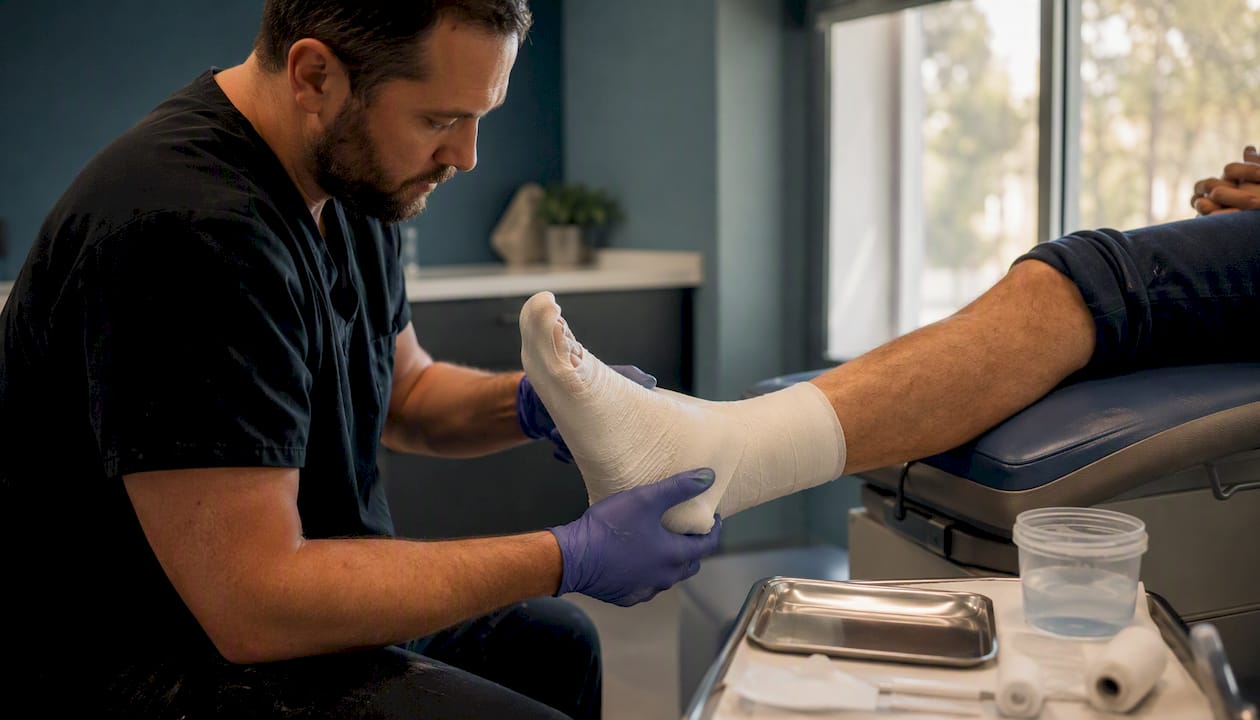
Wound debridement removes necrotic tissue, reduces bacterial burden, and stimulates the wound edge to advance. Offloading, typically with a total-contact cast or removable cast walker, redistributes plantar pressure away from the ulcer. These two interventions form the mechanical foundation of local wound management and are most effective when performed consistently by a trained podiatrist within the MDT.
Vascular disease assessment and management
Ischemia is present in a substantial proportion of diabetic foot ulcers and is one of the strongest predictors of amputation. The MDT’s vascular specialist performs ankle-brachial index testing, toe pressures, or duplex ultrasound to quantify perfusion. When arterial disease is significant, revascularization (angioplasty or bypass) may restore enough blood flow to allow healing. Without this assessment, wounds are treated as if perfusion is adequate when it is not.
“Consistently and synchronously addressing all contributing factors — vascular status, infection, glycemic control, and local wound environment — and providing timely care through referral pathways and care algorithms is what the evidence repeatedly credits for improved outcomes.” (Sciencedirect.com, descriptive MDT review)
Infection control
Deep infection, osteomyelitis, and systemic sepsis require prompt, targeted treatment. The MDT’s infectious disease specialist interprets tissue cultures (not just swabs), selects appropriate antibiotics, and determines whether surgical debridement or bone resection is needed. Coordinated infection control in podiatry within the MDT framework prevents the escalation from localized infection to limb-threatening sepsis.

The V.I.P. framework (vascular, infection, plantar pressure) captures these three wound-level tasks and is embedded in routine MDT workflows so that all three are evaluated at every visit rather than addressed one at a time.
How is multidisciplinary wound care organized operationally?
The operational structure of an MDT is what converts good intentions into consistent outcomes. Care algorithms and explicit referral pathways are repeatedly cited as the core enablers of MDT success because they reduce delays and standardize who gets which intervention and when.
Referral pathway (typical flow):
Primary care or emergency department identifies a non-healing wound → triage by severity (wound depth, infection signs, ischemia) → referral to MDT hub → initial comprehensive assessment within a defined window (often 48–72 hours for urgent presentations) → care plan assigned with named captain → follow-up cadence set.
Care algorithms translate that pathway into clinical decisions. A well-designed algorithm specifies: if the wound is Wagner Grade 2 or higher, obtain vascular imaging; if probe-to-bone is positive, order MRI for osteomyelitis; if A1c is above a threshold, escalate endocrinology involvement. Algorithms reduce clinician-to-clinician variability and prevent the most common delay: waiting for one specialist’s report before engaging the next.
Team meeting cadence varies by program. High-functioning MDTs typically hold weekly case conferences where the captain presents new and complex cases, ancillary members update their findings, and the group agrees on the next intervention. This structure means a patient’s vascular result, glucose trend, and wound measurement are reviewed together, not in separate clinic notes that no one synthesizes.
Pro Tip: When assessing a wound-care program, ask: “Do you hold regular multidisciplinary case conferences, and will my case be discussed there?” Programs that say yes and can describe the cadence are operating at a higher coordination level than those that rely on informal phone calls between providers.
Who should see a multidisciplinary wound team, and when?
Most patients with a non-healing wound of any type benefit from at least a single MDT assessment. For diabetic foot ulcers and complex wounds, the threshold for referral should be low.
Indications for MDT referral:
- Diabetic foot ulcer that has not improved meaningfully after 2–4 weeks of standard care
- Any wound with signs of deep infection (warmth, erythema extending beyond the wound margin, purulent drainage, fever)
- Suspected or confirmed ischemia (absent pulses, cool foot, rest pain, low ankle-brachial index)
- Wound with exposed tendon, joint capsule, or bone
- Recurrent ulceration at the same site
- Post-amputation stump wound that is failing to heal
- Wound in a patient with poorly controlled diabetes (A1c above 8–9%), renal disease, or immunosuppression
- Any wound that has failed two or more courses of treatment without a clear explanation
Immediate red flags requiring urgent referral (same day or emergency department):
- Spreading cellulitis with systemic signs (fever, elevated white blood cell count, confusion)
- Crepitus or gas in soft tissue (suggests necrotizing infection)
- Rapidly worsening wound with blackened tissue
- Acute limb ischemia (sudden cold, pale, pulseless foot)
Timing matters. Patients referred after infection has become systemic or after ischemia has caused irreversible tissue loss face worse outcomes even with full MDT support. Early triage preserves the team’s ability to prevent major amputation.
For context on what a foot ulcer involves and how wounds are classified, that background helps you recognize when escalation is warranted.
What can you expect at a multidisciplinary wound care visit?
The first MDT visit is more thorough than a standard office appointment. Plan for 60–90 minutes and bring everything that documents your wound’s history.
What happens at the initial assessment:
- Detailed medical history (diabetes duration, prior amputations, medications, kidney function)
- Wound measurement and photography (length, width, depth, tissue type, exudate)
- Vascular testing (ankle-brachial index, toe pressures, or referral for duplex ultrasound)
- Neurological assessment (monofilament testing for peripheral neuropathy)
- Laboratory work (complete blood count, metabolic panel, A1c, inflammatory markers)
- Offloading assessment and device fitting or prescription
- Patient education session covering home wound care, glucose monitoring, and warning signs
What to bring:
- Your current shoes and any orthotics
- A glucose log or continuous glucose monitor download from the past 30 days
- A complete medication list including supplements
- Any prior wound photographs or measurements
- A list of questions about the care plan and expected timeline
Typical care pathway timeline:
| Phase | Timeframe | Key activities |
|---|---|---|
| Initial assessment | Week 1 | Full workup, vascular testing, labs, offloading |
| Early intervention | Weeks 2–4 | Debridement, dressing protocol, glycemic adjustment |
| Reassessment | Week 4–6 | Wound measurement, vascular follow-up, algorithm review |
| Advanced intervention (if needed) | Weeks 6–12 | Revascularization, surgical debridement, skin grafting |
| Maintenance and prevention | Ongoing | Footwear, monitoring, recurrence prevention |
Timelines vary by wound severity, vascular status, and patient adherence. A wound with adequate perfusion and controlled glucose can close in 6–12 weeks; an ischemic wound requiring revascularization may take considerably longer.
What are the limitations and access barriers to MDT wound care?
MDT care is not universally available, and the evidence supporting it, while consistent in direction, has real methodological limits.
Evidence limitations:
- The majority of studies are observational; randomized controlled trials are sparse, as noted in a systematic review of team-based wound care for pressure injuries
- Team composition varies widely across studies, making direct comparisons difficult
- Many single-center reports reflect highly motivated programs that may not generalize to average settings
- Publication bias likely inflates reported effect sizes
Access and resource barriers:
- Full MDTs require coordinated scheduling across multiple specialists, which is logistically demanding
- Rural and underserved areas often lack on-site vascular surgery or infectious disease coverage
- Insurance coverage for MDT visits varies; some payers reimburse team-based care poorly compared to individual specialist visits
- Unclear role definitions and integration gaps between hospital and community settings remain common barriers, according to a scoping review of MDT roles and facilitators
Practical alternatives when full MDT access is limited:
- An optimized single-provider pathway with a podiatrist who has established referral relationships with vascular and infectious disease specialists
- Telehealth MDT hubs, where a regional center advises local providers remotely; this model has shown promise in shrinking access gaps for patients in underserved areas
- Referral to a regional academic medical center or wound-care center of excellence for a one-time comprehensive assessment, with ongoing care managed locally
- For patients managing wound care between visits, a resource like wound care at home can help families understand what to monitor and when to escalate
Ask your primary care provider or podiatrist directly: “Do you have a referral pathway to a multidisciplinary wound team, or can you coordinate with vascular and infectious disease specialists for my case?”
What does the research actually show?
The evidence base for multidisciplinary wound care is consistent in direction but limited in design quality. Here is an honest summary.
Strongest signal: diabetic foot ulcer and major amputation.
The systematic review of 33 observational studies remains the most cited aggregate finding: 31 of 33 studies reported reduced major amputations after MDT introduction. Common team elements across those studies included medical and surgical disciplines, a team captain, care algorithms, and the four core tasks (glycemic control, local wound management, vascular assessment, infection control).
Reported major-amputation reductions across single-center MDT program reports ranged from minimal change to absolute reductions of up to 51% in select high-performing settings, with wide variability by population and team structure.
Diagnostic and healing improvements.
The Ontario interprofessional cohort study demonstrated that team-based assessments improved healability classification, increased vascular and offloading evaluations, detected infection more reliably, and produced better healing outcomes with fewer advanced modalities compared to conventional community care.
Pressure injuries and other wound types.
Evidence for team-based care in pressure injury management shows prevalence and healing improvements, but the systematic review of pressure-ulcer team interventions notes that the evidence base is mainly observational and that randomized-trial data remain sparse.
Key limitations to keep in mind:
- No large randomized controlled trials exist for MDT wound care
- Team composition and outcome definitions vary across studies
- Most evidence comes from single centers with motivated teams
- Generalizability to community settings with limited specialist access is uncertain
The honest conclusion: the evidence consistently points in the same direction, but the magnitude of benefit depends heavily on team quality, patient selection, and how early referral happens.
How Stride Foot & Ankle participates in coordinated wound care
A local podiatry practice that operates within a coordinated care framework gives patients a practical entry point into the MDT model without requiring them to navigate a large hospital system independently.
At Stride Foot & Ankle, the initial podiatric assessment covers wound measurement, offloading evaluation, vascular screening, and infection assessment. When findings indicate vascular disease, deep infection, or poorly controlled diabetes, the practice coordinates referrals to vascular specialists, infectious disease physicians, and endocrinologists through established regional partnerships. A documented care plan with follow-up intervals is set at the first visit.
What to look for in any podiatry practice participating in MDT care:
- Board certification in foot and ankle surgery (Dr. Nahad Wassel holds this credential)
- Documented referral relationships with vascular surgery and infectious disease
- Use of a wound-care algorithm or structured assessment protocol
- Wound photography and measurement at every visit for objective progress tracking
- Willingness to discuss outcome data when asked
When you call or visit, ask specifically: “Do you coordinate with vascular surgeons and infectious disease specialists for complex wounds, and can you refer me to a multidisciplinary team if my wound requires it?” A practice that answers clearly and specifically is one worth trusting.
For a full overview of the wound-care services available at Stride Foot & Ankle, including debridement, offloading, and specialist coordination, that page outlines what patients can expect from the first visit onward.
An editorial perspective on what MDT care actually demands
The evidence for multidisciplinary wound care is compelling, but there is a gap between what the research describes and what patients often encounter in practice. Most studies credit well-organized, highly motivated teams operating in academic or specialty centers. The average community wound clinic may have a podiatrist and a wound-care nurse, with vascular and infectious disease involvement that is more aspirational than routine.
That gap does not mean patients should give up on the MDT model. It means they should ask harder questions. A team that meets weekly, uses a written care algorithm, and tracks its own healing rates is operating at a fundamentally different level than one that coordinates informally. The difference in outcomes reflects that difference in structure.
Early referral is the variable patients and caregivers control most directly. Waiting until a wound is infected to the bone or the foot is ischemic hands the team a much harder problem. A wound that has not improved after two to three weeks of standard care deserves an MDT evaluation, not another month of the same dressing.
Stride Foot & Ankle: coordinated wound care in Las Vegas
For patients in Las Vegas dealing with a non-healing wound, diabetic foot ulcer, or complex foot injury, Stride Foot & Ankle offers a structured entry point into coordinated care. Dr. Nahad Wassel, a board-certified foot and ankle surgeon, performs comprehensive wound assessments, debridement, offloading, and orthotics fitting, and coordinates directly with regional vascular and infectious disease specialists when the wound requires it.
The practice’s wound-care services include wound debridement, vascular assessment coordination, custom offloading and orthotics, and referrals for diabetes management. Patients receive a documented care plan at the first visit, with follow-up intervals matched to wound severity.
If your wound has not improved in two to four weeks, or if you have diabetes and any open wound on your foot, contact Stride Foot & Ankle to schedule a wound evaluation. You can also review general foot and ankle care options to understand the full scope of services before your appointment.
Sources
- A systematic review of multidisciplinary teams to reduce major amputations for patients with diabetic foot ulcers
- The impact of team based interprofessional comprehensive assessments on the diagnosis and management of diabetic foot ulcers: A retrospective cohort study
- Systematic review evaluating impact of multidisciplinary wound-care teams on pressure ulcer prevention and management
- A descriptive review of multidisciplinary team components and reported effects on amputation rates
FAQ
What does a multidisciplinary wound care team actually do?
An MDT simultaneously addresses the four main drivers of wound failure: poor glycemic control, inadequate local wound management (debridement and offloading), vascular insufficiency, and infection. Each specialist manages their domain in parallel rather than in sequence, which shortens healing time and reduces the risk of major amputation.
How do I know if my wound needs a multidisciplinary team?
Any diabetic foot ulcer that has not improved after 2–4 weeks of standard care, any wound with signs of deep infection or ischemia, or any wound with exposed bone or tendon warrants an MDT referral. Immediate red flags such as spreading cellulitis with fever or a cold, pulseless foot require same-day or emergency evaluation.
Is the evidence for multidisciplinary wound care strong?
The evidence is consistent in direction: 31 of 33 observational studies reported reduced major amputations after MDT introduction. However, most studies are observational rather than randomized, team compositions vary, and results differ by setting. The signal is reliable enough to support MDT care as a standard approach for complex wounds, with the caveat that team quality matters considerably.
Can I access MDT-style care through a local podiatry practice?
Yes. A podiatry practice with established referral relationships to vascular surgery, infectious disease, and endocrinology can coordinate MDT-level care without requiring a hospital-based team. Stride Foot & Ankle in Las Vegas offers this coordinated model, with Dr. Nahad Wassel performing the initial assessment and managing specialist referrals based on wound findings.
What is the most important thing I can do before my first MDT appointment?
Bring a complete glucose log or continuous glucose monitor download, your current footwear, a full medication list, and any prior wound photographs. Arriving with that documentation allows the team to classify your wound accurately and begin the care plan at the first visit rather than spending time gathering history.
This article provides general health information and is not a substitute for professional medical advice. Please consult a qualified clinician or your primary care provider for guidance specific to your condition.
Recent Comments