

Most flat feet in children are flexible, painless, and resolve on their own as the arch develops. No treatment is needed unless your child has pain, stiffness, or a foot that stays flat even on tiptoe. Two findings change that: persistent activity-related pain or an asymmetric, progressive deformity that doesn’t improve with age.
Quick home checks to do now:
- Watch your child walk barefoot on a hard floor. Does one foot roll inward more than the other?
- Ask your child to stand on tiptoe. Does a visible arch appear?
- Check the inner soles of their shoes for uneven wear along the inside edge.
- Ask your child directly whether their feet or ankles hurt after running or playing.
Key Takeaways
| Point | Details |
|---|---|
| Most flat feet are normal | Flexible flat feet make up roughly 95% of pediatric cases and are usually painless. |
| Arches develop by age 6–10 | Only 10–20% of children remain flat-footed into adulthood; watchful waiting is appropriate before that window closes. |
| Stiffness is the key red flag | A foot that forms no arch on tiptoe needs clinical evaluation regardless of age. |
| Conservative care comes first | A minimum 6-month trial of stretching, supportive shoes, and orthotics is recommended before any surgical discussion. |
| Stridefootankle offers pediatric evaluation | Dr. Nahad Wassel at Stride Foot & Ankle in Las Vegas provides full pediatric flat foot assessment and conservative care. |
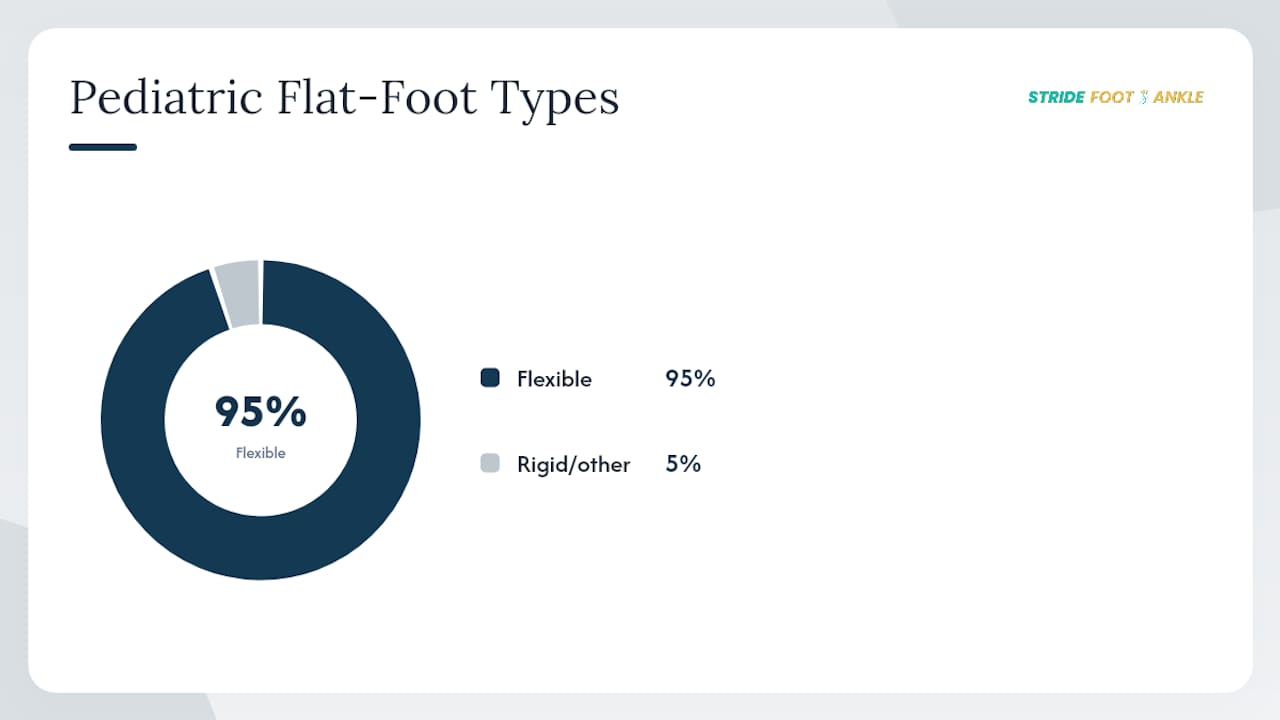
Table of Contents
- What flat feet in children are and how arches normally develop
- Types of flat feet parents should know: flexible versus rigid
- How to tell at home: simple tests and visual examples parents can use
- Common symptoms and red flags that warrant medical attention
- What clinicians do: the evaluation parents should expect at a visit
- How flat feet are managed: conservative care, orthotics, exercises, and when surgery is considered
- Age-by-age expectations: what’s normal at each stage
- Three realistic clinic examples parents will recognize
- When to see a podiatrist or orthopedic specialist and how to prepare
- What parents often get wrong about flat feet
- Stride Foot & Ankle: pediatric flat foot care in Las Vegas
- Sources
- FAQ
What flat feet in children are and how arches normally develop
Flat feet, or pes planus, means the medial arch (the inner curve of the foot) is reduced or absent when your child stands. Nearly every baby is born with flat-looking feet, and that’s completely normal. Two things explain the appearance: a soft fat pad along the inner sole and naturally loose ligaments that allow the foot to spread under body weight.
As children grow, that fat pad thins and the ligaments tighten. The arch gradually takes shape. According to Healthychildren, arches typically develop between ages 6 and 10, and only about 10–20% of children remain flat-footed into adulthood. A review published in Pediatrics In Review notes that parental cosmetic concern is actually one of the most common reasons families bring children in for evaluation, even when the child has no pain at all.
Stat to remember: Only 10–20% of children who have flat feet in early childhood will still have them as adults. For most kids, the arch forms on its own.
The practical takeaway: a flat-looking foot before age 6 is almost always a normal developmental stage, not a structural problem. The question worth asking isn’t “does my child have flat feet?” but “does my child have symptomatic flat feet?”
Types of flat feet parents should know: flexible versus rigid
Understanding the difference between flexible and rigid flat feet is the single most useful thing a parent can take from this article. The distinction drives every clinical decision.
Flexible flat foot is by far the most common presentation. The arch disappears when your child stands but reappears when they sit, hang their foot in the air, or rise onto tiptoe. Flexible flat feet make up roughly 95% of pediatric flatfoot cases and are usually painless. Common contributing factors include:
- Normal physiologic development (the most frequent cause)
- Generalized ligamentous laxity (loose joints throughout the body)
- A tight Achilles tendon, which can push the heel outward and flatten the arch
- Accessory navicular bone (an extra bone on the inner ankle that can cause pain in some children)
Rigid flat foot stays flat in every position, including non-weight-bearing and tiptoe. This is far less common but clinically significant. Causes include:
- Tarsal coalition (two or more foot bones fused together, often hereditary)
- Congenital vertical talus (a rare condition present at birth)
- Neuromuscular conditions such as cerebral palsy or muscular dystrophy
Pro Tip: Stiffness, not flatness, is the surgical red flag. A foot that forms no arch on tiptoe and feels rigid to gentle manipulation needs professional evaluation regardless of the child’s age. Flatness alone, in a flexible foot, rarely requires anything beyond observation.
How to tell at home: simple tests and visual examples parents can use
These checks give you useful information before a clinic visit. They can’t replace a clinical exam, but they help you describe what you’re seeing and flag anything worth mentioning.
Step-by-step home checks
- The tiptoe test. Have your child stand on both feet, then rise onto their toes. Watch the inner arch. In a flexible flat foot, a visible arch forms as the heel rises. If the foot stays completely flat with no arch visible, that’s worth noting.
- The wet footprint test. Wet your child’s foot and have them step onto a piece of cardboard or a paper bag. A normal arch leaves a gap along the inner edge. A flat foot leaves a nearly complete imprint with little or no gap. A very narrow imprint can indicate a high arch.
- The look-from-behind test. Stand behind your child while they face away from you. Look at the heel alignment. In a flat foot, the heel often tilts outward (valgus position). You may also see more toes visible on the outer side of the foot than you’d expect, a finding sometimes called the “too many toes” sign.
- Shoe wear check. Flip your child’s shoes over. Excessive wear along the inner heel and ball of the foot suggests the foot is rolling inward (overpronation). Rapid breakdown of the inner midsole is a consistent pattern in children with significant flat feet.
- Gait observation. Watch your child walk barefoot on a flat surface. Does one foot turn inward more than the other? Does your child limp, walk on the outer edges, or avoid certain activities? Asymmetric gait is more concerning than symmetrical flat feet.
What these tests can’t tell you:
- Whether a rigid structural cause like tarsal coalition is present
- Whether a tight Achilles tendon is contributing
- Whether imaging is needed
If the tiptoe test produces no arch and the foot feels stiff, skip the watchful-waiting phase and schedule a clinical evaluation. For foot mobility exercises that can support arch development at home, a podiatrist can guide you on what’s appropriate for your child’s age and presentation.
Common symptoms and red flags that warrant medical attention
Most children with flat feet have no symptoms at all. When symptoms do appear, they tend to show up during or after physical activity. The NHS recommends seeing a clinician if your child has pain or difficulty walking, and that guidance applies at any age.
Red flags that warrant a pediatrician or specialist visit:
- Persistent foot or ankle pain during or after activity (not just occasional soreness)
- Stiffness in the foot or ankle, especially in the morning
- No arch visible on tiptoe (rigid presentation)
- Limping or favoring one foot
- Asymmetric findings: one foot significantly flatter than the other
- Recurrent ankle sprains
- Rapid or uneven shoe breakdown
- Reluctance to participate in physical activity or sports
- Progressive worsening of the flat appearance over time
Timeline guidance: Observation is appropriate through early childhood. Flat feet that persist and remain symptomatic beyond age 8–10 are more likely to be long-term and warrant formal evaluation. Children with obesity, known neuromuscular conditions, or a family history of rigid foot deformity carry higher risk and should be evaluated earlier if any symptoms appear.
For a broader look at pediatric foot pain and what causes it, the clinic’s parent guide covers the full range of conditions that can produce similar symptoms.
What clinicians do: the evaluation parents should expect at a visit
A thorough clinical evaluation for flat feet in children follows a consistent sequence. Knowing what to expect helps you prepare and makes the visit more productive.
- History. The clinician will ask when you first noticed the flat appearance, whether your child has pain (and where, when, and how often), any activity limitations, and whether there’s a family history of foot problems.
- Standing observation. Your child will be observed from the front, side, and behind while standing. The clinician notes heel alignment, arch height, and whether the deformity is symmetric.
- Walking and gait analysis. Your child walks barefoot so the clinician can assess how the foot moves through each step, whether the heel rises properly, and whether the gait is symmetric.
- Tiptoe (toe-raise) test. The clinician asks your child to rise onto tiptoe, watching for arch reconstitution. This is the key test for distinguishing flexible from rigid flat foot.
- Single-leg stance. Standing on one foot at a time reveals subtle asymmetries and tests dynamic arch control.
- Heel cord assessment. The clinician checks Achilles tendon tightness, since a tight heel cord can drive flat foot mechanics and is a common, treatable contributing factor.
- Imaging. X-rays are not routine for asymptomatic flexible flat feet. They are ordered when the foot is rigid, findings are asymmetric, tarsal coalition is suspected, or trauma is a possibility. MRI or CT may follow if coalition or structural pathology is confirmed on X-ray. For more on imaging in podiatric evaluation, the clinic’s guide explains when and why each modality is used.
After the exam, the clinician will either recommend observation, begin conservative treatment, or refer to a pediatric orthopedic surgeon or pediatric podiatrist for complex structural cases.
How flat feet are managed: conservative care, orthotics, exercises, and when surgery is considered
Most flexible flat feet are physiologic and require no treatment. When symptoms are present, management follows a stepwise approach from least to most invasive.
Conservative care options (in order of intensity):
- Reassurance and observation. For asymptomatic children, this is the appropriate first step. No intervention needed.
- Activity modification. Reducing high-impact activities temporarily can relieve pain flares without stopping all exercise.
- Supportive footwear. Shoes with a firm heel counter and mild arch support help manage symptoms. Avoid completely flat, unsupportive shoes.
- Achilles tendon stretching. A tight heel cord frequently contributes to flat foot mechanics. Daily calf stretches are simple, effective, and appropriate for children of all ages.
- Physical therapy. A PT can address heel cord tightness, strengthen intrinsic foot muscles, and improve gait mechanics.
- Orthotics. Custom or over-the-counter arch supports reduce pain and fatigue in symptomatic children. CHOP’s guidance is clear: orthotics relieve symptoms but do not create a permanent arch in asymptomatic children. Buying corrective insoles before a clinician recommends them is generally unnecessary.
- Surgery. Reserved for persistent symptomatic or rigid cases that fail conservative management. Per 2026 clinical guidance from Frontiers in Pediatrics, a minimum 6-month conservative trial is recommended before surgical referral, unless severe rigid pathology is identified earlier.
Pro Tip: Stretching the Achilles tendon daily is one of the most underused home interventions for symptomatic flat feet. Have your child stand facing a wall, place one foot back, keep the heel flat on the floor, and lean forward gently. Hold for 20–30 seconds, three times per side. It takes two minutes and can meaningfully reduce arch strain over weeks.
For a full overview of conservative foot care approaches, the clinic’s resource explains how non-surgical options are applied across different foot conditions.
Age-by-age expectations: what’s normal at each stage
Infancy (0–2 years): All infants have flat-looking feet. The medial fat pad fills the arch space completely, and ligaments are naturally lax. No treatment is indicated, and no evaluation is needed unless a structural abnormality is visible at birth (such as a rocker-bottom foot, which suggests congenital vertical talus).

Toddler years (2–5 years): The arch begins to emerge as the fat pad thins and ligaments mature. Flat feet remain very common and are still considered normal. Most children this age will show at least a partial arch on tiptoe.
School age (6–10 years): This is the window when most arch development occurs. NHS guidance confirms that arches generally develop between ages 3 and 10. Flat feet that persist beyond age 8–10 with symptoms are more likely to be long-term and warrant evaluation.
Adolescence: By the teenage years, the foot has largely reached its adult structure. A child who still has flat feet at 12–14 is likely to have them as an adult. That said, many adults with flat feet are completely asymptomatic and function without any limitation.
Stat to remember: HealthyChildren.org reports that only 10–20% of children remain flat-footed into adulthood, meaning the majority develop a functional arch without any intervention.
Three realistic clinic examples parents will recognize
These vignettes reflect the kinds of presentations seen in pediatric podiatry practice. They are illustrative of typical clinical patterns, not records of specific patients.
Vignette A: The asymptomatic toddler
A parent brings in a 3-year-old whose feet look completely flat when standing. The child runs, plays, and shows no signs of pain or limping. On tiptoe, a partial arch is visible. The foot is flexible and symmetric.
What happened: The clinician reassured the parent that this is a normal developmental finding. No orthotics, no corrective shoes, no follow-up unless symptoms develop.
Parent next steps:
- Continue observing gait and activity tolerance
- Return if pain, limping, or stiffness develops
- No special footwear needed at this stage
Vignette B: The active 9-year-old with activity-related pain
A 9-year-old who plays soccer reports foot and ankle pain after practice. The parent notices the inner soles of both shoes wear out quickly. On exam, the tiptoe test produces a partial arch, but the response is limited. The Achilles tendon is tight bilaterally.
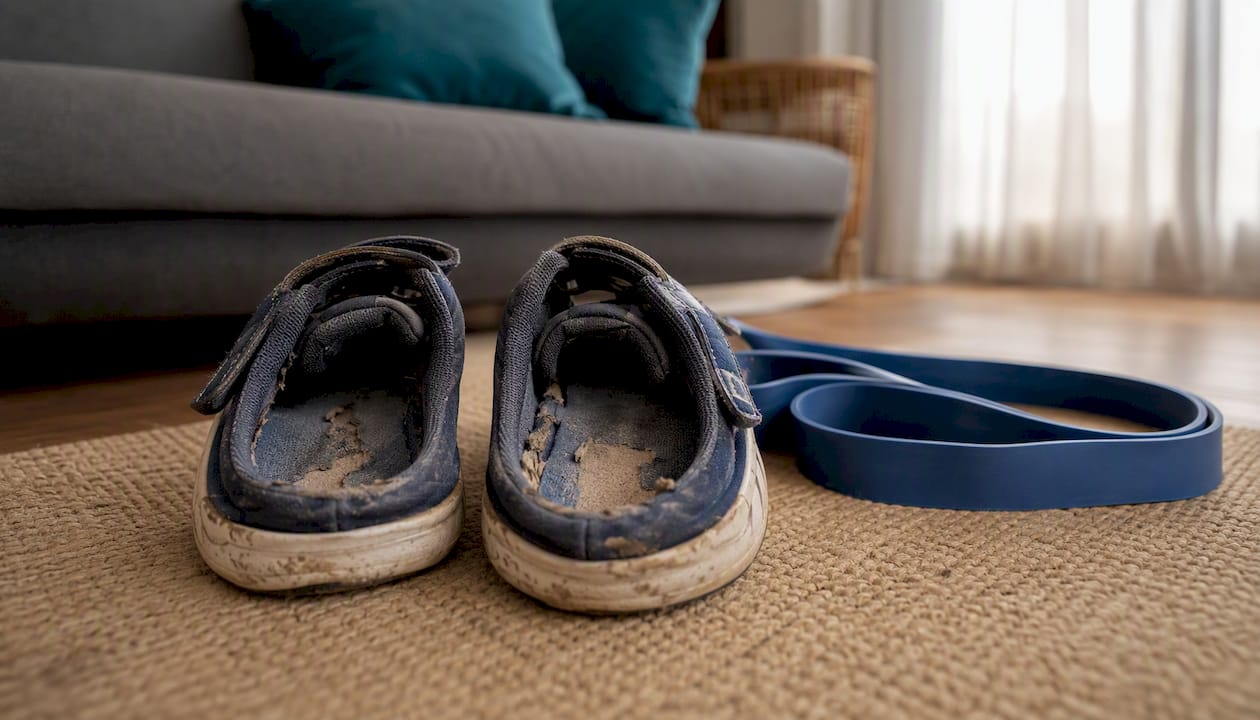
What happened: The clinician confirmed flexible flat foot with a contributing tight heel cord. A 6-month conservative trial was started: daily Achilles stretching, supportive athletic shoes, and custom orthotics for symptom relief. Physical therapy was added after six weeks.
Parent next steps:
- Commit to daily stretching before and after activity
- Replace worn shoes promptly; check for firm heel counter
- Follow up at 6 months to assess response before any further discussion
Pro Tip: Activity-related foot pain in a school-age child is not something to dismiss as “growing pains.” If it’s consistent, location-specific, and tied to exercise, it deserves a clinical look.
Vignette C: The adolescent with progressive stiffness
A 13-year-old presents with gradually worsening stiffness in the right foot, which is noticeably flatter than the left. The tiptoe test produces no arch on the right side. The foot feels rigid on passive manipulation.
What happened: X-rays were ordered and suggested a possible tarsal coalition. The patient was referred to a pediatric orthopedic surgeon for further imaging (CT scan) and surgical planning. The left foot, which remained flexible and asymptomatic, was monitored conservatively.
Parent next steps:
- Pursue the imaging referral promptly; coalition can worsen with growth
- Limit high-impact activity on the affected side until the structural diagnosis is confirmed
- Ask the orthopedic surgeon specifically about the recovery timeline and return-to-sport expectations
When to see a podiatrist or orthopedic specialist and how to prepare
Referral triggers — book an appointment when:
- Your child has persistent foot or ankle pain during or after activity
- The tiptoe test produces no visible arch
- One foot is significantly flatter or stiffer than the other
- Conservative care (supportive shoes, stretching) has been tried for 6 months without improvement
- Your child limps, avoids activity, or has neurologic symptoms (numbness, weakness)
- A pediatrician has already recommended specialist evaluation
Visit-prep checklist:
- Bring your child’s most-worn pair of shoes so the clinician can assess the wear pattern
- Take a short video of your child walking barefoot on a hard floor before the appointment
- Note when pain occurs (during activity, after, in the morning), where it is, and how long it lasts
- Write down any family history of foot problems, connective tissue disorders, or neuromuscular conditions
- Be ready to answer: Has the flatness gotten worse over time? Does it affect both feet equally?
After the visit, expect one of three pathways: a conservative plan (stretching, orthotics, PT), imaging if structural pathology is suspected, or a surgical consultation for rigid or refractory cases. For a step-by-step guide on how to schedule a podiatrist appointment, the clinic’s resource walks you through exactly what to expect.
What parents often get wrong about flat feet
Most flat feet in children are benign. The appearance of a flat foot before age 6 is almost never a reason to intervene, and the instinct to buy corrective shoes or custom orthotics for a pain-free toddler is understandable but usually unnecessary. The evidence is consistent: orthotics don’t build arches in asymptomatic children. They manage symptoms when symptoms exist.
What actually matters is function. A child who runs, plays, and keeps up with peers without pain or fatigue is doing well, regardless of what their arch looks like standing still. The clinical focus belongs on pain, stiffness, asymmetry, and gait, not on the cosmetic appearance of the arch.
The 6-month conservative trial rule before surgery is worth holding onto. Even in symptomatic cases, most children respond well to stretching, appropriate footwear, and orthotics when indicated. Surgical options exist and are effective for the right cases, but they are genuinely a last resort for pediatric flat feet, not a shortcut to a faster fix.
If you’re unsure whether what you’re seeing is within normal range, a single evaluation with a board-certified podiatrist gives you a clear answer and a documented baseline. That’s worth more than months of uncertainty.
Stride Foot & Ankle: pediatric flat foot care in Las Vegas
When your child’s flat feet come with pain, stiffness, or a foot that won’t form an arch on tiptoe, a clinical evaluation gives you answers that home observation can’t. At Stridefootankle, Dr. Nahad Wassel provides pediatric foot and ankle evaluations that cover the full diagnostic picture: gait analysis, tiptoe testing, heel cord assessment, and imaging when indicated.
Conservative care is the starting point for nearly every pediatric case. That means orthotics fitted for your child’s specific presentation, PT referrals, stretching guidance, and footwear recommendations grounded in what the exam actually shows. Surgical options are available for the rare cases that genuinely need them, but the clinic’s approach prioritizes getting children back to activity through the least invasive path first.
If your child has foot pain after activity, a rigid flat foot, or findings that concern you, book a pediatric evaluation at Stride Foot & Ankle in Las Vegas. You can also review conservative care options before your visit to understand what the first steps typically look like.
Sources
These are the primary references used throughout this article. Each is publicly accessible and produced by a recognized clinical or academic authority.
- Healthychildren
- Pediatric Flexible Flatfoot; Clinical Aspects and Algorithmic Approach – PMC
- Frontiers in Pediatrics — Clinical guidance for pediatric flatfoot (2026)
- Flat feet in children — Children’s Hospital of Philadelphia (CHOP)
- Pediatric Pes Planus: A State-of-the-Art Review – PMC
- Flat feet – NHS
FAQ
How can you tell if a child has flat feet?
Have your child stand barefoot and look at the inner edge of the foot. If no arch is visible, ask them to rise onto tiptoe. A visible arch forming on tiptoe indicates flexible flat foot; no change suggests a rigid presentation that warrants professional evaluation.
Is it normal for a 7-year-old to have flat feet?
Yes, it’s common. Arches typically develop between ages 6 and 10, so a 7-year-old with flat feet is still within the normal developmental window. Evaluation is recommended if the child has pain, stiffness, or asymmetric findings.
When do kids outgrow flat feet?
Most children develop a functional arch between ages 6 and 10.
Are flat feet common in autism?
Children with autism spectrum disorder have higher rates of generalized ligamentous laxity, which can contribute to flat feet. Flat foot appearance in this population follows the same evaluation principles: flexible and asymptomatic cases are observed; painful or rigid presentations are referred for clinical assessment.
This article provides general health information and is not a substitute for professional medical advice. If your child has foot pain, stiffness, or findings that concern you, consult a qualified clinician or podiatrist for an individualized evaluation.
Recommended
- Pediatric Concerns: Top 10 Foot Issues Parents Should Know – Stride Foot & Ankle – Dr. Nahad Wassel
- What is pediatric foot pain? A parents’ guide to causes and care – Stride Foot & Ankle – Dr. Nahad Wassel
- Guide to Common Pediatric Foot Problems: Causes, Signs, Care – Stride Foot & Ankle – Dr. Nahad Wassel
- Treating Pediatric Heel Pain: A Parent’s Action Guide – Stride Foot & Ankle – Dr. Nahad Wassel
Recent Comments