

TL;DR:
- Consistent daily exercises help improve foot mobility, which reduces pain and prevents structural problems. Proper footwear and lifestyle habits support foot strength and flexibility, while early professional evaluation addresses persistent issues. Maintaining a regular routine ensures long-term foot health and overall movement quality.
Foot mobility is defined as the ability to move your toes, feet, and ankles through their full natural range with both strength and control. Poor foot mobility is a primary contributor to knee, hip, and lower back pain through compensatory movement patterns. The good news: consistent daily practice of targeted exercises can produce noticeable improvements in foot strength and toe independence within 8–12 weeks. This guide covers the most effective exercises for foot mobility, the footwear and lifestyle factors that work against you, and when to get professional help before a minor problem becomes a chronic one.
What key exercises improve foot mobility effectively?
The most effective exercises for foot mobility target three distinct areas: intrinsic muscle strength, toe independence, and ankle range of motion. Each area plays a separate role in how your foot loads, propels, and stabilizes your body. Neglecting any one of them creates weak links that show up as pain or stiffness elsewhere. Most foundational exercises require less than 5 minutes daily for effective results, which removes the most common excuse for skipping them.
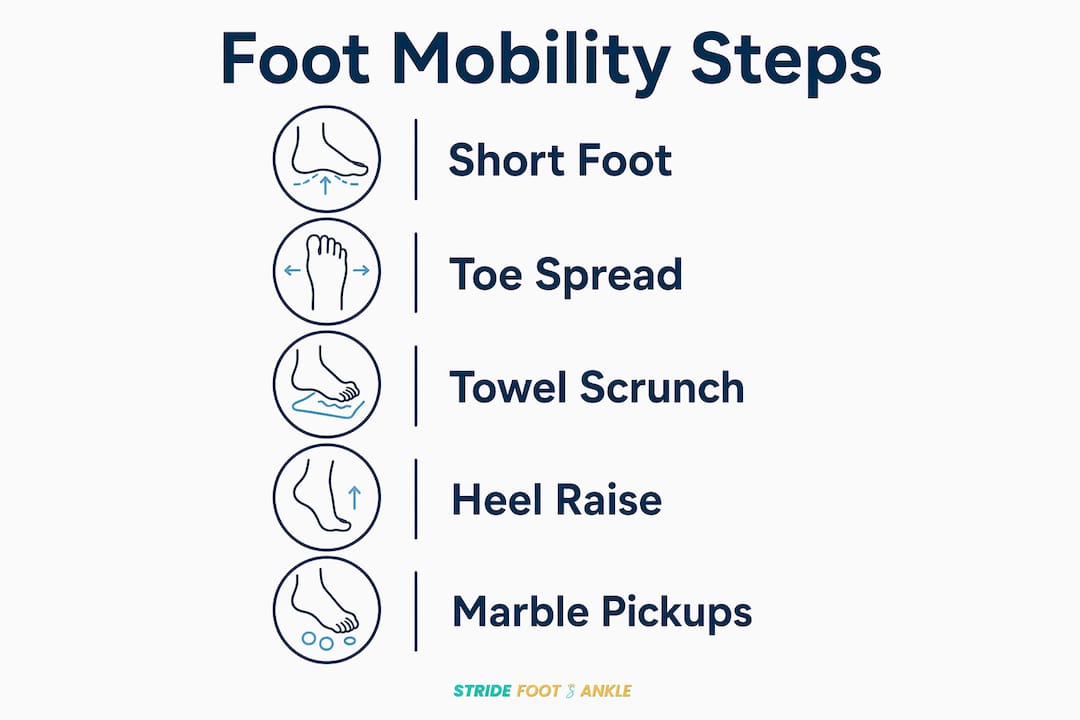
The five foundational exercises
Work through these in order. Each one builds on the last.
Short Foot Exercise. Sit with your foot flat on the floor. Without curling your toes, shorten the distance between your heel and the ball of your foot by contracting the arch. Hold for 5 seconds, release, and repeat 10 times per foot. This targets the intrinsic muscles that support the arch and stabilize the foot tripod during standing and walking.
Toe Spreads. Sit or stand with bare feet flat on the floor. Spread all five toes as wide apart as possible, hold for 3 seconds, then relax. Repeat 10–15 times. Most people find this surprisingly difficult at first because years in narrow shoes suppress toe independence. Consistent practice restores the neuromuscular control that makes balance and propulsion efficient.
Towel Scrunches. Place a small towel flat on the floor. Use only your toes to scrunch it toward you, then push it back out. Do 3 sets of 10 repetitions. This exercise strengthens the flexor digitorum brevis and the lumbricals, the small muscles that control toe grip and floor contact.
Heel Raises (Eccentric Focus). Stand with feet hip-width apart. Rise onto your toes over 2 seconds, then lower slowly over 4 seconds. The slow descent is the most important part. Slow, controlled eccentric movements drive tendon remodeling and build calf and Achilles strength more effectively than fast repetitions. Aim for 3 sets of 12.
Marble Pickups. Place 10 marbles on the floor beside a cup. Using only your toes, pick up each marble and drop it into the cup. This drill trains fine motor control in the foot, which directly supports balance and gait stability. It also makes a measurable progress test: track how long it takes each week.
Pro Tip: Slow down every movement deliberately. Speed feels productive but removes the neuromuscular challenge that actually builds strength. Two seconds up, four seconds down is the standard tempo for any foot exercise involving a raise or lower.
Common mistakes that slow progress
- Curling toes instead of spreading them during Toe Spreads (this recruits the wrong muscles)
- Rushing through Heel Raises without the eccentric phase
- Wearing socks during exercises (reduces sensory feedback from the floor)
- Skipping rest days and training through sharp pain rather than mild fatigue
- Stopping the program the moment symptoms improve, before strength is fully consolidated
Patients who focus solely on rest and ice fail to address the mechanical causes of their pain. Exercises are not optional add-ons. They are the primary treatment for most mobility deficits.
How do footwear choices and lifestyle factors impact foot mobility?
Footwear is the single most overlooked factor in foot mobility. Conventional shoes with narrow toe boxes and elevated heels suppress toe independence and restrict the natural splay that the foot needs during push-off. Over years, this compresses the toes, weakens intrinsic muscles, and trains the foot to function in a shortened, restricted position. The result is reduced ankle dorsiflexion, which then increases knee stress during squats, stairs, and walking.
Choosing footwear that supports natural movement
Wide-toe-box shoes and minimalist footwear allow the toes to spread naturally and the foot to contact the ground with more surface area. Brands that design around foot anatomy rather than fashion produce measurably better outcomes for patients working to restore mobility. The transition, however, must be gradual.
Abrupt changes to barefoot-style shoes can overload tendons adapted to restricted patterns. A safe transition looks like this:
- Week 1–2: Wear wide-toe-box shoes for 1–2 hours per day, then return to your current footwear.
- Week 3–4: Increase to half-day wear, adding barefoot time at home on safe surfaces.
- Week 5–8: Transition to full-day wear as your foot strength and tolerance build.
- Ongoing: Reserve elevated-heel shoes for special occasions only, not daily use.
Lifestyle habits that work against you
Prolonged sitting shortens the calf complex and reduces ankle dorsiflexion over time. Inactivity allows the intrinsic foot muscles to atrophy, which shifts load to the plantar fascia and Achilles tendon. Repetitive strain from hard surfaces without adequate footwear compounds both problems.
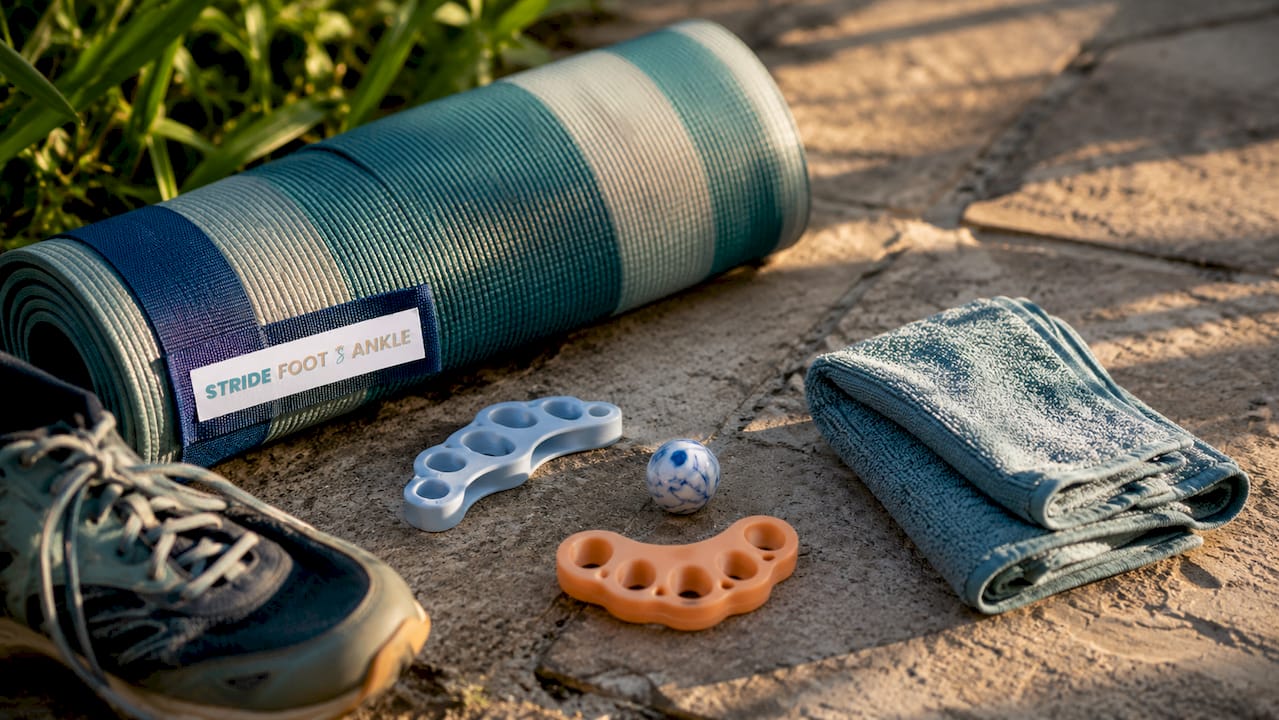
Spending 10–15 minutes per day barefoot on a safe, flat surface is one of the simplest lifestyle changes you can make. Walking barefoot on grass or a yoga mat activates the small muscles of the foot that shoes suppress. Pair this with the exercises above and the cumulative effect accelerates your progress significantly.
Pro Tip: Place a small exercise mat next to your bed. Doing your Short Foot and Toe Spread exercises before you stand up in the morning takes under 3 minutes and primes your feet for the day before they take your full body weight.
When should you seek professional help for foot mobility issues?
Most foot stiffness responds well to daily exercises and footwear changes within 4–8 weeks. Certain symptoms, however, signal that a professional evaluation is needed before you continue self-managing. Early evaluation is strongly preferred over waiting, because delayed care typically requires longer and more costly treatment.
Seek a podiatric evaluation if you experience any of the following:
- Foot or ankle pain that persists beyond 3–5 days without improvement
- Visible changes in your gait, such as limping or favoring one side
- Swelling, bruising, or warmth that does not resolve within 48 hours
- Inability to bear weight on the affected foot
- Numbness, tingling, or burning sensations in the foot or toes
- Rapidly worsening stiffness that does not respond to stretching
Diabetic patients and anyone with signs of infection, including redness spreading from a wound, fever, or discharge, require emergency evaluation immediately. Do not wait for a scheduled appointment. Delayed care in these cases can lead to serious complications.
Asymmetric shoe wear is a subtler warning sign that many patients miss. Check the soles of your shoes. If one side wears down faster than the other, your gait is compensating for an underlying imbalance. That compensation pattern, left uncorrected, creates overload in the knees, hips, and lower back over time.
Proactive intervention for minor stiffness prevents the progression to structural problems like bunions and hammertoes. A podiatrist can assess your foot mechanics, identify the root cause, and prescribe a targeted exercise plan or orthotic support that self-treatment cannot replicate. If you are in the Las Vegas area, the foot pain diagnosis guide from Stridefootankle provides a clear framework for deciding when home care is enough and when it is not.
How to maintain and progress foot mobility over time?
Consistency produces results that intensity cannot. Patients who practice foot mobility drills daily for 8 weeks outperform those who train hard for two weeks and stop. The goal is to build a sustainable routine that fits into your existing schedule, not to add a major new commitment.
Here is a practical progression framework:
- Weeks 1–2 (Foundation). Master the Short Foot, Toe Spreads, and Towel Scrunches. Focus entirely on form and control. Do not add resistance or difficulty yet.
- Weeks 3–4 (Load Introduction). Add Heel Raises and Marble Pickups. Begin transitioning footwear gradually as described above.
- Weeks 5–8 (Strength Building). Add a resistance band around your toes during Toe Spreads to increase the challenge. Perform single-leg Heel Raises instead of bilateral. Incorporate balance exercises that challenge foot stability in dynamic positions.
- Weeks 9–12 (Integration). Combine mobility work with functional movements like single-leg squats and step-ups. Your foot should now be strong enough to support these patterns without compensation.
- Ongoing Maintenance. Reduce to 3–4 sessions per week once your baseline is established. Never stop entirely. Strength and mobility regress within weeks of stopping.
Tracking your progress
| Tracking method | What it tells you |
|---|---|
| Marble pickup time | Measures fine motor control and toe strength improvement week over week |
| Shoe sole wear pattern | Reveals gait compensations and whether imbalances are resolving |
| Single-leg balance duration | Tracks foot tripod stability and intrinsic muscle function |
| Ankle dorsiflexion angle | Indicates whether ankle range of motion is increasing with exercise |
| Morning stiffness duration | Shows whether inflammation and tissue restriction are decreasing |
Monitoring shoe wear patterns is a simple, free diagnostic tool you can use at home between professional visits. Photograph the soles of your shoes every four weeks and compare them. Asymmetric wear that persists despite consistent exercise warrants a podiatric assessment.
A common pitfall is stopping exercises the moment pain resolves. Pain relief typically arrives before structural strength is restored. Stopping early leaves the foot vulnerable to re-injury under normal daily loads. Commit to the full 12-week program before scaling back frequency.
Pro Tip: Perform your foot mobility drills while doing something you already do daily, like watching the news or waiting for coffee to brew. Habit stacking removes the decision to exercise from the equation entirely.
For guidance on performing exercises safely at home without aggravating existing conditions, the resource on safe home physical therapy covers technique principles that apply directly to foot mobility work.
Key takeaways
Consistent daily foot mobility exercises, combined with appropriate footwear and early professional evaluation when needed, produce the most reliable long-term improvement in foot strength, flexibility, and pain-free movement.
| Point | Details |
|---|---|
| Start with five foundational exercises | Short Foot, Toe Spreads, Towel Scrunches, Heel Raises, and Marble Pickups cover all key mobility components. |
| Slow eccentric tempo drives results | Lower movements over 4 seconds to build tendon strength and avoid injury from fast, uncontrolled reps. |
| Footwear transition must be gradual | Abrupt shifts to barefoot-style shoes overload tendons; increase wear time by 1–2 hours per week. |
| Seek care after 3–5 days of persistent pain | Early podiatric evaluation prevents minor stiffness from progressing to structural deformity. |
| Track progress with measurable tools | Shoe wear patterns, marble pickup time, and single-leg balance duration reveal real improvement objectively. |
Why foot mobility deserves more attention than most patients give it
Patients come to me after months of rest, ice, and anti-inflammatories that never fully resolved their pain. The pattern is almost always the same. They treated the symptom and ignored the mechanical cause. Foot mobility is not a recovery tool. It is a maintenance requirement, the same way brushing your teeth prevents cavities rather than treating them.
What I have seen consistently is that patients who start foot exercises early, before pain becomes chronic, recover faster and with fewer interventions. The ones who wait until they cannot walk without limping often need months of structured rehabilitation to achieve what six weeks of proactive exercise would have prevented.
The footwear piece surprises most patients. They assume that supportive, cushioned shoes are always better. They are not. Shoes that do all the work for your foot train the intrinsic muscles to stop working. Over time, that atrophy is what creates the instability and stiffness patients describe as “my feet just feel weak.” The foot is designed to be strong and adaptable. It becomes weak when we remove the stimulus it needs to stay that way.
My honest recommendation: treat your feet like athletes treat their hands. Deliberate, daily attention to strength and range of motion pays dividends across your entire kinetic chain. Your knees, hips, and lower back will thank you before your feet even give you a reason to complain.
— Ramil
Foot mobility care at Stridefootankle
Stridefootankle, led by Dr. Nahad Wassel in Las Vegas, offers personalized podiatric evaluations that go beyond symptom management. If your foot stiffness, pain, or restricted movement has not responded to home exercises, a clinical assessment can identify the specific mechanical cause and build a targeted plan around it.
Dr. Wassel’s approach combines conservative care, custom exercise programming, and advanced diagnostics to address the root cause of mobility issues before they require surgical intervention. Patients receive clear explanations, realistic timelines, and follow-up support at every stage. Explore the full range of foot and ankle care services available at Stridefootankle, or review the conservative care options that resolve most mobility problems without surgery.
FAQ
How long does it take to improve foot mobility?
Most patients see noticeable improvement in foot strength and toe independence within 8–12 weeks of consistent daily exercise. Results depend on the severity of restriction and adherence to the program.
What are the best stretches for tight feet?
The most effective stretches target the plantar fascia, calf complex, and toe flexors. Towel Scrunches, Toe Spreads, and standing calf stretches held for 30 seconds address the most common areas of restriction.
Can poor foot mobility cause knee or back pain?
Yes. Restricted foot mobility forces compensatory movement patterns that transfer stress to the knees, hips, and lower back. Restoring foot range of motion often reduces pain in these secondary areas without directly treating them.
How do I strengthen foot muscles at home?
Short Foot exercises, Heel Raises with a slow eccentric phase, and Marble Pickups are the most effective at-home options. They require no equipment and take under 10 minutes daily.
When is foot stiffness a medical emergency?
Foot pain combined with inability to bear weight, signs of infection such as spreading redness or fever, or sudden severe swelling requires emergency evaluation. Diabetic patients should seek immediate care for any foot wound or unexplained pain.
Recommended
- How to Improve Foot Circulation: Proven Daily Steps – Stride Foot & Ankle – Dr. Nahad Wassel
- How to prevent foot injuries: expert strategies for healthy feet – Stride Foot & Ankle – Dr. Nahad Wassel
- General Foot & Ankle Care – Stride Foot & Ankle
- Foot and Ankle Swelling: Causes, Remedies, and Red Flags – Stride Foot & Ankle – Dr. Nahad Wassel
Recent Comments