

TL;DR:
- Swelling in the feet and ankles results from excess fluid buildup caused by injury or systemic health problems. Identifying the pattern of swelling, such as unilateral versus bilateral, helps determine whether it is caused by local or systemic issues. Proper home care includes elevation, compression, and activity, but persistent or severe swelling requires urgent medical evaluation.
Swelling is defined as the abnormal enlargement of body tissue caused by excess fluid buildup or inflammation, and the feet and ankles are among the most common sites affected. Gravity pulls fluid downward throughout the day, and weakening venous valves make the lower extremities especially vulnerable. Pitting edema and swelling in only one foot are key red flags that warrant medical evaluation. Understanding what drives foot and ankle swelling, whether a twisted ankle, a systemic condition, or chronic venous insufficiency, is the first step toward getting the right care.
What causes swelling in the feet and ankles?
Foot and ankle swelling, clinically called edema, results from fluid leaking out of blood vessels into surrounding tissue. The cause can be as simple as a long flight or as serious as heart failure. Identifying whether the swelling affects one foot or both is the single most useful first step in narrowing down the cause.
Local versus systemic causes
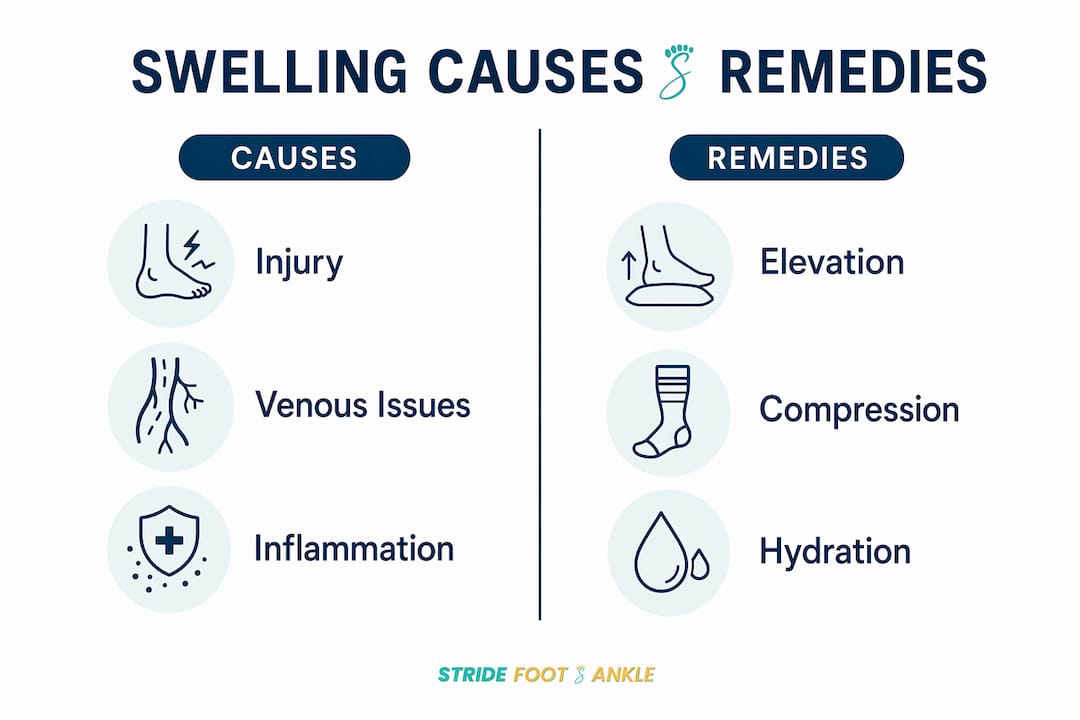
Local causes affect one foot or ankle and typically point to a specific injury or infection. Systemic causes affect both feet and signal a body-wide problem. Bilateral edema often indicates heart, kidney, or liver disease, while unilateral swelling more commonly points to a localized issue such as deep vein thrombosis (DVT) or cellulitis. This distinction guides how urgently you need care and what kind of specialist you should see.
Common local causes include:
- Ankle sprains and fractures: Trauma triggers immediate fluid accumulation around the injured joint. You can learn more about this in Stridefootankle’s ankle sprain recovery guide.
- Infection or cellulitis: Bacterial skin infections cause redness, warmth, and rapid swelling in the affected area.
- Gout: Uric acid crystals deposit in joints, most often the big toe, causing sudden, intense swelling and pain.
- DVT: A blood clot in a deep leg vein causes unilateral swelling, often with warmth and tenderness along the calf.
Common systemic causes include:
- Heart failure: The heart cannot pump blood efficiently, causing fluid to back up into the legs and feet.
- Kidney disease: Reduced kidney function allows fluid and sodium to accumulate throughout the body. Signs of kidney disease include persistent bilateral ankle swelling alongside fatigue and changes in urination.
- Liver disease: Low albumin production reduces the blood’s ability to hold fluid inside vessels.
- Venous insufficiency: Damaged vein valves allow blood to pool in the lower legs. Venous reflux accounts for roughly 90% of edema cases, making it the most frequent chronic cause of leg swelling.
| Swelling pattern | Likely cause category | Urgency |
|---|---|---|
| One foot, sudden onset | Injury, DVT, infection | High |
| Both feet, gradual | Venous insufficiency, systemic disease | Moderate to high |
| Both feet, end of day only | Gravity, prolonged standing | Low |
| Face or mouth involved | Allergic reaction, anaphylaxis | Emergency |
Pro Tip: Take a photo of the swollen area each morning and evening for three days. This simple log helps your doctor see whether the swelling is positional (worse at night, gone by morning) or persistent, which points toward a systemic cause.
How does inflammation contribute to swelling?
Inflammation is the body’s built-in defense response, and it is a direct driver of tissue swelling. Acute inflammation is a rapid protective immune response that causes swelling, redness, and pain, and it typically resolves within days. Chronic inflammation is a different problem entirely. It lingers for weeks, months, or years, and it is associated with lifestyle factors and autoimmune diseases that cause persistent, recurring swelling.
How acute inflammation works
When you sprain your ankle or cut your foot, the immune system floods the area with white blood cells and plasma. Blood vessels dilate and become more permeable. Fluid pours into the surrounding tissue, creating the visible swelling you feel within minutes of an injury. This process is protective. It delivers healing resources to damaged tissue. The swelling is a side effect of repair, not the problem itself.
Chronic inflammation and its triggers
Chronic low-grade inflammation is different. It does not come from a single injury. Sedentary lifestyle, poor diet, and chronic stress all sustain a low-level inflammatory state that keeps tissue slightly swollen and sensitive over time. Autoimmune conditions like rheumatoid arthritis and psoriatic arthritis cause the immune system to attack joint tissue directly, producing persistent swelling in joints throughout the body, including the ankles and midfoot. Gout flares are another form of inflammatory arthritis that can cause dramatic, recurring swelling in the feet.
The four main inflammatory conditions that cause foot and ankle swelling are:
- Rheumatoid arthritis: Symmetric joint swelling, often affecting the small joints of the foot alongside the ankles.
- Psoriatic arthritis: Can cause “sausage toe” (dactylitis), where an entire toe swells due to tendon and joint inflammation.
- Gout: Sudden, severe swelling and redness, classically in the big toe joint, triggered by uric acid buildup.
- Reactive arthritis: Swelling in one or more joints following a bacterial infection elsewhere in the body.
Pro Tip: If your foot swelling is worse in the morning and improves with movement, inflammatory arthritis is a more likely cause than venous insufficiency, which typically worsens throughout the day. Sharing this pattern with your doctor speeds up diagnosis significantly.
When should swelling prompt urgent medical evaluation?
Most mild foot swelling at the end of a long day is not dangerous. But certain patterns and accompanying symptoms signal that something more serious is happening and that you need medical attention quickly.
More than 50% of adults over 65 experience mild end-of-day swelling from gravity and weakening venous valves. That statistic matters because it means most older adults normalize swelling they should actually report to a doctor, especially when it becomes persistent.
Seek urgent or emergency care if you notice any of the following:
- Sudden, severe swelling in one leg or foot with no clear injury. This pattern is the hallmark of DVT, which can lead to a life-threatening pulmonary embolism if untreated.
- Pitting edema: Press your finger into the swollen skin for five seconds. If an indentation remains, that is pitting edema and it requires medical evaluation.
- Skin discoloration: Red, purple, or darkened skin over a swollen area suggests infection, vascular compromise, or DVT.
- Swelling with chest pain or shortness of breath: This combination requires immediate emergency care and may indicate heart failure or pulmonary embolism.
- Swelling involving the face or mouth: Generalized swelling with breathing difficulty is a medical emergency. Call 911 immediately.
- Fever alongside swelling: This combination suggests infection, including cellulitis or septic arthritis, which require antibiotics.
Swelling that is mild, affects both feet equally, and disappears overnight after elevation is generally low risk. Swelling that is new, worsening, painful, or accompanied by any of the symptoms above is not something to wait out at home. Stridefootankle’s foot pain assessment guide outlines how symptoms like these are evaluated in a clinical setting.
How can you safely reduce swelling at home?
Home management works well for mild, positional, or injury-related swelling. Rest, ice, compression, and elevation (RICE) relieve mild swelling effectively, but persistent or systemic swelling requires medical evaluation. The key is matching the remedy to the actual cause.
Here is a step-by-step approach to managing swelling at home:
Elevate your feet above heart level. Venous pressure in the legs rises from approximately 8 mm Hg lying down to about 100 mm Hg when standing. Elevation reduces venous pressure dramatically, making it the single most effective positional intervention for gravity-driven swelling. Aim for 20–30 minutes, three times per day.
Apply ice for acute injury swelling. Use a cloth-wrapped ice pack for 15–20 minutes at a time during the first 48–72 hours after an injury. Never apply ice directly to skin.
Use compression socks or wraps. Graduated compression stockings (typically 15–30 mmHg for mild swelling) support vein walls and reduce fluid leakage. Wear them during the day and remove them at night.
Move regularly. Calf muscle contractions act as a pump, pushing venous blood back toward the heart. A 10-minute walk every hour counteracts the pooling effect of prolonged sitting or standing.
Reduce sodium intake. High sodium causes the body to retain water. Cutting processed foods and added salt reduces fluid retention within days for many patients.
Stay hydrated. Counterintuitively, drinking enough water helps the kidneys flush excess sodium and reduces fluid retention.
Avoid prolonged heat exposure. Heat dilates blood vessels and worsens swelling. Las Vegas residents in particular should be cautious during summer months, as high ambient temperatures accelerate lower extremity fluid accumulation.
One important caution: diuretics (water pills) are not a universal fix. Diuretics are often ineffective or counterproductive for lymphedema, which is caused by lymphatic drainage failure rather than fluid overload. Using diuretics for the wrong type of swelling can cause dehydration without reducing the edema. Lymphedema requires specialized manual lymphatic drainage and compression therapy, not medication.
Personalized treatment is critical. Rest and elevation help minor cases, but organ failure-related swelling requires specialized medical management. If your swelling does not improve within a week of consistent home care, schedule a professional evaluation.
Pro Tip: Sleep with a pillow under your calves rather than under your knees. Elevating the calves keeps the ankles above heart level throughout the night, which is more effective than bending at the knee, which can restrict blood flow.
Key takeaways
Foot and ankle swelling requires matching the treatment to the cause: positional swelling responds to elevation and compression, while systemic or inflammatory causes require medical diagnosis and targeted care.
| Point | Details |
|---|---|
| Identify the pattern first | Unilateral swelling suggests a local cause; bilateral swelling often points to a systemic condition. |
| Use RICE for minor injuries | Rest, ice, compression, and elevation reduce mild swelling effectively within 48–72 hours. |
| Elevation is the most effective home tool | Raising feet above heart level drops venous pressure from roughly 100 mm Hg to 8 mm Hg. |
| Not all swelling responds to diuretics | Lymphedema requires compression and drainage therapy, not water pills. |
| Know the red flags | Pitting edema, unilateral swelling, chest pain, or breathing difficulty require prompt medical care. |
What I’ve learned from watching patients dismiss swelling too long
Patients consistently underestimate swelling. They tell me it has been there for months, they thought it was just age, or they assumed it would go away on its own. By the time they come in, what started as manageable venous insufficiency has progressed to skin changes, ulceration risk, or an undiagnosed systemic condition that needed attention much earlier.
The part that frustrates me most is how often swelling gets attributed to the wrong cause. A patient treats what they assume is an injury with ice and rest for two weeks, when the real driver is inflammatory arthritis or early kidney dysfunction. The swelling pattern tells a story, but you have to know how to read it. Bilateral, gradual, worse at night? Think systemic. Sudden, one-sided, with skin changes? Think vascular or infectious. Morning stiffness that improves with movement? Think inflammatory.
My honest advice: do not wait three months to mention swelling to a doctor. One week of home care is a reasonable trial for mild, positional swelling. If it persists beyond that, or if any red flag appears at any point, get it evaluated. The foot is not an isolated structure. What shows up in your ankle often reflects what is happening in your heart, kidneys, or immune system. Catching that early changes outcomes.
— Ramil
Foot and ankle care at Stridefootankle
Persistent or unexplained foot and ankle swelling deserves a thorough clinical evaluation, not just a wait-and-see approach.

Stridefootankle, led by Dr. Nahad Wassel in Las Vegas, provides expert foot and ankle care that includes detailed assessment of swelling causes, from venous insufficiency and inflammatory arthritis to post-injury edema. Dr. Wassel uses a conservative-first approach, combining clinical examination, imaging when needed, and personalized treatment plans that address the root cause rather than just the symptom. Whether your swelling is new or has been building for months, the right diagnosis makes all the difference. Schedule your evaluation today and get back on your feet with confidence.
FAQ
What is the most common cause of foot swelling?
Venous insufficiency, where damaged vein valves allow blood to pool in the lower legs, accounts for the majority of chronic foot and ankle swelling cases. Prolonged standing, sitting, and gravity all worsen this condition throughout the day.
How do I know if my swelling is serious?
Pitting edema (skin that stays indented when pressed), sudden swelling in one leg, skin discoloration, chest pain, or difficulty breathing all signal that swelling requires urgent medical evaluation rather than home treatment.
Can drinking more water reduce swelling?
Yes, adequate hydration helps the kidneys excrete excess sodium, which reduces fluid retention. Dehydration can paradoxically worsen swelling because the body holds onto fluid as a protective response.
Is swelling after an ankle injury normal?
Swelling after an ankle sprain or injury is a normal part of the acute inflammatory response and typically peaks within 24–48 hours. Swelling that worsens after 72 hours, or that is accompanied by severe pain and inability to bear weight, warrants imaging to rule out a fracture.
Why does swelling get worse in hot weather?
Heat causes blood vessels to dilate, which increases fluid leakage into surrounding tissue. Las Vegas residents often notice worsened lower extremity swelling during summer months for exactly this reason. Staying cool, hydrated, and wearing compression socks during hot weather reduces this effect.
Recommended
- Flat Foot: Causes, Symptoms, and Treatment Options – Stride Foot & Ankle – Dr. Nahad Wassel
- Foot Pain: Causes, Symptoms, and Treatment Options – Stride Foot & Ankle – Dr. Nahad Wassel
- General Foot & Ankle Care – Stride Foot & Ankle
- Ankle Sprain: Causes, Treatment, and Recovery Guide – Stride Foot & Ankle – Dr. Nahad Wassel
Recent Comments