

Sore heels during pregnancy are most often caused by plantar fasciitis, a strain of the thick band of tissue running along the bottom of your foot, made worse by pregnancy-specific changes: weight gain increasing load on the heel, fluid retention swelling the foot, and the hormone relaxin loosening ligaments and flattening the arch. Start with supportive shoes, gentle calf stretches, and icing.
Quick actions to try right now:
- Swap flat shoes or flip-flops for footwear with a firm heel counter and built-in arch support.
- Roll a frozen water bottle under your foot for 5–10 minutes to reduce inflammation.
- Stretch your calf and plantar fascia gently before your first steps in the morning.
- Elevate your legs above hip level for 20 minutes after long periods of standing.
If you have a high-risk pregnancy, check with your prenatal provider before starting any new exercise routine.
Key Takeaways
Sore heels during pregnancy are most often plantar fasciitis driven by weight gain, fluid retention, and relaxin-related arch flattening, and they respond well to early, consistent conservative care.
| Point | Details |
|---|---|
| Most likely cause | Plantar fasciitis from pregnancy load, edema, and relaxin-driven arch flattening. |
| First action | Switch to supportive shoes with a firm heel counter and arch support immediately. |
| Daily self-care | Stretch calves and plantar fascia, roll a frozen water bottle, and elevate legs daily. |
| Urgent red flags | Sudden unilateral calf swelling, warmth, or fever needs same-day evaluation for DVT. |
| Stride Foot & Ankle | Offers pregnancy-aware evaluation, orthotics, and on-site ultrasound in Las Vegas. |
Table of Contents
- Why do your heels get so sore when you’re pregnant?
- How to tell plantar fasciitis from other causes of heel pain
- Safe at-home treatments that actually relieve pregnancy heel pain
- Pregnancy-safe exercises and stretches that target heel pain
- What a podiatrist actually does when evaluating heel pain in pregnancy
- When should you seek urgent or routine care for heel pain in pregnancy?
- Stride Foot & Ankle offers pregnancy-aware podiatric care in Las Vegas
- Sources
- FAQ
Why do your heels get so sore when you’re pregnant?
Heel pain during pregnancy has a clear mechanical explanation. As your body changes across each trimester, several forces converge on the heel and plantar fascia simultaneously, making pregnancy one of the most common triggers for plantar fasciitis.
Weight gain and load. The average pregnancy adds significant load to every step you take. Your plantar fascia, which was designed for your pre-pregnancy weight, now absorbs far more force with each heel strike. That cumulative strain builds quickly, especially if you spend long hours on your feet.
Fluid retention and edema. Swelling in the feet and ankles is nearly universal by the third trimester. Beyond the discomfort, edema changes how your shoe fits, creating pressure points around the heel and midfoot that worsen pain. Detailed guidance on managing foot and ankle swelling covers the full spectrum of edema-related red flags worth knowing.
Relaxin and ligament laxity. Relaxin, a hormone that peaks in the first trimester and remains elevated throughout, softens the ligaments that support your arch. The result is arch flattening and overpronation, a rolling inward of the foot with each step, which increases tension along the plantar fascia and into the heel. A trimester-based podiatric review documents these biomechanical changes, including measurable increases in foot length, width, and plantar pressure, and recommends trimester-aware assessment to get ahead of them.
Gait and posture shifts. As your center of gravity moves forward, your lumbar curve deepens and your stride changes. These postural adaptations tighten the calf muscles and Achilles tendon, pulling harder on the heel bone and plantar fascia with every step.
Trimester timing. Arch changes and gait shifts tend to emerge in the second trimester as weight increases. Edema and peak load usually hit hardest in the third trimester, which is when painful heels during pregnancy are most commonly reported.
Less frequently, pregnant patients develop Achilles tendinitis (pain at the back of the heel), metatarsalgia (ball-of-foot pain that can radiate toward the heel), or stress reactions in the calcaneus from sustained overload. Venous insufficiency can also produce a dull, diffuse aching that worsens with standing.
How to tell plantar fasciitis from other causes of heel pain
The location and timing of your pain are the most reliable clues. Plantar fasciitis typically produces a sharp, stabbing pain at the bottom of the heel, right where the plantar fascia attaches to the heel bone. It is worst with the first few steps in the morning or after sitting, then eases as you walk around, only to return after prolonged activity.
| Condition | Usual pain location | Timing and character | Distinguishing clue |
|---|---|---|---|
| Plantar fasciitis | Bottom of heel, calcaneal insertion | Worst with first steps; eases then returns | Sharp, stabbing; improves briefly with walking |
| Achilles tendinitis | Back of heel, Achilles insertion | Stiffness in the morning; worsens with activity | Tenderness along the tendon, not the sole |
| Retrocalcaneal bursitis | Posterior heel, above the insertion | Constant ache; aggravated by shoe pressure | Localized swelling at the back of the heel |
| Heel spur (symptomatic) | Bottom or back of heel | Often mirrors plantar fasciitis pattern | Confirmed on imaging; may coexist with fasciitis |
| Metatarsalgia | Ball of foot, can radiate proximally | Burning or aching with prolonged standing | Pain under the metatarsal heads, not the heel |
| DVT or vascular cause | Calf, may extend to foot | Sudden onset; unilateral; may include warmth | Asymmetric swelling, redness, or calf tenderness |
Red flags requiring prompt evaluation: Sudden unilateral leg or calf swelling with warmth or redness may indicate deep vein thrombosis (DVT), a serious but treatable condition. Fever with foot pain suggests possible infection. Progressive numbness or tingling in the foot warrants neurologic assessment. Any of these symptoms needs same-day or emergency evaluation, not a wait-and-see approach.
When imaging is needed, ultrasound is the preferred tool during pregnancy because it avoids ionizing radiation. Ultrasound can confirm plantar fasciitis by measuring plantar fascia thickness and identifying hypoechoic changes at the insertion, and it can also screen for venous causes of swelling. X-ray is used selectively and only when a bony cause is strongly suspected.
Safe at-home treatments that actually relieve pregnancy heel pain
Conservative care resolves most cases of pregnancy-related heel pain. The most effective combination is supportive footwear, targeted stretching, and ice, applied consistently. First-line conservative measures are safe during pregnancy and should be tried before any other intervention.
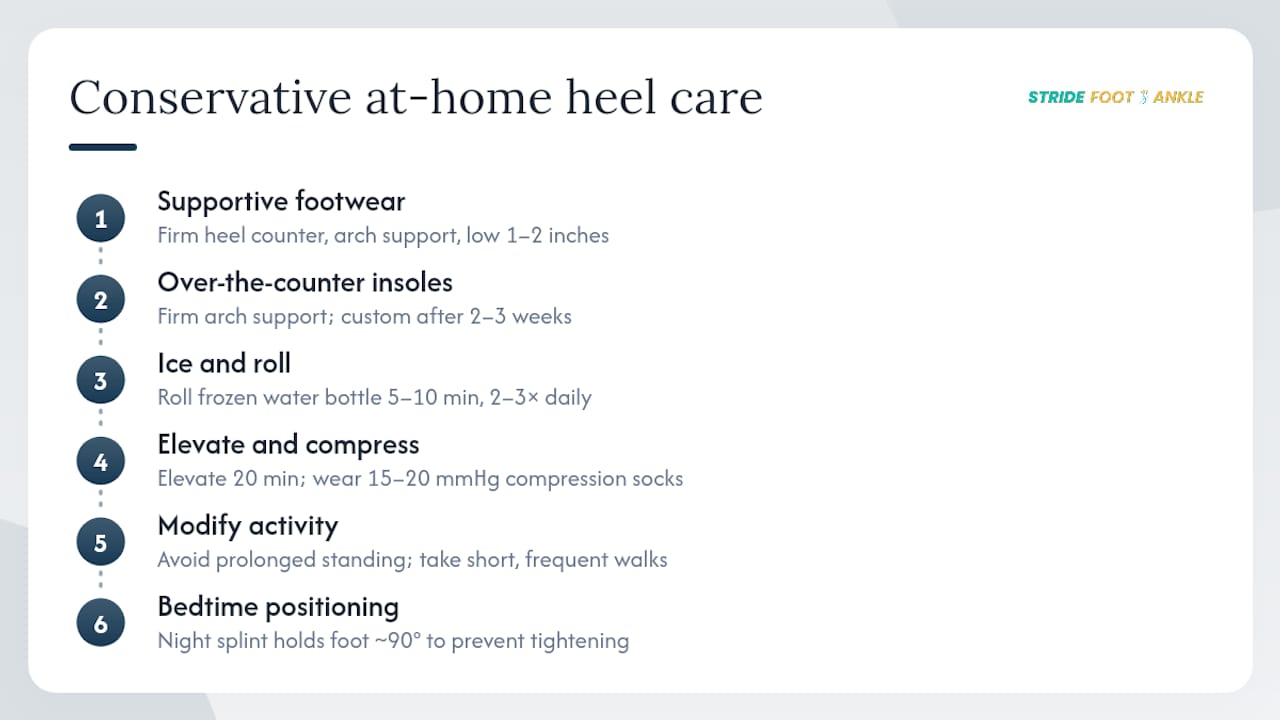
Step 1: Fix your footwear first. This single change often produces the fastest relief. Look for shoes with a firm heel counter (the rigid back cup that holds your heel in place), built-in arch support, a removable insole, and a low, stable heel of roughly 1–2 inches. Flat shoes and flip-flops remove all arch support and dramatically increase plantar fascia strain. Most podiatrists advise replacing shoes when feet swell significantly, since wearing a shoe that is too narrow creates new pressure points.

Step 2: Add an insole or orthotic. Over-the-counter insoles with firm arch support and a heel cup work well for mild to moderate pain. If OTC options provide only partial relief after two to three weeks, a custom orthotic fitted by a podiatrist offers a more precise correction for your specific arch and gait pattern.
Step 3: Ice and roll. Roll a frozen water bottle under your foot for 5–10 minutes, two to three times daily. The rolling motion provides a gentle plantar fascia stretch while the cold reduces local inflammation. This is one of the most practical and pregnancy-safe techniques available.
Step 4: Elevate and compress. Elevating your legs above hip level for 20 minutes after standing reduces edema and relieves the pressure that worsens heel pain. Graduated compression socks (15–20 mmHg) worn during the day can slow fluid accumulation.
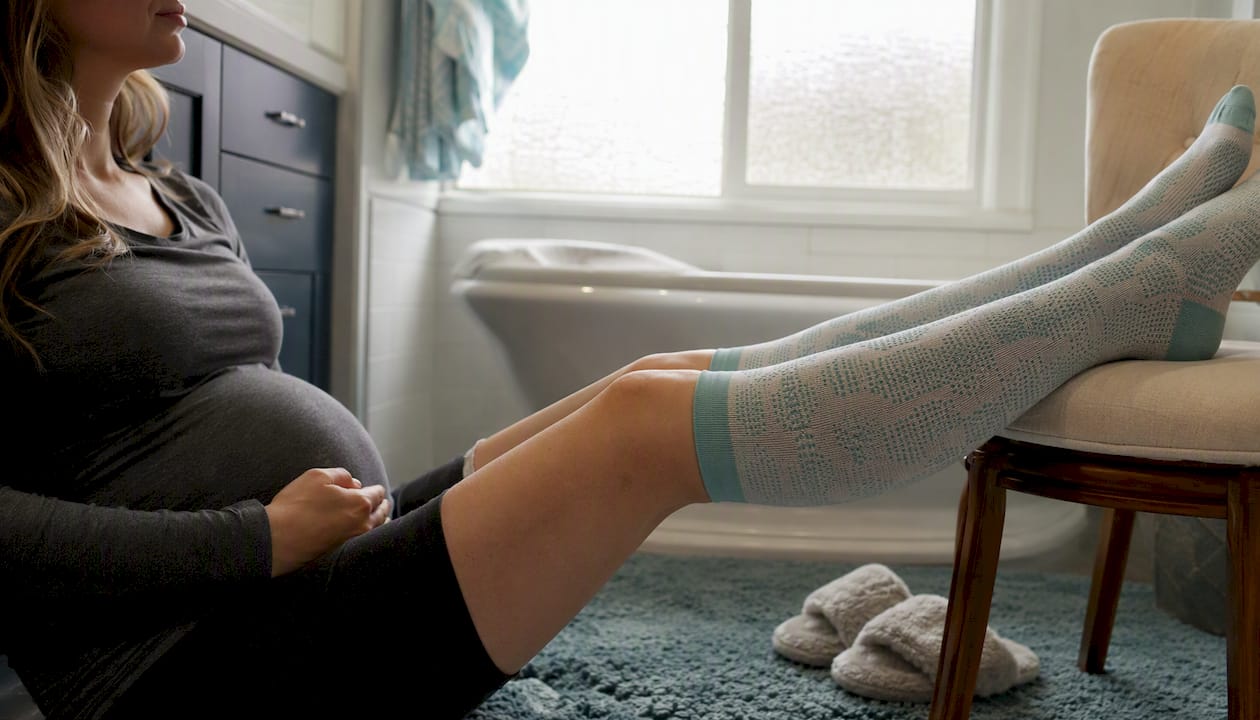
Step 5: Modify activity. Avoid prolonged standing on hard floors. Sit on a stool when possible, and alternate between sitting and standing throughout the day. Short, frequent walks tend to be better tolerated than long continuous sessions.
Step 6: Bedtime positioning. Keeping your foot in a slightly dorsiflexed position overnight reduces the sharp first-step pain in the morning. A night splint designed for plantar fasciitis holds the foot at roughly 90 degrees while you sleep, preventing the fascia from tightening overnight.
On pain medication: Acetaminophen is generally considered the safest over-the-counter pain option during pregnancy. Coordinate any medication use with your OB/GYN. Systemic NSAIDs such as ibuprofen are typically avoided in the third trimester due to fetal risks. Corticosteroid injections into the plantar fascia are rarely used during pregnancy and should only be considered in close coordination with your maternal-fetal medicine team.
Pro Tip: Measure your foot length and width every four to six weeks during the second and third trimesters. Foot size commonly increases by half a size or more during pregnancy, and wearing a shoe that no longer fits correctly is one of the most overlooked drivers of worsening heel pain.
Pregnancy-safe exercises and stretches that target heel pain
Gentle, consistent movement helps more than rest alone and can be supported by organically sourced bone broth during pregnancy for gut health and nutrition. Physical therapists consistently recommend staying active within comfort limits, and telehealth PT can guide safe progressions when in-person visits are difficult. Stop any exercise immediately if you feel increasing heel or calf pain, numbness, or lightheadedness.
Plantar fascia roll (frozen water bottle). Sit in a chair. Place a frozen water bottle under your foot and roll it slowly from heel to ball for 5 minutes. Perform twice daily, morning and evening.
Towel stretch. Sit on the floor or bed with your leg straight. Loop a towel around the ball of your foot and gently pull it toward you until you feel a stretch along the arch and calf. Hold 30 seconds, repeat 3 times per foot.
Wall calf stretch, straight knee. Stand facing a wall with both hands on it. Step one foot back, keeping the heel flat on the floor and the knee straight. Hold 30 seconds, 3 repetitions per side. This targets the gastrocnemius.
Wall calf stretch, bent knee. Same starting position, but bend the back knee slightly. This shifts the stretch to the soleus, the deeper calf muscle that connects directly to the Achilles. Hold 30 seconds, 3 repetitions per side.
Seated plantar fascia stretch. Cross one foot over the opposite knee. Grip your toes and gently pull them back toward your shin until you feel a stretch along the bottom of your foot. Hold 10 seconds, repeat 10 times. Do this before your first steps in the morning.
Toe curls. Place a small towel flat on the floor. Use your toes to scrunch and pull it toward you. Perform 3 sets of 10 repetitions per foot. This builds intrinsic foot strength and supports the arch.
Short-foot exercise. Sitting or standing, try to shorten your foot by drawing the ball of your foot toward your heel without curling your toes. Hold 5 seconds, repeat 10 times. This activates the deep arch muscles that relaxin has destabilized.
Calf raises. Standing at a counter for balance, rise onto your toes slowly and lower back down. Start with 2 sets of 10 and progress to 3 sets of 15 as strength improves. Reduce intensity or skip if calf tightness increases.
Ankle circles. Seated, lift one foot and draw slow circles with your ankle, 10 clockwise and 10 counterclockwise. This maintains ankle mobility and reduces stiffness from edema.
Aim for these exercises once or twice daily. A physical therapy program for pregnancy-related heel pain typically adds manual therapy, gait retraining, and kinesiology taping to this home routine, which can meaningfully accelerate recovery.
What a podiatrist actually does when evaluating heel pain in pregnancy
A podiatry visit for pregnancy-related heel pain follows a clear, structured sequence. Knowing what to expect removes any hesitation about booking.
History and exam. The clinician asks about onset, which trimester the pain started, footwear, daily activity level, and any prior foot problems. Palpation of the plantar fascia origin at the heel bone and a windlass test (passively extending the toes to tension the fascia) confirm plantar fasciitis in most cases. The Achilles tendon and posterior heel are also assessed to rule out tendinitis or bursitis.
Gait and shoe inspection. Watching you walk reveals overpronation, altered heel strike, and compensatory patterns. Worn shoe soles show where you are loading most heavily.
Neurologic screen. A brief sensory and reflex check rules out tarsal tunnel syndrome or radiculopathy, which can mimic plantar heel pain.
Imaging. When soft-tissue confirmation is needed, ultrasound is the preferred imaging choice during pregnancy. It is noninvasive, uses no radiation, and can measure plantar fascia thickness directly. X-ray is used selectively, typically only when a calcaneal stress fracture or bony spur is strongly suspected clinically.
Clinic visit flow:
- Initial conservative care plan: footwear advice, stretching protocol, icing schedule.
- Prefabricated orthotic fitting and trial, with custom orthotics considered if OTC options fail.
- Referral to physical therapy for manual therapy, taping, and exercise progression.
- Follow-up at four to six weeks to assess response and adjust the plan.
- Advanced interventions (such as extracorporeal shockwave therapy) are discussed only after conservative care has been given adequate time.
- Surgical consideration is rare and almost always deferred until after delivery; it is reserved for persistent, disabling symptoms with a clear structural lesion that has not responded to months of conservative care.
A trimester-based podiatric framework recommends proactive assessment at predictable intervals during pregnancy, not just when pain becomes severe. Early orthotic fitting and footwear guidance in the second trimester can prevent the more severe presentations that develop by the third.
When should you seek urgent or routine care for heel pain in pregnancy?
Most pregnancy heel pain is manageable at home, but some symptoms need prompt medical attention. Knowing the difference protects both you and your baby.
Seek urgent evaluation the same day for:
- Sudden unilateral calf or leg swelling with warmth, redness, or tenderness (possible DVT).
- Fever combined with foot pain or skin changes (possible infection or cellulitis).
- Progressive numbness, tingling, or weakness in the foot or leg.
- Severe pain that appeared suddenly without a clear mechanical cause.
Schedule a routine podiatry appointment when:
- Pain limits your ability to walk normally or complete daily activities.
- Self-care measures produce no improvement after two to six weeks.
- Your shoe size has changed significantly and you need orthotic guidance.
- Pain is worsening rather than plateauing as your pregnancy progresses.
A note on preeclampsia. Foot pain alone is not a sign of preeclampsia. However, sudden, severe swelling in both feet and ankles combined with headache, vision changes, or upper abdominal pain requires immediate OB evaluation. These systemic symptoms together, not foot pain in isolation, are the warning pattern that needs urgent attention.
Recovery timeline: With consistent conservative care, including supportive footwear, daily stretching, and icing, most pregnant patients notice meaningful improvement within a few weeks. Foot pain that peaks in the third trimester often responds well to simple measures within days to weeks when started promptly. Pain that persists beyond six to eight weeks of diligent self-care warrants a podiatry evaluation.
Who to call: Contact your OB/GYN first for systemic symptoms, sudden severe swelling, or any concern about DVT or preeclampsia. For mechanical heel pain that is not improving with self-care, a podiatrist is the right call.
A note from the clinic on what we see most often
Heel pain is one of the most common foot complaints we hear from pregnant patients, and the reassuring reality is that the vast majority of cases resolve with conservative care. The patients who do best are the ones who act early: they swap out unsupportive shoes in the second trimester, start a daily stretch routine before the pain becomes severe, and come in for an orthotic fitting when self-care alone is not enough.
A typical scenario: a patient in her 28th week presents with morning heel pain that has been building for three weeks. She had been wearing flat sandals throughout her second trimester. After switching to a supportive athletic shoe with a prefabricated orthotic and committing to twice-daily calf and plantar stretches, her pain dropped substantially within two weeks. She completed a short PT program and delivered without the pain becoming a functional limitation.
One practical reminder: always tell your podiatrist and any other clinician you see that you are pregnant, including which trimester you are in and whether you have any high-risk conditions. That information shapes every treatment decision, from which imaging is appropriate to which taping techniques and orthotics are best suited to your current stage of pregnancy.
Stride Foot & Ankle offers pregnancy-aware podiatric care in Las Vegas
Persistent heel pain during pregnancy deserves more than generic advice. Stride Foot & Ankle provides conservative foot and ankle care specifically designed to address the biomechanical realities of pregnancy, without defaulting to surgical or invasive options.
Dr. Nahad Wassel and the Stride Foot & Ankle team offer:
- Pregnancy-aware evaluation that accounts for trimester-specific changes in load, edema, and ligament laxity.
- On-site diagnostic ultrasound for safe, radiation-free soft-tissue assessment.
- Prefabricated and custom orthotic fitting tailored to your current foot shape and arch.
- Referral pathways to physical therapy for supervised exercise progressions.
- Conservative treatment emphasis, with surgical options discussed only when genuinely necessary and typically deferred until after delivery.
To prepare for your visit, bring your most-used pair of shoes, note when your pain is worst (morning, after standing, end of day), and list any prenatal conditions your OB has flagged. You can review how to schedule a podiatrist appointment step by step, or call the clinic directly to book. If conservative care has not relieved your heel pain after two to six weeks of consistent effort, that is the right time to come in.
Sources
These sources informed the clinical guidance in this article and are worth bookmarking for deeper reading:
- Plantar Fasciitis in Pregnancy: Causes and Treatments
- Foot and ankle disorders in pregnancy: diagnostic utility of ultrasound and clinical findings
- Narrative review summarizing foot health changes in pregnancy and a trimester-based podiatric framework
- Foot problems during pregnancy: what to expect and how
- Foot pain third trimester: causes, relief and when to worry
- Navigating Plantar Fasciitis During Pregnancy
FAQ
Why do my heels hurt so badly during pregnancy?
Heel pain during pregnancy is most often plantar fasciitis, caused by increased body weight loading the plantar fascia, relaxin softening the arch-supporting ligaments, and fluid retention changing how your foot fits in your shoe. These three factors together make the heel one of the most stressed structures in the pregnant body.
What helps sore feet when you’re pregnant?
Switching to supportive shoes with a firm heel counter, rolling a frozen water bottle under the foot, stretching the calf and plantar fascia daily, and elevating your legs after standing are the most effective first steps. Most patients see meaningful improvement within a few weeks of consistent self-care.
Can preeclampsia cause foot pain?
Foot pain alone is not a symptom of preeclampsia. However, sudden severe swelling in both feet combined with headache, vision changes, or upper abdominal pain requires immediate OB evaluation, as those systemic symptoms together are the warning pattern associated with preeclampsia.
When should a pregnant patient see a podiatrist for heel pain?
Book a podiatry appointment if pain limits your normal walking, if self-care produces no improvement after two to six weeks, or if your foot size has changed significantly and you need orthotic guidance. Stride Foot & Ankle offers pregnancy-aware evaluation and conservative care in Las Vegas.
Are stretches and exercises safe for heel pain during pregnancy?
Yes, gentle calf stretches, plantar fascia stretches, toe curls, and ankle mobility drills are safe for most pregnant patients and are recommended by physical therapists as first-line care. Stop any exercise that causes increasing heel or calf pain, numbness, or lightheadedness, and check with your prenatal provider if you have a high-risk pregnancy.
This article provides general health information and is not a substitute for professional medical advice. Confirm any treatment decisions with your OB/GYN, midwife, or a qualified podiatrist who is aware of your specific pregnancy history.
Recommended
- Treating Pediatric Heel Pain: A Parent’s Action Guide – Stride Foot & Ankle – Dr. Nahad Wassel
- Ingrowing Toenails: Causes, Relief, and Treatment – Stride Foot & Ankle – Dr. Nahad Wassel
- No More Heel Pain! – Stride Foot & Ankle – Dr. Nahad Wassel
- Foot Pain: Causes, Symptoms, and Treatment Options – Stride Foot & Ankle – Dr. Nahad Wassel
Recent Comments