

TL;DR:
- Foot problems impair mobility by causing pain, muscle weakness, and joint stress, leading to falls and joint injuries. Early intervention with proper footwear, targeted exercises, and podiatric care can restore foot function and prevent secondary health issues. Addressing foot health is essential for maintaining independence and overall mobility.
Foot health is the foundation of your mobility. When your feet hurt, everything changes. You walk differently, move less, and your knees, hips, and back absorb the extra stress. The Framingham Foot Study found that chronic foot pain affects roughly 20–25% of older adults, with direct links to walking difficulties and mobility restrictions. Understanding why foot health impacts mobility is the first step toward protecting your independence and quality of life.
How do foot problems affect your ability to move and maintain balance?
Foot problems reduce your ability to move freely, shift your weight safely, and maintain the gait efficiency your body depends on every day. The effects go far beyond localized pain.
Pain changes how you walk
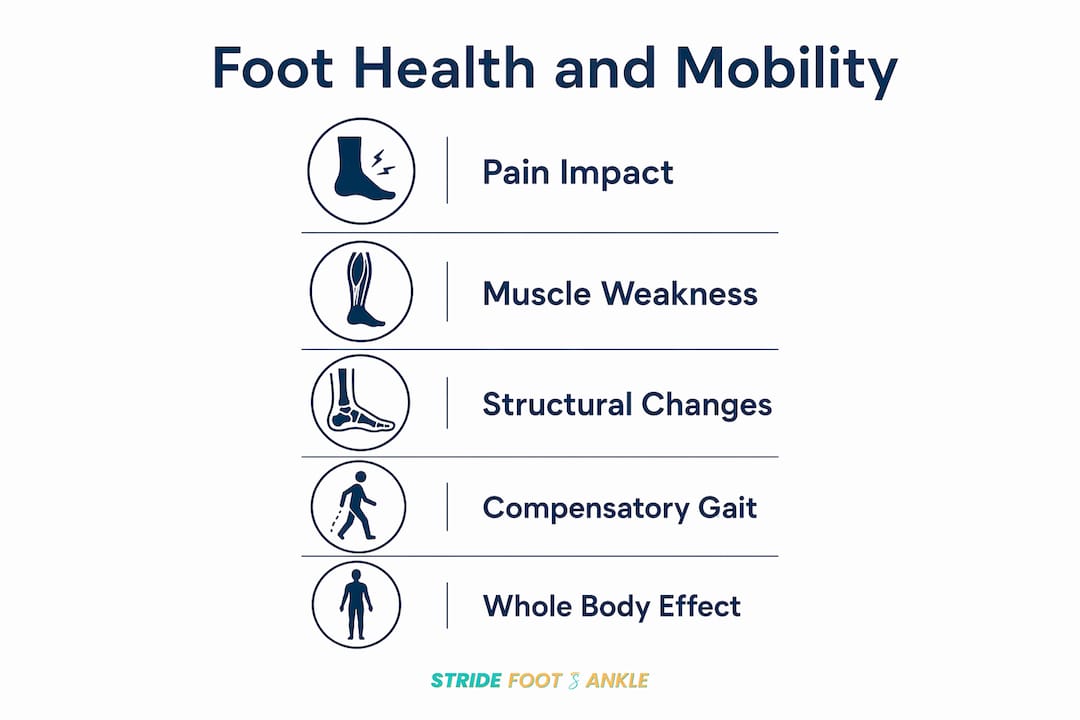
When one part of your foot hurts, your brain automatically adjusts your movement to protect it. This is called a compensatory gait pattern. You might shift weight to the outer edge of your foot, shorten your stride, or avoid pushing off with your toes. These adjustments feel natural in the moment, but they place abnormal stress on your ankles, knees, hips, and lumbar spine. Over time, compensatory movement patterns cause joint stress well beyond the foot itself, turning a localized problem into a full-body one.
Muscle weakness and structural changes compound the problem
Age-related declines in foot function, including reduced intrinsic muscle strength, decreased hallux (big toe) joint mobility, and diminished plantar sensation, independently contribute to balance issues and gait inefficiency. These are not inevitable consequences of getting older. They are mechanical impairments that respond to targeted care. When the small muscles inside your foot weaken, your arch loses support, your toes lose their grip on the ground, and your balance becomes less reliable. Modern footwear can accelerate this process by doing the stabilizing work your muscles should be doing, leading to intrinsic muscle atrophy and a measurable increase in fall risk.
The kinetic chain: how your feet affect your whole body
Your body moves as a connected system. Podiatric and physical therapy experts describe this as the kinetic chain. The foot functions as a tripod, with three contact points distributing your body weight evenly. When that tripod is unstable, stress shifts upward through knees, hips, and spine, creating pain and dysfunction far from the original foot problem. Limited ankle dorsiflexion, the ability to flex your foot upward toward your shin, is one specific example. When this range of motion is restricted, your knee must compensate during walking and stair climbing, increasing wear on the joint.
Common ways foot problems impair mobility include:
- Reduced walking speed and distance due to pain avoidance
- Increased fall risk from weakened toe grip and poor balance
- Knee and hip pain caused by altered gait mechanics
- Lower back strain from uneven weight distribution
- Reduced physical activity leading to cardiovascular and metabolic consequences
Pro Tip: If you notice that one hip feels higher than the other when you walk, or that one shoe wears out faster than the other, these are early signs of compensatory gait. A podiatric evaluation can identify the foot-level cause before it becomes a knee or hip problem.
What scientific evidence links foot health to mobility outcomes?
Research consistently shows that foot health and mobility are directly connected, and the data is specific enough to guide clinical decisions.
The Framingham Foot Study, one of the largest epidemiological studies of foot health in older adults, documented a 20–25% prevalence of chronic foot pain in its cohorts. That prevalence comes with a measurable cost: patients with chronic foot pain show significantly higher odds of mobility impairment and walking difficulty, even after controlling for age and body weight. This means foot pain is an independent risk factor for losing the ability to move freely.
The systemic consequences extend further when diabetes is involved. Clinical findings published in 2026 show that diabetes-related foot disease carries an odds ratio of 3.04 for lean body mass loss and 2.59 for activity difficulties. An odds ratio above 2.0 is clinically significant. These numbers indicate that foot disease in diabetic patients is not just a wound-care issue. It is a driver of sarcopenia, the progressive loss of muscle mass and strength that accelerates functional decline.
Footwear research adds another layer of evidence. Randomized trials show that supportive footwear reduces foot pain and increases average daily step counts meaningfully. More steps mean better cardiovascular health, stronger muscles, and greater independence. The intervention is simple, but the downstream benefits are substantial.
| Research finding | Clinical implication |
|---|---|
| 20–25% of older adults have chronic foot pain | Foot pain is a common, addressable cause of mobility decline |
| Odds ratio of 3.04 for lean mass loss in diabetic foot disease | Foot disease accelerates whole-body muscle loss |
| Supportive footwear increases daily step counts | Simple footwear changes produce measurable activity gains |
| Intrinsic muscle weakness increases fall risk | Targeted foot exercises reduce fall incidence |
| Compensatory gait causes knee and hip stress | Treating foot pain prevents secondary joint injuries |
The Journal of Kinesiology emphasizes that the foot’s role as the body-ground interface is often overlooked in mobility assessments, particularly in aging populations. Clinicians who assess foot function as part of fall prevention programs consistently achieve better outcomes than those who focus only on balance training.
How can improving foot health enhance your movement and reduce pain?
Improving foot health produces direct, measurable gains in mobility. The strategies below are grounded in clinical evidence and practical experience.
Wear properly fitted, supportive footwear. Shoes that match your foot shape and provide adequate arch support reduce pain and increase how much you move each day. Avoid flat, unsupportive shoes for extended walking. Look for a firm heel counter, a wide toe box, and cushioning appropriate for your activity level. Patients who improve foot circulation through proper footwear choices report less fatigue and more consistent daily activity.
Strengthen your intrinsic foot muscles. These small muscles inside your foot control toe grip, arch support, and balance. Effective exercises include toe spreads (spreading all toes wide and holding for five seconds), short foot exercises (drawing the ball of your foot toward your heel without curling your toes), and single-leg balance drills. Performing these daily builds the muscular foundation your gait depends on.
Improve ankle mobility. Restricted ankle dorsiflexion is one of the most common and most correctable contributors to gait problems. Calf stretches against a wall, ankle circles, and banded ankle mobilizations performed daily can restore range of motion within weeks. Greater ankle mobility reduces knee and hip compensation immediately.
Use orthotics when indicated. Custom orthotics correct structural alignment issues that exercises alone cannot fully address. Conditions like flat feet (pes planus), high arches (pes cavus), and plantar fasciitis often require orthotic support to redistribute pressure and allow healing. A podiatrist can assess whether over-the-counter insoles are sufficient or whether custom devices are warranted. Conservative foot care through orthotics and physical therapy prevents many patients from needing surgery.
Seek early podiatric assessment. Proactive podiatric care focuses on functional deficits before they become structural problems. Early intervention with orthotics, strengthening programs, and footwear guidance prevents invasive treatments and maintains independence longer.
Modify lifestyle habits that stress your feet. Prolonged standing on hard surfaces, barefoot walking on concrete, and high-impact activity without adequate footwear all accelerate foot muscle fatigue and joint wear. Alternating footwear, using anti-fatigue mats, and scheduling rest periods during long standing shifts protect your feet without limiting your activity.
Pro Tip: Many patients dismiss foot exercises as too simple to matter. The research says otherwise. Consistent intrinsic muscle training, done for just 10 minutes daily, produces measurable improvements in balance and walking efficiency within six to eight weeks.
What are common signs that your foot health is affecting your mobility?
Recognizing the early signs of foot-related mobility decline gives you the best chance of reversing the problem before it becomes entrenched. Many people attribute these signs to normal aging, but they are often mechanical impairments that respond well to care.
Watch for these warning signs:
- Morning stiffness lasting more than 10 minutes in your heel or arch, which may indicate plantar fasciitis or Achilles tendon tightening
- Pain that changes how you walk, such as limping, favoring one side, or shortening your stride
- Numbness or tingling in your feet, which can signal nerve compression or diabetic neuropathy
- Swelling that does not resolve overnight, suggesting inflammation or circulatory issues
- Calluses or corns forming in unusual locations, which indicate abnormal pressure from gait changes
- Difficulty climbing stairs or rising from a chair without holding on, which may reflect ankle or toe weakness
- Recurring knee, hip, or lower back pain with no clear cause, which often traces back to foot biomechanics
Diabetic patients face additional risks. Diabetes-related neuropathy reduces sensation in the feet, meaning wounds and pressure sores can develop without pain as a warning signal. Preventing foot ulcers requires daily foot inspection and regular professional monitoring. Foot deformities like bunions (hallux valgus) and hammertoes alter weight distribution and accelerate the compensatory patterns described earlier.
The threshold for seeking professional help is lower than most patients assume. If foot pain or stiffness limits your daily activities for more than two weeks, a podiatric evaluation is warranted. Waiting longer allows compensatory patterns to become habitual, making them harder to correct. Podiatry for seniors is particularly effective when started before mobility decline becomes significant, because the window for conservative intervention is wider.
A professional assessment includes gait analysis, pressure mapping, and structural evaluation. These tools identify the specific deficits driving your symptoms and guide a targeted treatment plan. The goal is always to restore function with the least invasive approach possible.
Key Takeaways
Foot health directly determines mobility quality because the foot is the body’s primary contact point with the ground, and dysfunction there cascades through every joint above it.
| Point | Details |
|---|---|
| Foot pain causes compensatory gait | Altered walking patterns stress knees, hips, and spine, creating secondary injuries. |
| Chronic foot pain is common | The Framingham Foot Study documents a 20–25% prevalence in older adults with direct mobility consequences. |
| Muscle weakness increases fall risk | Intrinsic foot muscle atrophy from inactivity or poor footwear raises fall risk measurably. |
| Supportive footwear increases activity | Proper shoes reduce pain and increase daily step counts, improving cardiovascular and functional health. |
| Early care prevents surgery | Proactive podiatric assessment with orthotics and strengthening keeps most patients out of the operating room. |
What years of watching patients walk taught me about foot pain
Most patients who come in with knee or hip pain have never been told their feet might be the cause. That gap in awareness is the most preventable problem I see. Foot pain is quiet. It does not announce itself the way a broken bone does. It whispers, and people learn to ignore the whisper until the rest of their body starts shouting.
What I have observed repeatedly is that patients who address foot problems early, before the compensatory patterns become automatic, recover faster and more completely. The ones who wait often need to unlearn months of bad movement habits in addition to treating the original foot problem. That is a harder road.
The other thing I want to say plainly is this: many people believe their foot pain is just aging. They accept it. They reduce their activity, stop walking the dog, skip the stairs, and gradually shrink their world. But the research is clear that most of these changes are mechanical, not inevitable. Intrinsic muscle weakness, limited ankle mobility, and poor footwear are all correctable. Accepting them as permanent is the real risk.
Feet are not a footnote in your health. They are the reason you can stand up, walk to your kitchen, and live independently. Treating them as an afterthought is a choice that compounds quietly until it is not quiet anymore.
— Ramil
Foot care at Stridefootankle: your next step toward better mobility
Stridefootankle, led by board-certified podiatrist Dr. Nahad Wassel, provides comprehensive foot and ankle care for patients in Las Vegas who want to move better and hurt less. The practice emphasizes conservative, evidence-based treatment, including gait analysis, custom orthotics, strengthening programs, and footwear guidance, before considering surgical options.
Whether you are managing plantar fasciitis, recovering from an ankle injury, or noticing the early signs of mobility decline, Dr. Wassel’s patient-centered approach starts with a thorough evaluation and a clear plan. Patients leave with specific, practical steps, not generic advice. Schedule a consultation at Stridefootankle and find out exactly what your feet need to keep you moving.
FAQ
How does foot pain cause knee and hip problems?
Foot pain triggers compensatory gait changes that shift abnormal stress to the knees, hips, and lumbar spine. Over time, these compensations cause secondary joint pain and injury even when the original foot problem is minor.
What percentage of older adults experience chronic foot pain?
The Framingham Foot Study documents a 20–25% prevalence of chronic foot pain in older adults, with those affected showing significantly higher odds of walking difficulty and mobility impairment.
Can foot exercises actually improve my balance and gait?
Targeted intrinsic foot muscle exercises, such as toe spreads, short foot drills, and single-leg balance work, strengthen the muscles that control arch support and toe grip, directly improving balance and gait efficiency.
When should I see a podiatrist for foot-related mobility issues?
Seek a podiatric evaluation if foot pain or stiffness limits your daily activities for more than two weeks, or immediately if you have diabetes and notice any skin changes, numbness, or wounds on your feet.
Does supportive footwear really make a measurable difference?
Randomized trial evidence shows that supportive footwear reduces foot pain and increases average daily step counts, producing real gains in physical activity and the cardiovascular and functional health benefits that come with it.
Recommended
- Why foot care matters: prevent pain, injuries, and complications – Stride Foot & Ankle – Dr. Nahad Wassel
- How to prevent foot injuries: expert strategies for healthy feet – Stride Foot & Ankle – Dr. Nahad Wassel
- Pediatric Concerns: Top 10 Foot Issues Parents Should Know – Stride Foot & Ankle – Dr. Nahad Wassel
- How to Prevent Foot Ulcers: a Guide for At-Risk Patients – Stride Foot & Ankle – Dr. Nahad Wassel
Recent Comments