

TL;DR:
- Most childhood foot differences are normal and do not limit function or cause pain.
- Parents should focus on symptoms like pain, limping, or activity avoidance rather than appearance alone.
Pediatric concerns about foot health are among the most common reasons parents bring their children to a podiatrist. Yet many parents struggle to tell the difference between a foot appearance that looks unusual and one that actually signals a problem. Most childhood foot differences are normal parts of development and cause no pain or functional limitations. This guide breaks down the ten most important pediatric foot conditions, backed by the latest 2026 clinical research, so you know exactly what to watch, what to treat, and when to call a specialist.
Table of Contents
- Key takeaways
- 1. Understanding pediatric concerns: flexible flatfoot
- 2. Metatarsus varus
- 3. Callosities
- 4. Plantar warts
- 5. Ingrown toenails
- 6. Hallux valgus
- 7. Toe walking
- 8. Sever’s disease (calcaneal apophysitis)
- 9. Surgical options for pediatric flatfoot
- 10. Evaluating your child’s foot symptoms at home
- My honest take on pediatric foot care
- How Stridefootankle can help your child stride confidently
- FAQ
Key takeaways
| Point | Details |
|---|---|
| Symptoms matter more than appearance | Focus on pain, limping, and activity limitations rather than how a foot looks. |
| Flatfoot is often normal | Most children with flexible flatfoot resolve naturally; orthotics are first-line before surgery is ever considered. |
| Common conditions are widespread | A 2026 Danish study found metatarsus varus in 53% of children aged 6 to 16. |
| Surgery is rarely the first step | Conservative care resolves most pediatric foot problems without surgical intervention. |
| Early documentation helps specialists | Tracking when pain occurs, during activity or at rest, gives your doctor the most useful information. |
1. Understanding pediatric concerns: flexible flatfoot
Flexible flatfoot, clinically called pes planus, is the most discussed pediatric foot condition. The arch appears flat when a child stands but returns when the foot is lifted off the ground. That distinction matters because it separates a flexible, developing foot from a rigid structural problem requiring immediate attention.
Most children have flat feet before age six. The arch typically develops as ligaments and muscles strengthen through weight-bearing activity. Arch development continues well into the early school years, so what looks alarming at age three may resolve entirely by age eight.
When to watch closely:
- Foot pain during or after activity, particularly at the arch or heel
- Calf or knee pain that correlates with walking or sports
- Visible changes in how your child walks, such as rolling the ankles inward
- Reluctance to participate in physical activity or complaints of fatigue in the legs
Orthotics combined with proper footwear are the established first-line treatment. They reduce pain across the foot, leg, knee, and lower back by supporting the arch and correcting alignment during walking. Most children achieve meaningful relief without ever needing surgery.
Surgery is reserved for rigid flatfoot that does not flex, cases with an underlying structural cause like tarsal coalition, or progressive symptomatic presentations where conservative care has failed after a sustained period. Conservative care resolves the vast majority of cases.
Pro Tip: Buy shoes with firm heel counters and some arch support for children who complain of foot fatigue. Avoid completely flat, soft-soled shoes for kids with known flexible flatfoot.
2. Metatarsus varus
Metatarsus varus is a condition where the front of the foot curves inward relative to the heel, giving the foot a bean-shaped appearance. It is the most prevalent foot condition in school-age children. A 2026 Danish cross-sectional study of 501 children aged 6 to 16 found metatarsus varus in 53% of participants, making it far more common than most parents realize.
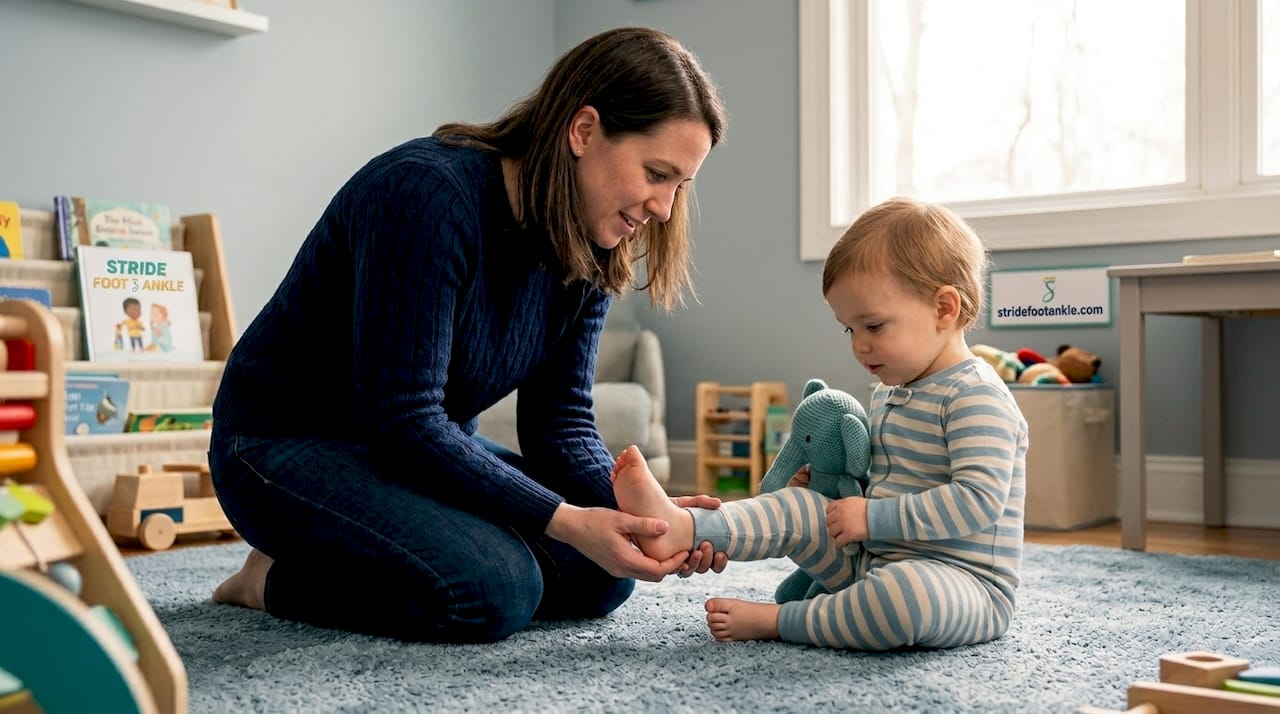
Many children with metatarsus varus are completely asymptomatic. The inward curve is often noticed by parents during bath time or when buying shoes. Mild cases require no treatment and frequently self-correct as the child grows.
Moderate to severe cases, especially those identified in infancy, may benefit from serial casting or corrective footwear. The key symptom to watch for is any difficulty fitting shoes normally, tripping more than expected for the child’s age, or complaints of forefoot pain during walking or running.
3. Callosities
Callosities, or calluses, are areas of thickened skin that develop in response to repeated friction or pressure. They ranked second in the 2026 Danish prevalence study at 46% of children examined. Prevalence increased with age, which makes sense given that older children spend more time in structured sports and formal footwear.
Most callosities are painless and benign. They become a concern when they grow thick enough to cause discomfort during activity, or when parents mistake them for warts. The key difference is that calluses have continuous skin lines running through them, while warts interrupt those lines.
Treatment is straightforward. Cushioned insoles reduce the pressure that causes calluses to form. Properly fitting shoes, replacing footwear that has worn unevenly, and periodic gentle exfoliation under parental supervision are effective for most cases. If a callus is painful, thick, or recurs rapidly, a podiatric evaluation is worth scheduling.
4. Plantar warts
Plantar warts are caused by the human papillomavirus (HPV) and appear on the sole of the foot. They affect approximately 12% of school-age children and are picked up in warm, moist environments like pool decks and gym locker rooms.
Unlike calluses, warts often feel tender when you squeeze them from the sides rather than pressing directly on them. They can develop in clusters called mosaic warts, and they frequently bleed as small pinpoints when the surface is pared down.
Many plantar warts resolve on their own within two years without treatment. Over-the-counter salicylic acid preparations are a reasonable first approach for cooperative children. When warts are large, painful, multiply quickly, or do not respond to home care after several months, see a podiatrist. Children who are immunocompromised need earlier specialist involvement.
5. Ingrown toenails
Ingrown toenails occur when the nail edge curves and grows into the surrounding skin, triggering pain, redness, swelling, and sometimes infection. The 2026 Danish study found a 14% prevalence in children aged 6 to 16, with rates increasing significantly in older children. This likely reflects the greater time older kids spend in tight athletic footwear.
The big toe is affected most often. Early-stage ingrown nails can be managed by soaking the foot in warm water, gently lifting the nail edge, and placing a small piece of clean cotton underneath. Shoes with a wide toe box reduce recurrence substantially.
If the area is infected, draining, or the child is in significant pain, do not attempt home correction. A podiatrist can perform a minor, quick in-office procedure to remove the offending nail border, usually under local anesthesia. Recurrence is common without addressing the underlying nail shape, so nail edge trimming technique matters. Always cut straight across, never curved.
6. Hallux valgus
Hallux valgus, commonly called a bunion, is an angular deviation of the big toe toward the second toe with a bony prominence at the inner forefoot. It is less common in younger children but the 2026 Danish study confirmed its prevalence increases with age, particularly in adolescent girls.
Juvenile hallux valgus has a strong genetic component. If a parent has bunions, a child has a meaningfully higher risk. Tight, narrow shoes accelerate the deformity but do not cause it independently in children with a genetic predisposition.
Pain over the bunion prominence during shoe-wearing, skin irritation, and difficulty finding comfortable footwear are the most common complaints. Wide toe-box shoes and padding reduce discomfort in mild to moderate cases. Surgery is generally deferred until skeletal maturity to reduce the risk of recurrence, so conservative management takes priority during childhood and adolescence.
7. Toe walking
Toe walking means a child walks predominantly on the balls of the feet without bringing the heel down. It is common and often normal in toddlers just learning to walk. Persistent toe walking beyond age three warrants a closer look at pediatric gait concerns.
Idiopathic toe walking, meaning no underlying cause is found, is the most frequent diagnosis. However, toe walking can also be associated with tight Achilles tendons, cerebral palsy, autism spectrum disorder, or other neurodevelopmental conditions. The distinction matters because the management paths differ significantly.
Physical therapy to stretch the Achilles tendon and strengthen dorsiflexor muscles is the primary conservative approach. Serial casting can be used for children with a tight heel cord who do not respond to stretching alone. Surgery to lengthen the Achilles tendon is reserved for cases with a confirmed structural tightness that limits function despite prolonged conservative care.
8. Sever’s disease (calcaneal apophysitis)
Sever’s disease is not a disease in the traditional sense. It is a painful inflammation of the growth plate at the back of the heel, most common in active children between the ages of 8 and 14. It is one of the most frequent causes of heel pain in this age group and is tied directly to periods of rapid growth combined with high physical activity.
The pain is typically felt at the back of the heel, worsens with running and jumping, and improves with rest. Parents sometimes notice a child beginning to limp toward the end of a sports practice or refusing to participate in activities they previously enjoyed.
Treatment centers on relative rest, heel cushion inserts, calf stretching, and anti-inflammatory measures. Most children recover fully within a few weeks to a few months. The condition resolves permanently once the growth plate closes, typically by mid-adolescence.
9. Surgical options for pediatric flatfoot
When conservative treatments have been tried for an adequate period without relief, and a child has symptomatic, progressive, or rigid flatfoot, surgical evaluation becomes appropriate. Two procedures are most commonly discussed: subtalar arthroereisis and osteotomy.
Subtalar arthroereisis involves placing a small implant into the subtalar joint to block excessive inward rolling of the heel. It is minimally invasive, preserves joint motion, and has a lower complication profile. Osteotomy involves cutting and repositioning the bones of the foot to correct alignment. It provides greater radiographic correction in certain planes but requires more recovery time.
A 2026 comparative study found that both procedures achieve similar functional outcomes, meaning neither is universally superior for restoring a child’s ability to walk and run comfortably. The right choice depends on deformity severity, the child’s age, and the surgeon’s assessment of the individual anatomy.
Open growth plates add a layer of complexity that does not exist in adult surgery. Techniques must be chosen carefully to avoid premature physeal closure, which could cause a limb length discrepancy. This is precisely why pediatric foot surgery requires a specialist with specific training in this area.
Pro Tip: Ask any surgeon you consult whether they routinely perform both arthroereisis and osteotomy for pediatric flatfoot. A surgeon familiar with both options is better positioned to recommend the approach that fits your child’s specific anatomy.
10. Evaluating your child’s foot symptoms at home
Knowing when a foot issue genuinely needs medical attention is one of the most practical skills a parent can develop. Many common foot conditions in children are asymptomatic and require only monitoring. The goal is not to react to appearance alone but to track functional changes over time.
Here is a simple framework for evaluation:
- Note when pain occurs. Activity-related pain that eases with rest suggests a mechanical or growth-related issue. Pain at rest or at night warrants earlier evaluation.
- Watch for limping. A child who starts limping mid-activity, or who consistently avoids one leg, needs to be seen by a provider.
- Track participation changes. A child who was previously active and now avoids running, gym class, or sports is communicating something through behavior that may not be visible to the eye.
- Document the pattern. Write down how often symptoms occur, which activities trigger them, and how long they last. This detail makes a clinical evaluation far more targeted and accurate.
- Check the footwear. Look for uneven wear patterns on the soles. Heavy inner-edge wear suggests pronation. Wear concentrated at the ball of the foot is consistent with toe walking.
“Focus on what your child does, not just what their foot looks like. A flat foot that lets a child run, jump, and play without pain is a healthy foot for that child.”
Reassurance matters here too. Seeing a wide, flat foot or a bumpy toe does not automatically mean something is wrong. Clinicians prioritize symptom clustering over static visual findings when deciding whether to intervene.
My honest take on pediatric foot care
I’ve seen parents come in genuinely distressed over a foot appearance that turned out to be completely normal for their child’s age. I’ve also seen families who waited years because their child “wasn’t complaining” when a gradually worsening gait change had already started affecting how the child moved.
What I’ve learned is this: the appearance-versus-symptoms distinction is not just a clinical rule. It’s the single most useful filter a parent can apply at home. Flat feet, wide feet, in-toed walking. These can all be normal. Pain that limits a child from playing, limping that shows up mid-activity, a child who quietly stops running because it hurts. Those are the signals worth acting on quickly.
I also want to be honest about something that doesn’t always get said clearly enough. Conservative care is not a consolation prize when surgery “isn’t needed yet.” For the vast majority of children’s foot concerns, conservative management with proper footwear, orthotics, stretching, and activity modification is not just adequate. It is genuinely the best treatment available. Surgery carries risks, especially in children with open growth plates, and those risks exist for good reasons that parents deserve to hear plainly.
My encouragement to you is to stay curious, stay observant, and trust your instincts when something seems off with how your child moves. Bring your notes to the appointment. A good specialist will want exactly that information.
— Ramil
How Stridefootankle can help your child stride confidently
At Stridefootankle, Dr. Nahad Wassel provides specialized pediatric foot and ankle care for families in the Las Vegas area, from conservative management to advanced surgical evaluation when it’s truly needed.
Whether your child is dealing with persistent flatfoot pain, an ingrown toenail that keeps returning, or a gait pattern that doesn’t look quite right, the team at Stridefootankle offers personalized, evidence-based care at every step. You can explore foot and ankle care services to understand the full range of options available. If surgery has come up in conversation with another provider, the pediatric ankle surgery guide explains candidacy, procedures, and what to expect in terms that make sense to parents. Scheduling is easy and appointments are built around your family’s needs.
FAQ
What is the most common foot condition in school-age children?
Metatarsus varus, a curving of the forefoot inward, is the most prevalent condition, found in 53% of children aged 6 to 16 in a 2026 Danish study. Most cases are asymptomatic and do not require treatment.
When should I take my child to a podiatrist for flat feet?
See a podiatrist if your child complains of foot or leg pain, starts limping, or avoids physical activity due to discomfort. Flat feet that cause no pain or functional limitations typically do not require intervention.
Are plantar warts in children dangerous?
Plantar warts are caused by HPV and are not dangerous in healthy children. Most resolve on their own within two years. Treatment is recommended when warts are painful, multiplying rapidly, or not responding to over-the-counter care.
Is foot surgery safe for children?
Pediatric foot surgery is safe when performed by a qualified specialist who accounts for open growth plates. Both subtalar arthroereisis and osteotomy show similar functional outcomes in 2026 research, with the best choice depending on deformity type and severity.
How do I know if my child’s toe walking needs treatment?
Toe walking that persists beyond age three, involves tightness in the Achilles tendon, or is accompanied by developmental concerns should be evaluated. Idiopathic cases often respond well to physical therapy and stretching without surgery.
Recommended
- Guide to Common Pediatric Foot Problems: Causes, Signs, Care – Stride Foot & Ankle – Dr. Nahad Wassel
- What is pediatric foot pain? A parents’ guide to causes and care – Stride Foot & Ankle – Dr. Nahad Wassel
- Why foot care matters: prevent pain, injuries, and complications – Stride Foot & Ankle – Dr. Nahad Wassel
- How to prevent foot injuries: expert strategies for healthy feet – Stride Foot & Ankle – Dr. Nahad Wassel
Recent Comments