

TL;DR:
- Previous injuries to the foot and ankle create structural changes, scar tissue, and altered movement patterns that increase reinjury risk. Rehabilitation, prevention, and honest documentation are essential for lasting recovery and legal protection. Active management through structured therapy, supportive footwear, and detailed injury records helps maintain long-term function and minimize setbacks.
A previous injury is any prior trauma or damage to foot or ankle tissues that permanently alters how those structures absorb load, respond to stress, and heal from new damage. Clinically, this is called a pre-existing condition, and it is the single most important factor your podiatrist considers when building your recovery plan. Whether you are managing a history of ankle sprains, plantar fasciitis, stress fractures, or tendon tears, understanding how past injuries shape your current risk profile is the first step toward lasting recovery. This guide covers the effects of previous injury, proven rehabilitation strategies, prevention methods, and the legal considerations that affect your treatment access and compensation rights.
How does a previous injury affect foot and ankle function?
A previous foot or ankle injury does not simply heal and disappear. It leaves behind structural changes, scar tissue, and altered movement patterns that affect every step you take afterward. Understanding these effects is what separates a recovery that holds from one that keeps breaking down.
Compensatory movement and load redistribution
When your foot or ankle is injured, your body immediately shifts weight and movement to protect the damaged area. This is a natural protective response. The problem is that compensatory movement patterns can persist long after the original injury heals, overloading tendons, joints, and bones that were never meant to carry that extra stress. The result is a predictable cycle: one injury creates the conditions for the next.

A classic example is a lateral ankle sprain that goes undertreated. The peroneal tendons on the outer ankle compensate for ligament laxity. Over months, that compensation produces peroneal tendinitis, then potentially a stress fracture in the fifth metatarsal. The original sprain is “healed,” but the chain reaction it started is still running.
Increased reinjury risk and chronic pain
The history of injury is the strongest single predictor of future injury in the foot and ankle. Scar tissue that replaces damaged ligament or tendon fibers is less elastic and less load-tolerant than original tissue. Nerve endings in previously injured areas can become hypersensitive, producing pain signals at lower thresholds than normal tissue would. This is why chronic pain after a past injury is not imaginary. It reflects real structural and neurological changes.
Analyzing previous injury patterns is the foundation of performance-intelligence medicine, a clinical approach that maps tissue stress and repair history to predict and prevent reinjury. Dr. Nahad Wassel at Stridefootankle applies this same principle: your injury history is not background noise. It is diagnostic data.
Key signs that a previous injury has not fully resolved include:
- Persistent stiffness in the morning or after sitting, lasting more than 10 minutes
- Asymmetrical gait, where you unconsciously favor one side during walking or running
- Recurring swelling in the same area after activity, even mild activity
- Reduced range of motion compared to the uninjured side
- Vague aching that worsens with load and eases with rest
Pro Tip: Film yourself walking barefoot on a flat surface and compare your foot strike on both sides. Visible asymmetry is a reliable early signal of unresolved compensatory mechanics, even when you feel no pain.
What are the best treatment options for past injuries?
Effective treatment for a previous foot or ankle injury depends on the injury type, how long ago it occurred, and what structural changes remain. The injury recovery process follows defined phases, and skipping phases is the most common reason patients end up back in the clinic.
Rehabilitation phases and timelines
Modern rehabilitation medicine treats recovery as an active second phase of treatment, not a passive waiting period. Early mobilization, goal-directed therapy, and staged loading are the standard of care. Passive rest alone leads to muscle atrophy, joint stiffness, and prolonged disability.
General timelines for common foot and ankle injuries:
- Lateral ankle sprain (Grade 1–2): 2–6 weeks with structured ankle sprain rehabilitation
- Plantar fasciitis: 6–12 weeks of conservative care; up to 6 months in chronic cases
- Achilles tendinopathy: 12–16 weeks of progressive loading protocol
- Stress fractures: Monitored with follow-up imaging every 4–6 weeks to confirm healing before return to activity
- Grade 3 ligament tears or tendon ruptures: Often require surgical repair followed by 3–6 months of rehabilitation
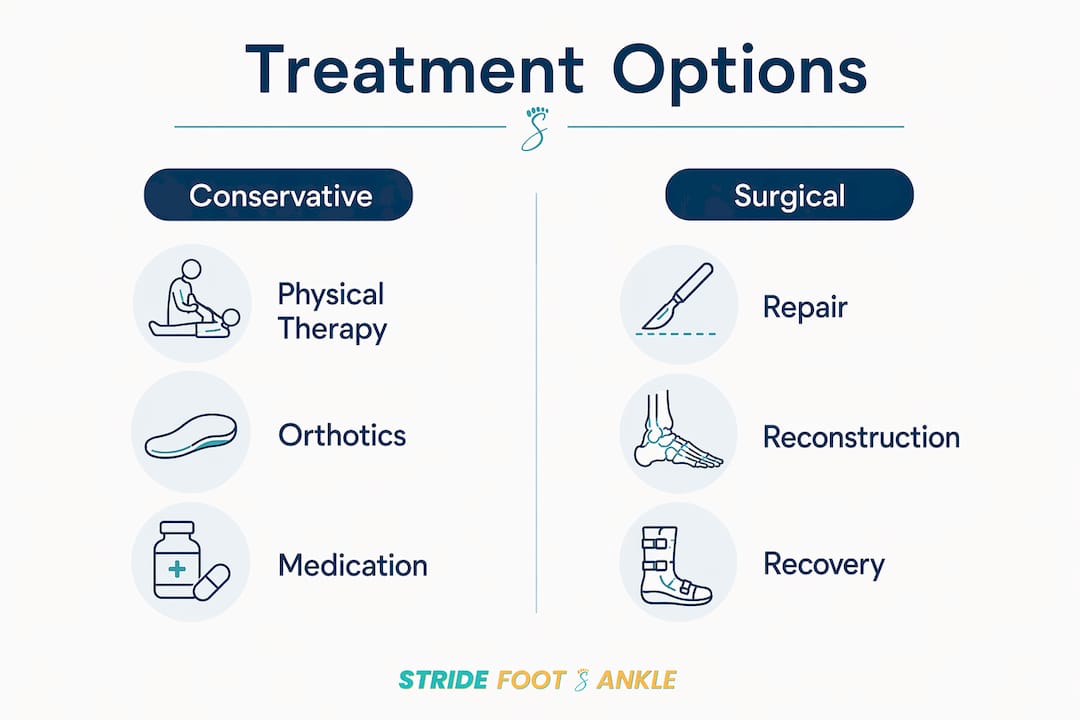
Conservative vs. surgical treatment: a direct comparison
| Treatment Modality | Best Indication | Key Advantage | Typical Recovery Duration |
|---|---|---|---|
| Physical therapy | Sprains, tendinopathy, post-fracture | Restores strength and movement patterns | 6–16 weeks |
| Custom orthotics | Flat foot, overpronation, chronic plantar fasciitis | Corrects load distribution without surgery | Ongoing use |
| Corticosteroid injection | Acute inflammation, plantar fasciitis flare | Fast pain reduction | Days to weeks |
| Extracorporeal shockwave therapy (ESWT) | Chronic tendinopathy, heel pain | Stimulates tissue repair non-surgically | 6–12 weeks |
| Surgical repair | Complete tendon or ligament rupture, structural deformity | Restores mechanical integrity | 3–9 months |
| Post-surgical rehab | After any foot or ankle surgery | Prevents complications, restores function | 3–6 months |
Nonsurgical options for tendon and ligament injuries resolve the majority of foot and ankle cases when applied correctly and consistently. Surgery becomes the right choice when conservative care has failed after an adequate trial, or when structural damage is too severe for tissue to heal on its own.
Complex musculoskeletal injuries demand patience. SLAP tear surgery, for example, requires 6–9 months of rehabilitation. That timeline reflects the reality of tissue repair, not a failure of treatment. Foot and ankle surgeries follow similar arcs.
Pro Tip: Ask your podiatrist for a written rehabilitation milestone chart at your first appointment. Knowing exactly what “progress” looks like at weeks 4, 8, and 12 keeps you on track and prevents premature return to activity.
How can you prevent reinjury after a foot or ankle injury?
Preventing reinjury after a history of injury requires more than rest and caution. It requires deliberate retraining of movement patterns, load management, and environmental awareness. The goal is to rebuild the foot and ankle so it is stronger and more resilient than before the original injury.
Daily habits that reduce reinjury risk
Follow this numbered protocol to build a sustainable prevention routine:
- Wear supportive footwear every day. Shoes with adequate arch support and heel cushioning reduce ground reaction forces on previously injured tissues. Replace athletic shoes every 300–500 miles of use.
- Complete a structured strengthening program. Exercises targeting the intrinsic foot muscles, peroneals, and calf complex rebuild the dynamic stability that ligaments alone cannot provide. Resistance band exercises, single-leg calf raises, and towel scrunches are proven starting points.
- Retrain your gait. Work with a physical therapist on gait retraining if you notice any limping, toe-out walking, or asymmetrical push-off. Correcting these patterns breaks the compensatory cycle before it creates a secondary injury.
- Manage your training load. Increase activity volume by no more than 10% per week. This applies to walking, running, and standing time. Sudden load spikes are the most common trigger for stress fractures and tendon flare-ups in previously injured feet.
- Recognize early warning signs. Pain that rates 3 out of 10 or higher during activity, swelling that persists the next morning, or stiffness that does not resolve within 10 minutes of movement are signals to reduce load and seek evaluation.
- Keep a medical injury diary. Documenting injury details and rehabilitation milestones helps your clinician map tissue stress patterns and predict potential flare-ups before they become full reinjuries.
- Schedule periodic check-ins with your podiatrist. Even when you feel well, an annual foot and ankle assessment catches mechanical drift, footwear wear patterns, and early tissue changes before they become clinical problems.
The role of footwear and orthotics in long-term protection
Footwear is not a cosmetic choice after a foot or ankle injury. The wrong shoe can undo months of rehabilitation by reintroducing the same mechanical stresses that caused the original injury. Custom orthotics, prescribed by Dr. Wassel at Stridefootankle, address individual biomechanical deficits that off-the-shelf insoles cannot correct. For patients with flat foot, overpronation, or leg length discrepancy, orthotics are a long-term management tool, not a short-term fix.
Preventing foot injuries also means modifying your environment. Anti-fatigue mats at standing workstations, non-slip surfaces in bathrooms, and adequate lighting on stairs all reduce the external factors that contribute to common injury setbacks.
Pro Tip: Bring your most-used shoes to your podiatry appointment. Wear patterns on the sole reveal compensatory mechanics that are invisible during a standard gait assessment.
Do previous injuries affect your legal and insurance claims?
A previous injury directly affects personal injury claims and insurance coverage, but it does not automatically disqualify you from compensation. The legal term is “pre-existing condition,” and how it is handled depends on the doctrine applied and how thoroughly your medical history is documented.
The eggshell plaintiff doctrine and comparative fault
The eggshell plaintiff doctrine holds that a defendant is liable for the full extent of harm caused to a plaintiff, even if that plaintiff was more vulnerable due to a pre-existing condition. In practical terms: if a new accident aggravates your previously injured ankle, the at-fault party cannot escape liability simply because your ankle was already weakened. The law requires them to take you as they find you.
Comparative fault works differently. If your prior injury contributed to the severity of your current injury, a court may reduce your compensation proportionally. This is why accurate, complete medical documentation matters so much.
Honest disclosure of prior injuries is critical for both accurate medical treatment and legal injury claims. Concealing your injury history does not protect your claim. It destroys it.
Key points to understand about previous injury compensation and insurance:
- Document everything. Medical records, imaging reports, physical therapy notes, and your own injury diary all serve as evidence that a new incident caused new harm or aggravated an existing condition.
- Distinguish aggravation from pre-existing symptoms. Your attorney and physician must demonstrate that the new incident worsened your condition beyond its baseline. Imaging before and after the incident is the clearest evidence.
- Do not minimize your history. Insurance adjusters routinely request full medical histories. Gaps or inconsistencies in your records are used to argue that your current symptoms are pre-existing, not caused by the new incident.
- Work with a podiatrist who documents thoroughly. Clinical notes from Dr. Wassel at Stridefootankle include detailed functional assessments that clearly distinguish baseline status from new injury findings.
“A pre-existing injury does not bar recovery. What matters is whether the new incident caused harm beyond what already existed. Thorough medical documentation is the difference between a successful claim and a denied one.”
Key takeaways
Managing a previous foot or ankle injury requires active rehabilitation, deliberate prevention, and honest documentation to achieve lasting recovery and protect your legal rights.
| Point | Details |
|---|---|
| Previous injury changes function | Past trauma alters load distribution and movement patterns, raising reinjury risk long after healing. |
| Rehabilitation must be structured | Follow phased timelines with imaging checkpoints; skipping phases is the leading cause of reinjury. |
| Prevention requires daily habits | Supportive footwear, strengthening, gait retraining, and a medical injury diary reduce recurrence risk. |
| Legal claims depend on documentation | Honest, thorough medical records distinguish new harm from pre-existing conditions and protect compensation rights. |
| Conservative care resolves most cases | Physical therapy and orthotics address the majority of foot and ankle injuries without surgery. |
Why managing your injury history is the real work of recovery
I have seen patients who did everything right after their initial injury, completed their physical therapy, followed their timelines, and still ended up back in the clinic six months later. Almost every time, the reason was the same: they treated recovery as a finish line rather than an ongoing process.
The effects of previous injury do not end when your pain does. The compensatory mechanics your body developed during the acute phase can persist for years. Scar tissue does not remodel itself back to full elasticity without deliberate loading. And the neurological hypersensitivity that develops in chronically injured tissue does not simply reset. These are structural realities, not excuses.
What I find most underestimated is the value of the medical injury diary. Patients who track their symptoms, activity levels, and flare-up triggers give their clinicians something genuinely useful: a longitudinal picture of how their tissue behaves under real-world conditions. That information is more clinically valuable than a single in-office assessment. Detailed injury documentation surpasses patient memory alone in guiding diagnosis and recovery planning in complex cases.
The patients who recover fully and stay recovered are the ones who treat their injury history as active clinical data. They show up to appointments with notes. They ask about their compensatory patterns. They do not wait for pain to return before seeking guidance. That proactive mindset, combined with the right clinical team, is what turns a history of injury into a foundation for stronger movement.
— Ramil
Start your recovery at Stridefootankle
If you are managing a previous foot or ankle injury in Las Vegas, Stridefootankle offers the personalized, evidence-based care your recovery requires. Dr. Nahad Wassel reviews your full injury history, orders advanced imaging when needed, and builds a treatment plan that addresses both your current symptoms and the underlying mechanics that put you at risk.

Whether you need conservative foot care or a surgical consultation, Stridefootankle provides the full spectrum of podiatric services under one roof. From custom orthotics to post-surgical rehabilitation, every plan is built around your specific history and goals. Schedule your consultation today through Stride’s general foot and ankle care page and take the first real step toward lasting recovery.
FAQ
What counts as a previous injury for medical and legal purposes?
A previous injury is any documented or diagnosable prior trauma to a body part that affects its current structure or function. For legal purposes, it is classified as a pre-existing condition and must be disclosed in both medical intake forms and personal injury claims.
How long does rehabilitation after a previous foot injury take?
Rehabilitation timelines vary by injury type. Ankle sprains typically resolve in 2–6 weeks, while stress fractures require imaging every 4–6 weeks to confirm healing. Complex tendon or ligament repairs can require 3–9 months of structured rehabilitation.
Can a previous injury affect a new personal injury claim?
A previous injury does not automatically reduce your compensation. Under the eggshell plaintiff doctrine, a defendant is liable for aggravating a pre-existing condition. Honest medical disclosure and thorough documentation are the keys to a successful claim.
What are the most common setbacks during recovery from a past injury?
The most common setbacks are premature return to activity, inadequate footwear, and unaddressed compensatory movement patterns. Recovery requires active, structured phases with progressive loading, not passive rest alone.
How do i know if my previous injury has fully healed?
Full healing means restored strength, full range of motion equal to the uninjured side, no swelling after normal activity, and symmetrical gait. A podiatrist can confirm functional recovery through physical assessment and imaging, which is more reliable than pain absence alone.
Recommended
- Ankle Sprain Recovery Process: Your 2026 Rehab Guide – Stride Foot & Ankle – Dr. Nahad Wassel
- Post-Surgery Foot Care Steps for Safe Recovery – Stride Foot & Ankle – Dr. Nahad Wassel
- Ankle Sprain: Causes, Treatment, and Recovery Guide – Stride Foot & Ankle – Dr. Nahad Wassel
- General Foot & Ankle Care – Stride Foot & Ankle
Recent Comments