

TL;DR:
- Orthotics are shoe-in worn devices that relieve foot pain through cushioning, pressure redistribution, and motion control. Prefabricated insoles suit mild issues and are cost-effective, while custom orthotics offer tailored correction for complex conditions, often lasting several years. Proper fit, gradual adaptation, and professional evaluation are essential for maximizing orthotic benefits and long-term relief.
Orthotics are devices worn inside shoes to relieve foot pain by cushioning, redistributing plantar pressure, and controlling abnormal foot motion. The term covers everything from a $12 drugstore insole to a precision-molded custom foot support fabricated from a 3D scan of your foot. Shoe inserts, insoles, and orthotics are often used interchangeably, but the clinical distinction matters: OTC devices provide cushioning and support for general comfort, while custom orthotics are prescription-grade foot alignment devices designed to address specific biomechanical problems. Whether you are dealing with plantar fasciitis, flat feet, or cavus foot, understanding your options puts you in control of your recovery.
What are the different types of orthotics?
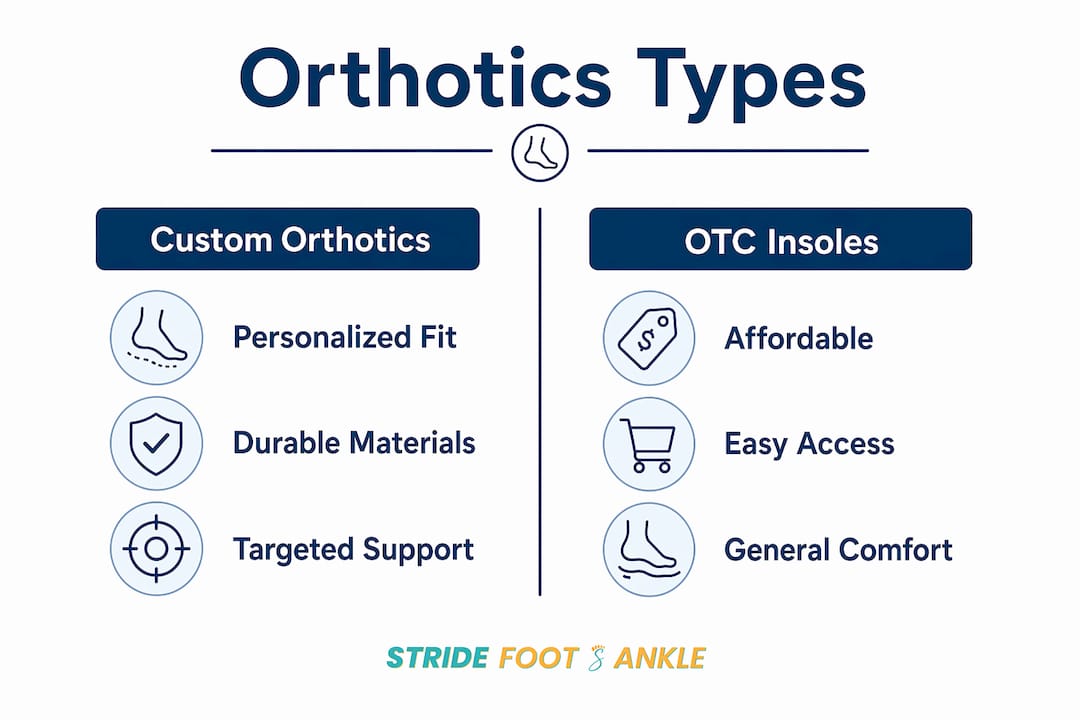
Orthotics fall into two primary categories: over-the-counter (OTC) prefabricated insoles and custom-made orthotic devices. Each category serves a different clinical purpose, and knowing the difference saves you time, money, and frustration.
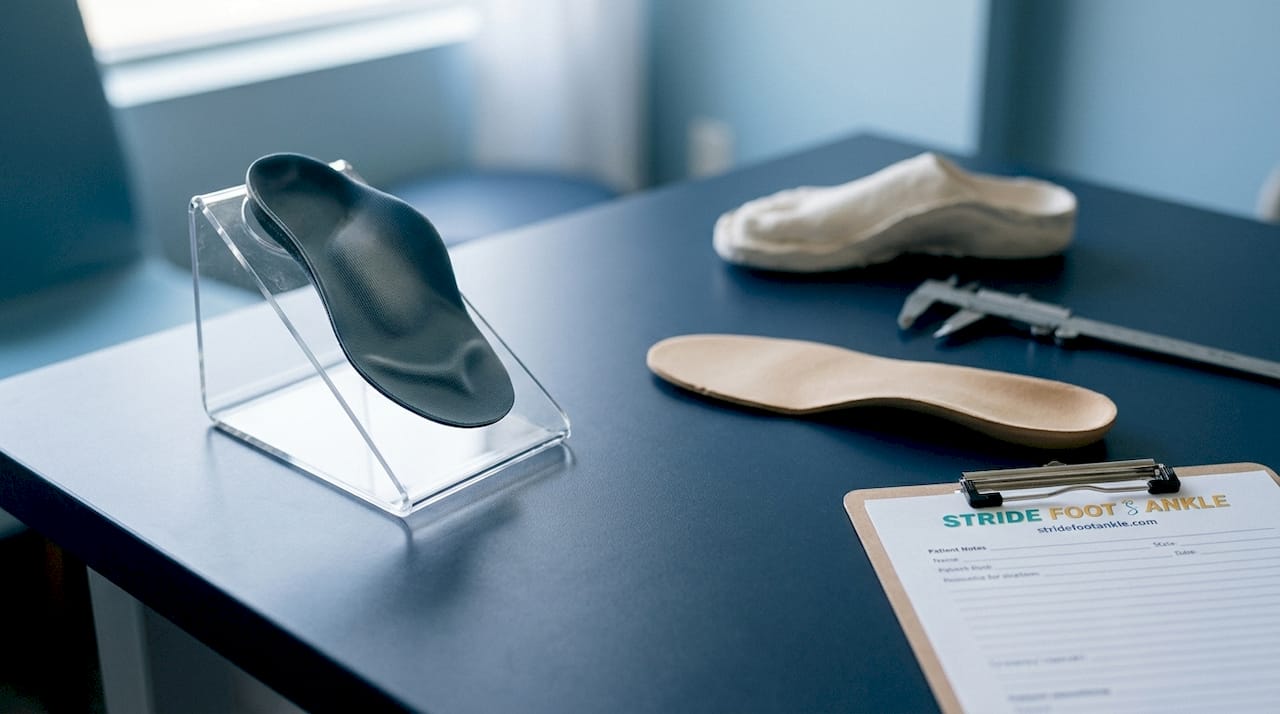
OTC insoles are mass-produced from foam, gel, or rubber and are designed to fit a range of foot shapes. They provide general cushioning and mild arch support. Consumer Reports 2026 testing found that Dr. Scholl’s Work All-Day Insoles, priced under $15, delivered meaningful comfort and stability for tired, achy feet. That result matters because it confirms OTC options are not just filler products. They genuinely help a large segment of people with mild to moderate foot discomfort.
Custom orthotics are fabricated from a cast, foam impression, or digital scan of your specific foot. Materials range from semi-rigid polypropylene and carbon fiber to soft EVA foam, depending on the therapeutic goal. A podiatrist prescribes them after a biomechanical assessment, and they are designed to correct your individual foot mechanics rather than approximate an average foot shape.
Here is how the two types compare across the factors that matter most to patients:
| Factor | OTC insoles | Custom orthotics |
|---|---|---|
| Cost | $10 to $60 | $300 to $800+ |
| Fit | Generic sizing | Molded to your foot |
| Conditions addressed | General fatigue, mild arch pain | Plantar fasciitis, cavus foot, flatfoot, biomechanical issues |
| Lifespan | 6 to 12 months | 2 to 5 years |
| Requires prescription | No | Yes |
Functionally, orthotics work through three mechanisms: cushioning impact forces, redistributing plantar pressure away from painful areas, and controlling abnormal motion at the subtalar and midtarsal joints. A 2025 cadaveric weight-bearing CT study confirmed that custom orthoses correct alignment by 1.3 to 2.6 degrees through precise medial arch height adjustment and metatarsal pad placement. Those numbers sound small, but in biomechanics, a 2-degree correction across thousands of daily steps adds up to a significant reduction in cumulative stress on soft tissue and bone.
- Rigid orthotics: Made from hard plastic or carbon fiber. Used to control motion in conditions like overpronation or posterior tibial tendon dysfunction.
- Semi-rigid orthotics: Combine a firm shell with soft top layers. Suited for athletes and active patients who need both support and shock absorption.
- Soft orthotics: Made entirely from cushioning materials. Best for diabetic patients or anyone with pressure-sensitive areas on the sole.
- Accommodative orthotics: Designed to offload specific pressure points rather than correct alignment. Common in diabetic foot care.
Pro Tip: When shopping for OTC insoles, look for options with a firm heel cup and a defined arch contour rather than flat foam pads. A structured heel cup stabilizes the calcaneus and reduces the rocking motion that causes Achilles and plantar fascia strain.
What does research say about orthotic effectiveness?
Orthotics reduce foot pain. That claim is now backed by multiple clinical trials, biomechanical studies, and cost-effectiveness analyses. The evidence is strongest for plantar heel pain, cavus foot, and flatfoot-related conditions.
A 2026 NIHR Open Research study found that prefabricated orthoses show similar effectiveness to custom devices for plantar heel pain while costing significantly less. Plantar heel pain affects a substantial portion of the adult population and is one of the most common reasons patients visit a podiatrist. The finding that a well-fitted prefabricated insole can match a custom device for this condition is clinically important. It means most patients do not need to spend hundreds of dollars upfront to get meaningful relief.
For patients with cavus foot, the picture shifts. A randomized controlled trial found that custom orthoses outperformed sham insoles by 8.3 points on pain scores and 9.5 points on functional outcome scores. Cavus foot, characterized by an abnormally high arch, creates concentrated pressure under the heel and ball of the foot. A generic insole cannot redistribute that load effectively because it was not shaped to match the elevated arch profile.
“Prefabricated orthoses can be an effective, lower-cost alternative to custom devices for many patients with plantar heel pain, a common disabling condition.” — NIHR Open Research, 2026
The biomechanical evidence adds important nuance. A 2026 Scientific Reports study found that deformable orthotics increase spring-like behavior at the metatarsophalangeal joint, but the energetic benefits can be offset by compensatory changes at the midtarsal joint. This means orthotics do not simply fix one joint in isolation. The entire foot-ankle system adapts, and those adaptations are not always uniformly beneficial, particularly in healthy individuals with normal gait patterns.
The TREADON trial, currently underway through the NIHR program, is specifically designed to establish the cost-effectiveness of individualized exercises combined with foot orthoses for plantar heel pain. Preliminary data is promising, but the field still needs larger, longer-term randomized trials to define which patient profiles benefit most from custom versus prefabricated devices.
| Condition | Evidence level | Recommended orthotic type |
|---|---|---|
| Plantar heel pain | Strong (2026 RCT data) | Prefabricated or custom |
| Cavus foot | Strong (RCT, 8.3-point pain improvement) | Custom |
| Flatfoot deformity | Moderate (cadaveric CT, 2025) | Custom with medial arch support |
| General foot fatigue | Moderate (Consumer Reports 2026) | OTC insole |
Pro Tip: If you have been told you need custom orthotics but your primary complaint is plantar heel pain, ask your podiatrist whether a trial with a high-quality prefabricated insole is appropriate first. Research supports this as a clinically reasonable starting point before committing to the higher cost of custom fabrication.
How to choose the right orthotics for your condition
Choosing the right orthotic device depends on your specific diagnosis, foot structure, activity level, and budget. There is no universal answer, but a clear decision framework helps you avoid wasting money on the wrong product.
Identify your diagnosis first. Pain under the heel points toward plantar fasciitis or heel bursitis. Pain across the ball of the foot suggests metatarsalgia. Arch fatigue with flat feet indicates overpronation. Each condition responds to different orthotic designs, and treating them interchangeably produces inconsistent results.
Start with OTC if your condition is mild. For general foot fatigue, mild arch pain, or early-stage plantar fasciitis, a structured OTC insole is a reasonable first step. The NIHR cost-effectiveness data supports prefabricated options as clinically valid for plantar heel pain. If you see improvement within four to six weeks, you may not need to progress to custom devices.
Go custom when your foot structure is atypical. Cavus foot, severe flatfoot, posterior tibial tendon dysfunction, and diabetic neuropathy all require the precision that only a custom-molded device can provide. The alignment correction data from 2025 cadaveric research confirms that medial arch height and metatarsal pad placement must be individually calibrated to produce measurable biomechanical change.
Match the orthotic to your footwear. A full-length orthotic designed for a running shoe will not fit inside a dress shoe or work boot. Ask your podiatrist about the specific shoe types you wear most often. Slim-profile orthotics exist for low-volume footwear, and sport-specific designs are available for cycling, hiking, and court sports.
Consider your activity level. Athletes and people who stand for eight or more hours daily need semi-rigid devices that balance motion control with shock absorption. Sedentary patients or those recovering from surgery often do better with softer, accommodative designs that prioritize pressure relief over correction.
Consult a podiatrist before spending on custom devices. A board-certified podiatrist performs a gait analysis, assesses your foot posture, and reviews imaging if needed before prescribing custom orthotics. This evaluation prevents the common mistake of purchasing expensive devices that do not address the actual biomechanical problem. You can learn more about conservative foot care options that include orthotic therapy as part of a broader treatment plan.
Pro Tip: Bring your most-worn shoes to your podiatry appointment. Wear patterns on the sole reveal a great deal about your gait mechanics and help your provider select the right orthotic design without relying solely on static measurements.
Practical tips for getting the most from your orthotics
Orthotics work best when you use them consistently and correctly. Many patients abandon their devices within the first two weeks because of discomfort during the adaptation period. That discomfort is normal and manageable with the right approach.
Break them in gradually. Start by wearing your orthotics for one to two hours on the first day, then increase wear time by one hour each day. Your foot muscles, tendons, and joints need time to adapt to the new load distribution. Jumping straight to full-day wear often causes arch soreness or shin pain that discourages continued use.
Wear them in appropriate footwear. Orthotics require a shoe with a removable insole and adequate depth in the toe box. Flat, slip-on shoes without structure undermine the orthotic’s ability to control motion. Best orthotic shoes typically include lace-up athletic shoes, supportive walking shoes, and work boots with removable footbeds.
Clean them regularly. Wipe down your orthotics with a damp cloth and mild soap every one to two weeks. Avoid soaking them in water or placing them near heat sources, which can warp the shell or degrade the cushioning layer. Proper care extends the lifespan of a custom device from two years to four or five years.
Watch for warning signs. If you develop new pain in your knees, hips, or lower back after starting orthotics, stop wearing them and contact your podiatrist. Orthotics that are incorrectly prescribed or poorly fitted can transfer stress to adjacent joints rather than relieving it. The compensatory joint changes identified in 2026 biomechanical research confirm that the foot-ankle system responds to orthotic input in complex ways.
Pair orthotics with targeted exercises. Orthotics address mechanical load, but they do not strengthen the intrinsic foot muscles or improve tissue flexibility. Combining orthotic use with physical therapy for foot pain produces better long-term outcomes than orthotics alone. Calf stretches, plantar fascia mobilization, and toe-strengthening exercises are standard complements to orthotic therapy.
Replace OTC insoles on schedule. Most foam-based OTC insoles lose their structural integrity after six to twelve months of daily use. A compressed insole provides no meaningful support and may actually increase plantar pressure in the areas you are trying to protect.
Pro Tip: If your orthotics feel uncomfortable after the break-in period, do not discard them. Return to your podiatrist for an adjustment. Custom devices can be modified with additional padding, arch height changes, or shell trimming to improve fit without starting over from scratch.
Key takeaways
Custom orthotics and prefabricated insoles both reduce foot pain, but the right choice depends on your specific diagnosis, foot structure, and how well you follow through with consistent use.
| Point | Details |
|---|---|
| OTC insoles work for many conditions | Prefabricated devices match custom orthotics for plantar heel pain at a fraction of the cost. |
| Custom orthotics are superior for complex cases | Cavus foot patients gained 8.3 points in pain relief with custom devices versus sham insoles. |
| Biomechanical correction is measurable | Custom orthoses shift foot alignment by 1.3 to 2.6 degrees through precise arch and pad calibration. |
| Gradual adaptation prevents abandonment | Increasing wear time by one hour daily reduces the discomfort that causes most patients to quit. |
| Orthotics work best alongside exercise | Pairing orthotic use with physical therapy produces stronger long-term outcomes than devices alone. |
Why I think most people are using orthotics wrong
After reviewing the research and seeing how patients actually interact with orthotic devices, one pattern stands out clearly. Most people either overspend on custom orthotics when a good prefabricated insole would do the job, or they buy a cheap drugstore insert and expect it to fix a structural problem that requires precision engineering.
The 2026 NIHR data on plantar heel pain is genuinely liberating for patients. It tells you that you do not need to spend $500 on a custom device as your first move. A structured, well-fitted prefabricated insole is a clinically defensible starting point. But that same research does not mean all orthotics are interchangeable. When a patient has cavus foot or significant flatfoot deformity, the randomized trial data is unambiguous. Custom devices produce measurably better outcomes, and the biomechanical correction data from the 2025 CT study explains exactly why.
What I find most underappreciated is the adaptation period. Patients give up on orthotics in week one because their arches ache, and they conclude the devices do not work. In reality, they are experiencing normal neuromuscular adaptation. The foot muscles are being asked to work in a new pattern, and that takes time. Clinicians need to communicate this more clearly upfront.
Technology is also changing the field faster than most patients realize. 3D-printed orthotics, digital gait analysis platforms, and pressure-mapping insoles are moving from research labs into clinical practice. The days of a podiatrist eyeballing your arch and guessing at a prescription are ending. That shift will improve outcomes and reduce the trial-and-error that frustrates so many patients today.
My honest recommendation: see a podiatrist before spending money on any orthotic device. A proper diagnosis takes 30 minutes and tells you whether you need a $15 insole or a $400 custom device. Getting that answer wrong costs you both money and months of unnecessary pain.
— Ramil
Get expert orthotic care in Las Vegas
If foot pain is affecting your daily life, a professional evaluation is the most direct path to relief. At Stridefootankle, Dr. Nahad Wassel provides comprehensive foot and ankle care that includes biomechanical assessment, orthotic prescription, and custom device fitting tailored to your specific condition. Whether you need a prefabricated insole recommendation or a fully customized orthotic solution, the practice combines clinical expertise with a patient-centered approach to get you moving comfortably again. Serving patients across Las Vegas, Stridefootankle makes it straightforward to schedule an evaluation and take the first step toward lasting foot pain relief.
FAQ
What are orthotics used for?
Orthotics are used to relieve pain from foot and ankle conditions including plantar fasciitis, cavus foot, flatfoot, and metatarsalgia by cushioning, redistributing plantar pressure, and controlling abnormal foot motion. They are worn inside shoes and range from OTC insoles to custom-prescribed devices.
Do orthotics really help with foot pain?
Yes. Clinical research confirms that both prefabricated and custom orthotics reduce foot pain. A 2026 NIHR study found prefabricated orthoses match custom devices for plantar heel pain, while a separate randomized trial showed custom orthotics improved pain scores by 8.3 points in cavus foot patients.
How long does it take for orthotics to work?
Most patients notice improvement within two to six weeks of consistent use. The first one to two weeks involve an adaptation period where mild arch or muscle soreness is normal. If pain worsens or spreads to the knees or hips after two weeks, consult your podiatrist for a fit adjustment.
What is the difference between custom orthotics and OTC insoles?
OTC insoles are mass-produced for general comfort and cost $10 to $60, while custom orthotics are individually molded to your foot and prescribed by a podiatrist, typically costing $300 to $800 or more. Custom devices are recommended when foot structure is atypical or when OTC options have not provided adequate relief.
Can I wear orthotics in any shoes?
Orthotics work best in shoes with a removable insole, adequate depth, and structured support. Lace-up athletic shoes and supportive walking shoes are the most compatible. Flat slip-on shoes and high heels limit orthotic function significantly, and slim-profile designs are available for lower-volume footwear.
Recommended
- Physical therapy for foot pain: recovery and relief – Stride Foot & Ankle – Dr. Nahad Wassel
- Foot home care: Essential guide for Las Vegas patients – Stride Foot & Ankle – Dr. Nahad Wassel
- Foot pain podiatry: Las Vegas diagnosis and treatment guide – Stride Foot & Ankle – Dr. Nahad Wassel
- What is pediatric foot pain? A parents’ guide to causes and care – Stride Foot & Ankle – Dr. Nahad Wassel
Recent Comments