

TL;DR:
- Mass gatherings influence public health, safety, and cultural identity through collective action.
- Effective management, surveillance, and individual preparation are vital for minimizing risks.
Masses are defined as large groups of people gathered in one place, whose collective presence decisively shapes public health, safety, and cultural identity. In 2026, events like a 2 million-person concert in Rio de Janeiro and a 1.2 million-person papal mass in Madrid proved that mass gatherings remain among the most powerful forces in modern society. Understanding how large crowds form, what risks they carry, and how communities manage them is no longer just a concern for event planners. It matters to anyone who participates in public life.
What are the social and cultural impacts of masses?
Masses are not simply large crowds. They are shared experiences that reinforce cultural identity, social bonds, and collective memory. When millions gather for a single purpose, whether religious, political, or artistic, the event becomes a societal ritual that outlasts the day itself.
The 2026 papal mass in Madrid drew over 1 million people into the streets to witness a flower-carpeted procession. That turnout challenged assumptions about declining communal religious identity in secular Europe. Mass gatherings like this one function as proof that shared belief and collective participation remain deeply embedded in human behavior, even as individual lifestyles grow more fragmented.
“Mass gatherings function as key societal rituals reinforcing social bonds even in secular societies. They remind communities of what they hold in common, which is something no digital platform has yet replicated.”
The social influence of public masses extends well beyond the event itself. Participants carry shared experiences back into their communities, which strengthens local identity and creates lasting cultural touchstones. Sociologists describe this as collective effervescence, a term coined by Émile Durkheim to describe the energy and sense of unity that emerges when people gather for a common purpose.
Large crowds also challenge cultural traditions, not just reinforce them. Protest gatherings, for example, have historically accelerated social change by making dissent visible at a scale that cannot be ignored. The same mechanism that binds a religious congregation together can mobilize a political movement. The form changes; the underlying social function does not.
Key social and cultural functions of mass gatherings include:
- Reinforcing shared identity: Religious, national, and cultural events create a sense of belonging that persists long after the crowd disperses.
- Challenging existing norms: Large-scale protests and demonstrations make collective demands visible and politically significant.
- Generating economic activity: Mass participation events drive tourism, local business revenue, and media attention for host cities.
- Preserving cultural traditions: Festivals, processions, and ceremonies pass cultural knowledge from one generation to the next through lived experience.
What are the health and safety risks associated with masses?
Mass gatherings generate a higher incidence of injuries and illnesses than everyday public settings, driven by crowd density, weather, environmental factors, and the concentration of people with varying health conditions. The field of mass gathering medicine exists specifically to address these unique risks, which differ significantly from standard emergency care scenarios.
The most serious risks fall into four categories:
Crowd crushes and stampedes: When crowd density exceeds 4–5 people per square meter, the crowd begins to behave like a fluid. At that density, individuals lose the ability to control their own movement, and compression injuries become likely regardless of the event’s intent or the crowd’s mood.
Rapid illness spread: Large gatherings concentrate people from different regions and health backgrounds in close proximity. Communicable diseases, including respiratory infections, spread quickly under these conditions. Substance availability and alcohol consumption also elevate medical call rates at entertainment events.
Security threats: Crowds create targets. Security incidents at mass events, from theft to coordinated attacks, require dedicated planning and real-time response capacity that most standard venues do not maintain on a daily basis.
Logistical failures: Poor planning around entry and exit points, inadequate medical staffing, and insufficient water or sanitation facilities can turn a manageable situation into a crisis. Heat exposure is a particular concern at outdoor events in warm climates.
Statistic callout: Crowd density above 4–5 people per square meter increases unpredictability and the risk of compression injuries, regardless of event intent. This threshold is the primary metric used by crowd safety specialists worldwide.
The risks compound when organizers underestimate attendance or fail to account for environmental conditions. A crowd that feels comfortable at 3 people per square meter can become dangerous within minutes if a bottleneck forms at an exit. Medical services at mass gatherings must be positioned for rapid access and on-site stabilization, not just transport to a hospital.
Pro Tip: If you attend a large event, identify at least two exit routes before the crowd fills in. Knowing your options before density increases is the single most effective personal safety measure you can take.
How are masses managed and risks mitigated?
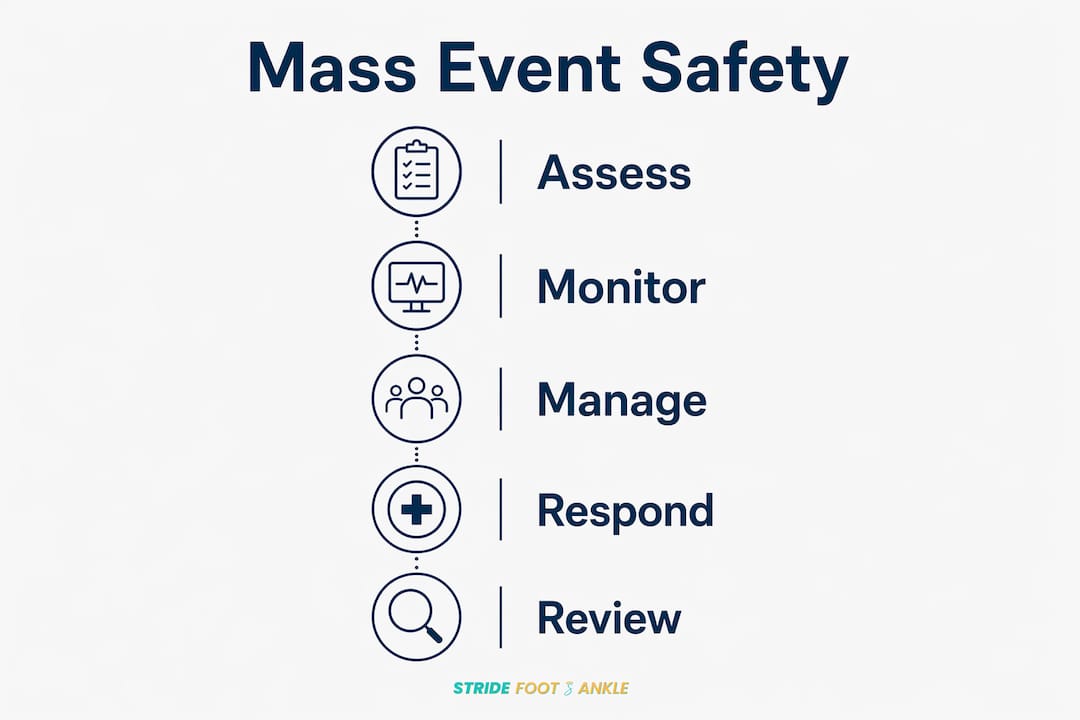
Effective mass gathering management combines risk assessment frameworks, real-time surveillance, and multisector coordination. No single tool or agency handles all of it. The best outcomes come from systems that share data across health, security, and logistics teams before and during the event.
Risk assessment frameworks
Specialized tools like the Jeddah Tool, developed for large-scale religious gatherings, give organizers a structured way to evaluate risk before an event opens. These frameworks assess factors including expected attendance, venue layout, crowd demographics, weather forecasts, and available medical resources. Effective risk management depends on adapting these tools to local conditions rather than applying a generic checklist.
Event-based surveillance
Event-based surveillance (EBS) is effective in 75% of studies for enhancing safety at mass gatherings. That figure reflects how much ground EBS covers compared to traditional reactive monitoring. EBS involves real-time tracking of social media activity, emergency room data feeds, environmental sensors, and crowd behavior signals to detect threats before visible signs emerge. The goal is to identify a problem at the signal stage, not after it becomes an incident.
Digital crowd monitoring
Modern events use geofenced mobile data to track crowd size and movement in real time. At a 2026 FIFA World Cup fan zone in Kansas City, organizers used real-time mobile tracking to monitor a 36,000-person crowd and manage density at entry points. That kind of data lets safety teams redirect foot traffic before a dangerous bottleneck forms.
| Management approach | Primary function | Key strength |
|---|---|---|
| Risk assessment frameworks (e.g., Jeddah Tool) | Pre-event planning and resource allocation | Structured, evidence-based preparation |
| Event-based surveillance (EBS) | Real-time threat detection across data sources | Early warning before incidents escalate |
| Geofenced mobile data monitoring | Live crowd density and movement tracking | Precise, location-specific crowd control |
| Multisector coordination protocols | Aligning health, security, and logistics teams | Unified response across agencies |
| On-site medical services | Rapid treatment and patient stabilization | Reduces severity of injuries and illness |
Logistics shape the attendee experience as much as the event itself. Designated screening points and controlled exit routes sometimes slow entry or exit, but they are the primary mechanism for preventing crowd compression at chokepoints. Organizers who prioritize convenience over safety at these points consistently see higher incident rates.
Pro Tip: Event organizers should run a tabletop simulation with health, security, and logistics teams at least 30 days before a large event. Identifying coordination gaps in a simulation costs nothing. Identifying them during an incident costs lives.
How can individuals and communities prepare for mass events?
Attending a large gathering safely requires preparation before you arrive, awareness while you are there, and follow-up after you leave. Most injuries and illnesses at mass events are preventable with basic planning.
Before the event
- Check your health status: If you have a chronic condition, consult your doctor before attending a high-density outdoor event. Heat, exertion, and crowd stress can aggravate conditions like heart disease, asthma, and diabetes.
- Review the venue layout: Know where medical stations, exits, and water points are located. Most large events publish this information in advance.
- Monitor local health alerts: Public health agencies issue advisories before major gatherings when disease risk is elevated. Check your local health department’s website before attending.
- Wear appropriate footwear: Hours of standing and walking on hard surfaces at large events cause significant foot and ankle strain. Supportive footwear reduces the risk of plantar fasciitis, ankle sprains, and blisters. Proper foot care before events is a step many people skip until they are already in pain.
During the event
- Stay aware of crowd density: If the space around you shrinks to the point where you cannot raise your arms, move toward the edges immediately. Do not wait for the situation to worsen.
- Hydrate consistently: Dehydration accelerates fatigue and impairs judgment. Drink water before you feel thirsty, especially at outdoor events in warm weather.
- Follow staff directions: Security and medical staff have real-time information you do not. Their instructions during a crowd management situation are based on data, not caution.
- Keep your group together: Establish a meeting point before you enter the venue. Separated groups create unnecessary pressure on emergency communication systems.
After the event
Communities near large gathering sites should monitor local health surveillance reports in the days following a major event. Communicable diseases can spread from attendees to the surrounding population within a week of a large gathering. Local health departments track these patterns and issue guidance when needed.
Pro Tip: Soak your feet in cool water after a long event day. Prolonged standing on hard surfaces compresses the plantar fascia and inflames the Achilles tendon. Five minutes of cool water immersion reduces swelling and speeds recovery.
Key Takeaways
Large crowds carry both profound social value and serious physical risks, and the gap between a safe gathering and a dangerous one is almost always determined by preparation, not luck.
| Point | Details |
|---|---|
| Masses define cultural identity | Large gatherings reinforce shared beliefs and social bonds that persist long after the event ends. |
| Crowd density is the primary safety metric | Density above 4–5 people per square meter creates dangerous crowd fluidity and compression injury risk. |
| Event-based surveillance works | EBS is effective in 75% of studies and detects threats before they become visible incidents. |
| Individual preparation reduces risk | Checking health status, knowing exit routes, and wearing supportive footwear prevents most common injuries. |
| Foot health enables participation | Proper foot and ankle care before and after large events reduces pain, injury, and recovery time. |
What I’ve learned from watching how masses move and why it matters
I have spent years reading about crowd dynamics, public health emergencies, and the sociology of large gatherings. The pattern I keep returning to is this: most people treat mass events as passive experiences. They show up, they participate, and they assume someone else has thought through the risks. That assumption is usually correct. And then, occasionally, it is catastrophically wrong.
The 2026 events in Rio and Madrid were managed well. The crowds were enormous, the logistics were visible, and the outcomes were positive. But those successes were not accidents. They were the result of frameworks, surveillance systems, and coordination protocols that most attendees never see or think about. The invisible infrastructure of a safe mass gathering is as important as the stage, the altar, or the field.
What concerns me is the gap between what organizers know and what attendees understand. Most people attending a large event have no idea what crowd density thresholds mean, what event-based surveillance does, or why exit route design matters. That knowledge gap is not a personal failing. It is a communication failure on the part of public health institutions and event organizers alike.
The physical toll of mass participation is also underappreciated. Foot and ankle injuries are among the most common outcomes of large events, and they are almost entirely preventable. Plantar fasciitis, ankle sprains, and stress fractures from hours of standing on hard surfaces send thousands of people to clinics in the days after major gatherings. These are not dramatic injuries. They are the quiet cost of mass participation that nobody talks about.
My honest view is that individual preparation and institutional planning are equally necessary. Neither substitutes for the other. You cannot rely on organizers to protect you from dehydration or a poorly fitted shoe. And organizers cannot rely on attendees to self-manage crowd density. Both sides have a role, and understanding that division of responsibility makes participation safer and more rewarding.
— Ramil
Foot health and large events: what Stridefootankle offers
Attending large gatherings puts real demands on your feet and ankles. Hours of walking, standing on hard surfaces, and navigating dense crowds can trigger plantar fasciitis, ankle sprains, and stress fractures, especially without proper preparation or footwear.
Stridefootankle provides general foot and ankle care designed to keep you mobile and pain-free before and after large events. Dr. Nahad Wassel offers personalized assessments, conservative treatment options, and injury prevention guidance tailored to your specific needs. Whether you are recovering from event-related foot pain or preparing for an upcoming gathering, Stridefootankle’s patient-centered approach in Las Vegas gives you the support to participate confidently and comfortably.
FAQ
What are masses in a social context?
Masses are large groups of people gathered in one place for a shared social, cultural, religious, or economic purpose. Their collective presence influences public health, safety, and cultural identity at a scale that individual action cannot replicate.
What is the most dangerous crowd density level?
Crowd density above 4–5 people per square meter creates dangerous crowd fluidity where individuals lose control of their own movement. At this threshold, compression injuries become likely regardless of the event’s intent or the crowd’s behavior.
How does event-based surveillance improve mass gathering safety?
Event-based surveillance monitors social media, emergency room data, and environmental sensors in real time to detect threats before they escalate. Research shows EBS is effective in 75% of studied gatherings, making it one of the most reliable tools in mass gathering management.
What foot and ankle problems are common after large events?
Plantar fasciitis, ankle sprains, and blisters are the most common foot and ankle injuries following large gatherings. Prolonged standing on hard surfaces and inadequate footwear are the primary causes, and both are preventable with proper preparation.
How can communities reduce health risks after a mass gathering?
Local health departments should monitor communicable disease reports in the week following a large event, as illnesses spread from attendees to surrounding populations within days. Individuals should watch for symptoms and follow any public health advisories issued after major gatherings.
Recommended
- Trauma: Types, Effects, and How to Heal – Stride Foot & Ankle – Dr. Nahad Wassel
- How to prevent foot injuries: expert strategies for healthy feet – Stride Foot & Ankle – Dr. Nahad Wassel
- How to Prevent Foot Ulcers: a Guide for At-Risk Patients – Stride Foot & Ankle – Dr. Nahad Wassel
- Insurances – Stride Foot & Ankle – Dr. Nahad Wassel
Recent Comments