

TL;DR:
- Ankle surgery encompasses various procedures tailored to specific conditions, ranging from minimally invasive arthroscopy to joint fusion or replacement.
- Recovery time and risks depend on the procedure type, patient health, and adherence to rehabilitation, with surgical success linked to surgeon experience and patient commitment.
If you’ve been told ankle surgery might be in your future, it’s easy to feel overwhelmed by questions. What is ankle surgery, exactly? Does it mean a long recovery, major hardware, or months off your feet? The reality is far more nuanced. Ankle surgery covers a wide range of procedures, from minimally invasive arthroscopic repairs to full joint replacements, and the right approach depends entirely on your specific condition, anatomy, and goals. This guide walks you through everything you need to know to make sense of your options.
Table of Contents
- Key takeaways
- What ankle surgery is and why patients need it
- Types of ankle surgeries and what each one treats
- What to expect during the ankle surgery procedure
- Ankle surgery recovery: what the timeline actually looks like
- Ankle surgery risks and when surgery should wait
- My take on what actually determines ankle surgery success
- Stride Foot & Ankle: expert ankle care in Las Vegas
- FAQ
Key takeaways
| Point | Details |
|---|---|
| Not a single procedure | Ankle surgery includes multiple types, each targeting different conditions and recovery timelines. |
| Arthroscopy is minimally invasive | Small incisions and a camera allow diagnosis and treatment with less pain and faster healing. |
| Recovery varies by surgery type | Some patients walk as early as two weeks post-op, while others require months of rehabilitation. |
| Surgeon selection matters greatly | Experience and patient selection are among the strongest predictors of a successful outcome. |
| Surgery is not always first | Conservative treatments are preferred when possible; surgery is typically a last resort. |
What ankle surgery is and why patients need it
Ankle surgery refers to any operative procedure performed on the bones, ligaments, tendons, or cartilage that make up the ankle joint. The goal varies by case. For some patients, it means eliminating chronic pain from arthritis. For others, it means repairing a fractured bone after trauma or reconstructing a torn ligament that won’t heal on its own.
The ankle is a complex joint that bears the full weight of your body with every step you take. When something goes wrong inside it, whether gradually through wear and tear or suddenly through injury, nonsurgical options like physical therapy, orthotics, bracing, and injections are typically tried first. If those approaches fail to provide adequate relief, surgery becomes a reasonable next step.
Common conditions that lead patients to consider ankle surgery include:
- Ankle arthritis: Cartilage breakdown that causes pain, stiffness, and reduced range of motion
- Ankle fractures: Broken bones that require realignment and fixation to heal correctly
- Ligament tears: Chronic instability from torn or stretched ligaments that cause repeated sprains
- Tendon damage: Ruptured or severely inflamed tendons (like the Achilles or posterior tibial tendon) that don’t respond to conservative care
- Cartilage defects: Localized areas of cartilage loss, often from previous injuries
- Deformities: Flatfoot, cavus foot, or congenital abnormalities that affect gait and function
The decision to operate is never made lightly. A thorough evaluation includes a detailed medical history, physical examination, X-rays, and often MRI or CT imaging to understand exactly what’s happening inside the joint. When you understand conservative treatment options before committing to surgery, you’re in a much stronger position to make the right choice.
Types of ankle surgeries and what each one treats
There is no single ankle surgery procedure. The type your surgeon recommends depends on your diagnosis, overall health, activity level, and what the joint actually looks like on imaging. Here are the four most common types of ankle surgery patients encounter.
Ankle arthroscopy
Ankle arthroscopy is a minimally invasive procedure where a surgeon inserts a small fiber-optic camera, called an arthroscope, into the joint through tiny incisions. This allows the surgeon to see the inside of the ankle in real time and treat problems with specialized instruments inserted through additional small portals. Arthroscopy serves as both a diagnostic and therapeutic tool, which makes it one of the most versatile procedures in modern foot and ankle care.
What can arthroscopy address? Loose cartilage fragments, scar tissue buildup (called arthrofibrosis), anterior impingement (where bone spurs pinch the joint during movement), and early-stage arthritis. Ankle arthroscopy treats anterior ankle impingement and posttraumatic arthrofibrosis with particular effectiveness in athletes. Compared to open surgery, arthroscopic techniques use smaller incisions and cause less damage to surrounding soft tissue, which generally means less pain and a faster return to normal activity.
Total ankle replacement
Total ankle replacement (TAR) involves removing the damaged joint surfaces and replacing them with artificial components, similar in concept to knee or hip replacement. It preserves motion, which is a meaningful advantage over fusion for patients who want to maintain an active lifestyle. However, TAR is generally recommended for patients over age 50, primarily because younger, more active patients face a higher likelihood of needing revision surgery as implants wear down.
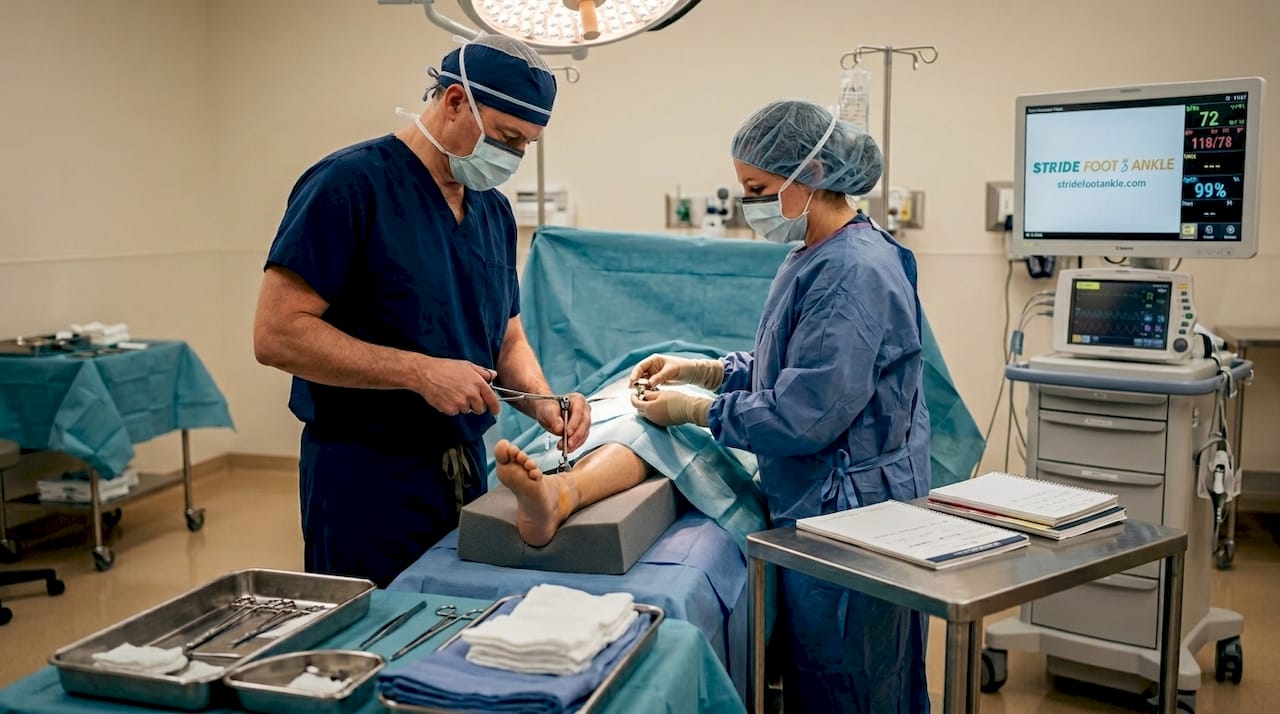
Complex cases often require customized implants and CT-guided planning to achieve the proper alignment and fit for each patient’s unique anatomy.
Ankle fusion (arthrodesis)
Ankle fusion permanently joins the bones of the ankle joint together, eliminating motion at that joint. While losing ankle motion sounds alarming, many patients are surprised by how functional they remain after fusion. The goal is pain elimination. When the joint surfaces no longer rub against each other, the pain stops. Surrounding joints in the foot can partially compensate for lost ankle motion over time.
Fusion is often preferred for patients with severe arthritis who are not good candidates for replacement, or for those whose anatomy or activity demands make replacement too risky.
Ankle reconstruction
Ankle reconstruction typically refers to procedures that repair or rebuild damaged ligaments to restore joint stability. This is common after chronic ankle instability, where repeated sprains have stretched or torn the lateral ligaments beyond the point of natural healing. Surgeons may tighten existing ligament tissue, graft tissue from another site, or both, depending on the severity of the damage. You can learn more about nonsurgical ligament options that are often tried before reaching this point.
Pro Tip: Ask your surgeon specifically whether your procedure will be arthroscopic, open, or a combination of both. Some ankle fusions, for example, are now performed with arthroscopic assistance, which improves visualization while reducing recovery time.
| Surgery type | Primary purpose | Approximate procedure length | Typical recovery time | Key risk |
|---|---|---|---|---|
| Ankle arthroscopy | Diagnose, repair cartilage/scar tissue | 45 to 90 minutes | 2 to 8 weeks | Nerve irritation |
| Total ankle replacement | Replace arthritic joint surfaces | 2 to 3 hours | 3 to 6 months | Implant loosening |
| Ankle fusion | Eliminate pain from severe arthritis | 1.5 to 2.5 hours | 3 to 6 months | Adjacent joint arthritis |
| Ankle reconstruction | Restore ligament stability | 1 to 2 hours | 3 to 6 months | Re-tear or residual laxity |
What to expect during the ankle surgery procedure
Understanding how ankle surgery is done removes a lot of the fear around it. Here is a step-by-step picture of what a typical surgical experience looks like, though specifics vary by procedure type.
- Preoperative evaluation: Your surgeon reviews your imaging, medical history, and medications. Blood work and an EKG may be ordered depending on your age and health. Surgical guides or custom implant templates are sometimes fabricated in advance for complex replacements, using measurements from your CT scan.
- Anesthesia: Ankle surgery is performed under general anesthesia, regional nerve block, or a combination. Spinal anesthesia is also used in some cases. Your anesthesiologist will discuss the safest option based on your health profile.
- Positioning and tourniquet: You are positioned on the operating table, typically on your back. A tourniquet is placed around the calf to minimize blood flow into the surgical field and give the surgeon a clearer view.
- Arthroscopic approach: For arthroscopic procedures, the surgeon makes two or three small incisions around the ankle. The arthroscope is inserted through one portal while instruments are passed through others. Portal placement and continuous joint irrigation optimize visibility and protect surrounding soft tissue during the entire procedure.
- Open approach: For procedures like fusion or replacement, the surgeon makes a larger incision, sometimes on the front or sides of the ankle, to directly access the joint. Bone surfaces are prepared, hardware is placed (screws, plates, or implants), and the incision is closed in layers.
- Closing and dressing: After the procedure, the ankle is wrapped, splinted, or casted depending on the type of surgery. You move to recovery where the care team monitors your anesthesia response and pain levels.
One detail most patients don’t realize: diagnostic arthroscopy can identify cartilage damage and joint disease that MRI or CT imaging may miss entirely. This means your surgeon may find and address additional problems during the procedure that weren’t visible beforehand.
Pro Tip: When selecting a surgeon, ask how many of that specific procedure they perform each year. Surgical outcomes in ankle replacement are strongly tied to the surgeon’s experience and case volume, not just their credentials.
Reading about how to prepare for foot surgery before your appointment will help you ask the right questions and walk into the operating room with confidence.
Ankle surgery recovery: what the timeline actually looks like
Recovery from ankle surgery is rarely a straight line, and the timeline depends significantly on which procedure you had. Here is what to realistically expect.
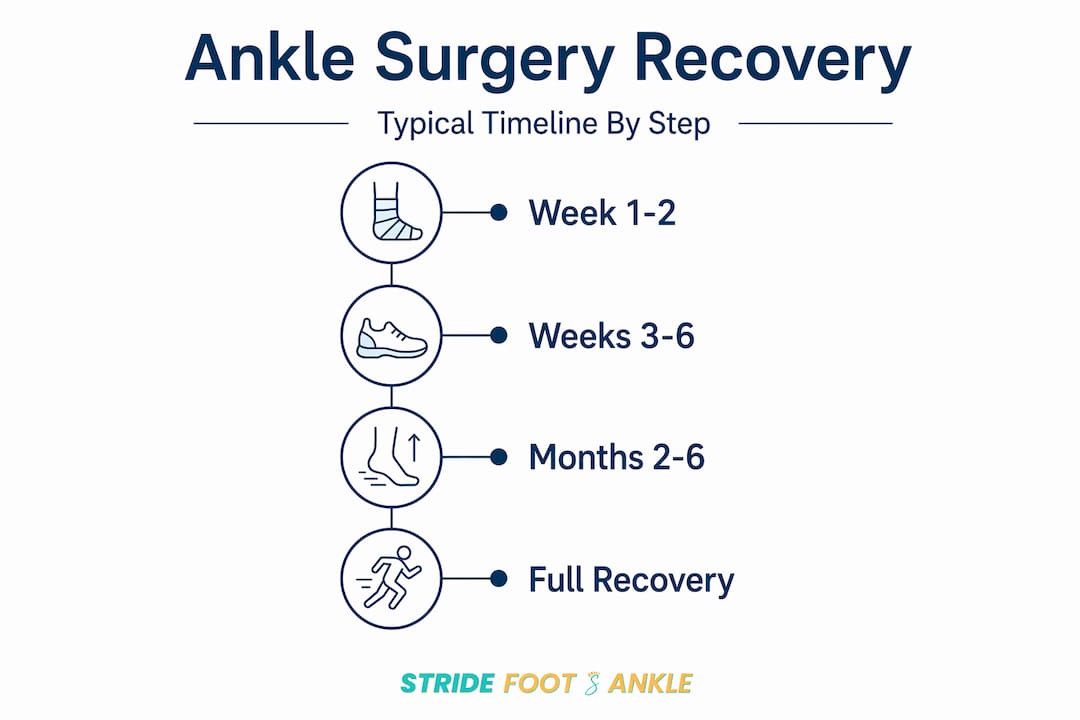
For arthroscopy, many patients are partial weight-bearing within days and return to low-impact activity within two to eight weeks. For fusion or replacement, the process is longer. Bones need time to heal or integrate with implants, and the joint needs time to adapt.
An important development in post-surgical care: research from the National Institute for Health and Care Research found that walking two weeks after ankle surgery is safe for many patients, which challenges the older standard of six weeks of strict non-weight-bearing. Earlier mobility has been associated with better outcomes in certain cases, though this depends on the specific procedure and your surgeon’s assessment.
Recovery milestones to track:
- Weeks one to two: Elevation, ice, and rest to control swelling; wound checks to monitor healing
- Weeks two to six: Transition from splint to boot for most procedures; limited weight-bearing begins
- Weeks six to twelve: Physical therapy starts in earnest, focused on range of motion and strength
- Months three to six: Return to regular walking, work, and low-impact exercise for most surgery types
- Months six to twelve: For total ankle replacement or fusion, full functional recovery and return to higher-demand activities
Physical therapy is not optional in recovery. It is the mechanism by which your brain and body relearn how to move safely. Exercises typically progress from gentle range of motion work to balance training, then strengthening, and finally functional movement patterns. Skipping or shortening this phase is one of the most common reasons patients plateau before reaching their potential.
Pro Tip: Swelling can persist for six to twelve months after ankle surgery, particularly after fusion or replacement. This is normal, not a sign of complications. Wearing compression socks and elevating the foot above heart level during rest speeds this process significantly.
Patients who approach recovery with realistic functional goals rather than expecting complete restoration of their pre-injury ankle consistently report higher satisfaction with surgical outcomes.
Ankle surgery risks and when surgery should wait
Every surgical procedure carries risk, and ankle surgery is no exception. Being honest about this builds better decisions.
General risks associated with any ankle surgery include:
- Infection: Most common at the wound site, but deep joint infections can occur and may require additional surgery
- Blood clots (deep vein thrombosis): The foot and leg are particularly susceptible during immobility; blood thinners are often prescribed preventively
- Nerve damage: The superficial nerves around the ankle are at risk during incision; some patients experience temporary or permanent numbness or tingling
- Poor wound healing: Especially in patients with diabetes, peripheral vascular disease, or active smoking
- Hardware failure: Screws, plates, or implants can loosen, break, or become symptomatic over time
- Incomplete pain relief: Surgery addresses structural problems, but some pain may persist even after a technically successful procedure
Arthroscopic procedures carry lower overall risk than open surgeries because of smaller incisions and less tissue disruption. That said, even arthroscopy carries risks of portal site complications and inadvertent cartilage damage from instrument use.
Not everyone is a good surgical candidate. Factors that may make surgery less advisable include uncontrolled diabetes, active infection, severe peripheral vascular disease (which impairs wound healing), and unrealistic expectations about outcomes. Age alone is not a disqualifying factor, but it is part of the overall picture. Managing these concerns in advance, through better blood sugar control or smoking cessation, can significantly improve candidacy and outcomes.
If you’re uncertain whether surgery is your best option, a second opinion from a specialist in foot and ankle care is always a reasonable step before committing to an operative plan.
My take on what actually determines ankle surgery success
I’ve seen patients come in expecting surgery to be a complete reset, a way to get back the ankle they had at twenty-five. I’ve also seen patients who walked in terrified of surgery, convinced it would sideline them permanently. Both sets of expectations tend to miss the mark, and that gap between expectation and reality is where most patient dissatisfaction lives.
What I’ve found in practice is that surgical outcomes are shaped less by the procedure itself and more by two things: the quality of the surgeon-patient match and the patient’s commitment to rehabilitation. A technically perfect fusion means very little if the patient doesn’t follow through with physical therapy. And even the most diligent patient can struggle if the surgical plan wasn’t tailored to their specific anatomy and lifestyle demands.
The patients I’ve seen thrive after ankle surgery are the ones who asked hard questions before saying yes. They wanted to know what they could realistically expect at six months, at one year, and at two years. They understood that “functional improvement” is not the same as “complete restoration,” and they were at peace with that distinction before they ever went under anesthesia.
My advice: be a proactive patient. Bring a list of questions to your consultation. Ask about alternatives before accepting surgery as the only path. And if your surgeon discourages those questions, that itself tells you something important about the care you’ll receive.
— Ramil
Stride Foot & Ankle: expert ankle care in Las Vegas

When you’re weighing whether ankle surgery is right for you, the quality of your care team makes all the difference. At Stridefootankle, Dr. Nahad Wassel brings specialized training in foot and ankle surgery to every patient consultation in Las Vegas. The focus is always on finding the most appropriate solution for your specific condition, whether that means surgery or a carefully designed conservative plan. You can explore the full range of foot and ankle services offered at the practice, or review the practical guidance available on preparing for foot surgery before your visit. If you’re ready to take the next step and get real answers about your ankle pain, scheduling a consultation with Dr. Wassel puts expert, personalized care within reach.
FAQ
What is ankle surgery used to treat?
Ankle surgery treats conditions including arthritis, fractures, ligament tears, tendon damage, cartilage defects, and structural deformities. The specific procedure depends on the diagnosis, the severity of the condition, and whether conservative treatments have been tried first.
What is ankle arthroscopy and how is it different from open surgery?
Ankle arthroscopy uses a small camera and instruments inserted through tiny incisions to diagnose and treat joint problems with minimal tissue damage. Open surgery involves a larger incision for direct access and is used for more complex procedures like joint replacement or fusion.
How long does ankle surgery recovery take?
Recovery ranges from two to eight weeks for arthroscopic procedures to three to six months for fusion or total ankle replacement. Physical therapy plays a major role in regaining strength, balance, and function throughout the recovery period.
What are the main risks of ankle surgery?
Common ankle surgery risks include infection, blood clots, nerve damage, poor wound healing, hardware failure, and incomplete pain relief. Your surgeon will evaluate your individual risk factors before recommending any procedure.
When is ankle surgery actually necessary?
Ankle surgery is generally considered when conservative treatments such as physical therapy, orthotics, bracing, and injections have failed to provide adequate relief, or when the structural damage is severe enough that nonsurgical care cannot restore function or prevent further harm.
Recommended
- How to prepare for foot surgery: steps, recovery, and expert tips – Stride Foot & Ankle – Dr. Nahad Wassel
- Minimally invasive foot surgery: Benefits and recovery – Stride Foot & Ankle – Dr. Nahad Wassel
- How Conservative Foot Care Relieves Pain and Prevents Surgery – Stride Foot & Ankle – Dr. Nahad Wassel
- General Foot & Ankle Care – Stride Foot & Ankle
Recent Comments