

TL;DR:
- Nail salons can provide only temporary relief for mild ingrown toenails and cannot treat infections or perform invasive procedures.
- Moderate to severe cases require professional medical care from a podiatrist to prevent complications and ensure proper treatment.
A nail salon can help with a mild ingrown toenail, but it cannot fix the problem the way a podiatrist can. If your toe shows only slight discomfort and no signs of redness, swelling, or drainage, a careful pedicure may offer temporary relief. The moment you see inflammation or pus, a nail salon is the wrong place to be. This guide walks you through exactly what salons can and cannot do safely, what the real risks are, and when professional medical care is the only smart path forward.
Table of Contents
- Key Takeaways
- Understanding ingrown toenail causes and stages
- What nail salons can safely do for your toenails
- Risks of salon treatment for moderate or severe cases
- Podiatrist vs. nail salon: knowing when to escalate
- Prevention and long-term management
- My perspective: why I’d always choose a podiatrist over a salon for this
- Get real relief at Stride Foot & Ankle
- FAQ
Key Takeaways
| Point | Details |
|---|---|
| Salons help only mild cases | Nail salons can trim and soak early-stage ingrown toenails but cannot treat infection or perform invasive procedures. |
| Medical care beats salon care for moderate cases | Podiatrists offer partial nail removal, infection drainage, and permanent corrections that salons are legally forbidden from doing. |
| Infection risk is real | Salon tools are often not sterilized to medical standards, which can worsen an already compromised nail. |
| High-risk patients should skip salons entirely | Diabetes, poor circulation, or immune conditions make even mild salon treatment genuinely dangerous. |
| Prevention saves the most pain | Straight-across trimming, proper footwear, and timely medical follow-up are your best long-term strategy. |
Understanding ingrown toenail causes and stages
Before you decide where to get help, you need to understand what you are actually dealing with. Ingrown toenails occur when the edge of a nail grows into the surrounding skin rather than over it. The most common causes are trimming nails too short or rounding the edges, wearing shoes that compress the toes, trauma to the toe from repetitive impact, and a naturally curved nail shape that tends to grow inward over time.
Recognizing the stage of your condition is what determines whether a salon visit is reasonable or a mistake.
- Stage 1 (mild): Slight pain when pressure is applied, minor redness along the nail edge, no swelling or pus. This is the only stage where salon toenail care may be appropriate.
- Stage 2 (moderate): Noticeable swelling, redness that extends beyond the nail fold, possible drainage of clear fluid. This stage requires medical evaluation.
- Stage 3 (severe): Obvious infection with pus, significant swelling, granulation tissue (extra red flesh) growing alongside the nail, and sometimes fever. This stage needs a podiatrist, not a pedicure.
The difference between Stage 1 and Stage 2 can close fast. Warm soaks can ease early symptoms, but if there is no improvement within 48 to 72 hours of home care, that is your signal to see a doctor rather than book a salon appointment.
Pro Tip: Check your toe under good lighting before any salon appointment. Press gently on the skin beside the nail edge. If it feels warm, looks puffy, or you see any fluid, call a podiatrist instead.
People with recurring ingrown toenails often have a structural issue with how their nails grow. That is not something a salon pedicure can correct. Understanding this distinction early prevents cycles of temporary fixes that allow the condition to worsen gradually.
What nail salons can safely do for your toenails
A skilled nail technician working within their proper scope can genuinely help when the ingrown toenail is caught early. Knowing what that help looks like protects you from both expecting too little and expecting too much.
Here is what a reputable salon can safely offer for mild ingrown toenail treatment:
- Warm water soaking. Soaking your foot before any nail work softens the surrounding skin, making it easier to trim the nail without forcing or tearing the tissue.
- Careful straight-across trimming. A trained technician can trim the nail edge straight, avoiding the curved cuts that cause the nail to dig in further. This is the single most useful thing a salon can do.
- Gently lifting the nail edge. In mild cases, a technician may tuck a small piece of cotton or dental floss under the nail edge to redirect growth. This is a recognized first-aid technique, not an invasive procedure.
- Moisturizing and skin care. Dry, cracked skin around the nail fold can make ingrown nails worse. A quality pedicure that hydrates the skin and cuticle area reduces one contributing factor.
- Referral out. A genuinely professional technician will recognize when a toe is beyond their scope and will tell you directly to see a doctor. That referral is one of the most valuable things they can do.
What reputable salons must never do is cut into swollen or infected tissue. Attempting to “dig out” an ingrown nail with a metal tool on an inflamed toe is not a nail service. It is an invasive procedure that requires a sterile medical environment and a licensed clinician.
Pro Tip: Ask any salon before your appointment how they sterilize metal tools. Autoclave sterilization is the medical standard. If they use a liquid disinfectant spray only, that does not eliminate all pathogens and raises your infection risk.
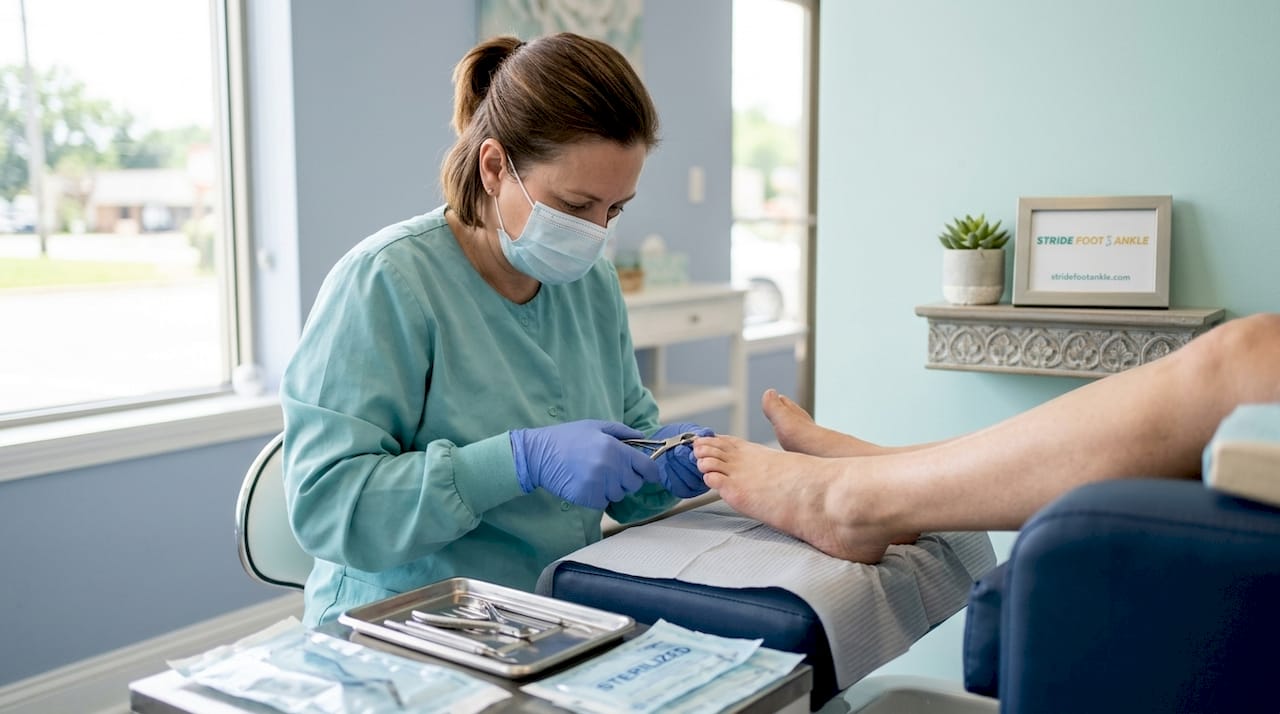
Selecting the right salon matters as much as knowing when to go. Look for technicians who are licensed by your state board, who use individually packaged or autoclaved instruments, and who demonstrate actual knowledge of nail anatomy. A rushed $15 pedicure at a high-volume salon is not the same as a careful, informed treatment from a trained professional.
Risks of salon treatment for moderate or severe cases
Here is where the stakes rise significantly. When an ingrown toenail has moved past the mild stage, a salon visit does not just fail to help. It can actively make things worse.
“Nail salons are strictly prohibited from performing invasive procedures like cutting or dissecting swollen nail tissue, which require sterile environments and medical licenses.” Source
The risks are specific and serious:
- Infection from non-medical tools. Salon tools are often not sterilized to medical standards, meaning bacteria can be introduced directly into already-compromised skin.
- Worsening the nail bed injury. Cutting or filing near inflamed tissue can push bacteria deeper into the nail fold, transforming a surface infection into a deeper one that may require oral antibiotics or drainage.
- Scope of practice violations. Nail technicians are legally prohibited from treating infections, diagnosing skin conditions, or performing anything that qualifies as medical treatment. Salons that cross this line expose you to harm and themselves to legal liability.
- Delayed proper treatment. Every day you spend relying on salon visits instead of seeing a podiatrist is a day the underlying issue can progress, sometimes to the point of requiring more aggressive intervention.
- Particular danger for high-risk patients. Individuals with diabetes, poor circulation, or immune compromise face a compounded threat. A minor wound caused by improper salon treatment can become a serious, slow-healing ulcer in patients with diabetic neuropathy. The risk is not theoretical. It is well-documented in podiatric medicine.
Salon technicians lack the training to identify early signs of vascular compromise, fungal involvement, or developing cellulitis. They are not expected to have that knowledge. The problem arises when patients expect clinical results from a cosmetic service.
If you have any underlying health conditions that affect circulation or immunity, skip the salon entirely for any toenail concern beyond basic nail polish. The risk is simply not worth it.
Podiatrist vs. nail salon: knowing when to escalate
This is where the comparison gets concrete. Understanding what a podiatrist actually does differently helps you appreciate why the same toe problem warrants completely different care depending on severity.
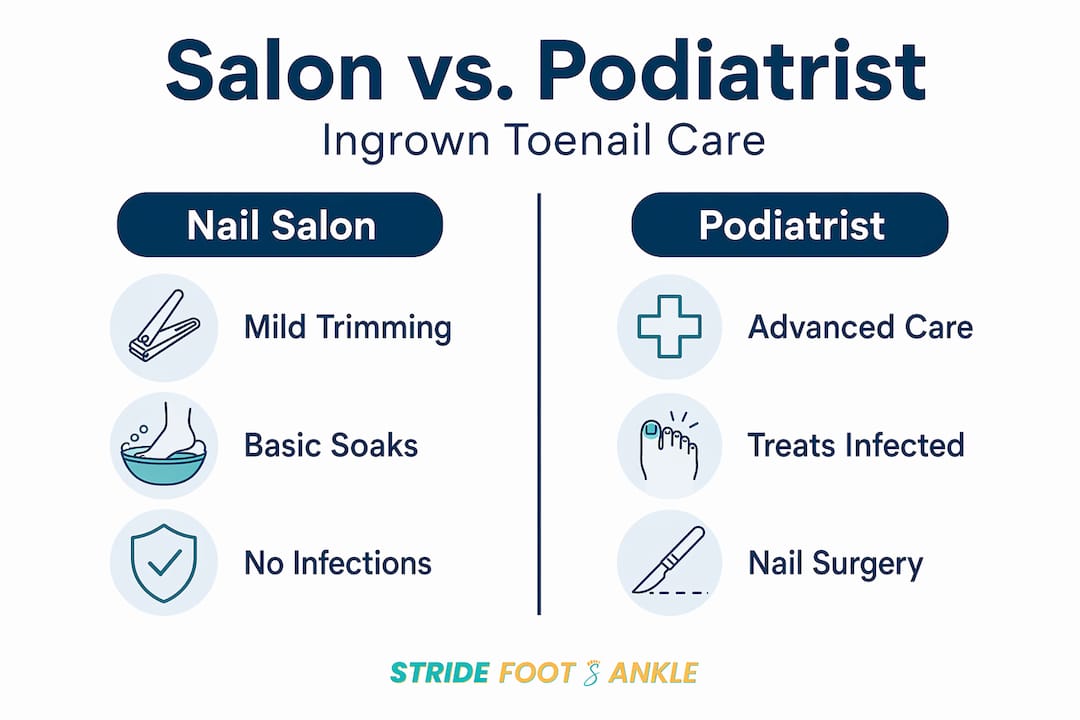
| Treatment | Nail Salon | Podiatrist |
|---|---|---|
| Nail trimming | Yes, mild cases only | Yes, with clinical precision |
| Infection treatment | No | Yes, including drainage and antibiotics |
| Partial nail removal | Prohibited | Yes, performed under local anesthetic |
| Permanent nail correction | No | Yes, via partial nail avulsion with matricectomy |
| Diagnosis of underlying cause | No | Yes, including fungal, gout, trauma |
| Sterile tools and environment | Not guaranteed | Required by medical standards |
| Medical pedicure services | No | Yes, licensed clinical foot care |
Medical pedicures differ from salon pedicures in one fundamental way: they are performed by licensed healthcare professionals who can assess, diagnose, and treat clinical conditions while also caring for the appearance and hygiene of the foot. For people with chronic foot problems, this fills a genuine gap between cosmetic nail care and full surgical intervention.
When a podiatrist sees a recurrent or severe ingrown toenail, they can perform a partial nail avulsion with matricectomy, a procedure that removes the offending nail edge and chemically or surgically destroys the nail matrix cells responsible for growing it back. This is the most effective long-term solution for chronic cases, and it is permanently outside the scope of what any nail salon can offer.
Pro Tip: If you have had the same ingrown toenail treated at a salon three or more times without lasting improvement, that is not a maintenance issue. It is a structural one. A single podiatry visit may resolve what months of salon visits have not.
Your timeline for escalation should be clear. If a mild ingrown toenail does not improve within 48 to 72 hours of home care, book a podiatry appointment. If you see any sign of infection at all, go directly to a podiatrist. Do not stop at a salon on the way. Understanding when to see a podiatrist can save you significant time, pain, and cost.
Prevention and long-term management
The most effective ingrown toenail treatment is the one you prevent from needing in the first place. Consistent, informed habits protect your nails far better than any reactive treatment.
Proper trimming, footwear, and hygiene form the foundation of prevention:
- Trim straight across. Never round the corners of your toenails. Use sharp, clean nail scissors or clippers and cut in a straight line, leaving the nail just long enough to clear the tip of the toe.
- Choose roomy footwear. Shoes that compress your toes from the front or sides are a direct cause of recurrent ingrown nails. In Las Vegas, where open footwear is common, this is easier than in colder climates, but athletic shoes still need adequate toe box space.
- Keep feet clean and dry. Moisture between the toes creates an environment where bacteria thrive. Dry your feet thoroughly after showers and consider moisture-wicking socks for daily wear.
- Inspect your feet regularly. Catching a nail that is beginning to curve before it causes pain is the most effective possible form of prevention. A weekly 30-second check can catch the problem at Stage 1 rather than Stage 3.
- Communicate clearly at salons. Tell your nail technician if a specific nail has been problematic before. A good technician will adjust their approach. A technician who dismisses that information is one you should leave.
For long-term maintenance, a salon visit every four to six weeks for careful trimming and skin care is reasonable for people without recurring problems. For anyone who has had ingrown toenail treatment in a clinical setting, follow your podiatrist’s specific guidance on how and when to return to salon services.
If your ingrown nails come back repeatedly despite doing everything right, that pattern signals a structural issue with how your nails grow. In that scenario, a consultation about permanent correction is worth taking seriously rather than committing to a lifetime of reactive management.
My perspective: why I’d always choose a podiatrist over a salon for this
I’ve seen what happens when people spend months trying to manage an ingrown toenail through salon visits before finally walking into a clinical setting. By that point, what started as a Stage 1 problem has become infected tissue, a thickened nail, and sometimes early signs of cellulitis spreading up the toe. What would have taken one appointment to fix permanently now takes several.
In my experience, the confusion comes from how common salon-based ingrown nail “treatment” has become. People see it offered on a menu and assume it is a legitimate medical service. It is not. A skilled technician can keep a healthy nail healthy, but they are working without diagnostic tools, without sterile environments, and without the training to recognize when a toe is at a clinical tipping point.
The honest truth is that most people who ask “can a nail salon fix an ingrown toenail?” are already past the mild stage when they ask it. If the nail felt fine, they would not be searching for answers. That discomfort they feel is the body signaling that something more than a pedicure is needed.
What I respect about conservative podiatric care is that it closes the gap between “wait and see” home treatment and surgery. Most ingrown toenails, even moderately infected ones, can be resolved without permanent procedures. But that requires professional evaluation, not a nail file and a warm soak.
The time and money spent on repeated salon visits that do not resolve the issue always exceeds the cost of one proper podiatric consultation. I’ve never seen the math work the other way.
— Ramil
Get real relief at Stride Foot & Ankle
If your ingrown toenail has moved past the point where a pedicure will help, Stridefootankle offers the clinical care that actually resolves the problem.

Dr. Nahad Wassel and the team at Stride Foot & Ankle in Las Vegas specialize in exactly this kind of foot condition. From careful clinical evaluation to same-day infection treatment and permanent nail corrections, the practice provides comprehensive foot and ankle care in a sterile, patient-focused environment. Every treatment plan is explained clearly before any procedure begins, so you understand exactly what is happening and why.
You do not have to keep managing pain with temporary fixes. Whether you need conservative care, a minor in-office procedure, or guidance on preventing recurrence, Stridefootankle has the expertise to get you back on your feet comfortably. Schedule your consultation today and stop guessing whether a salon visit will be enough.
FAQ
Can a nail salon remove an ingrown toenail?
No. Nail salons cannot cut out or remove ingrown nails because doing so is an invasive procedure that falls outside their legal scope of practice. Only a licensed podiatrist can perform nail removal or partial avulsion.
What happens if an infected ingrown toenail is treated at a salon?
Treating an infected ingrown toenail at a salon increases the risk of spreading bacteria into deeper tissue, since salon tools are not sterilized to medical standards. This can worsen the infection and delay proper treatment significantly.
How do I know if my ingrown toenail needs a podiatrist?
If you see swelling, redness that extends beyond the nail edge, any drainage, or pus, you need a podiatrist rather than a salon visit. Home care that does not improve within 48 to 72 hours is also a clear signal to seek medical evaluation.
Is a medical pedicure the same as a salon pedicure?
No. A medical pedicure is performed by a licensed healthcare professional who can diagnose and treat clinical conditions alongside nail grooming. Salon pedicures are cosmetic services without diagnostic oversight.
Can people with diabetes get a pedicure for an ingrown toenail?
People with diabetes should avoid salon treatment for ingrown toenails entirely. Underlying conditions that affect circulation or immunity significantly increase the risk of infection spreading from even a minor foot wound, making podiatric care the only safe option.
Recent Comments