

TL;DR:
- Proper post-surgery foot care, including elevation, wound protection, and medication adherence, is essential for complete healing and preventing complications. Establishing a safe home environment, preparing a recovery station, and following a structured rehabilitation plan promote optimal recovery. Recognizing warning signs early and maintaining long-term foot health habits help ensure lasting results and reduce re-injury risks.
Foot surgery can feel like a finish line, but your recovery is where the real work begins. Skipping or mismanaging post-surgery foot care steps is one of the most common reasons patients end up back in the operating room, dealing with infections, chronic pain, or incomplete healing. The good news is that with the right after foot surgery care plan, most people recover fully and get back to normal activity without major setbacks. This guide walks you through exactly what to do, when to do it, and what warning signs should never be ignored.
Table of Contents
- Key takeaways
- Post-surgery foot care steps: setting up before you go home
- Essential care in the first one to two weeks post-op
- Managing mobility and rehab after foot surgery
- Recognizing complications: when to call your doctor
- Long-term foot care and lifestyle after surgery
- What I’ve learned from watching patients recover
- How Stridefootankle supports your recovery
- FAQ
Key takeaways
| Point | Details |
|---|---|
| Elevate consistently | Keep your foot above heart level using pillows to reduce swelling and support healing. |
| Protect the wound | Keep dressings dry and intact; check daily for redness, discharge, or odor. |
| Follow your medication schedule | Taking pain meds as prescribed prevents breakthrough pain and improves sleep and function. |
| Progress mobility gradually | Move from non-weight bearing to full weight bearing only under your surgeon’s direction. |
| Know the warning signs | Fever above 100.5°F, spreading redness, or worsening pain require immediate medical contact. |
Post-surgery foot care steps: setting up before you go home
The first 24 to 48 hours after foot surgery set the tone for everything that follows. Most complications in early recovery are not random. They happen because patients come home to an unprepared environment or underestimate how much help they actually need.
Before your surgery day, gather these supplies:
- Dressing materials: gauze pads, medical tape, and any wound care products your surgeon recommends
- Ice therapy: reusable gel ice packs or a bag of frozen peas wrapped in a thin cloth
- Elevation support: two to three firm pillows or a foam wedge to keep your foot above heart level
- Mobility aids: crutches, a knee scooter, or a walker depending on your surgery type
- Waterproof bag or cast cover: to protect the wound during sponge baths or partial showering
- Loose, comfortable clothing: especially pants that can roll up easily over a boot or bandage
Your home setup matters more than most patients expect. Removing trip hazards and creating clear, well-lit pathways through your living space dramatically reduces the risk of falls during the first weeks of recovery. Place a comfortable chair or recliner in the room where you spend most of your time, and make sure your rest area allows easy foot elevation. Keep a small table or tray within reach for water, your phone, medications, and snacks so you are not getting up unnecessarily.
Pro Tip: Arrange a dedicated recovery station before your surgery date. Stock it with everything you need within arm’s reach so you minimize the temptation to walk on a healing foot just to grab something from the kitchen.
Mentally, the preparation is just as real. Recovery requires you to follow instructions strictly, even when you feel better than expected. Feeling less pain on day three does not mean the internal tissue has healed. Most patients underestimate how much help they need with daily tasks like cooking, laundry, or driving. Arrange for a friend or family member to assist for at least the first week.
| Preparation area | What to do | Why it matters |
|---|---|---|
| Home safety | Remove rugs, clear pathways, install grab bars | Prevents falls on a healing foot |
| Supplies | Stock dressings, ice packs, elevation pillows | Reduces unnecessary movement |
| Support system | Arrange help with meals, transport, tasks | Lowers physical strain and stress |
| Medical paperwork | Keep post-op instructions accessible | Supports accurate self-monitoring |
Essential care in the first one to two weeks post-op
This is the most critical window of your entire recovery. The tissue is fragile, the wound is fresh, and the risk of infection or swelling complications is highest. These post-surgery foot care steps apply from the moment you leave the clinic.
Elevate your foot immediately and consistently. Foot elevation above heart level is your single most effective tool for managing swelling in the first two weeks. Use pillows or a foam wedge to prop the foot higher than your chest whenever you are resting. Aim for at least 23 hours a day in the first three days, then as much as possible while awake.
Apply ice therapy the right way. Wrap your ice pack in a thin cloth and apply it to the surgical area for 15 to 20 minutes at a time, several times daily. Never place ice directly on skin or on your dressing. The combination of ice and elevation reduces inflammation and supports tissue repair more effectively than either method alone.
Take your pain medication on schedule. Many patients make the mistake of waiting until pain spikes before taking their prescribed medication. Taking pain meds as scheduled prevents breakthrough pain, supports better sleep, and allows you to function more safely with mobility aids. Do not let pain get ahead of the medication.
Keep your wound dressing clean and dry at all times. Follow your surgeon’s specific instructions for how often to change dressings. In general, dry dressings and scheduled changes are the standard best practice to prevent infection. Do not soak the wound in water, do not apply lotions or ointments unless specifically directed, and do not peel back the dressing to inspect the wound unless it is a scheduled change.
Inspect the wound during each dressing change. Look for normal signs of healing like mild redness immediately around the incision and slight pink or clear drainage. Compare how the wound looks day to day.
Rest. Actually rest. Being on your feet even briefly during the early post-op phase adds pressure to a delicate surgical site. Plan your bathroom visits, gather items before sitting down, and resist the urge to test your foot too soon.
“Proper wound care and consistent elevation in the first two weeks are not optional extras. They are the foundation of everything else that happens in recovery.” — Post-operative care guidance from Stridefootankle
Pro Tip: Take a photo of your wound at each dressing change. If a doctor asks whether the redness has spread or changed color, you will have a visual record instead of guessing.
Monitor for the following normal symptoms: mild swelling, bruising, tenderness around the incision, and minor aching. These are expected. What you are watching for are signs that something has shifted in the wrong direction, which is covered in detail in the complications section below.

Managing mobility and rehab after foot surgery
Most patients want to know one thing about this phase: “When can I walk again?” The honest answer is that it depends on your surgery type, and pushing that timeline is one of the leading causes of delayed healing and reoperation.
Typical recovery phases look like this. Most foot surgeries require two to eight weeks of non-weight bearing, where you rely entirely on crutches, a knee scooter, or a wheelchair. This is followed by partial weight bearing with a surgical boot, often for another four to six weeks. Full weight bearing and a return to normal footwear comes last, often guided by imaging and clinical assessment.
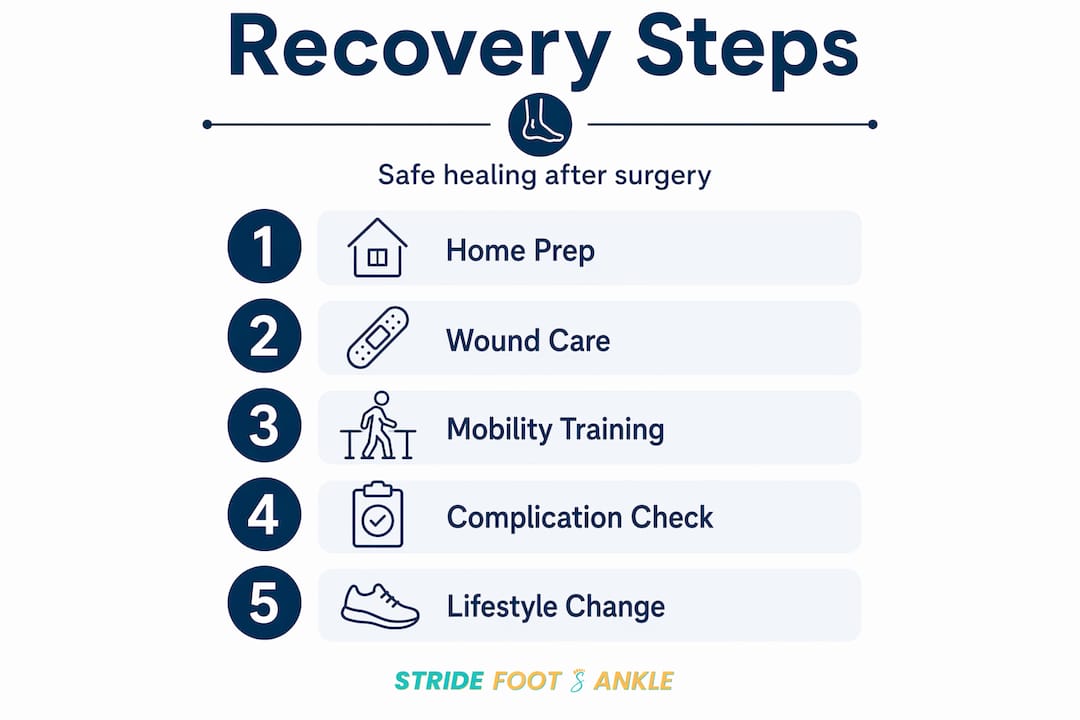
Structured physical therapy including manual therapy and gait retraining reduces recovery time and significantly lowers the risk of long-term complications. The rehab process is not about working through pain. It is about controlled, progressive loading of healing tissue.
What early physical therapy looks like:
- Isometric contractions: Gently tensing the muscles around your foot and ankle without moving the joint. These exercises prevent muscle atrophy while the foot is immobilized.
- Range-of-motion exercises: Ankle circles and gentle flexion movements, introduced when healing tissue allows. Early guided movement prevents stiffness and preserves function.
- Gait retraining: Once weight bearing begins, a physical therapist corrects compensatory walking patterns. Limping to avoid pain is natural, but it shifts stress to your hip, knee, and lower back in ways that cause their own problems.
- Balance and proprioception training: Your foot has thousands of nerve endings that help your body understand where it is in space. Surgery disrupts this. Balance retraining helps rebuild it.
Pro Tip: Ask your physical therapist specifically about gait retraining, even if you feel like you are walking fine. Compensatory patterns often feel normal to the patient but are visible to a trained eye, and correcting them early prevents chronic problems later.
Report any sudden increase in pain or swelling to your surgeon before your next scheduled visit. Do not assume it will settle on its own during a rehab phase. Changes in symptom patterns are data, and your surgical team needs that information.
Recognizing complications: when to call your doctor
One of the most important foot care instructions post-op is learning the difference between expected discomfort and a genuine red flag. Patients who misinterpret normal post-op symptoms versus signs of complications often wait too long to seek help, which turns manageable problems into serious ones.
Call your surgeon immediately if you notice any of the following:
- Fever above 100.5°F (38°C). This is the clinical threshold for suspected post-surgical infection and requires same-day contact with your care team.
- Thick yellow, green, or brown drainage from the wound, or any discharge with a foul odor. Clear or pale pink drainage is generally normal in the first few days. Colored or smelly discharge is not.
- Spreading redness or warmth that extends beyond the immediate incision area. Some redness at the wound edges is normal. Redness that expands outward, especially with a red streak, signals possible infection spreading through lymph channels.
- Worsening pain after day three or four. Pain should trend downward after the first few days, not upward. Pain that increases, especially without a clear cause like accidental impact, warrants a call.
- New numbness, tingling, or color changes in the toes or foot. These can indicate nerve or circulation problems that need prompt evaluation.
“Pain increasing or swelling spreading beyond the surgical site are the primary indicators that you should contact your doctor rather than wait for your next appointment.” — UPMC HealthBeat
Beyond infection, watch for swelling that extends well past the surgical site and does not improve with elevation. Some swelling throughout the foot is normal after surgery. Severe or rapidly progressing swelling that moves up the leg can signal a blood clot, which is a medical emergency.
The most dangerous patient behavior in this phase is minimizing symptoms because they are inconvenient to address. Your surgeon would far rather hear from you about something that turns out to be nothing than find out a week later that a manageable infection became a bone infection.
Long-term foot care and lifestyle after surgery
Getting through the first few weeks is a significant milestone. But post-surgery foot rehabilitation does not end when your boot comes off. Sustained habits protect your results and reduce the chance of re-injury or structural problems returning.
Focus on these ongoing practices:
- Daily foot hygiene: Keep your feet clean and dry, wash between the toes, and trim nails carefully straight across to prevent ingrown nails, which can introduce infection in healing tissue.
- Footwear choices: Once cleared by your surgeon, choose shoes with adequate arch support, a wide toe box, and a firm sole. Avoid flat, unsupportive shoes like flip-flops during the transition period. For Las Vegas patients, the desert heat makes breathable materials especially relevant for keeping feet dry and reducing skin breakdown.
- Continued strengthening exercises: The muscles around your foot and ankle weaken during immobilization. Continued foot care routines for strength help restore function and protect against future injury.
- Gradual return to activity: Rushing back to running, sports, or prolonged standing before your surgeon clears you is one of the most common ways patients undo months of healing. Follow a progressive plan, starting with walking, then low-impact activity, then higher-intensity movement.
- Follow-up appointments: Keep every scheduled post-op visit, even when you feel fine. Imaging and clinical evaluations at these visits catch issues that are not yet symptomatic, when they are still easy to address.
Building these habits into your daily routine is not about being cautious forever. It is about protecting the investment you made by going through surgery in the first place.
What I’ve learned from watching patients recover
I’ve seen recoveries that looked almost impossible turn out beautifully, and I’ve seen straightforward surgeries derailed by one or two weeks of poor wound management. The difference between those outcomes is rarely about the surgery itself.
The patients who struggle most tend to have one thing in common: they interpret feeling better as a sign that healing is complete. Pain is only one indicator of tissue recovery. Internal healing, bone consolidation, and tendon repair happen on timelines that do not match how you feel on any given morning.
What I’ve also noticed is that patients who ask more questions do better. Not because they know more about medicine, but because the act of asking keeps them engaged in their own recovery. If you are unsure whether a symptom is normal, call. If you do not understand why you are being told to stay off your foot for another week, ask. The preparation and recovery guidance available to patients has never been better, and using it is not a sign of anxiety. It is smart self-advocacy.
The other thing I would tell every post-op patient is this: the rehab phase is where most people give up too soon. Physical therapy feels tedious when you are three weeks out and mostly feeling okay. But the gait corrections, the balance training, the progressive loading, those are what determine whether you are still dealing with compensations and discomfort two years later. Stay consistent. The boring work is the work that lasts.
— Ramil
How Stridefootankle supports your recovery

Recovery from foot surgery goes better when you have expert support at every stage, not just on surgery day. At Stridefootankle, Dr. Nahad Wassel and the care team provide patient-centered podiatric services specifically designed for Las Vegas patients navigating post-op recovery. Whether you need specialized surgical wound care, guidance on when to progress your weight bearing, or a referral to physical therapy tailored to your procedure, the practice is built to support the full arc of your healing.
If you are approaching surgery or are already in recovery and have questions about how to care for foot post-surgery, scheduling a consultation gives you a personalized plan, not generic instructions. The team at Stridefootankle also provides general foot and ankle care services for long-term foot health once you are through the acute recovery phase. Staying connected to a podiatrist who knows your history is one of the most practical things you can do to protect your results.
FAQ
How long should I elevate my foot after surgery?
Elevate your foot above heart level as much as possible for the first one to two weeks, aiming for near-constant elevation in the first three days. After that, continue elevating whenever resting to manage swelling throughout the recovery period.
When do post-surgery foot care steps start?
They begin the moment you leave the surgical facility. Wound protection, elevation, ice therapy, and pain medication management all start on day one and form the foundation of safe early recovery.
What are the signs of infection after foot surgery?
Contact your surgeon immediately if you develop a fever above 100.5°F, notice thick or foul-smelling wound drainage, see spreading redness beyond the incision, or experience pain that worsens after the first few days rather than improving.
When can I start physical therapy after foot surgery?
The timing depends on your surgery type. Many patients begin gentle isometric exercises and range-of-motion work within the first one to two weeks, with formal gait retraining starting once partial weight bearing is cleared by the surgeon.
How do I care for my foot wound at home?
Keep the dressing clean and dry, change it on the schedule your surgeon gives you, and inspect the wound for changes in color, drainage, or smell at each change. Do not soak the wound in water until your surgeon explicitly clears this.
Recommended
- How to prepare for foot surgery: steps, recovery, and expert tips – Stride Foot & Ankle – Dr. Nahad Wassel
- General Foot & Ankle Care – Stride Foot & Ankle
- Step-by-step foot care routines for pain relief – Stride Foot & Ankle – Dr. Nahad Wassel
- How Conservative Foot Care Relieves Pain and Prevents Surgery – Stride Foot & Ankle – Dr. Nahad Wassel
Recent Comments