

Gout in the foot usually announces itself as a sudden, severely painful, hot, swollen joint, classically at the base of the big toe (podagra). Roughly 85% to 90% of first attacks involve just one joint, and about half start in the big toe, according to StatPearls. If the joint has spreading redness, feels feverish, or you can’t bear weight at all, treat that as urgent and get evaluated the same day, since gout and joint infection require very different treatment.
TL;DR:
- Most gout attacks in the foot involve a sudden, intense pain localized to one joint, often waking patients around 2 or 3 a.m.
- The big toe joint (podagra) accounts for about half of initial gout cases, but other foot and ankle areas are also common sites.
- Gout can be confused with infections or injuries, but the presence of fever, open wounds, or trauma usually indicates a different condition requiring urgent care.
- Most untreated gout flares resolve within 3 to 14 days, but there is a 60% chance of recurrence within one year without management.
- Diagnosis often involves joint fluid aspiration to confirm urate crystals, with blood tests and imaging supporting the clinical evaluation.
Table of Contents
- What Gout Pain in the Foot Feels Like
- Where Gout Shows Up in the Foot and Ankle
- What Can Be Mistaken for Gout in the Foot
- How Long Gout Flares Last and How Often They Come Back
- How Clinicians Confirm Gout in the Foot
- Your Next Step: What Happens at a Podiatry Visit
- An Editorial Take on Recognizing Gout Early
- Sources
- FAQ
What Gout Pain in the Foot Feels Like
Gout pain does not build gradually. It tends to wake people up, often around 2 or 3 a.m., with a joint that feels like it’s on fire from the inside.
Picture this common scenario: someone goes to bed feeling fine, then wakes in the middle of the night because their big toe is throbbing so hard that the weight of a sheet against it feels unbearable. That “bedsheet pain,” an extreme hypersensitivity to even light touch, is one of the more distinctive features of an acute gout flare and something patients describe almost identically across different cases.
Pro Tip: If pulling a blanket over your foot makes you wince, mention that specific detail when you call a clinic. Bedsheet sensitivity is a strong clue that points clinicians toward gout rather than a routine sprain.
The pain typically peaks within 12 to 24 hours of onset, which is faster than most other joint conditions. That rapid escalation, paired with visible changes at the joint, is part of what makes gout recognizable once you know the pattern.
During a flare, expect a cluster of sensations and signs together, not just pain:
- A deep, throbbing or burning ache localized to one joint
- Visible swelling that makes the toe or joint look noticeably larger
- Skin that feels warm or hot to the touch
- Redness or a purplish discoloration over the joint
- Stiffness that limits how far you can bend the toe or ankle
- Pain sharp enough that walking or wearing shoes becomes difficult
Peak intensity: 12 to 24 hours. Most people describe the worst pain arriving well before the first day is over, not building slowly over a week.
Where Gout Shows Up in the Foot and Ankle
The first metatarsophalangeal joint, the joint where the big toe meets the foot, accounts for about half of all initial gout attacks. That single statistic explains why podagra has become almost synonymous with gout in casual conversation, even though the disease can strike elsewhere.
Other foot and ankle locations show up regularly, and each affects function differently:
- First MTP joint (big toe): Directly disrupts push-off during walking, making even short walks painful.
- Ankle: Can mimic a sprain, since swelling and difficulty bearing weight look similar, but there’s usually no twisting injury to explain it.
- Midfoot and tarsal joints: Cause a broader, achier discomfort across the top of the foot rather than one pinpoint spot.
- Other toes: Less common than the big toe but follow a similar pattern of sudden swelling and redness.
- Achilles tendon and surrounding soft tissue: Occasionally involved, adding heel or posterior ankle pain to the picture.
Involvement of the spine or upper back is uncommon with gout, which stays overwhelmingly a disease of the extremities, especially the lower ones.
What Can Be Mistaken for Gout in the Foot
Several conditions mimic gout closely enough to cause real diagnostic confusion, and telling them apart matters because the treatments diverge sharply.
Cellulitis and septic arthritis produce similar redness, warmth, and swelling, but often come with systemic signs like fever, chills, or an open wound near the joint. In podiatric practice, an acute red, hot, swollen foot joint gets triaged urgently precisely because it might be an infection rather than gout, and infection can turn dangerous quickly if treated with the wrong approach.
Pseudogout, caused by calcium pyrophosphate crystals rather than uric acid crystals, tends to affect older adults and often targets the knee or wrist more than the foot, though it can occur there too. Ankle sprains and stress fractures usually have a clear trauma trigger and improve with rest, while gout often erupts with no injury at all. Plantar fasciitis causes heel pain that’s worst with the first steps in the morning, a very different pattern from the sudden, whole-joint swelling of a gout attack.
When you call a clinic about foot pain, come prepared with these details:
- When the pain started and how quickly it got worse
- Whether you have a fever or feel generally unwell
- Any visible wound, cut, or skin break near the joint
- Prior history of gout or high uric acid levels
- Current medications, including diuretics or aspirin
Pro Tip: Podiatrists treat suspected gout flares as diagnostic priorities, not routine appointments, because distinguishing gout from infection changes what happens in the first hour of your visit.
How Long Gout Flares Last and How Often They Come Back
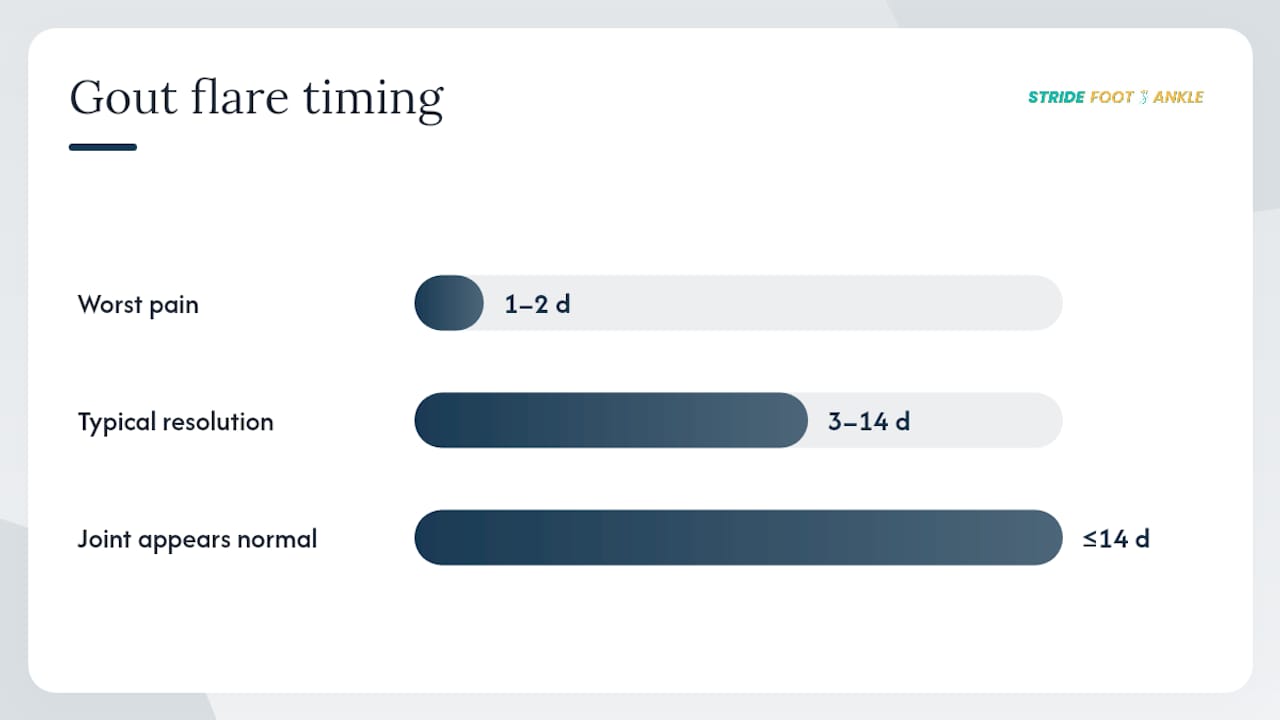
An untreated gout flare in the foot typically resolves on its own within 3 to 14 days, with the worst pain concentrated in the first day or two. That self-limiting pattern is part of what confuses people into skipping care, since the joint often looks and feels normal again within two weeks.
The recurrence numbers are the part most people underestimate. About 60% of patients have a second attack within one year, and that climbs to roughly 80% within three years if the underlying uric acid problem goes unmanaged. Each untreated flare also raises the odds of tophi, the chalky uric acid deposits that can eventually damage joint tissue permanently.
After a flare resolves, keep an eye on a few specific things:
- Whether pain and swelling fully disappear or linger at a low level
- New stiffness that persists even after the redness fades
- How soon a second flare occurs, and whether it hits the same joint or a new one
- Any change in how you walk or bear weight, which can strain other joints over time
How Clinicians Confirm Gout in the Foot
Joint fluid aspiration is the diagnostic gold standard for gout, and there’s no substitute for it when the diagnosis is uncertain. A clinician withdraws fluid from the swollen joint and examines it under a microscope for monosodium urate crystals, which confirms gout directly and, just as important, rules out septic arthritis and pseudogout at the same time. The ACFAS clinical consensus statement treats aspiration as definitive, with lab work and imaging serving as adjuncts rather than replacements.
Blood tests commonly ordered include:
- Serum urate, though levels can read normal during an active flare, making this an unreliable standalone test in the moment
- ESR and CRP, general inflammation markers that support but don’t confirm the diagnosis
- CBC, mainly to help rule out infection
Imaging plays a supporting role. Plain X-rays mostly show damage from repeated, chronic flares rather than an acute one. Ultrasound and dual-energy CT (DECT) can detect urate crystal deposits directly, with DECT sensitivity reported between roughly 85% and 100% and specificity between 83% and 92% in observational studies, useful when aspiration isn’t feasible. The best time to check baseline serum urate is after the flare has fully calmed down, not during the attack itself.
Your Next Step: What Happens at a Podiatry Visit
If you’re dealing with a hot, swollen, intensely painful foot joint right now, call a clinic and say specifically that you suspect an active gout flare. That detail helps the front desk prioritize your visit correctly, especially if fever, spreading redness, or an open wound raises the possibility of infection instead.
A focused visit typically includes a hands-on exam of the joint, aspiration if the diagnosis isn’t already clear, and a review of your kidney function and current medications before any anti-inflammatory is prescribed, since drugs like NSAIDs and colchicine carry real risks for patients with kidney impairment or certain drug interactions. If flares have changed how you walk, a podiatrist may also assess your gait and discuss orthotics to prevent secondary strain on tendons elsewhere in the foot.
Longer term, the visit isn’t just about the current flare. Recurring attacks warrant a conversation about urate-lowering therapy, since preventing the next flare matters more than treating the current one in isolation.
- Call and mention “active gout flare” when scheduling
- Expect an exam, possible aspiration, and medication review before treatment starts
- Ask about gait assessment and orthotics if flares are affecting how you walk
- Discuss long-term urate management if this isn’t your first attack
Pro Tip: Bring a list of every medication and supplement you take to your visit. Kidney function and drug interactions determine which flare medications are safe for you specifically.
If you’re managing a current flare or trying to prevent the next one, Stride Foot & Ankle’s general foot and ankle care services in Las Vegas, led by board-certified surgeon Dr. Nahad Wassel, cover both the urgent evaluation and the long-term prevention plan gout requires. For patients whose flares have already changed their gait or stressed nearby joints, the practice’s approach to conservative foot care focuses on orthotics and non-surgical options before anything more invasive is considered.
An Editorial Take on Recognizing Gout Early
The conventional advice on gout symptoms stops at “sudden pain in the big toe” and calls it done. That’s incomplete, and it leaves readers unprepared for the cases that don’t follow the textbook pattern, an ankle that swells with no twisting injury, or a midfoot ache that gets dismissed as overuse.
What the clinical data actually supports is a mindset, not a checklist: any sudden, severely painful, hot single joint in the foot deserves a same-week evaluation, regardless of which joint it is. The recurrence numbers make the stakes clear.
Where I think most self-diagnosis attempts go wrong is treating gout and infection as easy to tell apart from home. They aren’t, always. Fever, spreading redness, or an open wound changes the calculus entirely, and no online article, including this one, should be the final word when those signs appear. Get seen, get the joint aspirated if there’s doubt, and treat the first flare as the moment to start managing the disease, not just the pain.
— Ramil
This article is general information, not a substitute for advice from a qualified doctor. Consult a qualified healthcare professional about your own circumstances before acting on anything here.
Sources
This article draws on peer-reviewed clinical references rather than general health blogs, so you can verify the details yourself:
FAQ
What Can Be Mistaken for Gout in the Foot?
Cellulitis, septic arthritis, pseudogout, ankle sprains, stress fractures, and plantar fasciitis can all resemble gout. Fever, an open wound, or a clear injury history usually points away from gout and toward one of these alternatives.
How Do You Get Rid of Gout in Your Foot Quickly?
There’s no way to fully self-treat a flare, but resting the joint, elevating the foot, and avoiding pressure on it help while you arrange evaluation. A clinician can offer anti-inflammatory options after reviewing your kidney function and medications, since untreated flares still typically resolve within 3 to 14 days on their own.
What Is the Main Trigger for Gout?
Gout flares happen when uric acid crystallizes in a joint, often triggered by dehydration, alcohol, high-purine foods, certain medications, or sudden changes in uric acid levels. Identifying personal triggers is part of the long-term prevention conversation with a podiatrist.
What Can I Drink to Flush Out Gout?
Staying well hydrated with water is generally recommended and may help the body process uric acid, though hydration alone will not resolve an active flare or replace medical evaluation. Discuss fluid and dietary changes with a clinician as part of a broader prevention plan rather than relying on any single drink.
Recent Comments