

Most patients begin forming solid bone union by 6 to 12 weeks after ankle fusion, with meaningful functional recovery arriving between 3 and 6 months and continued improvement stretching to a full year. The first weeks demand strict non-weight-bearing, elevation above heart level, careful wound care, and attendance at every scheduled X-ray appointment.
TL;DR:
- Bone union usually occurs within 6 to 12 weeks post-surgery, with full functional recovery often taking up to a year, depending on individual factors.
- Strict non-weight-bearing, elevation, and wound care are critical in the first six weeks to reduce complication risks and support healing.
- Weight-bearing and physical therapy are solely determined by imaging evidence of bone bridging and clinical stability, typically starting between weeks 10 and 14.
- Common complications such as infection, nonunion, DVT, or hardware issues require prompt medical attention and can be mitigated by managing risk factors like smoking and diabetes.
- Long-term, patients often experience pain relief and return to low-impact activities, but the fused joint limits high-impact motion and increases strain on adjacent joints over time.
Table of Contents
- How Long Does Ankle Fusion Recovery Take?
- What Should You Do in the First Weeks After Surgery?
- When Does Weight-Bearing and Physical Therapy Start?
- What Complications Should Prompt a Call to Your Surgeon?
- What Can You Expect Long Term After Ankle Fusion?
- What Does the Evidence and Clinical Protocol Say?
- A Note From the Clinic
- Ready to Talk to a Foot and Ankle Surgeon?
- Sources
- FAQ
How Long Does Ankle Fusion Recovery Take?
Ankle fusion, also called ankle arthrodesis, fuses the tibia to the talus so the joint stops moving and stops hurting. Recovery unfolds in five distinct phases, and each one has its own goals, restrictions, and warning signs worth tracking.
- Immediate post-op (0 to 2 weeks). You leave surgery in a splint with your leg elevated. Your first clinic visit checks the incision and swaps the splint for a cast or boot.
- Early healing (2 to 6 weeks). You stay in a cast or boot and remain strictly non-weight-bearing. An X-ray around six weeks checks early bone bridging.
- Transition (6 to 10 weeks). If imaging shows healing progress, your surgeon typically moves you into a removable boot and allows progressive weight-bearing as tolerated.
- Wean and rehab (10 to 12+ weeks). Gait retraining and strengthening begin in earnest. If X-rays are unclear about union at this point, a CT scan around 3 to 4 months gives a sharper picture than plain film alone.
- Long term (3 to 12 months). You return to regular shoes and low-impact activity. Swelling, notably, can linger for up to a year even after the fusion itself is solid.
This isn’t a race. Two patients with identical surgeries can heal at different speeds depending on bone quality, age, and whether they smoke. Treat the timeline as a map, not a deadline.
What Should You Do in the First Weeks After Surgery?
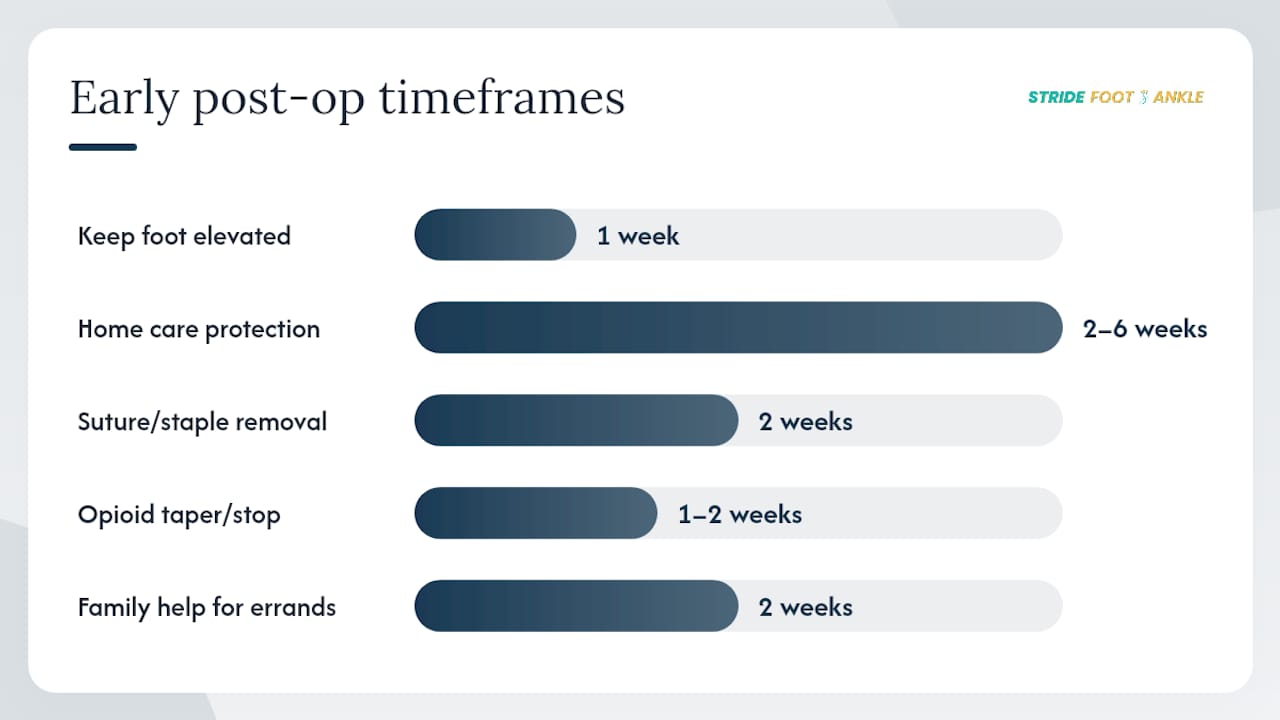
Home care in the first two to six weeks protects the fusion site while it’s most vulnerable. Get elevation, wound protection, and mobility logistics right early, and you reduce your odds of a setback later.
Keep your foot elevated above heart level as much as possible for the first week, tapering gradually as swelling subsides. Ice in 20-minute intervals over the dressing, never directly on skin, helps control early swelling without soaking the incision.
- Keep the dressing dry; ask your surgeon exactly when showers are safe.
- Watch for redness, warmth, drainage, or fever, which can signal infection.
- Sutures or staples usually come out at the two-week visit, unless your surgeon says otherwise.
- Follow the prescribed pain medication taper, and stop opioids as soon as pain allows, typically within one to two weeks.
- If you’re on blood thinners for DVT prevention, take them exactly as directed.
- Choose crutches, a knee scooter, or a wheelchair based on your upper-body strength and home layout, and confirm the choice with your surgical team.
Prep your home before surgery, not after. Move frequently used items to counter height, set up a shower chair, and line up a family member or friend for the first two weeks of meals and errands.
Pro Tip: Hopping around on crutches burns far more energy than walking normally does. If you’re older or you tire easily, ask your surgeon about a knee scooter before surgery, not after you’re already struggling at home.
For a deeper walkthrough of wound care and swelling control, see Stridefootankle’s post-surgery foot care guide.
When Does Weight-Bearing and Physical Therapy Start?
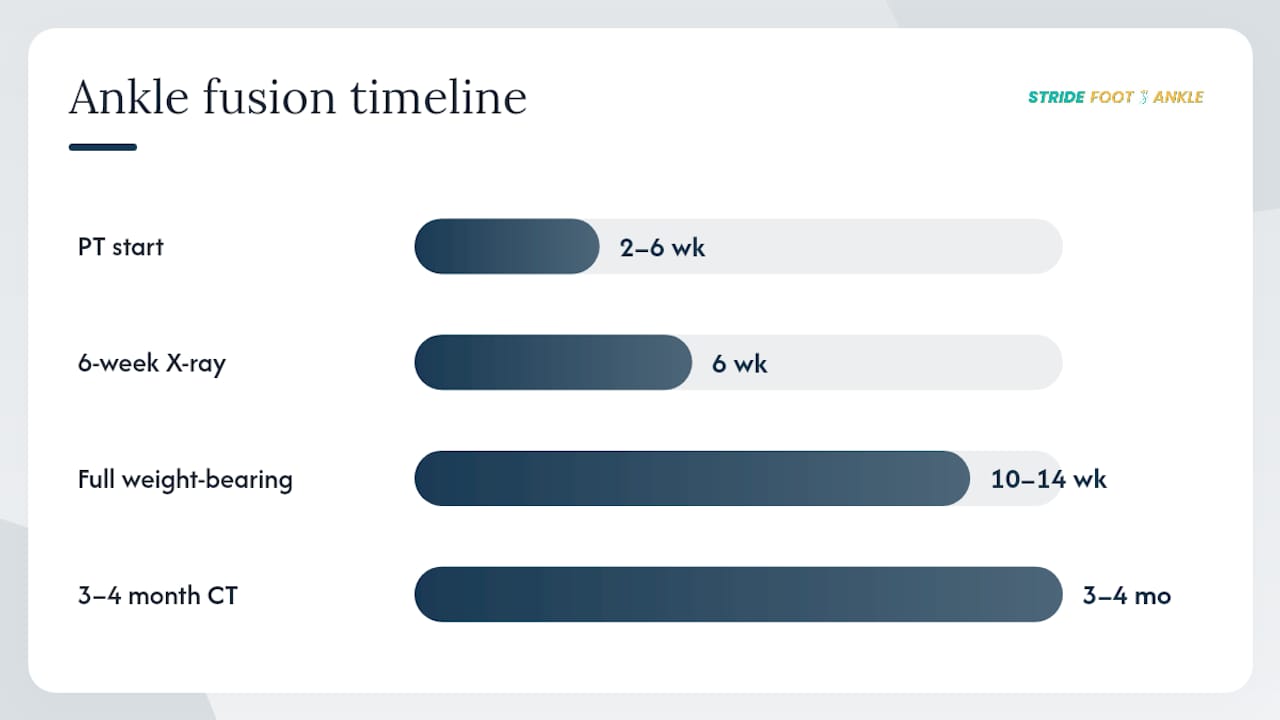
Your surgeon, not a calendar, decides when you start bearing weight. That decision rests on X-ray evidence of bone bridging combined with a clinical exam checking for pain and stability at the fusion site.
Early physical therapy, often starting in weeks 2 through 6, focuses on isometric contractions and range of motion in the joints above and below the fusion, since the ankle itself stays immobilized. Once your surgeon clears loading, progression usually follows a staged pattern:
- Touchdown weight-bearing, using the foot only for balance while crutches carry the load.
- Partial weight-bearing, often increasing gradually week to week as tolerated and pain permits.
- Full weight-bearing without support, generally reached somewhere between weeks 10 and 14.
Once you’re loading the limb, therapy shifts toward strength and proprioception. Typical exercises include:
- Ankle-directional isometrics before any real loading begins.
- Gentle calf and peroneal strengthening once partial weight-bearing starts.
- Single-leg heel raises, a late-stage milestone that signals solid functional strength.
- Balance drills on unstable surfaces to rebuild proprioception lost during immobilization.
Swimming and stationary cycling are usually safe reintroductions once your incision is healed, since they load the joint without impact. Running and jumping activities are typically discouraged long-term, because the fused joint no longer absorbs shock the way a healthy ankle does. One prospective study found that patients who paired a custom orthosis with a structured rehab program showed measurably better performance and patient-reported outcomes than rehab alone, which is worth raising with your surgeon if you’re weighing bracing options. Related exercise progressions are outlined in Stridefootankle’s ankle instability exercise guide.
What Complications Should Prompt a Call to Your Surgeon?
Most ankle fusions heal without incident, but knowing the warning signs matters more than memorizing statistics. Superficial wound infections show up as redness, warmth, or drainage near the incision. Deep infection or hardware problems tend to bring worsening pain, fever, or a wound that won’t close.
Nonunion, meaning the bone never fully bridges, occurs in roughly 5% of cases in some published series, though rates climb with smoking, diabetes, and poor bone quality. Deep vein thrombosis (DVT) risk is why your surgeon may prescribe blood thinners and push early ankle-adjacent movement.
- Fever above 101°F, spreading redness, or foul-smelling drainage: call your surgeon same-day.
- Calf swelling, warmth, or pain, or sudden shortness of breath: seek emergency care immediately, as this can signal DVT or pulmonary embolism.
- Persistent, worsening pain after week 6 despite rest and elevation: call your surgeon’s office.
- A cast or boot that feels suddenly loose or unstable: schedule an urgent visit.
Quitting smoking, managing blood sugar tightly if you’re diabetic, and eating adequate protein all measurably improve your odds of a smooth, timely union.
What Can You Expect Long Term After Ankle Fusion?
Most patients report substantial pain relief and a return to a normal walking pattern, along with comfortable participation in low-impact activities like hiking, cycling, and swimming. What fusion doesn’t restore is the ankle’s natural up-and-down motion, so activities demanding deep dorsiflexion, like squatting deeply or sprinting, often stay limited.
Because the fused joint no longer flexes, nearby joints in the foot absorb more motion than they used to. Over 10 to 20 years or longer, this added strain can contribute to arthritis in adjacent joints, a tradeoff worth discussing candidly with your surgeon before surgery, not after.
- Custom orthoses and supportive footwear reduce strain on adjacent joints over time.
- Targeted strengthening keeps the surrounding musculature carrying its share of the load.
- Desk-based work often resumes within 2 to 4 weeks; jobs requiring standing may take 8 to 12 weeks; heavy labor can take 4 to 6 months or longer.
- Driving typically resumes once you’re out of the cast or boot and have adequate control of the pedal foot, per your surgeon’s clearance.
What Does the Evidence and Clinical Protocol Say?
A dependable recovery rests on a checklist, a follow-up schedule, and evidence your surgeon can point to directly. Arrange transportation, a caregiver for the first two weeks, and a clear medication plan before surgery day arrives.
Standard follow-up typically runs on a 2-week wound check, a 6-week X-ray, and a 12-week reassessment, with CT imaging added if union looks uncertain on plain film.
Confirming true bone union takes more than a glance at an X-ray. CT imaging is more sensitive than plain radiographs and is commonly used around 3 to 4 months when the picture on X-ray isn’t conclusive, giving surgeons and patients a clearer answer before advancing activity.
The American Academy of Orthopaedic Surgeons notes that fusion is generally reserved for end-stage arthritis once conservative treatments have failed, and its patient guidance mirrors the staged recovery checkpoints outlined here.
A Note From the Clinic
Patients almost always ask two things: how much this will hurt, and how dependent they’ll be on others. Both ease with time. Bring a written question list to your pre-op visit, arrange home support in advance, and tell your surgeon honestly about smoking or diabetes so your plan accounts for it.
— Ramil
Ready to Talk to a Foot and Ankle Surgeon?
Patients benefit from a personalized recovery plan that considers specific X-rays, bone quality, and risk factors beyond a generic timeline. The practice supports patients through surgical evaluation and rehabilitation coordination to provide comprehensive care in one place.
If you’re weighing ankle fusion against other options, or you want a second opinion on a recovery plan that already feels off track, Stridefootankle’s foot and ankle care page is the place to start. You can also review what the surgical process itself involves before your consultation. Ready to move forward? Schedule a consultation and bring your imaging and question list with you.
This article is general information, not a substitute for advice from a qualified doctor. Consult a qualified healthcare professional about your own circumstances before acting on anything here.
Sources
- Outcomes after ankle arthrodesis (PMCID PMC5672856)
- Effect of Custom Orthosis and Rehabilitation Program on Outcomes Following Ankle and Subtalar Fusions (2016 DOI)
- PubMed listing related to ankle fusion outcomes
- AAOS — Arthritis of the foot and ankle
- FootCareMD — Ankle fusion patient information
FAQ
How Long Can You Walk After Ankle Fusion?
Most patients stay strictly non-weight-bearing for about 6 weeks, then progress to walking with support in a boot, reaching full unsupported walking somewhere between 10 and 14 weeks depending on healing.
What Is Life Like With a Fused Ankle?
Most people walk normally, feel significant pain relief, and return comfortably to low-impact activities like swimming and cycling, though high-impact sports and deep ankle-bending motions usually stay limited.
Is an Ankle Fusion Major Surgery?
Yes, ankle fusion is major orthopedic surgery requiring anesthesia, hardware placement, and months of staged recovery, though it’s a well-established procedure for end-stage arthritis once conservative care has failed.
What Happens 6 Weeks After Ankle Fusion Surgery?
Around 6 weeks, you typically get an X-ray to check early bone healing, and if it looks good, your surgeon may transition you from a cast to a removable boot with progressive weight-bearing.
When Is a CT Scan Needed After Ankle Fusion?
A CT scan is typically ordered around 3 to 4 months if X-rays don’t clearly confirm union, since CT imaging detects bone bridging more reliably than plain radiographs.
Recent Comments