

Most turf toe heals without surgery. The first move is RICE and strict limits on bending the big toe upward, followed by a phased return to activity. Recovery ranges from a few days for a mild sprain to several months for a complete ligament tear. See a specialist if you notice marked instability, suspect a fracture, or pain that will not ease.
TL;DR:
- Early motion within the first week helps prevent chronic stiffness and should be combined with proper immobilization based on injury grade.
- Grade 1 injuries typically recover in three to five days, while Grade 2 take two to four weeks, and Grade 3 can require six to twelve months for full recovery.
- Use a stiff-soled shoe or CAM boot to limit joint movement during recovery, with proper transition to athletic shoes after initial protection.
- Conservative treatment is effective for most cases, with surgery rarely necessary and usually reserved for severe instability or fractures.
- Prompt evaluation by a specialist is crucial if symptoms persist beyond expected timelines or if signs of instability or fractures are present.
Table of Contents
- Turf Toe Treatment: What to Do in the First 72 Hours
- How Turf Toe Grades Determine Your Recovery Time
- Which Conservative Treatments Actually Protect the Joint?
- Turf Toe Rehabilitation Exercises by Phase
- When Should You See a Specialist for Turf Toe?
- Is Surgery Necessary for Turf Toe?
- Preventing Turf Toe and Knowing When You’re Ready to Play
- A Clinical View From Stride Foot & Ankle
- What Most Advice Gets Wrong About Turf Toe
- How Stride Foot & Ankle Treats Turf Toe in Las Vegas
- Sources
- FAQ
Turf Toe Treatment: What to Do in the First 72 Hours
The acute window sets the tone for everything that follows. Get weight off the joint, control swelling, and avoid anything that forces the big toe into extension.
Ice the joint for short intervals every two to three hours for the first few days, and keep the foot elevated whenever you’re sitting. Over-the-counter NSAIDs help with pain and swelling, but StatPearls advises against corticosteroid injections in the acute phase since they can mask instability that needs to be assessed clinically. A stiff-soled shoe works for milder sprains; a CAM walking boot is often recommended once pushing off hurts or limping occurs.
Hold off on aggressive taping right away. A tight toe-spica wrap in the first day or two can trap swelling and increase pain. Taping earns its place later, once the acute inflammation settles.
- Ice 10 to 20 minutes, every 2 to 3 hours, for 72 hours
- Short course of NSAIDs for pain and swelling
- Stiff-soled shoe or CAM boot to limit dorsiflexion
- Skip corticosteroid injections during the acute phase
Watch for these red flags: a toe that looks visibly deformed, numbness, skin that’s turned pale or dusky, or pain so severe you can’t bear any weight. Any of those means you need same-day evaluation, not a wait-and-see approach.
How Turf Toe Grades Determine Your Recovery Time
Turf toe is graded on a 1 to 3 scale based on how much of the plantar plate and capsule at the first metatarsophalangeal (MTP) joint has torn, and the grade is what actually drives your timeline.
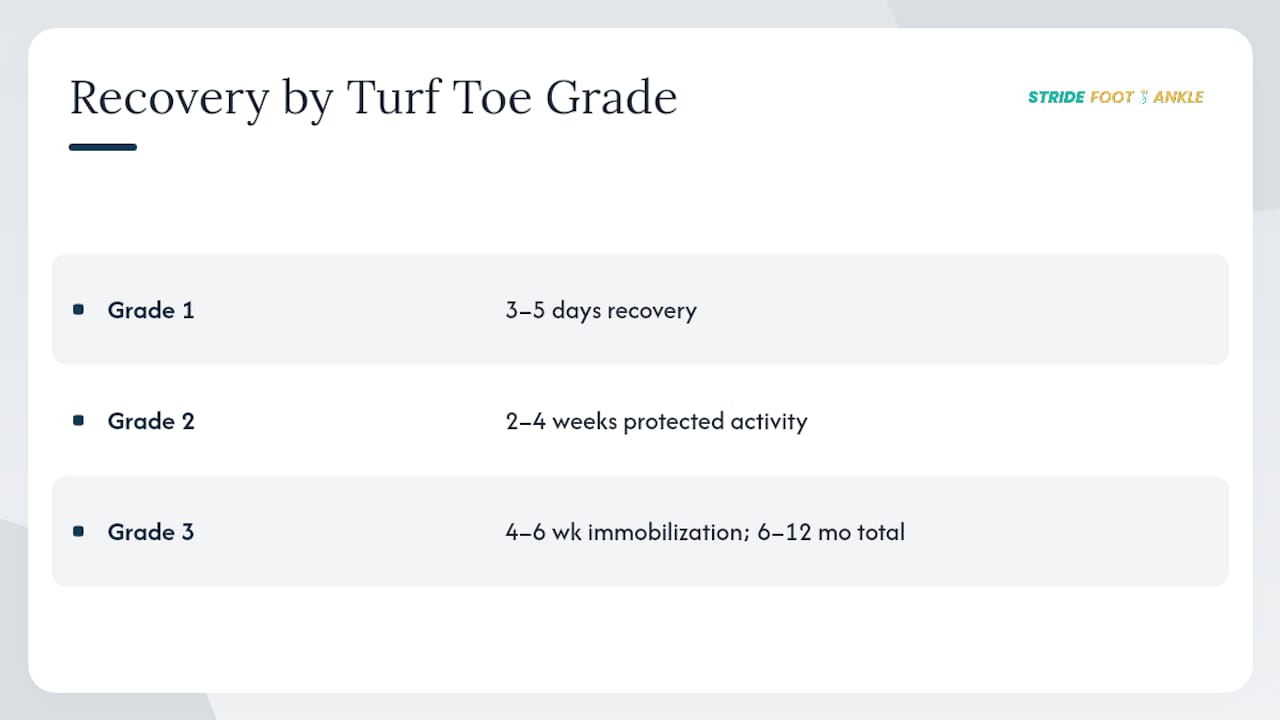
Grade 1 is a stretch injury to the ligament complex with no true tearing. Swelling is mild, and you can typically bear weight without much trouble. Recovery usually takes three to five days once pain starts to fade.
Grade 2 means a partial tear. Expect more swelling, some bruising, and noticeably reduced push-off strength. Athletes in this category generally need two to four weeks of protected activity, usually in a boot or stiff shoe, before returning to full training.
Grade 3 is a complete disruption of the plantar plate, sometimes with sesamoid fracture or diastasis. This calls for four to six weeks of immobilization, and total recovery, including rehab, often runs six to twelve months.
Competition level matters too. A systematic review found professional athletes tend to return faster than collegiate or high school athletes at the same injury grade, largely because they have quicker access to imaging, supervised rehab, and daily monitoring. Delaying care by even a week or two on a Grade 2 injury can push you toward the slower end of that range, so getting evaluated early matters as much as the grade itself.
Which Conservative Treatments Actually Protect the Joint?
Conservative care for turf toe centers on one goal: keep the first MTP joint from bending too far upward while it heals. A few tools do this well, and picking the right one depends on your grade and where you are in recovery.
- CAM walking boot. Best for Grade 2 and 3 injuries. It locks the ankle and forefoot in a position that removes almost all stress from the joint, which is why it’s the go-to for anything beyond a mild sprain.
- Stiff-soled or rocker-bottom shoes. Good for Grade 1 injuries or the tail end of Grade 2 recovery. The rigid sole lets you walk with a natural rolling motion instead of bending through the toe joint.
- Rigid forefoot inserts with a Morton’s extension. A carbon-fiber plate extending under the big toe restricts dorsiflexion more effectively than a standard rigid insert, according to research on first MTP joint motion. These work well once you’re transitioning out of a boot and back into athletic shoes.
- Taping (toe-spica technique). Useful during the later stages of recovery, especially for practice sessions and early return-to-play trials, but it’s not a substitute for a boot in the acute phase.
- Crutches or limited weightbearing. Reserved for the first few days of a Grade 2 or 3 injury when walking causes sharp pain.
Pro Tip: Don’t jump straight from a boot into your regular cleats. Spend a week or two in a stiff-soled shoe with a carbon-fiber insert first. It bridges the gap between full protection and unrestricted motion, and it’s the step most athletes skip.
Explore more on nonsurgical treatment options for ligament injuries if you’re weighing boot versus brace for your specific case.
Turf Toe Rehabilitation Exercises by Phase
Rehab follows three phases, and the biggest mistake athletes make is treating “rest” as the entire plan instead of one part of it.
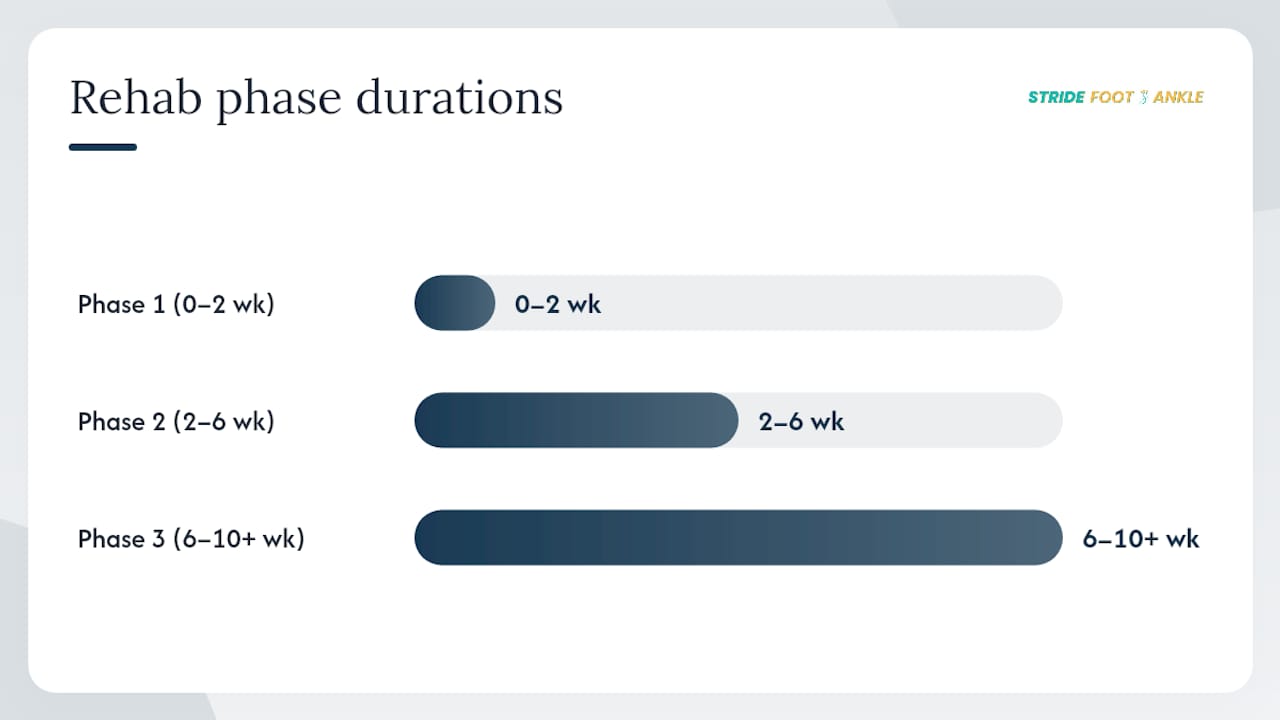
- Phase 1 (0 to 2 weeks): Control swelling and protect the joint, but don’t go completely still. Gentle passive plantarflexion starting around three to five days in helps prevent adhesions around the sesamoid bones and cuts down on long-term stiffness.
- Phase 2 (2 to 6 weeks): Restore full range of motion and normalize your walking pattern. Add toe flexor and intrinsic foot strengthening, plus hip and core work, since the entire kinetic chain matters for successful rehab and this step gets skipped constantly.
- Phase 3 (6 to 10-plus weeks): Layer in proprioception drills, sport-specific conditioning, and a supervised progression back to cutting and sprinting.
Pro Tip: A useful benchmark clinicians use: if you can walk and jog without a limp and achieve a 50 to 60 degree arc of pain-free motion, you’re a candidate for graded return-to-play trials on lower-grade injuries.
The three pitfalls that stall recovery: staying immobilized longer than necessary, skipping hip and core rehab because it “doesn’t feel related,” and returning to cutting drills before ROM and strength are symmetric. Structured rehab guidance, like the framework in Stridefootankle’s ankle recovery guide, applies the same phased logic to related lower-extremity injuries.
When Should You See a Specialist for Turf Toe?
A clinical exam usually starts with a stability test, pushing the big toe upward and checking for excessive give compared to the uninjured side. Loss of push-off strength and tenderness over the sesamoid bones both point toward a higher grade injury.
Imaging adds specific value at specific points. An X-ray rules out a fracture and checks for sesamoid displacement. An MRI becomes useful when the plantar plate, sesamoids, or surrounding soft tissue need a closer look, particularly if conservative care isn’t progressing as expected.
- See a specialist if there’s marked joint instability on exam
- Get evaluated if pain persists beyond the expected timeline for your grade
- Seek care if two to three weeks of conservative treatment brings no improvement
- Ask about imaging if you can’t recall a clear mechanism of injury (sudden fractures need ruling out)
You can read more about imaging’s role in diagnosing foot and ankle conditions if you want to understand what a workup typically involves.
Is Surgery Necessary for Turf Toe?
Surgery for turf toe is uncommon. Fewer than 2% of cases require an operation, and it’s generally reserved for confirmed structural instability, sesamoid fractures or diastasis, or injuries that fail a genuine trial of conservative care.
The evidence doesn’t clearly favor surgery even for high-grade injuries. A systematic review of operative versus nonoperative management found insufficient high-quality evidence that surgery outperforms conservative treatment across the board. One athlete cohort actually showed better outcomes without surgery: 100% return-to-play with nonoperative treatment versus 80% after surgery, with a much shorter average recovery (75.8 days versus 221.4 days).
- Surgical candidates: severe instability, sesamoid fracture/diastasis, failed conservative treatment
- Typical post-op course: brief immobilization, then progressive ROM starting at 7 to 10 days
- Boot protection for 8 to 12 weeks, with full sport return often taking several months
If surgery is on the table, preparing properly for foot surgery makes a real difference in how smoothly recovery goes.
Preventing Turf Toe and Knowing When You’re Ready to Play
Prevention starts with footwear. Stiff-soled cleats or carbon-fiber insert combinations reduce how far the joint can hyperextend during push-off, which is the mechanism behind most turf toe injuries. Playing surface matters too. Artificial turf’s grip contributes to the injury’s name for a reason.
Landing mechanics and hip and core conditioning reduce the load that eventually transfers down to the big toe joint during cutting and sprinting.
- Pain-free walking and jogging on a flat surface
- Symmetric range of motion and strength compared to the uninjured side
- Successful completion of sport-specific drills (cutting, sprinting, jumping) without compensating
- Confidence pushing off the injured toe under game speed
More on footwear and conditioning strategies that lower your risk of repeat injury once you’re cleared.
A Clinical View From Stride Foot & Ankle
Dr. Nahad Wassel, board-certified in foot and ankle surgery, treats turf toe using the same conservative-first approach outlined here. In practice, a boot is the default for anything beyond a mild sprain, with imaging ordered promptly whenever instability or a fracture is suspected, rather than waiting out a failed trial of rest.
What Most Advice Gets Wrong About Turf Toe
The biggest gap between conventional wisdom and what the evidence supports is this: most guidance overcorrects toward rest and undersells structured rehab. Total immobilization feels safer, but the research on early motion is fairly clear that gentle passive plantarflexion within the first week prevents the kind of stiffness that drags recovery out for months.
The second overlooked piece is the kinetic chain. Athletes fixate on the toe joint itself and skip hip and core strengthening entirely, treating it as irrelevant to a foot injury. It isn’t. Weak hip stabilizers change how load transfers through the foot during cutting, which raises re-injury risk even after the ligament has technically healed.
If you take one thing from this guide, prioritize getting graded early. A Grade 1 sprain mismanaged as a Grade 2 wastes weeks in a boot you didn’t need. A Grade 2 injury mistaken for a mild sprain risks turning into a Grade 3 problem. The grade determines almost everything that follows, and it’s worth a same-week visit to get it right.
— Ramil
How Stride Foot & Ankle Treats Turf Toe in Las Vegas
Stridefootankle gives you what a generic urgent care visit usually can’t: same-practice access to grading, imaging coordination, orthotics, and a rehab plan built around your sport and your timeline, all under one board-certified foot and ankle surgeon.
At your first visit, expect a hands-on stability exam, X-rays if a fracture is suspected, and a straightforward conversation about whether you’re looking at a boot and a few weeks off, or something that needs closer monitoring. Dr. Nahad Wassel’s approach leans conservative first, reserving surgical referral for the small share of cases where instability or sesamoid damage genuinely calls for it. If you’re dealing with turf toe symptoms and want a clear grade, a realistic timeline, and a plan you can actually follow, visit the general foot and ankle care page to schedule an evaluation and get moving on recovery this week.
Sources
- Turf Toe Injuries in the Athlete: an Updated Review of Treatment Options, Rehabilitation Protocols, and Return-to-Play Outcomes
- Turf toe – StatPearls
FAQ
What is the fastest way to heal turf toe?
Start RICE immediately, avoid corticosteroid injections, and protect the joint in a stiff-soled shoe or boot; mild Grade 1 sprains can resolve in three to five days with this approach.
What does a grade 2 turf toe look like?
Grade 2 means a partial ligament tear with visible swelling, bruising, and reduced push-off strength, typically requiring two to four weeks of protected activity.
What happens if turf toe goes untreated?
Untreated turf toe can progress to chronic joint instability, ongoing pain with push-off, and in severe cases, arthritis at the first MTP joint from repeated stress on unstable ligaments.
How long does turf toe last?
Recovery ranges from three to five days for Grade 1 injuries to six to twelve months for Grade 3 injuries, depending on severity, competition level, and how quickly treatment starts.
Does turf toe ever require surgery?
Rarely. Fewer than 2% of cases need surgery, and it’s typically reserved for severe instability, sesamoid fractures, or injuries that don’t improve with conservative care.
Recent Comments