

Peroneal tendonitis treatment starts with conservative care, not surgery. Activity modification, guided physical therapy, and bracing resolve most cases within weeks to months. Imaging and surgical referral come into play only when there are red flags like tendon instability or when six to twelve weeks of proper rehab produce no meaningful improvement.
TL;DR:
- Proper treatment focuses on progressive loading and controlled exercise, not prolonged immobilization or complete rest, to rebuild tendon strength.
- Diagnosis requires specific clinical tests like resisted eversion and imaging such as ultrasound or MRI to distinguish tendonitis from ankle sprains or instability.
- Conservative care includes short-term symptom relief with rest, ice, braces, and targeted exercises; injections and shockwave therapy are used selectively.
- If symptoms persist beyond 6 to 12 weeks despite conservative treatment, imaging or specialist referral is necessary to evaluate for tears, instability, or structural damage.
- Surgery is reserved for cases with confirmed structural tears, chronic instability, or persistent pain unresponsive to staged conservative management.
Table of Contents
- What Causes Peroneal Tendonitis and Why Loading Matters
- How Do You Know It’s Peroneal Tendonitis and Not a Sprain?
- What Is the Best Conservative Treatment for Peroneal Tendonitis?
- When Should You See a Specialist for Ankle Tendon Pain?
- What Are the Surgical Options for Peroneal Tendon Tears?
- How Long Does Peroneal Tendonitis Take to Heal?
- How Do You Prevent Peroneal Tendonitis From Coming Back?
- How Does a Foot and Ankle Specialist Evaluate Peroneal Tendon Pain?
- What the Research Actually Supports
- Get Back on Your Feet With Expert Foot and Ankle Care
- Sources
- FAQ
What Causes Peroneal Tendonitis and Why Loading Matters
The peroneus longus and peroneus brevis run along the outside of your ankle, stabilizing it during walking, running, and any move that shifts your weight sideways. When these tendons get inflamed or start to break down, it’s usually from overuse, a poorly rehabbed inversion sprain, a naturally high-arched (varus) hindfoot, or shoes that don’t support the outer edge of the foot.
Here’s what surprises a lot of patients: the fix isn’t rest alone. Tendons heal by adapting to mechanical stress, not by sitting still. Too much immobilization actually weakens the tissue further, according to reviews on peroneal tendon syndromes. That’s why effective treatment for tendonitis in the ankle centers on progressive loading, controlled, gradually increasing stress that rebuilds the tendon’s tolerance rather than just numbing the pain.
How Do You Know It’s Peroneal Tendonitis and Not a Sprain?
Peroneal tendonitis typically causes pain and swelling along the outer ankle and foot, worse with resisted eversion (turning the foot outward against resistance) and often tender directly over the tendon path behind the ankle bone. A clinician confirming the diagnosis will usually check for pain with resisted eversion and run a peroneal compression test, pressing along the tendon while you move the foot to reproduce the pain.
The tricky part is that this condition gets mistaken for a lateral ankle ligament sprain constantly, and the two need different care. A sprain involves the ligaments; tendonitis involves the tendons that glide behind them, and treating one like the other delays real recovery. If you’ve had a sprain that never fully settled, ankle instability may be part of the picture too.
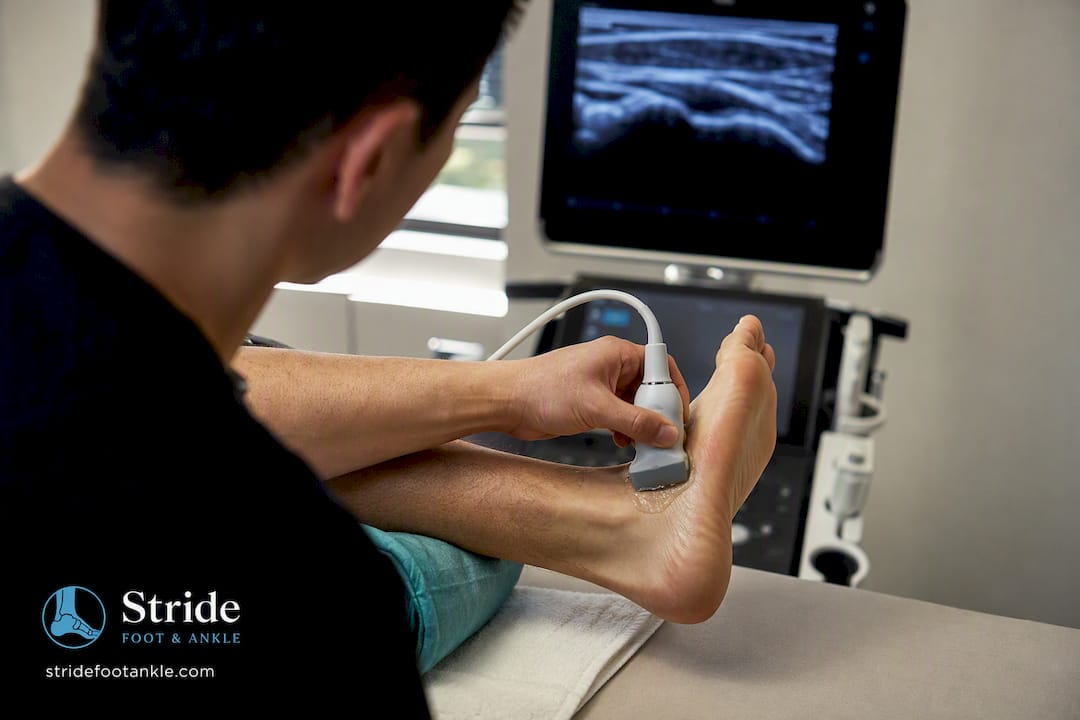
When the exam findings are ambiguous, imaging helps sort it out. Dynamic ultrasound shows the tendons moving in real time, which is useful for catching subluxation (the tendon slipping out of its groove) that only shows up during motion. MRI gives a clearer static picture of tears, splits, or fluid around the tendon sheath, and it’s generally reserved for cases where symptoms persist or surgery is being considered. Cleveland Clinic notes that peroneal tendonitis is often misdiagnosed as a simple sprain, which is exactly why a targeted exam matters before you commit to a treatment plan.
What Is the Best Conservative Treatment for Peroneal Tendonitis?
Most people recover with a structured, staged conservative program, and this is where the real work happens. The goal isn’t to eliminate all activity; it’s to reduce the load enough for the tendon to calm down, then rebuild its capacity in a controlled way.
Short-term symptom control (first 1 to 2 weeks):
Relative rest, ice after activity, and over-the-counter analgesics take the edge off acute pain. Avoid prolonged immobilization in a cast or boot unless pain is severe, since extended stillness works against the tendon’s need for gentle loading.
Offloading strategies:
- A lateral heel wedge, sized to comfortably shift your foot slightly, reduces strain on the peroneal tendons
- A lace-up ankle brace controls side-to-side motion during daily activity or light exercise
- A walking boot is reserved for severe acute pain or when weight-bearing itself is painful, used briefly rather than for weeks on end
Injections and adjunct therapies, used selectively:
Ultrasound-guided corticosteroid injections can ease pain, but ultrasound guidance matters because injecting directly into the tendon substance raises rupture risk. Most clinicians limit corticosteroid use to a single injection. Platelet-rich plasma (PRP) has limited evidence behind it for peroneal tendinopathy specifically. Shockwave therapy has some support for chronic cases that haven’t responded to initial conservative measures, according to the ESSKA-AFAS consensus statement.
Progressive exercise, the real engine of recovery:
- Restore pain-free range of motion with gentle ankle circles and alphabet tracing
- Add isometric eversion holds against a wall or resistance band, no movement, just controlled tension
- Progress to eccentric loading, slow, controlled lowering movements with a resistance band, which builds tendon tolerance more than concentric work alone
- Introduce balance and proprioception work, single-leg stands, wobble board drills, to retrain the ankle’s stabilizing reflexes
- Finish with sport-specific drills, cutting, jumping, or terrain-specific walking, before full return to activity
For structured balance progressions, a reactive neuromuscular training approach can add useful variety to the proprioception phase.
Pro Tip: Use the “mild pain, quick recovery” rule: some discomfort during exercise is fine if it settles within 24 hours and doesn’t get worse session to session. If pain lingers past a day or spikes suddenly, dial the load back rather than pushing through it.
When Should You See a Specialist for Ankle Tendon Pain?
Reassess your progress at four to eight weeks of consistent conservative treatment. If pain and function haven’t meaningfully improved by six to twelve weeks, referral for imaging or a specialist evaluation is the next step. This timeline reflects the ESSKA-AFAS consensus, which reserves invasive options for persistent cases rather than early failure of rehab.
Certain signs mean you shouldn’t wait out the full timeline:
- A sensation of the tendon slipping or popping out of place behind the ankle bone
- Inability to bear weight on the affected foot
- Mechanical catching or locking during movement
- Significant weakness with eversion that doesn’t improve with a few weeks of exercise
Imaging at this stage clarifies whether you’re dealing with a partial tear, a full tendon split, or instability from a damaged retinaculum (the tissue band that holds the tendons in place). That distinction directly shapes whether you continue rehab, add an injection, or move toward surgical consultation. If tendonitis exams haven’t clarified your diagnosis, this is the point to push for imaging rather than repeating the same conservative steps indefinitely.
What Are the Surgical Options for Peroneal Tendon Tears?
Surgery becomes reasonable when conservative care has genuinely failed, when imaging confirms a structural tear, when there’s chronic tendon instability, or when a symptomatic os peroneum (an accessory bone within the peroneus longus tendon) keeps causing pain despite rehab.
The procedure depends on how much tendon tissue is damaged. Research on operative treatment of peroneal tendon tears outlines a clear pattern: partial tears affecting less than half the tendon’s cross-sectional area often do well with debridement (removing damaged tissue) and tubularization (reshaping the remaining tendon into a functional tube). Tears involving more than half the tendon typically need segmental excision paired with tenodesis, attaching the damaged tendon to the healthy adjacent one, or autograft or allograft reconstruction when too much tissue is lost to repair directly. Chronic instability, where the tendons repeatedly slip from their groove, is addressed with groove deepening and retinacular repair to keep them tracking properly.
Surgeons sometimes favor grafting over tenodesis because grafting can better restore natural tendon tension, though tendon quality and patient activity level drive the final decision.
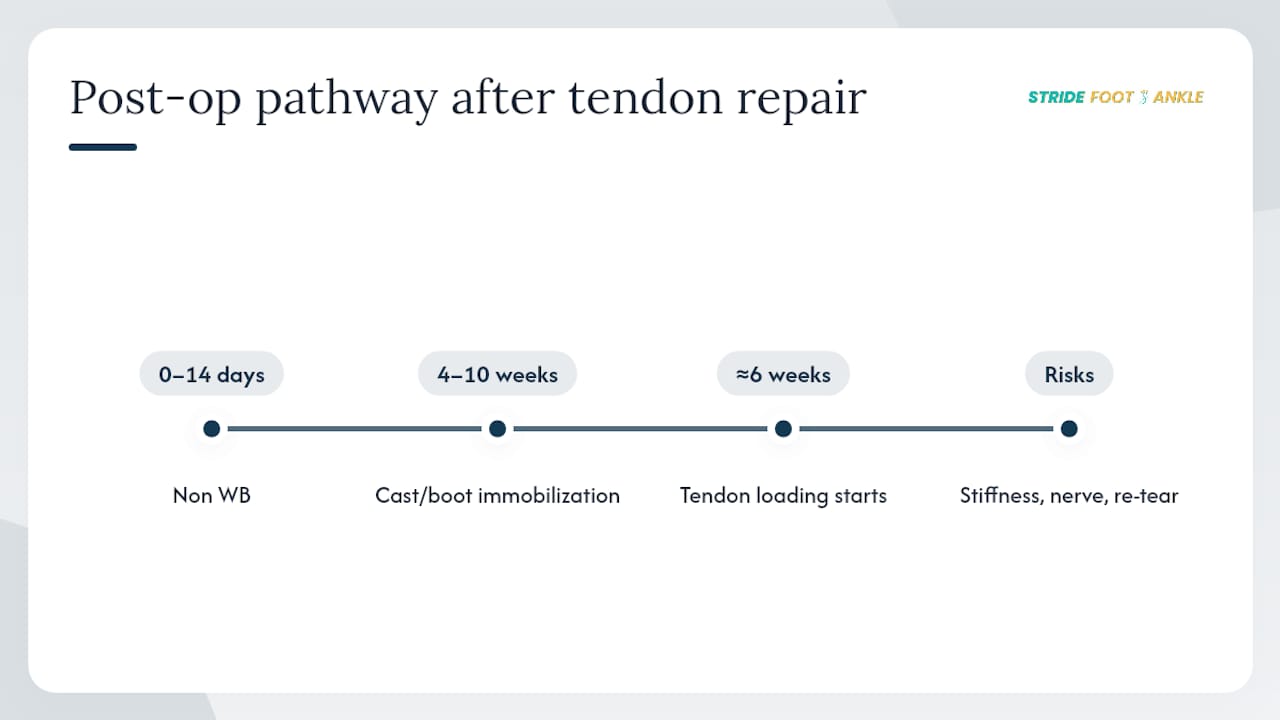
What recovery looks like: Postoperative protocols commonly start with 10 to 14 days of non-weight-bearing, then 4 to 10 weeks in a cast or boot, with tendon loading typically delayed until around six weeks post-op. Complications can include stiffness, nerve irritation, or, less commonly, re-tear. This is why staged rehab under supervision matters as much as the surgery itself. For a broader look at what these procedures involve, see this overview of ankle surgery types and recovery.
How Long Does Peroneal Tendonitis Take to Heal?
Recovery timelines vary by severity, but most conservative cases show real improvement within 6 to 12 weeks of consistent, progressive rehab. Post-surgical recovery runs longer, often four to six months before full return to sport-specific activity.
Conservative recovery milestones:
- Weeks 1 to 2: acute pain settles with relative rest and light loading
- Weeks 3 to 6: isometric and early eccentric exercises progress without flare-ups
- Weeks 6 to 12: balance, proprioception, and sport-specific drills return; most patients resume normal activity
Post-op recovery phases:
- Immobilization and non-weight-bearing (roughly the first two weeks)
- Protected weight-bearing in a boot (weeks 2 to 6 to 10)
- Progressive strengthening and proprioception once tendon loading begins around week 6
- Sport-specific return, typically starting at three to four months and continuing to full clearance
Readiness to advance a phase comes down to objective signs: pain that stays mild and resolves within a day, steady single-leg balance, and pain-free performance of functional tasks like calf raises or lateral hops.
Pro Tip: Track your single-leg balance time weekly. A steady improvement, even by a few seconds, is one of the most reliable early signs that your proprioception is recovering alongside tendon strength.
How Do You Prevent Peroneal Tendonitis From Coming Back?
Recurrence is common when the underlying mechanics that caused the problem never get addressed. Footwear with solid lateral support and a gradual return to training load, rather than jumping back to full mileage or intensity, protects the tendon long after symptoms fade.
- Choose shoes with firm heel counters and adequate outer-edge support, especially for running or court sports
- Use off-the-shelf lateral heel wedges for mild, activity-related strain; move to custom orthotics if you have a structural varus hindfoot or recurring symptoms
- Increase training volume or intensity in small increments, not sudden jumps after time off
- Address modifiable health factors like excess weight and metabolic conditions such as diabetes, both of which slow tendon healing and raise reinjury risk
Nonsurgical options for tendon and ligament injuries go into more detail on bracing and orthotic selection if you’re weighing which route fits your activity level.
How Does a Foot and Ankle Specialist Evaluate Peroneal Tendon Pain?
Dr. Nahad Wassel prioritizes conservative treatment first, reserving imaging and surgical options for cases that don’t respond to rehab or that show clear structural damage. A typical evaluation includes a detailed history, a focused exam of tendon strength and stability, and, when warranted, ultrasound or MRI alongside an orthotic assessment.
Patients should bring a summary of when symptoms started, what activities aggravate them, and any footwear or bracing already tried. For a full picture of what the clinic offers, visit general foot and ankle care.
What the Research Actually Supports
The conventional advice on tendon pain still leans too hard on rest. Patients hear “stay off it” and assume weeks of a boot will fix things, when the evidence points the other way: tendons need graded mechanical stress to rebuild, and excessive immobilization tends to leave them weaker, not stronger.
What gets underestimated is how much the exercise progression matters compared to the passive treatments. Injections and bracing have their place, but they’re supporting actors. The eccentric loading phase and the proprioception work are what actually restore function, and skipping straight from pain relief to full activity is the most common reason people relapse.
If there’s one thing readers should prioritize, it’s the reaction rule: mild pain that settles within 24 hours is fine, pain that lingers or worsens is a signal to scale back. That single habit prevents more setbacks than any brace or injection. Surgery has a real role for confirmed tears and instability, but it’s the fallback, not the starting point, and the data on peroneal tendon tear outcomes backs a measured, staged approach over rushing to the operating room.
— Ramil
Get Back on Your Feet With Expert Foot and Ankle Care
Stridefootankle treats peroneal tendon pain the way this article recommends: conservative care first, with imaging and surgical options available in-house if rehab alone doesn’t resolve your symptoms. Instead of bouncing between a physical therapist, an imaging center, and a surgeon, you get a board-certified foot and ankle surgeon who evaluates your case, builds your rehab plan, and stays with you through every stage of recovery.
Dr. Nahad Wassel’s approach combines hands-on exam findings with ultrasound or MRI when needed, so you’re not guessing which stage of treatment applies to you. If you’ve had ankle pain for more than a few weeks, or a sprain that never quite settled, scheduling a foot and ankle evaluation is the direct next step toward finding out exactly what’s going on and starting the right treatment sooner rather than later.
This article is general information, not a substitute for advice from a qualified doctor. Consult a qualified healthcare professional about your own circumstances before acting on anything here.
Sources
- Diagnosis and operative treatment of peroneal tendon tears (PMC article)
- Tendinopathies of the foot and ankle (AFP 2022)
- Peroneal tendonitis: Causes, Treatment and Prevention (Cleveland Clinic)
FAQ
Is Walking Good for Peroneal Tendonitis?
Light, pain-tolerant walking is generally fine and often better than complete rest, since tendons heal with graded mechanical loading rather than prolonged inactivity. Walking that causes lingering pain past 24 hours signals you need to reduce distance or pace.
Why Won’t My Peroneal Tendonitis Go Away?
Persistent symptoms usually mean the underlying mechanics, like an untreated varus hindfoot, unsupportive footwear, or skipped strengthening phases, were never addressed, or the rehab program moved too fast. If pain hasn’t improved after 6 to 12 weeks of consistent, progressive treatment, specialist evaluation and imaging are the next step.
What Triggers Peroneal Tendonitis?
Overuse, an incompletely rehabbed inversion ankle sprain, a naturally high-arched or varus hindfoot, and shoes lacking lateral support are the most common triggers. A sudden increase in training volume or intensity can also push a mildly irritated tendon into a symptomatic flare.
How Do You Heal Tendonitis Quickly?
There’s no shortcut that bypasses tissue healing time, but the fastest reliable path combines relative rest, offloading with a brace or heel wedge, and a progressive loading program started early rather than delayed. Most people notice meaningful improvement within weeks when they follow reaction rules for pain rather than pushing through discomfort or resting too long.
What Is the Best Brace for Peroneal Tendon Support?
A lace-up ankle brace that limits side-to-side motion while allowing normal walking mechanics is generally the most practical option for daily use during recovery. Severe acute cases sometimes need a short period in a walking boot before transitioning to a brace as pain improves.
Recent Comments