

TL;DR:
- A second opinion is a formal reassessment of diagnosis or treatment by a different qualified specialist, especially valuable for complex foot pain cases. It helps confirm, refine, or revise initial recommendations, offering patients greater clarity and confidence in their care decisions. Consulting with a board-certified specialist and preparing organized medical records optimizes the process, whether in person or virtually, and improves treatment outcomes.
A second opinion is a formal reassessment of your diagnosis or treatment plan by a different qualified specialist. For foot pain patients, this step is one of the most powerful tools available. Research from the Cleveland Clinic confirms that patients report higher satisfaction and greater clarity in their treatment after seeking a second opinion. Services like WorldCare and Cedars-Sinai now offer virtual second opinion consultations, making expert access faster than ever. This guide covers when to seek a second opinion for foot pain, how to find the right specialist, what to expect during the process, and how to act on what you learn.
When should you get a second opinion for foot pain?
Second opinions are most valuable when your diagnosis is unclear, your symptoms are not improving, or a surgeon has recommended an invasive procedure. Knowing the right moment to seek one protects both your health and your peace of mind.
Several situations call for a second opinion on foot pain:
- Complex or rare conditions. Conditions like Charcot foot, tarsal coalition, or avascular necrosis of the talus are uncommon. A specialist with direct experience in these diagnoses will catch details a general practitioner may miss.
- Ambiguous or conflicting imaging results. If your X-ray or MRI findings do not clearly explain your symptoms, a second set of expert eyes on the imaging can resolve the uncertainty.
- Surgery recommendations. Any recommendation for foot or ankle surgery warrants a second opinion. Procedures like bunionectomy, flatfoot reconstruction, or ankle fusion carry real recovery demands. You deserve to know whether conservative options have been fully explored first.
- Stalled treatment progress. If you have followed a treatment plan for plantar fasciitis, Achilles tendinopathy, or a stress fracture and your pain has not improved after 6–8 weeks, a reassessment is reasonable.
- Emotional unease. Feeling overwhelmed, confused, or unsure about your diagnosis is a valid reason to seek another perspective. Your confidence in your care plan directly affects how well you follow it.
One practical question to ask your current provider: is this treatment urgent? Understanding treatment urgency helps you plan your second opinion appointment without putting your health at risk. Most foot conditions allow a window of days to weeks before a decision must be made.
Pro Tip: Ask your doctor directly: “Is there any harm in waiting two weeks before deciding?” If the answer is no, you have time to consult a second specialist without pressure.

How do you find the right specialist for a second opinion?
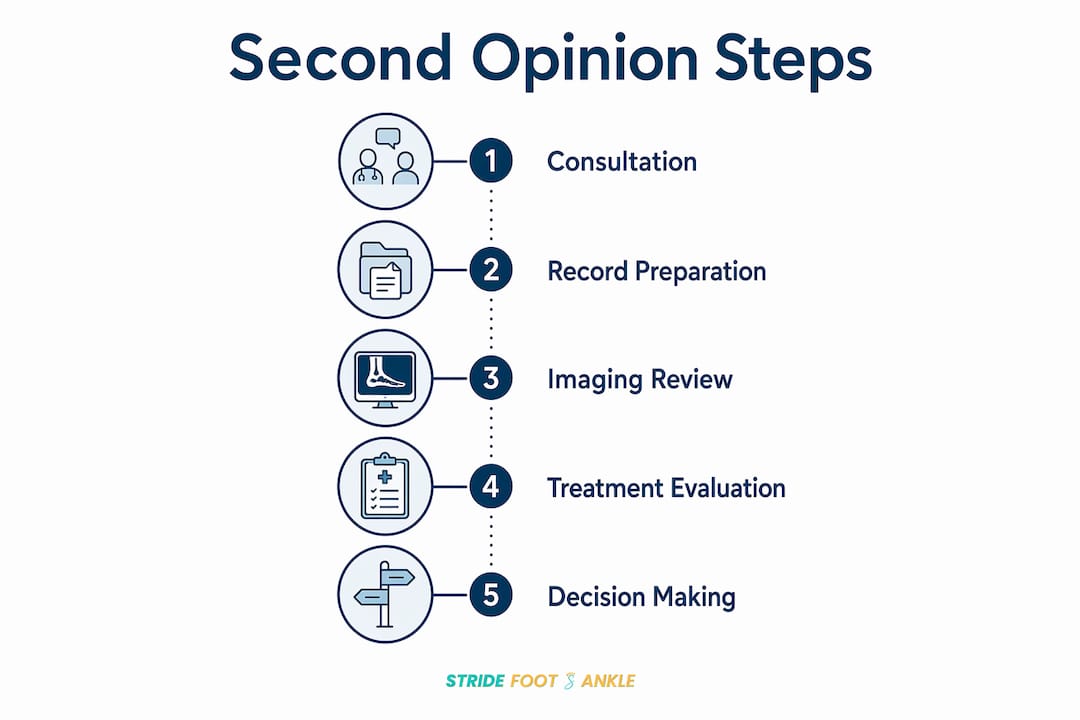
The right specialist for a second opinion is a board-certified podiatrist or orthopedic foot and ankle surgeon with documented experience in your specific condition. General practitioners and even some orthopedic surgeons lack the focused training that complex foot cases require.
Prioritize condition-specific expertise
Selecting a foot specialist with expertise in your exact condition improves the accuracy and usefulness of the second opinion. Academic medical centers and specialized orthopedic institutions, such as the Hospital for Special Surgery in New York or the Mayo Clinic’s orthopedic division, are known for diagnostic precision. If you are in Las Vegas, a foot and ankle specialist with surgical training and podiatric credentials offers a level of focus that general orthopedics cannot match.
What to look for when evaluating a specialist
- Board certification. Look for certification from the American Board of Foot and Ankle Surgery (ABFAS) or the American Board of Podiatric Medicine (ABPM).
- Fellowship training. Surgeons who completed a fellowship in foot and ankle reconstruction have advanced skills beyond standard residency training.
- Patient reviews and outcomes. Verified reviews on platforms like Healthgrades or Vitals give you real patient perspectives on communication, diagnosis accuracy, and follow-up care.
- Virtual second opinion availability. Platforms like WorldCare connect patients with specialists at top academic centers. Reviews are typically delivered within 48–72 hours for initial findings.
Prepare your records before the appointment
Bring a complete packet to your second opinion consultation. This means printed or digital copies of your MRI or CT scans in DICOM format, X-ray images, lab results, a current medication list, and your clinical notes from prior visits. Organized medical documentation prevents delays and allows the specialist to evaluate your case objectively from the start.
Pro Tip: Request your imaging files on a USB drive or through a patient portal before your appointment. Most radiology departments provide this at no charge, and it eliminates the risk of the second specialist relying only on a written radiology report rather than the actual images.
What happens during a second opinion consultation?
A second opinion consultation is a structured clinical review of your full medical history, imaging, lab results, and prior diagnoses. It is not simply a repeat of your first appointment. The specialist approaches your case fresh, without the assumptions that may have shaped the initial diagnosis.
The table below outlines how a second opinion consultation typically compares to your first appointment:
| Feature | First appointment | Second opinion consultation |
|---|---|---|
| Focus | Establish diagnosis and initial plan | Validate, refine, or revise existing diagnosis |
| Imaging review | New imaging ordered as needed | Existing imaging reviewed in detail |
| Treatment discussion | First-line options presented | Alternative or additional options explored |
| Timeline | Same day or within days | In-person: same day; virtual: 48 hours to 10 business days |
| Outcome | Initial treatment plan | Confirmation, modification, or new recommendation |
Virtual second opinion services, such as those offered through WorldCare, deliver expert reviews within 48–72 hours for initial findings and comprehensive written reports within up to 10 business days. This is especially useful for patients in smaller markets or those with limited mobility due to foot pain.
Complex foot cases may involve a multidisciplinary review. A team might include a podiatric surgeon, a radiologist, and a physical medicine specialist reviewing the same case together. This approach is common at academic centers and produces more thorough assessments for conditions like Charcot arthropathy or complex tendon ruptures.
After your second opinion, bring the written report back to your original provider. Discussing the findings openly with your primary physician keeps your care coordinated and prevents conflicting treatment paths from developing in parallel.
How to handle insurance, records, and logistics
Getting a second opinion requires some preparation on the administrative side. Handling this correctly prevents delays and unexpected costs.
Follow these steps to manage the process smoothly:
- Check your insurance coverage first. Insurance policies vary widely on second opinion benefits. Some plans cover the consultation fully as a standard specialist visit. Others require prior authorization or carry higher out-of-pocket costs. Call your insurer before scheduling and ask specifically whether a second opinion visit is covered under your plan. You can also review accepted plans through resources like the insurance information page at Stridefootankle.
- Request all your medical records. You have a legal right to copies of your imaging, pathology reports, lab results, and clinical notes. Submit a written records request to your provider’s medical records department. Most practices fulfill requests within 5–7 business days.
- Organize your documents in a standard digital format. DICOM files for imaging, PDF for clinical notes and labs. Label each file clearly with the date and type of record. A well-organized medical packet enables the second specialist to evaluate your case without chasing down missing information.
- Communicate with both providers. Tell your original provider you are seeking a second opinion. Most physicians support this. Keeping both providers informed prevents duplicate testing and ensures your care remains coordinated.
- Decide between in-person and virtual. In-person consultations allow physical examination, which matters for conditions requiring hands-on assessment like tendon integrity or joint stability. Virtual second opinions work well for reviewing imaging and pathology when travel is difficult or when you need a specialist at a distant academic center.
A practical example: a Las Vegas patient diagnosed with posterior tibial tendon dysfunction and recommended for reconstructive surgery could request a virtual second opinion from a specialist at a major academic center within the same week, at a fraction of the cost of traveling out of state.
How do you interpret two different diagnoses or treatment plans?
Two specialists reaching different conclusions does not mean one of them made an error. Medicine involves clinical judgment, and foot conditions often present with overlapping symptoms that support more than one diagnosis. The goal of a second opinion is informed medical decision-making, not finding proof that your first doctor was wrong.
Here is how to work through conflicting opinions effectively:
- Identify where the opinions agree. If both specialists agree on the diagnosis but differ on treatment, the disagreement is about approach, not accuracy. That is a much easier gap to resolve.
- Ask each specialist to explain their reasoning. A good specialist will walk you through the evidence behind their recommendation. If one recommends surgery and the other recommends physical therapy and custom orthotics, ask both to explain what outcome data supports their approach.
- Explore conservative options before committing to surgery. Second opinions frequently surface alternative, less invasive treatments that the first provider did not present. This is especially common in foot care, where conditions like plantar fasciitis, neuromas, and mild bunions often respond well to conservative foot care before surgery becomes necessary.
- Use the second opinion report as a conversation tool. Bring the written findings back to your original provider. Expert reports serve as tools to improve communication between patients and physicians, not as verdicts.
- Consider a third opinion when opinions diverge significantly. If two specialists recommend completely different surgical approaches for the same condition, a third consultation at an academic center is a reasonable next step. This is rare but appropriate for high-stakes decisions like ankle fusion versus total ankle replacement.
Balancing your personal preferences matters too. Recovery time, activity level, and your tolerance for surgical risk all factor into the right choice for you. A treatment plan that is medically sound but incompatible with your life is not the best plan for you specifically.
Key takeaways
Second opinions in foot care are a standard, respected step that gives patients the clarity and confidence to make the best possible treatment decisions.
| Point | Details |
|---|---|
| Know when to seek one | Surgery recommendations, stalled treatment, or unclear diagnoses all justify a second opinion. |
| Choose the right specialist | Board-certified podiatrists or orthopedic foot surgeons with condition-specific experience deliver the most useful assessments. |
| Prepare your records | Organized DICOM imaging files, labs, and clinical notes prevent delays and improve evaluation accuracy. |
| Understand your insurance | Coverage varies; call your insurer before scheduling to confirm benefits and avoid surprise costs. |
| Use findings to communicate | Bring the second opinion report back to your original provider to keep care coordinated and decisions informed. |
Why I tell every patient: ask the question
I have worked with patients who spent months on a treatment plan that was not the right fit, simply because they felt uncomfortable asking for another perspective. The fear of offending a physician is real, but it is also unfounded. Most physicians welcome patients who seek second opinions. It signals that you are engaged in your own care, and engaged patients follow through on treatment better.
The cases that stick with me are the ones where a second opinion changed everything. A patient told she needed immediate flatfoot reconstruction came to see a second specialist and learned she was a strong candidate for a structured physical therapy program combined with custom orthotics. Eighteen months later, she avoided surgery entirely. That outcome was not luck. It was the result of asking one more question.
What I have found is that the second opinion process also improves the relationship between patients and their original providers. When you return to your first doctor with a written specialist report, the conversation becomes more specific and more productive. You are no longer asking vague questions. You are discussing concrete findings, and that changes the dynamic entirely.
My honest advice: do not wait until you are frustrated or in crisis to seek a second opinion. Build it into your process from the start, especially when surgery is on the table. You deserve to walk into any treatment decision with full information. That is not a challenge to your doctor’s competence. It is the standard of care you are entitled to.
— Ramil
Ready to get a trusted second opinion on your foot pain?
If you are dealing with a foot pain diagnosis that does not feel right, or a surgery recommendation you are not sure about, Stridefootankle is here to help you think it through. Dr. Nahad Wassel brings board-certified expertise in foot and ankle surgery and conservative care to every consultation in Las Vegas.

At Stridefootankle, every patient receives a thorough review of their history, imaging, and treatment options. Whether you are exploring foot and ankle care services for the first time or looking for a second set of expert eyes on an existing diagnosis, the team is ready to give you the clarity you need. Most major insurance plans are accepted. Schedule your consultation today and take the next step toward confident, informed care.
FAQ
What is a second opinion in healthcare?
A second opinion is a formal evaluation of your diagnosis or treatment plan by a different qualified specialist. It confirms, refines, or revises the original recommendation to help you make a more informed decision.
When should you get a second opinion for foot surgery?
Seek a second opinion any time surgery is recommended for a foot or ankle condition. Surgery carries recovery demands and risks, and a second specialist may identify conservative alternatives that have not been fully explored.
How long does a second opinion consultation take?
In-person second opinion consultations typically occur within days of scheduling. Virtual second opinion services deliver initial findings within 48–72 hours and comprehensive written reports within up to 10 business days.
Will my doctor be offended if I seek a second opinion?
Most physicians support patients who seek second opinions. Research confirms that physicians welcome engaged patients because informed participation improves treatment compliance and outcomes.
Does insurance cover second opinion consultations?
Coverage varies by plan. Some insurers cover second opinions as standard specialist visits, while others require prior authorization or charge higher copays. Call your insurer before scheduling to confirm your specific benefits.
Recommended
- Why Choose a Foot Specialist for Expert Foot Care – Stride Foot & Ankle – Dr. Nahad Wassel
- Top 5 Shoe Evaluations Providers 2026 – Stride Foot & Ankle – Dr. Nahad Wassel
- General Foot & Ankle Care – Stride Foot & Ankle
- Foot Pain: Causes, Symptoms, and Treatment Options – Stride Foot & Ankle – Dr. Nahad Wassel
Recent Comments