

TL;DR:
- Ankle instability is a chronic condition often resulting from incomplete recovery after ankle sprains. It causes repeated “giving way,” persistent pain, and weakness, especially on uneven surfaces. Early diagnosis and targeted neuromuscular training are essential to prevent joint damage and improve long-term stability.
Ankle instability is a condition where the ankle’s ligaments are weakened or lax, causing the joint to repeatedly “give way” during normal activity. It most often develops after one or more ankle sprains that did not fully heal. Unlike a typical sprain, which resolves within weeks, ankle instability persists for six months or longer and creates an ongoing cycle of re-injury if left unaddressed.
The key distinction is this: a sprain is an acute injury, while ankle instability is a chronic condition that reflects incomplete recovery. Up to 40% of acute ankle sprains develop into chronic ankle instability when rehabilitation is inadequate. Early diagnosis and targeted treatment can stop that cycle before permanent joint damage occurs.
What does ankle instability feel like?
Recognizing ankle instability early gives you the best chance of avoiding long-term complications. The symptoms are distinct from ordinary post-sprain soreness and tend to persist or worsen over time.
Common symptoms include:
- Recurring “giving way” sensation, especially during walking, running, or standing on uneven ground
- Wobbliness or a feeling of looseness in the ankle joint
- Chronic dull pain or discomfort that lingers even without a recent injury
- Localized swelling and tenderness around the outer ankle
- Stiffness after periods of rest or inactivity
- Reduced confidence on uneven surfaces, such as gravel paths or stairs
A practical example: you step off a curb, your ankle rolls outward, and you nearly fall. That kind of stumble, happening repeatedly without a clear cause, is a hallmark sign. Chronic ankle instability is defined as persistent giving-way episodes for more than six months after an initial sprain.
What causes ankle instability?
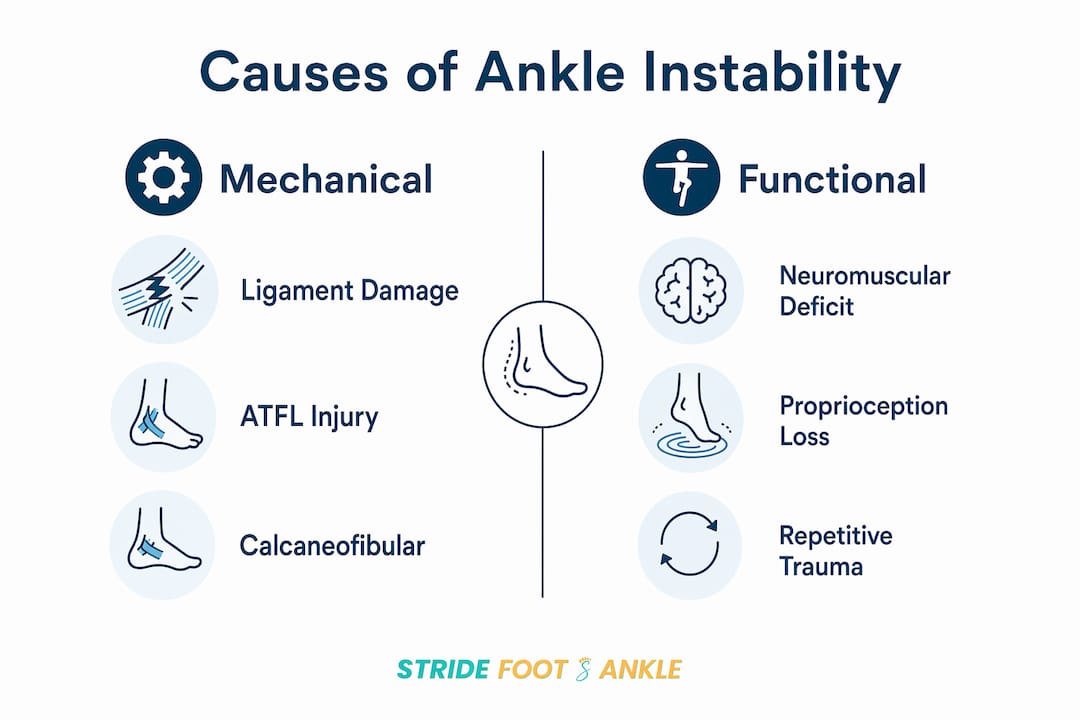
Ankle instability develops from two overlapping problems: mechanical ligament damage and functional neuromuscular deficits. Understanding both is critical because treating only one rarely resolves the condition.
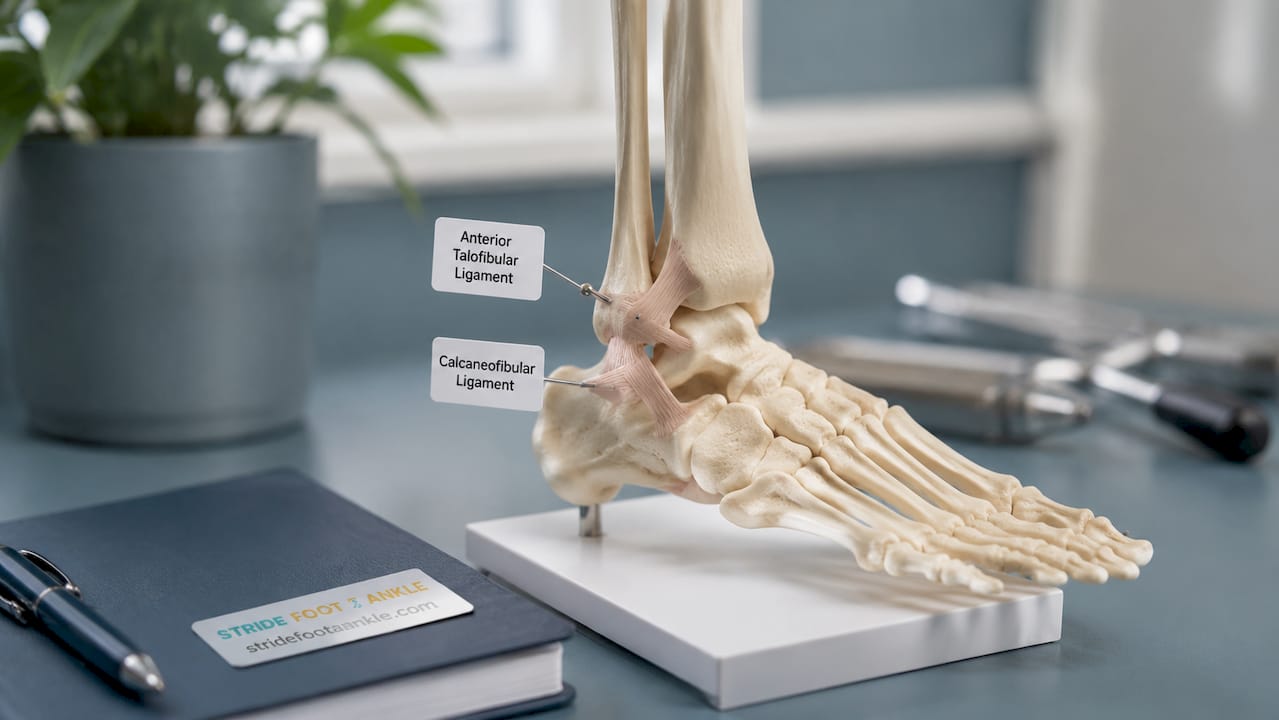
Mechanical instability occurs when ligaments, particularly the anterior talofibular ligament (ATFL) and the calcaneofibular ligament (CFL), are overstretched or torn and heal in a lengthened position. That extra length reduces the ankle’s ability to resist inversion forces, making re-injury far more likely. Hereditary conditions such as Ehlers-Danlos syndrome and Marfan’s syndrome can also cause generalized ligament laxity that predisposes the ankle to instability.
Functional instability is less visible but equally damaging. The ankle relies on proprioception, your body’s internal sense of joint position and movement, to coordinate balance reflexes. A sprain can disrupt the mechanoreceptors within the joint, impairing that feedback loop. The result is an ankle that feels unstable even when ligament laxity is not severe. Research confirms that fewer than half of patients with chronic ankle instability show true clinical laxity on examination, meaning the neuromuscular component is often the dominant driver.
Sports injuries and repetitive trauma are the most common triggers, but a single severe sprain can be enough to start the process. The progression from sprain to instability is not inevitable. It is largely preventable with proper rehabilitation.
How is ankle instability diagnosed?
Diagnosis combines a thorough clinical history, physical examination, and imaging. No single test tells the whole story.
The Anterior Drawer Test (ADT) is the standard starting point. The clinician applies a forward force to the heel while stabilizing the lower leg, assessing how far the talus shifts anteriorly. Excessive displacement suggests ATFL laxity. Physical exam tests like the ADT have variable reliability, though, which is why imaging often follows.
Stress radiography provides a more objective measure of mechanical instability. A healthy ankle typically shows a talar tilt of around 5°; an unstable ankle often measures 15°–20° on stress X-ray. These measurements guide surgical planning when conservative treatment has not resolved the problem.
MRI adds a different layer of information. It visualizes soft tissue structures, including torn or thickened ligaments, cartilage damage, and osteochondral lesions of the talus, which occur in a meaningful proportion of chronic instability cases. MRI is particularly valuable before surgery because it reveals associated injuries that might need to be addressed at the same time.
Pro Tip: If your ankle keeps giving way but your X-rays look normal, ask your provider specifically about stress radiography and MRI. Standard weight-bearing X-rays do not assess ligament integrity.
What are the treatment options for ankle instability?
Conservative treatment is always the first step. Surgery is reserved for cases where the ankle remains unstable despite a full course of rehabilitation.

Conservative approaches
Physical therapy is the cornerstone of non-surgical care. A structured program targets three areas: strength (peroneal muscles and ankle stabilizers), proprioception (balance and joint-position sense), and neuromuscular control (coordinated reflex responses). Neuromuscular training has been shown to improve ankle stability and movement in the early weeks of treatment.
Ankle bracing or splinting provides external support during rehabilitation and reduces re-injury risk while the neuromuscular system recovers. Bracing is not a substitute for exercise, but it plays a real role in protecting the joint during the retraining process. Learn more about ankle bracing options and how they fit into a full recovery plan.
Nonsurgical treatment for ligament injuries also includes activity modification, taping techniques, and targeted proprioceptive exercises that can be progressed over weeks as stability improves.
Surgical options
When ligaments remain too loose despite rehabilitation, surgery becomes appropriate. The most common procedure is the modified Broström repair, which shortens and tightens the ATFL and CFL to restore their original length and tension. In cases where ligament tissue is insufficient, a tendon graft from the lower leg can reconstruct the lateral ligament complex. No clear evidence shows surgery produces better long-term outcomes than rehabilitation alone, but it is the right choice when mechanical laxity is the primary driver and conservative care has failed.
Starting rehabilitation exercises two to three weeks after surgery, rather than waiting six weeks, helps patients return to work and sports faster, according to available study data.
What happens if ankle instability goes untreated?
Ignoring chronic ankle instability does not lead to a stable plateau. The condition tends to worsen with each re-injury.
Every repeated sprain causes additional ligament stretching, cartilage microtrauma, and further disruption of proprioceptive nerve endings. Over time, untreated instability can cause permanent cartilage damage and early-onset osteoarthritis, a painful and largely irreversible outcome. The link between chronic instability and ankle arthritis is well established in the orthopedic literature.
Beyond joint damage, patients often develop chronic pain, reduced mobility, and a loss of confidence in physical activity. That functional decline can affect quality of life far beyond the ankle itself. Getting a specialist evaluation early, rather than waiting to see if the ankle “settles down,” is the decision that protects long-term joint health.
Expert podiatric insights from Stridefootankle
At Stridefootankle, the clinical approach to ankle instability starts from a principle that changes how treatment is designed: this is a brain-ankle connection problem, not just a ligament problem.
Dr. Nahad Wassel and the team at Stridefootankle prioritize neuromuscular retraining as the foundation of recovery, whether a patient is post-sprain or post-surgery. Strengthening the ligaments matters, but retraining the nervous system to respond correctly to balance challenges is what prevents the next sprain. Patients who understand this distinction tend to stay more committed to their rehabilitation programs because the goal shifts from “resting until it feels better” to actively rebuilding a skill.
The diagnostic process at Stridefootankle is thorough by design. A careful history, physical examination, and appropriate imaging are combined before any treatment plan is finalized. That combination, rather than relying on a single test, is what sports medicine research consistently supports for accurate diagnosis of chronic lateral ankle instability.
Patient education is woven into every appointment. When patients understand why proprioceptive exercises matter, and what the imaging actually shows, adherence to conservative foot care improves and outcomes follow.

If your ankle keeps giving way, or if you have had repeated sprains that never fully resolved, Stridefootankle offers personalized evaluation and treatment in Las Vegas. Visit Stride Foot & Ankle’s general care page to request an appointment with Dr. Wassel.
Key Takeaways
Ankle instability is a chronic, treatable condition, and addressing both its mechanical and neuromuscular components is what produces lasting recovery.
| Point | Details |
|---|---|
| Definition and timeline | Ankle instability persists beyond six months after an initial sprain and causes repeated giving-way episodes. |
| How common it becomes | Up to 40% of acute ankle sprains develop into chronic instability without proper rehabilitation. |
| Two root causes | Mechanical ligament laxity and functional proprioceptive deficits both contribute and often coexist. |
| Diagnostic tools | The Anterior Drawer Test, stress radiography (normal tilt ~5°; unstable at 15°–20°), and MRI are used together for accurate diagnosis. |
| Untreated risks | Repeated sprains can cause permanent cartilage damage and early-onset osteoarthritis over time. |
A perspective worth considering
There is a persistent gap between how patients think about ankle instability and what the clinical evidence actually shows. Most people assume a wobbly ankle means a torn ligament that needs surgery or simply more rest. Neither assumption holds up well.
The research is clear that fewer than half of patients with chronic instability have measurable ligament laxity on examination. The real driver, in many cases, is a disrupted feedback loop between the ankle and the brain. That means the most powerful intervention is not a brace, not surgery, and not time off. It is deliberate, progressive neuromuscular training that rebuilds the reflexes the original injury damaged.
What concerns me about how ankle instability is commonly managed is the tendency to treat the symptom rather than the system. Bracing alone keeps the ankle from rolling, but it does nothing to restore the proprioceptive awareness that would have prevented the roll in the first place. Patients who rely on a brace indefinitely without completing a neuromuscular program are managing a deficit, not resolving it.
The other underappreciated point is timing. Starting rehabilitation early, within weeks of injury or surgery, produces measurably better functional outcomes than delayed mobilization. Waiting for pain to fully subside before beginning exercise is not conservative care. It is a missed window.
For patients in Las Vegas dealing with recurring ankle problems, the path forward is a thorough evaluation that separates mechanical from functional instability, followed by a treatment plan that addresses both. That is the standard Stridefootankle holds to, and it is the standard that produces patients who stop coming back for the same injury.
FAQ
What does ankle instability feel like?
Ankle instability typically feels like the ankle is about to give out, especially on uneven surfaces or during physical activity. Patients often describe a combination of wobbliness, chronic dull pain, and recurring sprains that seem to happen with minimal provocation.
How do you fix ankle instability?
Most cases respond to a structured physical therapy program focused on strengthening and proprioceptive retraining, often combined with ankle bracing during recovery. Surgery to tighten or reconstruct the lateral ligaments is considered when the ankle remains unstable after a full course of conservative rehabilitation.
What causes ankle pain in children with instability?
In children, ankle instability and pain most often follow a sprain that was not fully rehabilitated, leaving the ligaments lax and the neuromuscular control system impaired. Pediatric cases warrant specialist evaluation because growing joints respond differently to both injury and treatment.
When should you see a doctor for ankle instability?
See a specialist if your ankle gives way repeatedly, if you have had more than one sprain within six months, or if pain and swelling persist beyond the normal recovery window of a few weeks. Early evaluation prevents the cumulative ligament and cartilage damage that makes the condition harder to treat.
Recommended
- Ankle Sprain: Causes, Treatment, and Recovery Guide – Stride Foot & Ankle – Dr. Nahad Wassel
- What Is Ankle Arthritis? Causes, Symptoms, and Treatment – Stride Foot & Ankle – Dr. Nahad Wassel
- Flat Foot: Causes, Symptoms, and Treatment Options – Stride Foot & Ankle – Dr. Nahad Wassel
- Ankle Sprain Recovery Process: Your 2026 Rehab Guide – Stride Foot & Ankle – Dr. Nahad Wassel
Recent Comments