

Foot neuropathy is nerve damage in the feet that disrupts how sensory, motor, and autonomic nerves function. It causes symptoms ranging from numbness and tingling to burning pain and balance problems. Peripheral neuropathy affects millions of people in the U.S., and the feet are typically the first place symptoms appear because the nerves there are the longest in the body.
Key characteristics of foot neuropathy at a glance:
- Nerve types affected: Sensory nerves (feeling), motor nerves (movement), and autonomic nerves (sweating, circulation)
- Most common cause: Diabetes mellitus, which accounts for the majority of peripheral neuropathy cases in the U.S.
- Symptom onset: Often gradual, starting in the toes and spreading upward
- Risk of progression: Without treatment, nerve damage can worsen and lead to foot ulcers, infections, or falls
- Reversibility: Some causes are treatable; others require long-term management to slow progression
Understanding what foot neuropathy is and catching it early gives you the best chance of protecting your feet and your quality of life.
Table of Contents
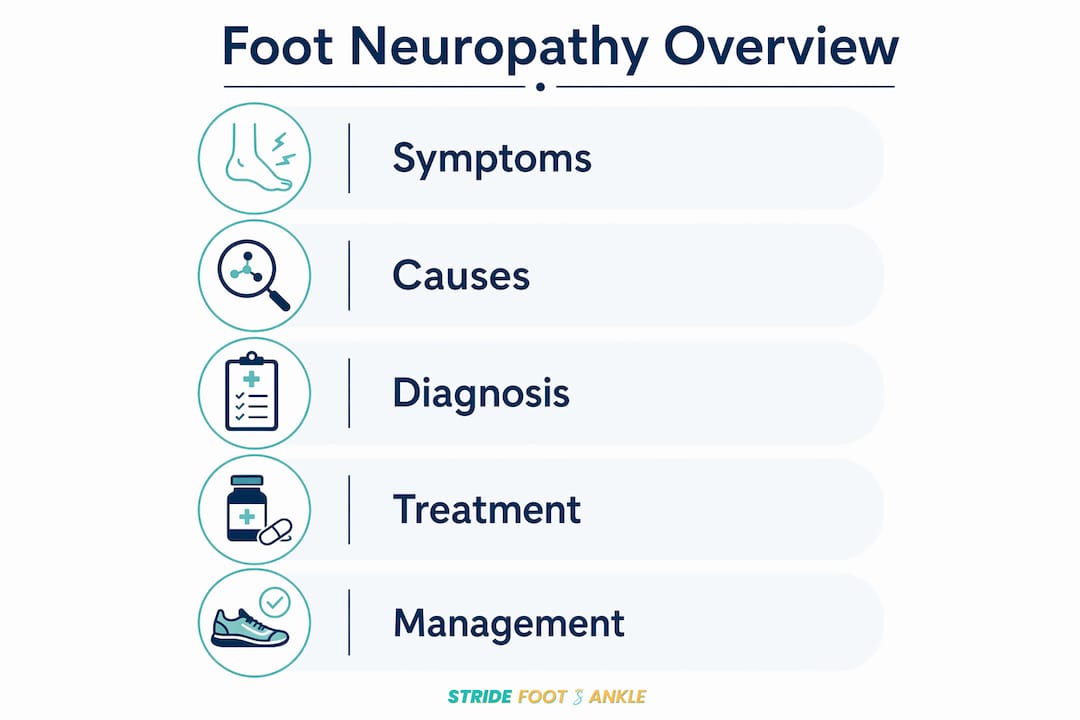
- What are the symptoms and early warning signs of foot neuropathy?
- What causes neuropathy in feet, and who is most at risk?
- How is foot neuropathy diagnosed?
- What are the treatment and management options for foot neuropathy?
- When should you see a doctor about foot neuropathy?
- Expert insights on managing foot neuropathy effectively
- Key Takeaways
- FAQ
What are the symptoms and early warning signs of foot neuropathy?
Foot neuropathy symptoms vary depending on which nerve type is affected, but most patients notice sensory changes first. Burning feet at night, a “pins-and-needles” sensation, or sudden sharp pain in the toes are often the earliest signals. You can learn more about foot numbness causes and how they overlap with neuropathy symptoms.
Common symptoms include:
- Numbness or reduced sensation in the toes, soles, or entire foot
- Tingling or burning that often worsens at rest or during the night
- Sharp, shooting, or electric pain that comes without warning
- Sensitivity to light touch where even a bed sheet causes discomfort
- Loss of balance or coordination due to impaired position sense
- Muscle weakness in the foot or ankle, making walking unsteady
- Inability to feel heat, cold, or injury, which raises the risk of unnoticed wounds
Motor involvement tends to appear later and can cause foot drop or difficulty lifting the front of the foot. Autonomic involvement may produce dry, cracked skin from reduced sweating. Symptoms often progress from the toes upward, and their severity can fluctuate day to day.
Pro Tip: Inspect your feet every evening under good lighting. Look for blisters, cuts, or redness you may not have felt. Patients with reduced sensation frequently discover injuries only after they have already become infected.
What causes neuropathy in feet, and who is most at risk?
Diabetes is the leading cause of peripheral neuropathy in the U.S., eventually affecting roughly half of all people with the condition. High blood sugar damages both the nerves and the small blood vessels that supply them, producing the classic length-dependent pattern where the feet are hit first. But diabetes is far from the only culprit.
Major causes of foot neuropathy:
- Diabetes mellitus: Poor glucose control accelerates axonal damage in distal nerves
- Alcohol misuse: Toxic effects on nerve fibers combined with nutritional deficiencies
- Vitamin deficiencies: Low B12 is a common, treatable cause; deficiencies in B6 and folate also contribute
- Medications: Certain chemotherapy drugs, antiretrovirals, and some antibiotics are neurotoxic
- Infections: HIV, Lyme disease, and shingles can all damage peripheral nerves
- Hereditary conditions: Charcot-Marie-Tooth disease is the most recognized inherited neuropathy
- Autoimmune disorders: Conditions like lupus or Guillain-Barré syndrome trigger nerve inflammation
- Idiopathic causes: In a meaningful portion of cases, no cause is ever identified despite thorough workup
Risk factors that amplify nerve vulnerability include older age, prolonged poor glucose control, heavy alcohol use, and nutritional gaps from restrictive diets or malabsorption. The nerve damage itself can be axonal (the nerve fiber degenerates) or demyelinating (the protective myelin sheath breaks down), and that distinction shapes both diagnosis and treatment.
How is foot neuropathy diagnosed?

Diagnosis starts with a thorough clinical history and physical exam. Your doctor will ask about symptom onset, distribution, and any known risk factors, then test sensation using tools like a monofilament (a thin filament pressed against the skin) and a tuning fork for vibration sense. Monofilament testing is the standard first step for detecting loss of protective sensation and identifying patients at risk for foot ulcers.
Diagnostic approaches used in clinical practice:
- Monofilament and vibration testing: Bedside tools that screen for sensory loss quickly and reliably
- Nerve conduction studies (NCS) and EMG: Measure electrical activity in nerves and muscles; useful for moderate-to-severe cases but less sensitive for small-fiber neuropathy
- Sudomotor testing: Measures sweat response to evaluate autonomic nerve function; a non-invasive option that detects early small-fiber involvement before NCS changes appear
- Blood tests: Fasting glucose, hemoglobin A1c, vitamin B12, and serum protein electrophoresis (SPEP) are recommended by American Academy of Neurology guidelines as first-line tests to identify treatable causes
- Glucose tolerance test (GTT): Ordered when routine glucose testing is normal but neuropathy is present
One important caution: MRI and EMG are frequently overused and add significant cost without often changing the diagnosis or management plan. Simple blood tests remain the most cost-effective starting point. A phenotype-driven approach that classifies neuropathy by its pattern (length-dependent vs. non-length-dependent, small-fiber vs. large-fiber) guides which tests are actually warranted.
What are the treatment and management options for foot neuropathy?

Effective treatment targets two goals simultaneously: correcting the underlying cause and relieving symptoms. For diabetic patients, tight blood sugar control can slow or partially reverse nerve damage. For alcohol-related neuropathy, stopping alcohol and correcting nutritional deficiencies often produces meaningful improvement.
First-line pharmacologic options for neuropathic pain:
- Gabapentin: An anticonvulsant widely used for nerve pain; typically started at a low dose and titrated upward
- Pregabalin: Similar mechanism to gabapentin, with a more predictable dose-response; approved by the FDA specifically for diabetic peripheral neuropathy
- Duloxetine: A serotonin-norepinephrine reuptake inhibitor (SNRI) that addresses both pain and mood, which often co-occurs with chronic neuropathy
- Amitriptyline: A tricyclic antidepressant used at low doses for nerve pain; particularly helpful when sleep disruption is a major complaint
These medication classes are moderately effective for neuropathic pain and are recommended by clinical guidelines, but none eliminate symptoms entirely for most patients. Non-pharmacologic care is equally important.
Non-pharmacologic management:
- Physical therapy: Strengthens foot and ankle muscles, improves balance, and reduces fall risk; physical therapy for foot pain is a core part of long-term management
- Proper footwear: Cushioned, well-fitted shoes and custom orthotics protect insensate feet from pressure injuries
- Gait training: Helps patients compensate for proprioception loss and walk more safely
- Cannabis-based therapies: Some patients explore cannabis for nerve pain as an adjunct; discuss this with your physician before starting
Pro Tip: Combining medication with consistent foot care and physical therapy produces better outcomes than medication alone. Treating the pain without protecting the foot leaves the door open for ulcers and infections.
When should you see a doctor about foot neuropathy?
See a doctor promptly if you notice any of the following:
- Worsening numbness, tingling, or burning that does not resolve
- A foot wound, blister, or sore that is slow to heal or that you did not feel forming
- Muscle weakness causing tripping, foot drop, or difficulty walking
- Balance problems that have led to a near-fall or fall
- Symptoms that are new, rapidly progressing, or affecting both feet symmetrically
Mild or intermittent symptoms still warrant evaluation. Patients who delay care until pain becomes severe miss the window when early intervention has the greatest impact on outcomes. Diabetic patients and others with known risk factors should schedule regular foot exams at least annually, even when they feel no symptoms. Loss of protective sensation can be present and dangerous long before pain begins.
Expert insights on managing foot neuropathy effectively
Clinical experts emphasize several principles that separate good neuropathy care from reactive symptom management:
- Phenotype-first diagnosis: Classifying neuropathy by its pattern (distal axonopathy, small-fiber, autonomic) before ordering tests avoids unnecessary MRIs and EMGs while directing resources toward targeted diagnostic testing that actually changes management
- Early screening in high-risk patients: Focused, pattern-driven screening in primary care catches neuropathy before complications develop, particularly in diabetic patients
- Sudomotor testing for early detection: Standard nerve conduction studies miss small-fiber neuropathy, the most common early form in diabetic feet; sudomotor testing fills that gap non-invasively
- Preventive foot care as a clinical priority: Preventing foot ulcers through protective footwear, daily inspection, and prompt wound care is as clinically important as pharmacologic treatment
- Combined treatment approach: Balancing symptom control with cause management and physical rehabilitation produces the best long-term outcomes per current clinical guidelines
Stridefootankle’s approach to foot neuropathy reflects these principles, with Dr. Nahad Wassel providing personalized, evidence-based care for patients in Las Vegas who need both accurate diagnosis and practical management strategies.
If you are experiencing foot numbness, burning, or pain, the team at Stridefootankle is here to help. Dr. Wassel offers comprehensive foot and ankle care tailored to your specific condition, from early neuropathy screening to advanced treatment planning. Schedule your appointment today and take the first step toward protecting your feet.

Key Takeaways
Foot neuropathy is a progressive nerve condition that requires early detection, cause-specific treatment, and consistent preventive foot care to avoid serious complications like ulcers and falls.
| Point | Details |
|---|---|
| Feet are affected first | Most neuropathies are length-dependent, meaning the feet develop symptoms before other body areas. |
| Diabetes is the top cause | High blood sugar damages nerves and their blood supply, making glucose control central to treatment. |
| Blood tests come before imaging | Fasting glucose, B12, and SPEP are the recommended first-line tests; MRI and EMG are frequently overused. |
| Four first-line medications | Gabapentin, pregabalin, duloxetine, and amitriptyline are the primary pharmacologic options for nerve pain. |
| Safety, not just pain | Loss of protective sensation creates injury risk; daily foot inspection and proper footwear are non-optional. |
FAQ
What are the first signs of neuropathy in your feet?
The earliest signs are typically tingling, burning, or numbness in the toes that often worsens at night. Some patients notice they can no longer feel temperature changes or light touch on the soles of their feet.
Does foot neuropathy go away?
It depends on the cause. Neuropathy from vitamin B12 deficiency or alcohol misuse can improve significantly with treatment, while diabetic neuropathy is usually managed rather than reversed, though good glucose control can slow progression.
How do you treat neuropathy in the foot?
Treatment combines addressing the underlying cause (such as controlling blood sugar) with medications like gabapentin, pregabalin, duloxetine, or amitriptyline for pain, plus physical therapy and protective footwear to prevent injury.
Should you walk a lot with neuropathy?
Moderate walking is generally beneficial for circulation and muscle strength, but patients with significant balance problems or loss of protective sensation should do so with proper footwear and, ideally, guidance from a physical therapist to reduce fall risk.
Recommended
- Foot Numbness: Causes, Diagnosis, and Treatment – Stride Foot & Ankle – Dr. Nahad Wassel
- Flat Foot: Causes, Symptoms, and Treatment Options – Stride Foot & Ankle – Dr. Nahad Wassel
- Foot Pain: Causes, Symptoms, and Treatment Options – Stride Foot & Ankle – Dr. Nahad Wassel
- Nerve Damage: Symptoms, Causes, and Treatment Options – Stride Foot & Ankle – Dr. Nahad Wassel
Recent Comments