

TL;DR:
- Flat foot affects 20 to 30 percent of adults, with symptoms ranging from none to chronic pain impacting the lower limbs and back. Conservative treatments like exercises, orthotics, and proper footwear are effective for most, while surgery remains a last resort for severe or unresponsive cases. Early evaluation and consistent management prevent progression and improve overall foot health and alignment.
Flat foot affects roughly 20 to 30 percent of adults, yet most people either panic unnecessarily or ignore symptoms they should be addressing. The truth sits in the middle. Many flat feet never cause a single problem. Others lead to chronic pain in the ankle, knee, and even the lower back if left unmanaged. This guide cuts through the confusion by explaining what causes flat foot, how to recognize symptoms that warrant attention, and which treatments actually work — from targeted exercises to surgical correction when truly needed.
Table of Contents
- Key takeaways
- What flat foot actually is
- Recognizing symptoms and getting a diagnosis
- Non-surgical treatment options that work
- When surgery becomes the right choice
- Daily self-care and lifestyle management
- My perspective on managing flat foot well
- Get expert flat foot care at Stridefootankle
- FAQ
Key takeaways
| Point | Details |
|---|---|
| Not all flat feet need treatment | Asymptomatic flat foot requires no intervention; pain, fatigue, or instability are the real triggers for care. |
| Type determines treatment | Flexible flat foot responds well to exercises and orthotics; rigid flat foot may require imaging and surgical evaluation. |
| Short foot exercises work | Consistent intrinsic muscle strengthening improves arch height and reduces pain, especially in flexible flat foot. |
| Conservative care comes first | Orthotics, footwear, and physical therapy resolve most symptoms without surgery. |
| Early evaluation prevents bigger problems | Delayed treatment leads to worse outcomes and a higher likelihood of needing surgical intervention. |
What flat foot actually is
Flat foot, also called pes planus, is a condition where the medial longitudinal arch of the foot is reduced or absent, causing the entire sole to make contact with the ground during standing. This can affect one or both feet and may be present from birth or develop over time. It occurs across all ages, and the critical distinction is not whether the arch looks flat. It is whether that flat arch is causing you problems.
The medial longitudinal arch acts as the foot’s natural shock absorber. It distributes body weight across the heel and the ball of the foot, controls how force travels up through the ankle, knee, and hip, and allows for efficient push-off during walking. When the arch collapses, that load distribution shifts and the surrounding muscles, tendons, and joints compensate. Over time, that compensation creates pain.
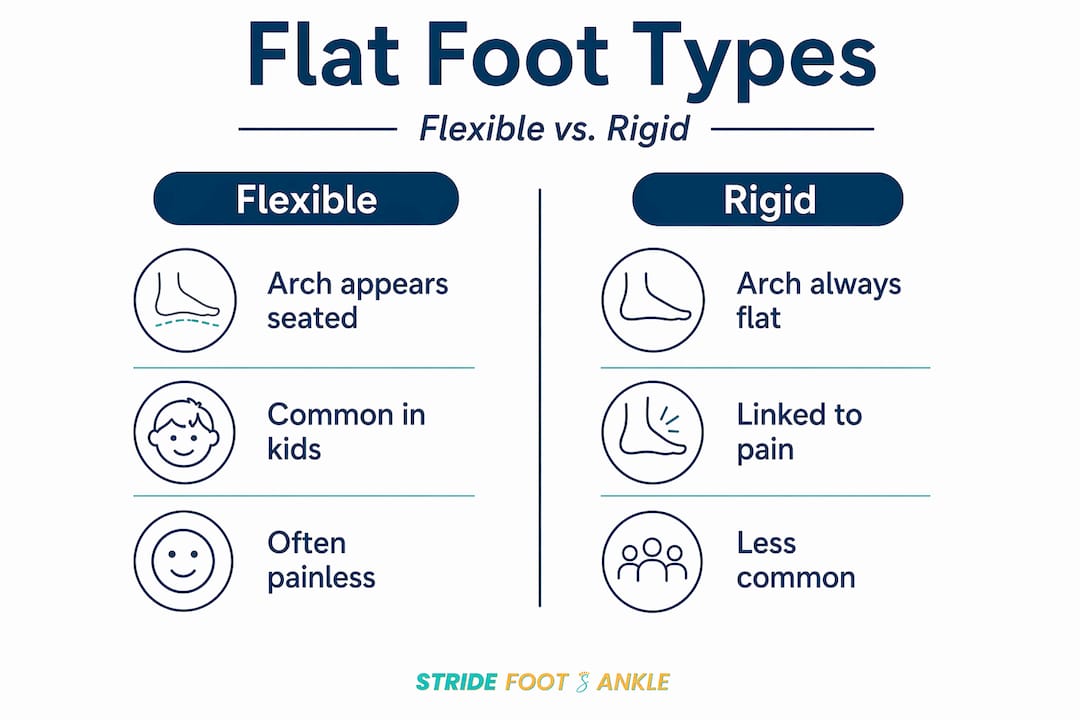
Flexible vs. rigid flat foot
| Feature | Flexible flat foot | Rigid flat foot |
|---|---|---|
| Arch when standing | Absent or reduced | Absent |
| Arch when non-weight-bearing | Present | Still absent |
| Common cause | Ligament laxity, normal variation | Congenital, post-traumatic, tarsal coalition |
| Who it affects most | Children, young adults | All ages; often structural |
| Treatment focus | Exercises, orthotics, footwear | May require imaging, surgical evaluation |
Flexible flat foot is by far the more common type. The arch appears when you lift your foot off the ground or stand on your toes, then flattens again under body weight. Flexible flat foot often resolves spontaneously in children and frequently causes no pain at all in adults. Rigid flat foot is different. The arch is absent regardless of position and does not change with weight-bearing status. This type is more likely linked to structural abnormalities, tarsal coalition (where two foot bones are fused), or significant posterior tibial tendon dysfunction.
Adult-acquired flatfoot is most commonly linked to posterior tibial tendon dysfunction, which involves attenuation, partial tears, or full rupture of the tendon responsible for holding up the arch. Risk factors include obesity, ligament laxity, and tightness in the calf muscles. When this tendon deteriorates progressively, the arch collapses from the inside out.
Pro Tip: If your arch appears when you sit or stand on tiptoe, you likely have flexible flat foot. This is a strong predictor of how well you will respond to conservative treatment.
Recognizing symptoms and getting a diagnosis
Flat foot symptoms range from nothing at all to significant, daily pain. The key is knowing which symptoms signal a problem that deserves attention rather than a wait-and-see approach.
Common symptoms of problematic flat foot include:
- Pain or aching along the inner ankle or arch — often the first sign of posterior tibial tendon stress
- Swelling on the inner side of the ankle — a hallmark of tendon inflammation
- Fatigue in the feet after standing or walking — the muscles are overworking to compensate
- Knee, hip, or lower back pain — misalignment from poor arch mechanics travels upward
- Instability when walking or running — the ankle rolls inward (overpronation) without proper support
- Difficulty standing on tiptoe on the affected foot — a specific red flag for posterior tibial tendon dysfunction
Posterior tibial tendon dysfunction causes progressive arch collapse and pain starting around the ankle, sometimes radiating up the calf. Early management with rest, anti-inflammatory medications, exercises, and orthotics can prevent progression to arthritis or complete tendon rupture.
How flat foot is diagnosed
A podiatrist will typically begin with a weight-bearing observation, watching how your foot looks and functions while you stand and walk. Three specific tests provide critical diagnostic information:
The tiptoe test asks you to rise onto your toes on one foot. A healthy posterior tibial tendon causes the heel to swing outward (inversion) as you rise. If the heel stays flat or you cannot rise at all, tendon dysfunction is likely.
The too many toes sign is viewed from behind. If more than two toes are visible lateral to the heel when you stand normally, the foot is rotating outward excessively, indicating arch collapse.
The Jack test (Hubscher maneuver) involves extending the big toe while standing. In flexible flat foot, this passively recreates the arch. In rigid flat foot, it does not.
Advanced imaging is primarily used for assessing tendon integrity and differentiating flat foot deformity types to guide treatment decisions. X-rays taken weight-bearing measure arch angles and bone alignment, while MRI is reserved for evaluating the posterior tibial tendon when dysfunction is suspected and clinical findings are inconclusive.
Non-surgical treatment options that work
Conservative management resolves the vast majority of symptomatic flat foot cases. The evidence backs this up. Conservative care combining orthotics, exercises, and footwear support is effective in managing adult flexible flat foot and preventing further worsening. The approach works best when it addresses multiple factors simultaneously rather than relying on a single intervention.
Here is a practical, evidence-based framework for non-surgical flat foot treatment:
Start with short foot exercises. These are the single most underused yet highly effective intervention for flat foot. The exercise involves shortening the foot by drawing the ball of the foot toward the heel without curling the toes. This activates the intrinsic plantar muscles directly. Short foot exercises improve arch height and reduce flat foot pain by strengthening the deep muscles that support the arch from below. Perform 3 sets of 10 to 15 repetitions daily, progressing from seated to standing to single-leg standing over four to eight weeks.
Add calf and ankle strengthening. Tightness in the gastrocnemius and soleus muscles places added stress on the posterior tibial tendon. Eccentric heel drops on a step, ankle circles, and single-leg balance training all reduce that load. Physical therapy that targets this area produces measurable improvements in function and pain.
Get properly fitted custom orthotics. Foot orthotics with medial arch support and semi-rigid construction relieve symptoms in symptomatic adult flat foot, particularly when combined with muscle strengthening and appropriate footwear. Over-the-counter insoles help some people but do not address individual arch geometry the way custom orthotics do.
Choose the right footwear. The best shoes for flat feet share several features: motion control or stability category, a firm heel counter that resists inward roll, wide toe box, and moderate cushioning. Running shoes marketed for overpronation are specifically engineered for this. Avoid completely flat footwear like flip-flops and ballet flats; they offer zero arch support and accelerate strain.
Consider physical therapy and taping. Low-Dye taping temporarily supports the arch and reduces pain during activity, making exercise therapy more tolerable in the early stages. Physical therapy for foot pain combines manual therapy, gait retraining, and progressive loading to address the root causes of flat foot symptoms.
Pro Tip: The specific mechanics of short foot exercises matter. Focus on activating the arch without letting the toes curl or grip the floor. Many patients compensate by flexing the toes, which defeats the purpose entirely. Practice in front of a mirror to check your form.
Research confirms that exercise therapy and orthoses combined significantly decrease plantar pressure and alleviate flat foot symptoms in the short term. The challenge, as with most conservative care programs, is maintaining those gains over time, which requires ongoing compliance and lifestyle integration.
| Intervention | What it does | Best for |
|---|---|---|
| Short foot exercises | Strengthens intrinsic muscles, raises arch height | Flexible flat foot, early-stage PTTD |
| Custom orthotics | Redistributes plantar pressure, supports arch | Symptomatic adults, active individuals |
| Stability footwear | Controls overpronation, cushions impact | Daily wear and athletic activity |
| Physical therapy | Gait retraining, strengthening, manual therapy | Moderate to severe symptomatic flat foot |
| Calf stretching | Reduces posterior tibial tendon stress | All flat foot types with calf tightness |
When surgery becomes the right choice
Surgery is not the starting point. It is the last resort when months of consistent conservative care have not delivered adequate relief, or when structural deformity is severe enough that non-surgical approaches cannot realistically correct it.
Situations where surgical intervention may be appropriate include:
- Failed conservative management — at least three to six months of orthotics, physical therapy, and footwear modification without meaningful improvement
- Severe rigid flat foot — particularly when caused by tarsal coalition or significant structural deformity present since childhood
- Advanced posterior tibial tendon dysfunction — Stage III or IV, where the tendon is ruptured, the arch has completely collapsed, and arthritis has developed in the surrounding joints
- Significant pain limiting daily function — when walking, working, or basic activities have become genuinely difficult
Surgical procedures are reserved for severe or rigid flat foot not responding to conservative care. Common operations include lateral column lengthening (to correct foot alignment), medial displacement calcaneal osteotomy (repositioning the heel bone), subtalar fusion (locking a joint for stability in arthritic cases), and tendon transfer or repair for posterior tibial tendon damage.
Recovery from flat foot surgery typically involves six to twelve weeks non-weight-bearing in a cast or boot, followed by a structured rehabilitation program. Post-surgical rehabilitation is not optional. Rebuilding strength, flexibility, and gait mechanics after surgery is what determines long-term success. Most patients return to normal activity within six to twelve months, with outcomes depending heavily on the severity of deformity before surgery and the quality of post-operative care.
Daily self-care and lifestyle management
What you do every day has more impact on your flat foot symptoms than most people realize. Long-term symptom control comes from building consistent habits, not just attending appointments.
Practical steps to manage flat foot symptoms at home:
- Manage body weight. Every extra pound adds roughly four pounds of force through the foot during walking. Obesity is a recognized risk factor for posterior tibial tendon dysfunction, and even modest weight reduction reduces arch strain significantly.
- Rotate your footwear. Never wear the same pair of shoes every single day. Alternating between two pairs allows cushioning to recover and reduces repetitive stress on the same pressure points.
- Avoid prolonged barefoot walking on hard surfaces. Tile, concrete, and hardwood floors offer no arch support and increase tendon fatigue. Supportive sandals or slippers at home matter more than most people think.
- Do your exercises consistently. Adherence and foot type predict outcomes for short foot exercise programs. Five minutes of focused exercise daily beats an hour-long session once a week.
- Notice worsening symptoms early. Sudden increases in pain, new swelling around the ankle, or a feeling that your arch has “given way” are signs to seek professional evaluation promptly rather than pushing through.
Pro Tip: Las Vegas summers mean more time in sandals and lightweight footwear. That seasonal shift catches many flat foot patients off guard. If your symptoms worsen every summer, footwear is almost certainly the cause. Plan ahead and choose sandals with built-in arch support.
You can find practical foot home care guidance for managing symptoms between professional appointments, including specific footwear advice suited to the Las Vegas climate and active lifestyle.
My perspective on managing flat foot well
I have worked with enough flat foot patients to see a clear pattern. Most people who come in with significant pain waited far too long. They dismissed aching feet as normal fatigue, pushed through discomfort at work, and told themselves it was not serious enough for a doctor visit. By the time they arrived, what could have been resolved with six weeks of exercises and new orthotics had become a more complex problem requiring months of care.
In my experience, the single most underrated intervention is the short foot exercise. Patients who actually learn the correct technique and stick with it for eight weeks consistently report meaningful improvements in pain and walking endurance. The word “consistently” is doing a lot of work in that sentence. Compliance is the real obstacle, not the exercise itself. I now spend the first appointment teaching the exercise in detail, having patients demonstrate it back to me, and framing it as a non-negotiable part of their daily routine rather than an optional add-on.
What I find equally important is pairing exercises with custom orthotics from the start in moderate-to-severe cases. The orthotic handles the structural support while the exercise builds the active muscular support underneath. Neither works as well in isolation. Treatment plans must be individualized, reflecting each patient’s flat foot type, symptom severity, and activity level. A teacher on their feet for eight hours a day needs a different plan than someone working from home.
Managing flat foot is not just about foot pain. When the arch mechanics improve, so does the loading pattern all the way up the kinetic chain. I have seen knee pain, hip discomfort, and even lower back issues resolve in patients who prioritized their flat foot treatment. Start striding confidently by treating what your feet are telling you.
— Ramil
Get expert flat foot care at Stridefootankle
If your feet have been aching, fatiguing quickly, or showing any signs of arch collapse, you do not have to figure it out alone. At Stridefootankle, Dr. Nahad Wassel provides personalized, evidence-based care for flat foot patients in Las Vegas — from precise diagnosis to treatment plans built around your specific condition, activity level, and goals.
Whether you need custom orthotics, a structured exercise program, or guidance on whether surgery is the right path forward, Stridefootankle covers the full spectrum of flat foot and ankle care. The clinic combines thorough clinical evaluation with patient-centered treatment planning so you leave with a clear understanding of your condition and a realistic path to relief. Persistent flat foot symptoms only get more complex with time. Schedule your evaluation today and start getting the answers your feet deserve.
For patients weighing their options before committing to surgery, the conservative pain relief program at Stridefootankle is specifically designed to help you avoid the operating room whenever possible.
FAQ
Does flat foot always cause pain?
No. Many people with flat foot are completely asymptomatic and never require treatment. Pain, fatigue, instability, or swelling are the indicators that evaluation and treatment are warranted.
What exercises help most with flat foot?
Short foot exercises, which activate intrinsic plantar muscles without toe curling, are the most evidence-backed option. Consistent practice over four to eight weeks improves arch height, gait mechanics, and pain levels, particularly in flexible flat foot.
What shoes are best for flat feet?
Stability or motion control shoes with a firm heel counter, medial arch support, and a wide toe box provide the most effective flat foot support. Avoid completely flat footwear like flip-flops, which accelerate tendon strain.
Can flat foot in children correct itself?
Yes. Flexible flat foot often resolves spontaneously in children as the arch develops, typically by ages eight to ten. Evaluation is recommended if the child experiences pain, the flat foot is rigid, or it persists beyond that age range.
When is flat foot surgery necessary?
Surgery is considered when three to six months of conservative care have failed to relieve symptoms, or when the flat foot deformity is rigid and severe. Common procedures include tendon repair, osteotomy, and in advanced cases, joint fusion to restore function and reduce pain.
Recommended
- What is pediatric foot pain? A parents’ guide to causes and care – Stride Foot & Ankle – Dr. Nahad Wassel
- Toe walking in children: Causes, treatments, and when to seek help – Stride Foot & Ankle – Dr. Nahad Wassel
- Guide to Common Pediatric Foot Problems: Causes, Signs, Care – Stride Foot & Ankle – Dr. Nahad Wassel
- General Foot & Ankle Care – Stride Foot & Ankle
Recent Comments