

TL;DR:
- Proper home removal of corns and calluses involves soaking, gentle filing, applying keratolytic creams, and pressure relief over several weeks. Avoid aggressive tools, sharp cuts, and neglecting footwear modifications to prevent recurrence and infection. Consistent care and professional evaluation are essential for safe, lasting results.
Corn and callus removal is defined as the gradual softening, filing, and moisturizing of thickened skin on the feet, combined with pressure relief to prevent regrowth. The standard corn and callus removal steps recommended by podiatrists include soaking, gentle filing with a pumice stone, applying urea or salicylic acid cream, and using protective padding. Skipping any one of these phases, especially pressure relief, causes the skin to rebuild within weeks. This guide walks you through each step in detail, with safety tips and prevention strategies grounded in podiatric practice.
What tools and preparations do you need for corn and callus removal at home?
Safe removal starts with the right setup. Gathering your tools before you begin prevents interruptions and reduces the risk of over-filing or introducing bacteria to softened skin.
Essential supplies
- Warm water basin large enough to soak both feet comfortably
- Mild soap or Epsom salts to soften skin and reduce inflammation
- Pumice stone or foot file with a medium-grit surface for gradual reduction
- Urea-based moisturizer (20–40% urea concentration) or salicylic acid cream (17% liquid or 40% pads)
- Donut-shaped felt pads or silicone toe separators to offload pressure during healing
- Clean towel and nail brush to keep the area hygienic before and after treatment
Hygiene matters as much as technique. Rinse your pumice stone or foot file with hot water and mild soap after every use. A contaminated tool can introduce bacteria to freshly filed skin, which is more vulnerable than intact skin. Let tools air dry completely between sessions.
Pro Tip: Set your water temperature between 98°F and 104°F. Water that is too hot strips natural oils and leaves skin more prone to cracking after filing.
A note for high-risk patients
Patients with diabetes or poor circulation face a higher risk of infection from any break in the skin. Reduced sensation means you may not feel when you have filed too deeply. If you have diabetes, peripheral neuropathy, or vascular disease, skip medicated pads and sharp tools entirely and consult a podiatrist before attempting home removal.
| Supply | Purpose | Notes |
|---|---|---|
| Pumice stone or foot file | Gradual mechanical reduction of thickened skin | Medium grit; never use on broken skin |
| Urea moisturizer (20–40%) | Chemical softening and hydration | Apply after filing, not before |
| Salicylic acid pads (40%) | Targeted keratolytic treatment for corns | Apply to corn only, not surrounding skin |
| Felt donut pads | Pressure redistribution during healing | Available at most pharmacies |
| Epsom salt soak | Softens skin before filing | 1–2 tablespoons per gallon of warm water |
What are the step-by-step instructions to safely remove corns and calluses at home?
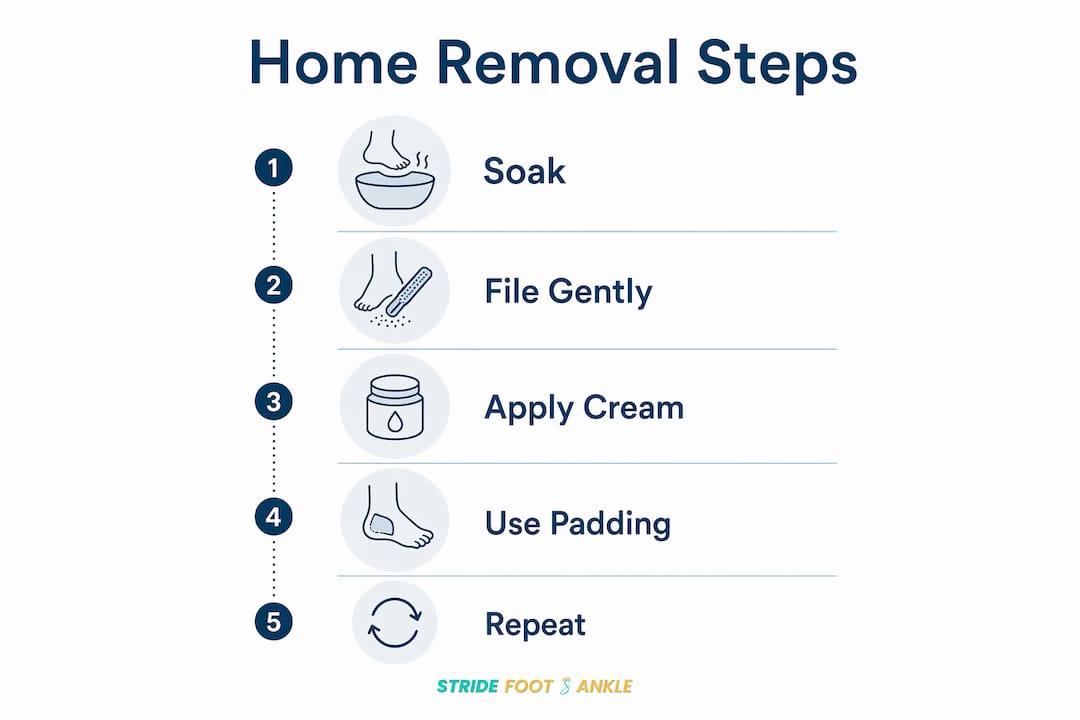
The safest approach to removing corns and calluses at home follows five sequential steps: soak, file gently, apply a keratolytic cream, protect with padding, and repeat consistently over several weeks. Consistent home care with daily soaking and urea moisturizing produces visible softening within days and near-resolution within 4–6 weeks when pressure is also addressed.
Step 1: Soak to soften the skin
Fill your basin with warm water and add mild soap or Epsom salts. Soak your feet for 10–15 minutes. This softens the thickened keratin layer, making it easier to file without excessive force. Softening reduces the effort needed and lowers the risk of tearing healthy skin. Pat your feet dry with a clean towel before moving to the next step. Do not rub aggressively, as freshly soaked skin is more delicate.
Some patients find that adding apple cider vinegar diluted 1:2 with warm water enhances softening. Castor oil applied after soaking also hydrates thick skin and reduces friction between the corn and your shoe. These natural softening methods work best as complements to, not replacements for, consistent filing and moisturizing.
Step 2: File gently with a pumice stone or foot file
Apply the pumice stone or foot file to the thickened area using light, circular strokes. Work in one direction rather than back and forth, which reduces friction heat on the skin. File for no more than 60–90 seconds per session. Stop immediately if you see pink or red skin, which signals you have reached healthy tissue.
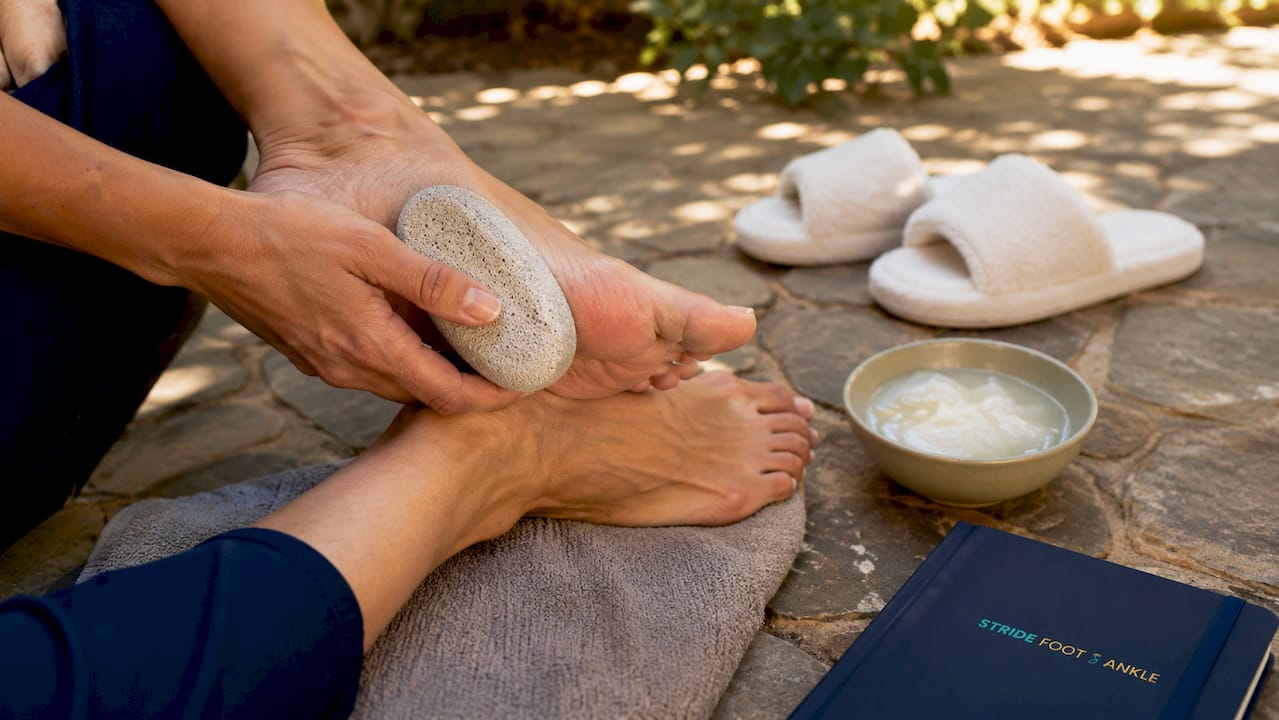
Gradual reduction over several sessions is safer and more effective than aggressive filing, which causes painful raw skin and delays healing. Think of each session as removing one thin layer. Over two to four weeks, those layers add up to meaningful reduction without injury.
Pro Tip: File only after soaking, never on dry skin. Dry filing on hardened callus requires far more pressure and dramatically increases the chance of tearing into healthy tissue.
Step 3: Apply a keratolytic cream
Keratolytic means “skin-dissolving.” These creams chemically break down the bonds holding dead skin cells together, accelerating the softening that filing starts mechanically.
Two options work best:
- Urea-based cream (20–40%): Apply a generous layer to the corn or callus after filing. Cover with a sock overnight to lock in moisture. Urea is gentler and suitable for daily use on calluses.
- Salicylic acid (17% liquid or 40% pads): Salicylic acid is the only over-the-counter treatment with significant clinical evidence. Soak for 5–10 minutes, dry the area, and apply the product directly to the corn only. Leave it on for 24–48 hours, then repeat weekly. Significant improvement typically appears within 4–8 weeks.
Apply salicylic acid products only to the thickened skin, not the surrounding healthy tissue. Use a small piece of petroleum jelly around the corn to protect the border if needed. Urea cream can be applied more broadly to the entire callused area.
Step 4: Protect with padding
Removing thickened skin without offloading the pressure that caused it produces a short-lived result. Donut-shaped felt pads and silicone toe separators redistribute weight away from the affected area during healing. These devices do not remove corns, but they relieve pain and prevent the mechanical stress that drives regrowth.
Place a donut pad so the corn or callus sits in the center hole, not under the pad itself. This shifts pressure to the surrounding tissue. For corns between toes, a silicone toe separator holds the digits apart and eliminates the friction that created the corn in the first place. Change pads daily to maintain hygiene.
Step 5: Repeat consistently over weeks
One session produces minimal visible change. The real results come from repeating this routine daily for soaking and moisturizing, and weekly for salicylic acid applications. Expect pain reduction by days 3–7, roughly 50–80% improvement by day 14, and near-resolution by weeks 4–6 when pressure is also addressed. That timeline assumes you are also wearing appropriate footwear and using padding between sessions.
Consistency beats intensity every time. A patient who soaks and moisturizes daily for six weeks will outperform one who files aggressively once a week. The skin responds to steady, gentle signals, not force.
How do you avoid common mistakes when removing corns and calluses?
The most dangerous mistake in home corn removal is using a razor blade, nail scissors, or any sharp cutting tool on thickened skin. Cutting creates open wounds that can become infected, especially in patients with reduced circulation or sensation. Pharmacies sell “corn cutters” that look like small razors. Avoid them entirely.
Here are the most common errors and how to prevent them:
- Filing too aggressively: Raw, red skin after filing means you went too deep. Stop, apply an antibiotic ointment, and cover with a bandage. Resume filing only after the skin heals completely.
- Applying salicylic acid to healthy skin: The acid dissolves any skin it contacts. Protect surrounding tissue with petroleum jelly before each application.
- Skipping moisturizer: Filing without moisturizing leaves skin dry and prone to cracking. Cracked skin around a callus is painful and can become infected.
- Expecting overnight results: Thickened skin built up over months. It takes weeks of consistent care to reduce it safely.
- Ignoring footwear: Continuing to wear tight or narrow shoes while treating a corn guarantees regrowth. No amount of filing overcomes ongoing mechanical pressure.
“Patients with diabetes or poor circulation must avoid medicated corn pads and cutting corns at home. Poor healing and numbness increase infection risk from self-treatment, and what begins as a minor skin issue can escalate to a serious wound requiring medical intervention.”
Seek professional evaluation if you notice increasing pain, redness spreading beyond the corn, warmth, discharge, or any sign of infection. Patients with diabetes and foot complications should not attempt home removal at all. A podiatrist can remove the corn safely in a single visit using sterile instruments, with little to no discomfort.
What long-term strategies prevent corns and calluses from coming back?
Removing a corn without addressing its cause is like mopping a floor while the tap is still running. Pressure and friction are the direct triggers for skin thickening, and only removing those triggers stops regrowth permanently.
Footwear adjustments
Shoes are the most common cause of corns and calluses. Narrow toe boxes compress the toes, creating friction on the outer surfaces. High heels shift body weight forward onto the ball of the foot, generating calluses under the metatarsal heads. The fix is straightforward: choose shoes with a wide toe box, adequate arch support, and a heel no higher than one inch for daily wear.
Moisture-wicking socks reduce friction by keeping the skin dry. Cotton socks absorb sweat but hold moisture against the skin. Synthetic or wool-blend socks wick moisture away, reducing the friction coefficient between skin and shoe.
Orthotics and toe separators
Custom orthotics redistribute body weight across the entire foot, eliminating the pressure hotspots that produce calluses. They are particularly effective for patients with flat feet, high arches, or abnormal gait patterns. Over-the-counter insoles provide some benefit, but custom devices address your specific biomechanics. For guidance on managing foot pain at home, including pressure relief strategies, a structured approach makes a measurable difference.
Silicone toe separators work well for soft corns between the toes. They hold the digits in a neutral position, eliminating the skin-on-skin contact that drives corn formation.
Routine maintenance
| Strategy | Benefit | Frequency |
|---|---|---|
| Daily moisturizing with urea cream | Keeps skin supple and prevents thickening | Every evening |
| Weekly light filing after soaking | Removes surface buildup before it hardens | Once per week |
| Proper footwear selection | Eliminates mechanical pressure triggers | Every time you dress |
| Custom orthotics | Corrects biomechanical pressure distribution | Ongoing, as prescribed |
| Podiatrist check-up | Catches structural issues early | Annually or as needed |
Routine foot care maintenance keeps skin soft and prevents the buildup cycle from restarting. Patients who moisturize daily and file weekly rarely develop significant calluses, even with active lifestyles. The goal is not to eliminate all skin thickening, which is a normal protective response, but to keep it at a level that does not cause pain or restrict movement.
When corns or calluses return repeatedly despite good home care, a structural foot issue is likely driving the problem. Bunions, hammertoes, and flat feet all create abnormal pressure patterns that no amount of filing will permanently resolve. A podiatrist can assess your gait and foot structure and recommend targeted interventions.
Key takeaways
Safe, consistent corn and callus removal requires soaking, gentle filing, keratolytic cream, pressure relief, and footwear correction applied together over 4–6 weeks for lasting results.
| Point | Details |
|---|---|
| Soak before every filing session | Warm water for 10–15 minutes softens skin and reduces injury risk during filing. |
| Use salicylic acid or urea cream | Salicylic acid (17–40%) has the strongest clinical evidence; urea cream suits daily callus care. |
| Never cut corns with sharp tools | Razors and scissors create open wounds and serious infection risk, especially for diabetic patients. |
| Address pressure sources | Without footwear changes or orthotics, corns and calluses regrow regardless of removal technique. |
| Expect 4–6 weeks for full results | Consistent daily care produces near-resolution within 4–6 weeks when pressure is also managed. |
What I have learned from years of watching patients treat their own feet
The single biggest mistake I see is impatience. Patients soak once, file hard, and expect the corn to disappear by morning. When it does not, they file harder the next day and end up with raw, painful skin that sets them back two weeks. The skin does not respond to force. It responds to consistency.
The second misconception I encounter regularly is that professional corn removal must be painful. The thickened keratin in a corn lacks nerve endings, which means a skilled podiatrist can remove it layer by layer with a sterile scalpel and patients feel little to nothing. Most people are genuinely surprised. They expected pain and got relief instead.
What I find most telling is how rarely patients connect their shoes to their corns. A patient will faithfully follow every home care step, see improvement, then slip back into the same narrow dress shoes and wonder why the corn returned in six weeks. The shoe is the problem. The corn is just the symptom.
My honest advice: follow the five steps in this guide with patience and discipline. If you have done everything right for six weeks and the corn is still painful or growing, stop self-treating and see a podiatrist. Some structural problems, like a prominent metatarsal head or a rigid hammertoe, require professional intervention to resolve. Home care is powerful, but it has limits. Knowing when to cross that line is part of good foot care too.
— Ramil
Stride Foot & Ankle: professional care when home treatment is not enough
Stubborn or recurrent corns and calluses sometimes need more than a pumice stone and patience. At Stridefootankle, Dr. Nahad Wassel provides in-office corn and callus care that removes thickened skin safely in a single visit, with minimal discomfort. Professional debridement reaches clearance rates that home filing simply cannot match.

Stridefootankle also offers personalized orthotics fitting and footwear guidance to address the biomechanical causes that drive regrowth. If your corns keep coming back, or if you have diabetes, poor circulation, or significant foot pain, a professional evaluation is the right next step. Patients in Las Vegas can request an appointment online and get back to walking comfortably without guesswork or risk.
FAQ
What is the difference between a corn and a callus?
A corn is a small, focused area of thickened skin with a hard central core, typically found on the tops or sides of toes. A callus is a broader, flatter patch of thickened skin that forms on weight-bearing areas like the heel or ball of the foot.
How long does it take to remove a corn at home?
Consistent home care with daily soaking and urea moisturizing produces visible softening within days and near-resolution within 4–6 weeks, provided the pressure source is also addressed.
Can I use salicylic acid on a corn between my toes?
Salicylic acid is not recommended for soft corns between the toes. The moist environment between digits increases the risk of skin irritation and chemical burns. Use silicone toe separators and urea cream instead.
When should I see a podiatrist for a corn or callus?
See a podiatrist if the corn is painful despite two weeks of home care, if you notice redness, warmth, or discharge, or if you have diabetes or poor circulation. Professional debridement is safe, largely painless, and often resolves the issue in one visit.
Does removing a corn hurt?
Home filing on softened skin causes minimal discomfort when done correctly. Professional removal is largely painless because the thickened keratin layer of a corn lacks nerve endings, allowing a podiatrist to pare it down without affecting healthy tissue.
Recommended
- Corns and Calluses: Causes, Treatment, and Prevention – Stride Foot & Ankle – Dr. Nahad Wassel
- Treating Warts on the Feet – Stride Foot & Ankle – Dr. Nahad Wassel
- Step-by-step foot care routines for pain relief – Stride Foot & Ankle – Dr. Nahad Wassel
- Step-by-step foot care guide for Las Vegas residents – Stride Foot & Ankle – Dr. Nahad Wassel
Recent Comments