

TL;DR:
- Most childhood ankle sprains can be managed at home by protecting the ankle, applying ice, and monitoring for serious signs. If a child cannot bear weight, has deformity, or reports numbness, they should seek urgent medical care immediately. Early movement and criterion-based rehabilitation help prevent long-term instability and facilitate a safe return to sport.
Most suspected ankle sprains in children can start with safe home care right away. Protect the ankle, apply ice wrapped in a towel for 20 minutes every 2–4 hours, add a snug compression wrap, and keep the foot elevated. Watch for red flags: if your child cannot bear any weight, has visible deformity, or reports numbness, go to urgent care or the ER now.
Do right now:
- Stop the activity and have your child rest the ankle
- Apply a wrapped ice pack for 20 minutes — never ice directly on skin
- Wrap with an elastic bandage (snug, not tight enough to cut off circulation)
- Elevate the foot above heart level on pillows
Avoid in the first 48–72 hours:
- Heat, hot baths, or heating pads
- Massage on the injured area
- Letting your child “walk it off” through severe pain
Red flag: If your child cannot take even a few steps with support, has numbness, or the ankle looks deformed, skip home care and seek imaging today.
The American Academy of Pediatrics (AAP), Children’s Hospital of Philadelphia (CHOP), and Stridefootankle all align on this starting point: protect, control swelling, and watch carefully.
Table of Contents
- What is an ankle sprain in children, and how serious can it get?
- What signs and symptoms should you watch for?
- How do you care for a sprained ankle at home in the first 72 hours?
- Simple rehab exercises to start at home (and when to progress)
- When should you take your child to see a doctor?
- How do clinicians diagnose an ankle sprain?
- What is the typical recovery timeline by sprain grade?
- How can you prevent future ankle sprains?
- What does current research say about treating ankle sprains?
- Key Takeaways
- What we tell parents in the clinic
- Stride Foot & Ankle is here when home care isn’t enough
- Reliable sources for parents who want to go deeper
- FAQ
What is an ankle sprain in children, and how serious can it get?
An ankle sprain is a stretch or tear of one or more ligaments that hold the ankle joint together. Lateral ankle sprains account for about 15% of all reported acute, non-severe youth sports injuries, making them the single most common sports injury in kids.
The three main ligaments involved are:
- Anterior talofibular ligament (ATFL): the most commonly injured, on the outer front of the ankle
- Calcaneofibular ligament (CFL): runs along the outer side
- Posterior talofibular ligament (PTFL): injured only in the most severe cases
Inversion vs. eversion: An inversion sprain happens when the foot rolls outward (the far more common type). An eversion sprain happens when the foot rolls inward, stressing the inner ligaments.
Sprain grades at a glance:
- Grade I (mild): ligament stretched, minor swelling, child can usually bear weight
- Grade II (moderate): partial tear, notable swelling and bruising, walking is painful
- Grade III (severe): complete tear, significant instability, weight bearing is very difficult or impossible
One critical pediatric difference: in younger children, growth plates are biomechanically weaker than the surrounding ligaments. A severe twist that would sprain an adult’s ankle can fracture a child’s growth plate instead. Clinicians keep a low threshold for X-ray when a young child cannot bear weight or has focal bone tenderness.
What signs and symptoms should you watch for?
The most common signs of a pediatric ankle sprain are pain on the outer ankle, swelling that appears within minutes to hours, bruising that may develop over 24–48 hours, and difficulty walking normally.
Typical symptom progression:
- Immediate pain and tenderness along the outer ankle
- Swelling begins within 30–60 minutes and peaks around 24–48 hours
- Bruising (discoloration) appears within 1–2 days and may spread downward toward the foot
- Pain with any movement that rotates or stresses the ankle
Sprain vs. possible fracture — what to look for:
| Sign | Likely sprain | Suspect fracture |
|---|---|---|
| Weight bearing | Painful but possible | Unable to take 4 steps |
| Bone tenderness | Soft tissue, not directly on bone | Pinpoint tenderness on bone |
| Deformity | None | Visible angulation or bump |
| Swelling location | Diffuse, over ligament | Focal, over specific bone |
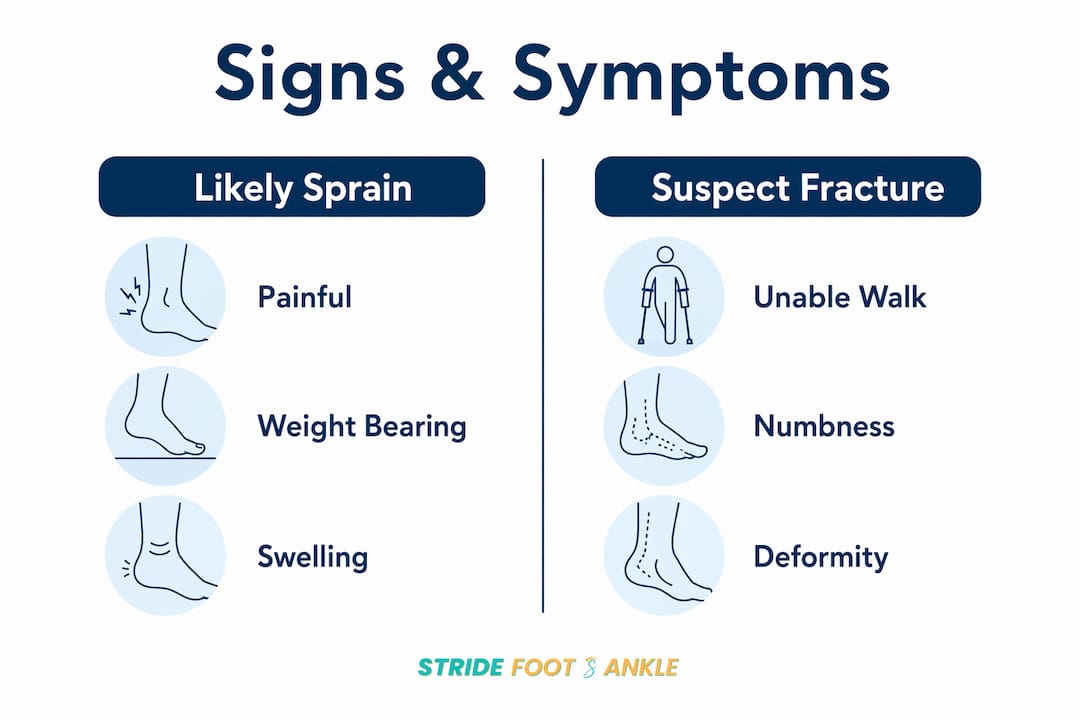
Pro Tip: Try a supported weight-bearing test: have your child take 4 steps with your hand for support on a flat surface. If they can do it, even with a limp, a fracture is less likely. If they refuse or cry out in severe pain, stop immediately and seek evaluation.
How do you care for a sprained ankle at home in the first 72 hours?
Protect the ankle, control swelling, and allow gentle early movement as pain permits. That three-part goal covers everything you need to do in the first three days.
Step-by-step home care:
- Protect: Have your child stop the activity. A lace-up ankle brace or elastic wrap provides support. Crutches are appropriate if walking causes significant pain.
- Ice: Wrap an ice pack or bag of frozen peas in a thin towel. Apply for 20 minutes every 2–4 hours as needed. Remove immediately if skin turns red or numb.
- Compress: Wrap with an elastic bandage from the toes upward. Check that toes stay warm and pink — rewrap if they feel cold or tingly.
- Elevate: Keep the ankle above heart level when resting, especially in the first 24 hours.
- Early movement: After the first 24–48 hours, encourage gentle ankle pumps and circles as pain allows. Prolonged immobility causes stiffness and slows recovery.
R.I.C.E. vs. P.E.A.C.E. & L.O.V.E.: The classic R.I.C.E. method (Rest, Ice, Compression, Elevation) focused on symptom control. Modern sports-medicine guidance, the P.E.A.C.E. & L.O.V.E. framework, shifts the emphasis toward early optimal loading and education rather than strict rest. In practice, this means: avoid prolonged immobilization, start pain-limited motion within 24–72 hours, and treat ice and anti-inflammatories as comfort tools rather than healing strategies.
Pain medication: Acetaminophen (Tylenol) is generally the first choice for children. Ibuprofen (Advil, Motrin) can help with pain and swelling but check dosing by weight with your pediatrician or pharmacist. Avoid aspirin in children. Short-term use of ibuprofen for pain control is reasonable, but routine heavy use may interfere with the natural healing process — use the lowest effective dose for the shortest time needed.
Signs home care isn’t enough: swelling that worsens after 48 hours, pain that is not improving after 5–7 days, or your child still refusing to bear weight.
Simple rehab exercises to start at home (and when to progress)
Early gentle motion and progressive loading speeds recovery when done safely and within pain limits. Starting movement within the first few days prevents stiffness and helps restore the neuromuscular control that protects against re-injury.
Phase-based progression:
- Days 1–3 (acute): Ankle pumps (flex and point the foot slowly, 10–15 reps, 3×/day) and ankle circles. Seated, pain-limited.
- Days 3–14 (early rehab): Ankle alphabet (trace each letter of the alphabet with the big toe, keeping the leg still). Add seated heel raises when pain allows.
- Weeks 2–4 (intermediate): Single-leg balance — stand on the injured foot for 20–30 seconds, progress to eyes closed. Use a wall for safety.
- Weeks 4–6+ (late/sport-specific): Light jogging, lateral shuffles, sport-specific drills when the criteria below are met, following a graduated return-to-sport plan to ensure safe progression.
Pro Tip: Make exercises fun. Set a timer and challenge your child to hold a single-leg balance while tossing a ball back and forth. Use a sticker chart to track daily exercise sessions. Kids who treat rehab as a game stick with it far better than those who treat it as a chore.
Return-to-play checklist (based on AAP criterion-based guidance):
- Full, pain-free range of motion in all directions
- Normal walking gait with no limp
- Single-leg balance equal to the uninjured side
- Able to hop on the injured foot without pain
- Completed sport-specific drills (cutting, jumping) without swelling or pain afterward
When should you take your child to see a doctor?
Go to urgent care or the ER immediately if your child cannot bear weight at all, has visible deformity, reports numbness or tingling, has uncontrolled pain, or the skin is broken near the injury.
Urgent red flags — seek care today:
- Cannot take 4 steps even with support
- Visible angulation or deformity of the ankle
- Numbness, tingling, or loss of sensation
- Severe swelling that develops within minutes
- Focal bone tenderness directly over the fibula or heel bone
- Open wound near the injury site
Non-urgent reasons to see a clinician within 1–2 weeks:
- Pain that is not improving after 5–7 days of home care
- Swelling that persists beyond 2 weeks
- Repeated ankle sprains or a feeling of the ankle “giving way”
- Your child is limping consistently or avoiding activity
Which clinician to choose: Your pediatrician or an urgent care clinic handles most initial evaluations and can order X-rays. For persistent instability, repeated sprains, or slow recovery, ask for a referral to a sports-medicine physician, pediatric orthopedist, or a podiatrist specializing in foot and ankle care. Stridefootankle offers pediatric ankle evaluation and can coordinate imaging when needed.
How do clinicians diagnose an ankle sprain?
Most ankle sprain diagnoses are clinical, based on the injury history and physical exam. X-rays are ordered when a fracture is suspected or when the Ottawa ankle rules indicate imaging is needed.
Typical exam steps:
- Review of how the injury happened (mechanism, direction of force)
- Visual inspection for swelling, bruising, and deformity
- Palpation for focal bone tenderness along the fibula, tibia, and heel
- Range-of-motion assessment
- Weight-bearing test (4 steps)
- Ligament stress tests (anterior drawer, talar tilt)
Ottawa ankle rules (parent-friendly version): An X-ray is recommended if your child has bone tenderness at the back edge of either ankle bone or the heel, or cannot bear weight. These rules guide X-ray decisions and have been validated in pediatric populations.
When advanced imaging is used:
- MRI: persistent pain beyond 6 weeks, suspected cartilage (osteochondral) injury, or high ankle sprain
- Ultrasound: real-time assessment of ligament integrity in some clinical settings
- Growth-plate note: in children under 12, clinicians maintain a low threshold for X-ray because physeal fractures can mimic sprains when the growth plate is involved
What is the typical recovery timeline by sprain grade?
Mild sprains heal within about 3–14 days; moderate sprains require about 2–6 weeks; severe sprains often require 6–12 or more weeks, depending on how consistently rehab is followed.
| Grade | Typical healing time | Common interventions |
|---|---|---|
| Grade I (mild) | 3–14 days | Home care, elastic wrap, early ROM exercises |
| Grade II (moderate) | 2–6 weeks | Walking boot if needed, physical therapy, progressive loading |
| Grade III (severe) | 6–12+ weeks | Boot or splint, PT, possible specialist referral; surgery rarely needed |
Functional milestones before returning to sport (per MGH pediatric rehab protocol):
- Pain-free full range of motion
- Normal gait with no compensation
- Single-leg balance and hop performance at least 80–90% of the uninjured side
- Completion of sport-specific drills without pain or swelling
Skipping rehab is the most common reason children re-sprain the same ankle. Completing the full progression — even after pain resolves — significantly lowers the risk of chronic instability. For a detailed phase-by-phase plan, the ankle sprain recovery guide at Stridefootankle walks through each stage.
How can you prevent future ankle sprains?
Most reinjuries are preventable with consistent neuromuscular training and appropriate footwear or bracing when returning to sport.
Prevention steps by age:
- Toddlers and young children: Prioritize well-fitting shoes with a stable sole. Avoid flip-flops and worn-out sneakers for active play. Encourage balance games like stepping stones, balance beams, and hopscotch.
- School-age children: Add single-leg balance drills to warm-ups before sports. Practice lateral shuffles and direction changes at low speed.
- Teens: Structured neuromuscular training programs (balance board work, plyometric progressions, peroneal strengthening) reduce re-sprain risk. A lace-up ankle brace during return to sport is supported by evidence, particularly after a first sprain.
When bracing helps: Bracing is most useful during the return-to-sport phase and for the first 6–12 months after a moderate or severe sprain. It does not replace strengthening but adds a mechanical safety margin while neuromuscular control rebuilds. Taping is an alternative for teens who prefer it, though it loses effectiveness after about 20 minutes of activity.
What does current research say about treating ankle sprains?
Modern guidance emphasizes early controlled loading and education — the P.E.A.C.E. & L.O.V.E. framework — rather than prolonged rest alone.
R.I.C.E. vs. P.E.A.C.E. & L.O.V.E. — what changes at home:
| Principle | R.I.C.E. | P.E.A.C.E. & L.O.V.E. |
|---|---|---|
| Rest | Complete rest advised | Protect, then load early as pain allows |
| Ice | Standard recommendation | Use for comfort; avoid prolonged icing |
| Anti-inflammatories | Routinely used | Avoid routine use; may blunt healing |
| Movement | Delayed | Start pain-limited motion within 24–72 hours |
| Education | Not emphasized | Central — explain the process to the child |
A 2025 randomized study in adolescents found that both the traditional PRICE approach and the P.E.A.C.E. & L.O.V.E. framework produced comparable short-term improvements in strength, range of motion, and dynamic balance over 12–15 weeks. Neither approach showed a statistically significant advantage. The practical takeaway: early movement and education matter as much as ice and rest.
The NSAID nuance: Short-term ibuprofen use for pain control in children is generally safe and reasonable. However, researchers caution that routine heavy use may blunt the inflammatory processes needed for collagen remodeling and tissue repair. Use pain medication to keep your child comfortable enough to move, not to eliminate all sensation of the injury. Always confirm dosing with your pediatrician. For a closer look at nonsurgical ligament care, Stridefootankle covers conservative approaches in detail.
Key Takeaways
Most ankle sprains in children respond well to early home care, progressive rehab, and criterion-based return to sport — with urgent evaluation needed only when red flags are present.
| Point | Details |
|---|---|
| Start home care immediately | Ice with a towel barrier for 20 minutes every 2–4 hours; compress, elevate, and protect the ankle. |
| Know the red flags | Inability to bear weight, deformity, or numbness means go to urgent care or the ER now. |
| Move early, not late | Start gentle ankle pumps and circles within 24–72 hours to prevent stiffness and speed recovery. |
| Return to sport by function, not calendar | Use the AAP criterion-based checklist: pain-free ROM, normal gait, and successful hop tests before full return. |
| Stridefootankle for local evaluation | Parents in Las Vegas can schedule a pediatric ankle evaluation at Stridefootankle when home care isn’t enough or red flags appear. |
What we tell parents in the clinic
When a child comes in with a suspected ankle sprain, the first priority is ruling out a fracture. That means a careful history of how the injury happened, hands-on palpation for bone tenderness, and a weight-bearing assessment. If the Ottawa ankle rules are met, we order X-rays. If imaging is clear, we confirm the sprain grade, explain what healing looks like, and send the family home with a simple, specific plan.
Most families are relieved to hear that Grade I and II sprains rarely need surgery or even a formal physical therapy referral if the home plan is followed carefully. We walk through the ice protocol, the compression wrap, and the first exercises before the family leaves. For Grade III sprains or children with repeated instability, a referral to physical therapy or a specialist is the right next step.
At Stridefootankle, the approach is the same: evaluate thoroughly, rule out what’s serious, and give parents a clear path forward. You shouldn’t leave a clinic visit wondering what to do next.
Stride Foot & Ankle is here when home care isn’t enough
When your child’s ankle isn’t improving as expected, or you want a professional evaluation to rule out a fracture or growth-plate injury, Stridefootankle provides focused foot and ankle care in Las Vegas.

Relevant services include clinical ankle evaluation, imaging coordination, conservative pediatric care (bracing, guided rehab, activity modification), and surgical options for the rare cases that need them. For parents who want a clear diagnosis and a concrete plan, scheduling a podiatrist appointment is straightforward online.
For emergencies — severe deformity, open wounds, or complete inability to bear weight — go directly to the nearest ER or urgent care. Stridefootankle is the right next step for non-emergency evaluation and ongoing foot and ankle care when you want a specialist’s eyes on the injury.
Reliable sources for parents who want to go deeper
- HealthyChildren.org (AAP): AAP treatment phases, return-to-sport criteria, and age-specific guidance for pediatric ankle sprains
- Children’s Hospital of Philadelphia (CHOP): Practical home-care instructions, ice safety, and when to seek evaluation
- MGH Pediatric Rehabilitation Protocol: Phase-based rehab protocol with objective return-to-sport criteria used in academic sports-medicine settings
- PMC — P.E.A.C.E. & L.O.V.E. vs. PRICE in adolescents: 2025 randomized study comparing rehabilitation frameworks in adolescent lateral ankle sprains
- Annals of Joint — Pediatric ankle and foot injuries: Peer-reviewed review of diagnosis, treatment, and surgical considerations specific to pediatric athletes
When in doubt, follow your child’s clinician’s guidance over any general web resource, including this one.
FAQ
Can my child walk on a sprained ankle?
For Grade I sprains, walking with mild discomfort is generally fine and encouraged. If your child cannot take 4 steps with support, or walking causes severe pain, seek evaluation to rule out a fracture.
How long does a sprained ankle take to heal in a child?
Mild sprains typically take about 3–14 days to heal; moderate sprains usually require about 2–6 weeks; severe sprains may take 6–12 or more weeks, depending on rehabilitation and severity.
Should I use ice or heat on my child’s sprained ankle?
Use ice only, wrapped in a towel, for the first 48–72 hours. Heat and massage increase blood flow and can worsen swelling during the acute phase, so both should be avoided early on.
When does a child need an X-ray for an ankle injury?
An X-ray is recommended when your child cannot bear weight, or when there is focal bone tenderness along the ankle bones or heel. Clinicians use the Ottawa ankle rules to guide this decision, and younger children get extra consideration because growth-plate injuries can mimic sprains.
How do I know when my child is ready to return to sports?
Return to sport should be based on function, not time. Your child should have full, pain-free range of motion, a normal gait, single-leg balance close to the uninjured side, and the ability to complete sport-specific drills without pain or swelling afterward.
Recommended
- Why Do Kids Need Ankle Surgery? A Parent’s Guide – Stride Foot & Ankle – Dr. Nahad Wassel
- Ankle Sprain: Causes, Treatment, and Recovery Guide – Stride Foot & Ankle – Dr. Nahad Wassel
- Ankle Sprain Recovery Process: Your 2026 Rehab Guide – Stride Foot & Ankle – Dr. Nahad Wassel
- Pediatric Ingrown Toenails: A Parent’s Complete Guide – Stride Foot & Ankle – Dr. Nahad Wassel
Recent Comments