

Most Las Vegas patients pay between $200 and $500 out of pocket for in-office ingrown toenail removal, with insured patients often owing just a copay of $20 to $60. Your best next move: call a podiatry office directly and ask them to verify your insurance benefits before you book, since an accurate quote depends on your specific plan and the procedure your toenail actually needs.
- Self-pay range for a standard in-office procedure: roughly $200 to $500
- Insured patients: typically a specialist copay or coinsurance after deductible
- In-office podiatric treatment costs far less than an ER visit for the same problem
Key Takeaways
Definitive in-office treatment, usually partial avulsion with phenol matricectomy, costs somewhat more upfront than a simple trim but avoids the repeat expense of recurrence.
| Point | Details |
|---|---|
| Typical Las Vegas self-pay range | Budget $200 to $500 for a standard in-office procedure, per national cost data. |
| Insurance changes the math | Insured patients often owe just a specialist copay once the deductible is met. |
| Procedure choice drives price | Phenol matricectomy costs more than simple avulsion but lowers recurrence significantly. |
| Avoid the ER when possible | Emergency room visits for the same problem often exceed $1,000. |
| Verify before you book | Stride Foot & Ankle offers insurance-verified estimates and same-week appointments for definitive treatment. |
This article is general information, not a substitute for advice from a qualified doctor. Consult a qualified healthcare professional about your own circumstances before acting on anything here.
Table of Contents
- How Much Does Ingrown Toenail Removal Cost in Las Vegas?
- What Makes One Quote Higher Than Another?
- Which Procedure Type Fits Your Toenail, and What Does It Cost?
- How Do Insurance and Payment Options Actually Work?
- What Happens During the Visit and Recovery?
- Why Choose Stride Foot & Ankle for Ingrown Toenail Care in Las Vegas?
- How Long Does It Take From Consultation to Procedure?
- What Are the Cancellation and Rescheduling Policies at Local Clinics?
- Sources
- FAQ
How Much Does Ingrown Toenail Removal Cost in Las Vegas?
National data on ingrown toenail procedures shows a wide spread, and Las Vegas pricing sits inside that same range rather than outside it. Cost surveys report self-pay averages of $200 to $500 for routine in-office procedures, with the full national range stretching from $150 for a simple, single-nail trim to as much as $1,500 for complex or recurrent cases treated in a surgical setting.
Here’s the number that matters for budgeting purposes: a healthy adult with one infected corner and no prior surgery on that toe should expect a mid-range quote in an office setting, whether insured or paying cash.
- Uninsured, single-corner partial avulsion in-office typically costs a reasonable amount
- Insured, deductible already met: usually a low specialist copay
- Insured, deductible not met: patient pays negotiated rate depending on plan
Urgent care and emergency rooms handle the same problem, but at a markup. Cost calculators note that ER visits for ingrown toenail issues often exceed $1,000 once facility fees and physician charges stack up. That price gap exists mainly because ERs bill a facility fee designed for emergency triage, not routine podiatric work. An ER trip makes sense only when the toe shows signs of spreading infection, fever, or you cannot get a podiatry appointment for several days and the pain is severe.
What Makes One Quote Higher Than Another?
Two patients with the “same” ingrown toenail can receive very different quotes, and the gap almost always comes down to severity, procedure choice, and setting. A mild case treated early costs less than a nail that has been infected for weeks and developed granulation tissue.
- Severity and infection: a red, swollen toe with drainage takes longer to treat and may need antibiotics on top of the procedure
- Procedure components: local anesthesia, chemical matricectomy, and pathology review of removed tissue each add a line item
- Facility setting: an outpatient surgery center or ER charges a facility fee that a standard podiatry office visit does not
- Bilateral or recurrent cases: treating both sides of the nail, or a toe that has already failed a prior removal, typically pushes the estimate higher
Pro Tip: Ask any clinic for a written, itemized estimate before you agree to the procedure. A quote that lists the CPT code, anesthesia, and any facility fee separately is far easier to compare against your insurance benefits than a single lump-sum number.
Which Procedure Type Fits Your Toenail, and What Does It Cost?
The label on your treatment plan changes the price more than almost anything else, because each procedure type carries a different level of complexity and a different recurrence rate. Understanding the options helps you compare quotes on equal footing.
- Partial nail avulsion: removes just the ingrown border of the nail; appropriate for a first-time, mild to moderate case; typically the least expensive option at $150 to $300 self-pay
- Partial avulsion plus phenol matricectomy: the ingrown edge is removed and a chemical (phenol) is applied to the nail root to stop regrowth; this is the most common definitive treatment because it lowers recurrence significantly compared to avulsion alone, and it runs somewhat higher, often $250 to $500
- Total nail avulsion with surgical matrixectomy: removes the entire nail and root surgically, reserved for severe, recurrent, or structurally deformed nails; usually priced at $400 to $800 or more depending on setting
- Vandenbos procedure (wedge excision): removes soft tissue around the nail fold rather than nail matrix; less common, generally reserved for chronic or difficult cases, with a longer healing window and cost that varies by surgeon
Recurrence data explains why the phenol option dominates: simple avulsion without matricectomy can recur in a large share of patients over time, while partial avulsion combined with phenol matricectomy drops recurrence into the single digits in several studies. Paying a bit more upfront for the matricectomy often avoids paying twice.
How Do Insurance and Payment Options Actually Work?
Your out-of-pocket cost depends on three things: whether the procedure is coded as medically necessary, where you stand on your deductible, and whether the clinic charges a separate facility fee. Getting a real answer takes a five-minute phone call, not a guess.
- Call your insurer and ask whether ingrown toenail removal (CPT codes typically in the 11730 to 11765 range) is covered as medically necessary, and what your specialist copay or coinsurance is
- Call the clinic and ask for the exact CPT code they plan to bill, whether a facility fee applies, and whether they offer a cash-pay discount
- If you’re on Medicare, confirm whether the visit meets medical necessity criteria, since Medicare generally covers treatment for infected or symptomatic ingrown toenails but not routine trimming
- Request a written, itemized estimate before scheduling, including anesthesia and any expected follow-up visit charges
- Ask whether payment plans or third-party medical financing are available if you’re paying cash
Platforms that publish upfront self-pay pricing report in-office ranges around $221 to $393 nationally, which gives uninsured patients a useful benchmark when price-shopping local clinics.
Pro Tip: If your deductible resets in January, timing a non-urgent procedure for late December versus early January can change your out-of-pocket cost by hundreds of dollars.
What Happens During the Visit and Recovery?
A standard in-office ingrown toenail removal is quick, and most patients resume normal footwear within a short recovery period. Knowing the timeline in advance helps you plan time off work and budget for aftercare supplies.
- You check in and the podiatrist examines the toe and confirms the procedure plan
- A local anesthetic (often a ring block) numbs the toe completely before anything is touched
- The procedure itself, whether partial avulsion or avulsion with phenol matricectomy, takes roughly 10 to 30 minutes
- The toe is dressed, aftercare instructions are given, and you walk out the same day
Most patients resume light daily activity soon after the procedure, although full healing of the nail bed can take several weeks, especially following matricectomy. A follow-up visit within one to two weeks lets the podiatrist confirm healing and catch any early infection. Clinics often bundle a follow-up check into the original quote, but antibiotics or extra wound care visits add cost if infection develops. Watch for: increasing redness, spreading warmth, or pus after the first few days, which are signs to call the clinic rather than wait for your scheduled follow-up. Dermatology references describe advanced ingrown toenails as showing severe inflammation and granulation tissue at this stage, which is exactly the presentation that pushes a case toward surgical matricectomy rather than a simple trim.
Why Choose Stride Foot & Ankle for Ingrown Toenail Care in Las Vegas?
Stride Foot & Ankle is led by a board-certified foot and ankle surgeon, Dr. Nahad Wassel, who treats ingrown toenails ranging from mild, first-time cases to recurrent nails that have failed treatment elsewhere. The practice’s approach favors definitive, in-office treatment over repeat trims that never solve the underlying problem.
- Board-certified surgical training means both conservative and surgical options are available under one roof, without an unnecessary referral
- The front office verifies insurance benefits and can provide either an insurance-verified estimate or a straightforward cash-pay price before you commit to a date
- Same-week appointments are typically available, which matters when a toe is too painful to wait
- Pre-procedure instructions and aftercare support are explained clearly so you know what to expect at every step
If you’re weighing conservative care against surgical removal, the clinic can walk you through which option fits your specific nail before any charges are finalized.
How Long Does It Take From Consultation to Procedure?
Most patients move from their first call to a completed procedure in under a week, and severe cases are often seen even faster. This is one of the more reassuring facts about ingrown toenail care: it rarely requires a long wait.

A typical timeline looks like this: you call and describe your symptoms, the front desk checks for a same-week opening, and if the toe is actively infected or very painful, many practices will fit you in within one to three business days. For a milder case with no urgency, scheduling within the same week is standard. The actual consultation and procedure frequently happen in the same visit. The podiatrist examines the toe, confirms which procedure fits (partial avulsion versus avulsion with phenol matricectomy), and if you consent, proceeds right then rather than scheduling a separate surgical date.
That single-visit model matters for cost planning because it means you’re generally not paying for two separate office visits: one exam and one procedure. Exceptions exist. A toe with severe infection may need a short course of oral antibiotics first, pushing definitive treatment out a few days until swelling subsides. Recurrent or structurally complex nails sometimes warrant imaging or a more detailed surgical plan, which can add a short delay. But for the majority of first-time or straightforward recurrent cases, expect a phone call, a same-week exam, and a same-day procedure, with a follow-up visit scheduled roughly one to two weeks out to confirm healing.
What Are the Cancellation and Rescheduling Policies at Local Clinics?
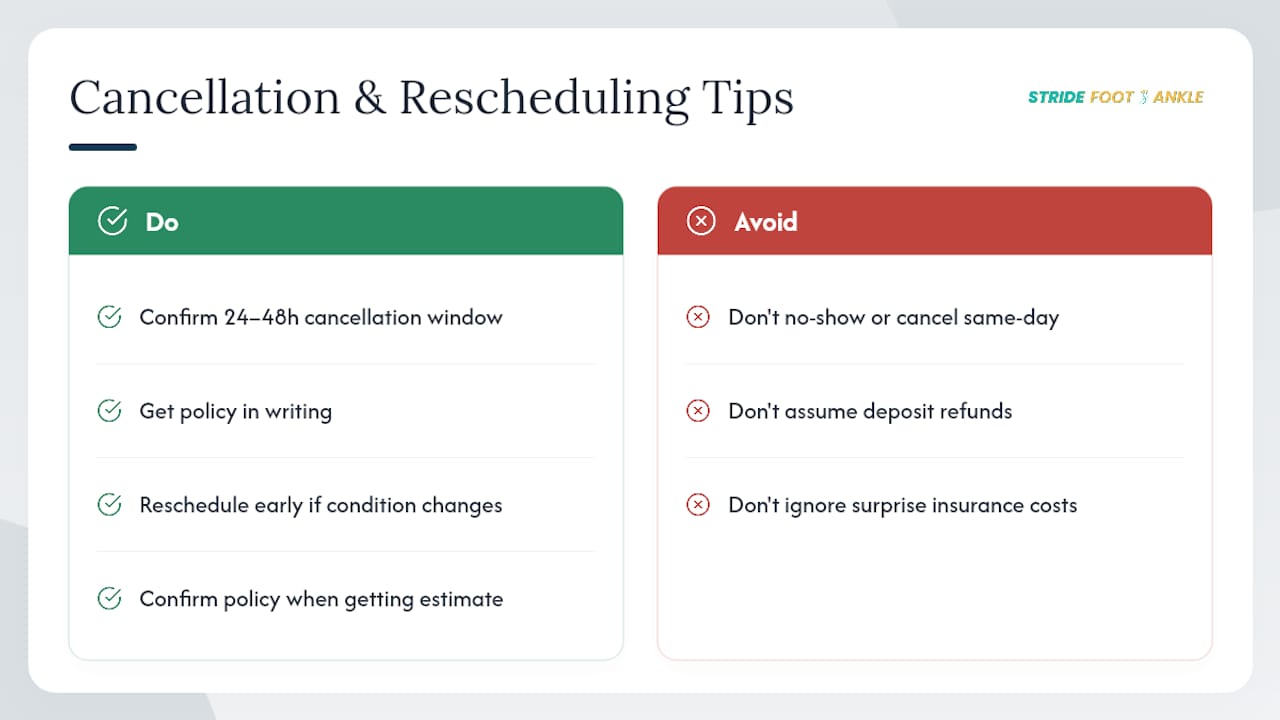
Most Las Vegas podiatry offices, including specialty and general medical practices, require 24 to 48 hours’ notice to cancel or reschedule an appointment without a fee, and it’s worth confirming this detail when you book. Same-day cancellations or no-shows commonly carry a flat fee, though policies vary by clinic and are typically explained at scheduling or listed on intake paperwork.
If you need to reschedule an ingrown toenail procedure because the infection has worsened or improved on its own, call as early as possible. Clinics generally prefer patients reschedule rather than no-show, since an open procedure slot for a same-week condition is valuable to other patients waiting in pain. Refund situations are uncommon for in-office podiatry since payment is usually collected at time of service rather than prepaid, but if you’ve paid a deposit for a scheduled surgical slot and need to cancel, ask directly what portion, if any, is refundable.
One practical note: if your insurance verification comes back with an unexpected cost after you’ve already scheduled, most clinics will let you reschedule while you sort out the estimate rather than penalizing you, but this varies. Always ask the specific clinic’s policy in writing, especially if you’re booking around a busy period or a Las Vegas convention week when appointment slots fill quickly. Pro Tip: Confirm the cancellation window at the same time you confirm your estimate, so you have both numbers, the price and the policy, in one call.
A note on transparent pricing
Patients rarely regret paying a little more upfront for a definitive procedure. I’ve seen the pattern repeat in cost data across clinics: someone chooses the cheapest simple avulsion, the nail regrows ingrown within a year, and they pay for a second procedure that a phenol matricectomy would have prevented the first time. Ask for an itemized estimate before you book, and ask specifically why one procedure costs more than another.
Get an Insurance-Verified Estimate From Stride Foot & Ankle
Stride Foot & Ankle gives Las Vegas patients a direct alternative to guessing at ER pricing or bouncing between urgent care visits that only offer temporary relief. Call the office or submit an online request, and the team will verify your insurance benefits and give you either a copay estimate or a straightforward cash-pay price before you commit to anything.

The practice accepts most major insurance plans, and self-pay patients can ask about cash pricing directly when they call. Because Dr. Wassel offers both conservative management and surgical matricectomy under one roof, you get a definitive treatment plan rather than a temporary fix that sends you back for a second round of costs. If your toe is painful, red, or has been bothering you for more than a few days, visit the general foot and ankle care page to request a same-week appointment and get your out-of-pocket number in writing before you walk in.
Sources
- Ingrown toenail — DermNet NZ
- Ingrown toenails — StatPearls / NCBI Bookshelf
- Ingrown Toenail Cost: What You’ll Really Pay in 2026 | HowMuchSurgeryCost
- Ingrown Toenail Removal (in office) — MDsave
FAQ
How much does it normally cost to get an ingrown toenail removed?
In-office removal typically runs $200 to $500 self-pay nationally, with insured patients often paying only a copay after meeting their deductible.
Where can I get an ingrown toenail removed in Las Vegas?
A board-certified podiatry practice like Stride Foot & Ankle handles both conservative and surgical ingrown toenail treatment locally, with same-week appointments generally available.
What does a stage 3 ingrown toenail look like?
A stage 3 ingrown toenail shows severe inflammation, granulation tissue, and often drainage, and it typically requires surgical intervention rather than home care.
Will urgent care remove an ingrown toenail?
Urgent care can sometimes perform a temporary partial avulsion, but a definitive in-office matricectomy from a podiatrist is generally more durable and often less costly than repeated urgent care visits.
Recommended
- Step-by-step foot care guide for Las Vegas residents – Stride Foot & Ankle – Dr. Nahad Wassel
- Toenail Treatment Near Me: Same-Week Las Vegas Care – Stride Foot & Ankle – Dr. Nahad Wassel
- Best Podiatrist Las Vegas: How to Choose the Right Foot and Ankle Specialist – Stride Foot & Ankle – Dr. Nahad Wassel
Recent Comments