

Most patients need several weeks for the bulk of recovery and a few months for full, unrestricted activity after cheilectomy. You’ll typically walk in a surgical shoe within days, transition to a regular sneaker after about two weeks, and return to sports or physically demanding work after two months or more.
- 0–2 weeks: Protected walking in a surgical shoe, stitches out around day 14
- 2–6 weeks: Transition to a supportive sneaker, swelling still present
- 6–12 weeks: Return to sports, running, and physical labor jobs
- 3–6 months: Full recovery, with swelling and stiffness fully resolved
Individual factors change this considerably. A desk worker with mild arthritis often bounces back faster than someone who had additional procedures, has diabetes, or smokes.
Key Takeaways
Cheilectomy recovery typically spans six to twelve weeks for most daily activities and three to six months for full, unrestricted function, with individual timelines shaped by job demands and underlying joint health.
| Point | Details |
|---|---|
| Early mobility | Walking in a surgical shoe usually starts within days, with sutures out around two weeks. |
| Shoe transition | Most patients switch to a roomy lace-up sneaker at the two-week follow-up visit. |
| Sports and impact activity | Running and high-impact sports generally wait until 10 to 12 weeks post-surgery. |
| Full recovery window | Swelling and stiffness typically resolve completely by three to six months. |
| Local follow-up care | Stride Foot & Ankle provides in-person wound checks and individualized rehab planning throughout recovery. |
Table of Contents
- What Is a Cheilectomy and Who Needs It?
- How Should You Prepare Before Surgery?
- What Happens the Day of Surgery and the First 48 to 72 Hours?
- What Does the Full Cheilectomy Recovery Timeline Look Like?
- How Do You Manage Pain and Care for the Incision?
- When Can You Return to Work, Driving, and Sports?
- When Should You Start Physical Therapy and Rehab Exercises?
- What Complications Should You Watch For?
- What Can You Do to Speed Up Recovery?
- What Should Stride Foot & Ankle Patients Expect During Recovery?
- Sources
- FAQ
What Is a Cheilectomy and Who Needs It?
A cheilectomy is a surgery that shaves away bone spurs and inflamed tissue at the top of the big toe joint to restore upward bending motion and relieve pain during push-off. Surgeons remove the bony overgrowth, called an osteophyte, that jams the joint when you try to bend your toe upward while walking.
Cheilectomy is used for:
- Early to moderate hallux rigidus (big toe joint arthritis)
- Bone spurs that block dorsiflexion, the upward bend of the toe
- Pain concentrated at push-off during walking or running, without advanced joint collapse
The procedure is almost always outpatient and same-day, performed under local anesthesia with sedation or a regional ankle block. You go home the same afternoon.
How Should You Prepare Before Surgery?
The best cheilectomy recovery starts before the operation, not after it. Arrange your ride home, adjust blood thinners or NSAIDs as your surgeon directs, and set up a recovery station at home before your surgery date.
- Confirm which medications to pause and which to continue
- Line up a driver, since anesthesia rules out driving yourself home
- Buy a roomy lace-up sneaker for week two, one size larger than usual to accommodate swelling
- Stock ice packs, gauze, and a pillow or footrest for elevation
- Request at least three days off work for pain control and elevation, per standard surgical rehab guidance
Reading how to prepare for foot surgery a week or two ahead gives you time to actually act on the checklist instead of scrambling the night before.
Pro Tip: Set up your recovery chair before surgery day, not after. A low, padded footrest positioned so your foot sits above heart level makes the first 72 hours noticeably more comfortable, and you won’t be hunting for pillows while hobbling around on a numb foot.

What Happens the Day of Surgery and the First 48 to 72 Hours?
Cheilectomy is typically outpatient surgery, and you’ll go home the same day wearing a bulky dressing and a rigid-soled surgical shoe. Anesthesia wears off within a few hours, and most patients can walk carefully in the surgical shoe almost immediately, though weight-bearing feels awkward at first.
Expect pain to peak in the first two days and start improving by day three, according to standard post-op instructions. Keep the foot elevated above heart level as much as possible for the first 48 hours, with ice applied in 20-minute intervals.
- Take scheduled acetaminophen or an NSAID as directed, since staying ahead of pain works better than chasing it
- Opioids, when prescribed, are usually meant for the first two to three nights only
- Keep the dressing completely dry until your surgeon clears showering
What Does the Full Cheilectomy Recovery Timeline Look Like?
Recovery unfolds in four predictable stages, running from immediate post-op swelling to full activity by three to six months. Here’s what each stage typically involves.
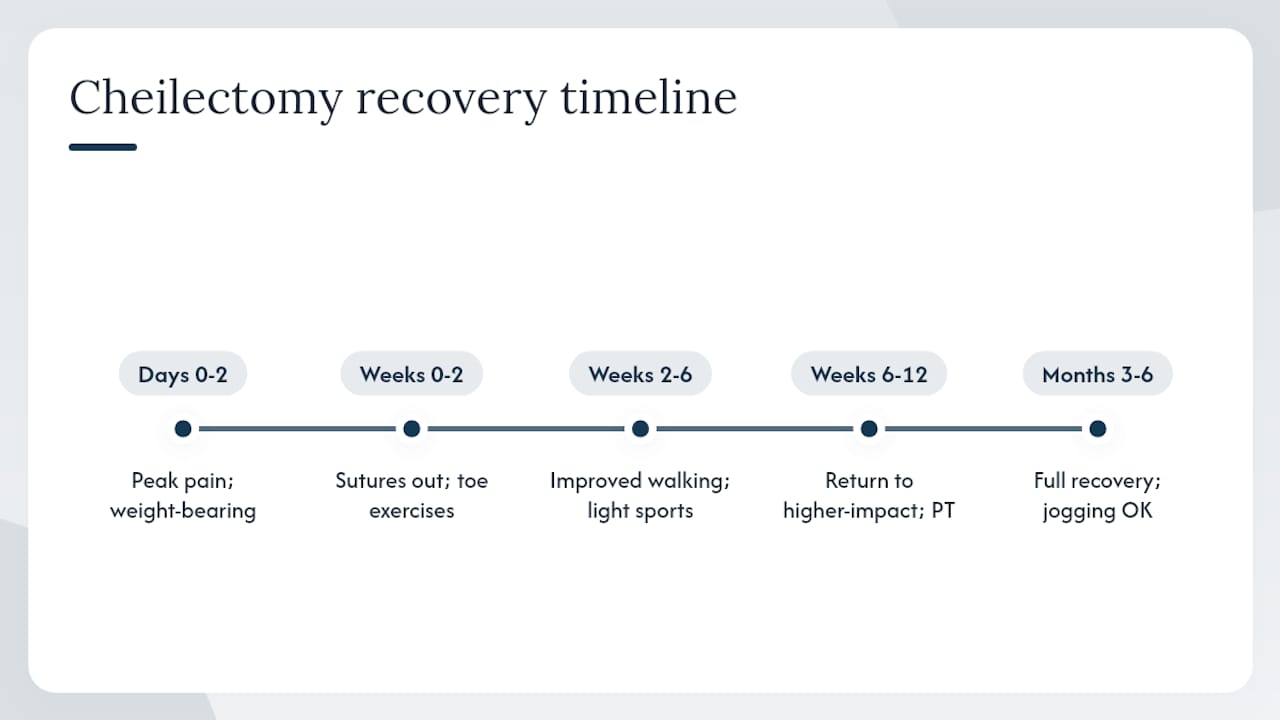
Days 0 to 2: Pain is at its highest, then begins easing. You’re walking in the surgical shoe with weight-bearing as tolerated, foot elevated most of the day.
Weeks 0 to 2: Swelling builds and stays noticeable. You’ll have a follow-up visit around the two-week mark, where sutures come out and you often switch into a roomy lace-up sneaker. Gentle toe motion exercises frequently start here.
Weeks 2 to 6: Walking becomes more natural. Swelling is still present but declining. Stretching and progressive range-of-motion work ramps up, and many patients report returning to light sports activity by around the four-week point, per the Kent Community Health protocol.
Weeks 6 to 12: This is when higher-impact activity typically resumes. Most rehab protocols recommend holding off on running or jumping until 10 to 12 weeks, and physical therapy, if needed, is usually well underway by now.
Months 3 to 6: Full recovery, with residual swelling and stiffness resolving. Jogging is often permitted around the three-month mark once pain and swelling have settled.
Recovery stretches longer for patients who combine cheilectomy with other procedures (like a Moberg osteotomy), have advanced arthritis rather than early-stage disease, smoke, or manage diabetes. Smoking in particular slows soft-tissue and bone healing across nearly every orthopedic procedure, cheilectomy included.
How Do You Manage Pain and Care for the Incision?
Ice, elevation, and scheduled pain medication control most of the discomfort, while keeping the dressing dry and watching the incision for changes protects against infection. Follow your surgeon’s specific dressing instructions rather than removing bandages early out of curiosity.
- Leave the original dressing untouched until your surgeon says otherwise, typically at the two-week visit
- Sutures usually come out around two weeks, coinciding with your shoe transition
- Ask your surgeon exactly when showering with a covered foot becomes safe, usually a few days in
Pain that eases steadily for three days and then suddenly spikes again is one of the clearest signals something is off. That pattern, rather than pain itself, is what should prompt a call to your surgeon’s office.
Watch for fever, spreading redness, or drainage that soaks through the dressing. Detailed dressing-change steps are covered in post-surgery foot care guidance, and wound-specific supply questions are addressed in Stride Foot & Ankle’s wound care resource.
When Can You Return to Work, Driving, and Sports?
Desk workers often return within a couple of weeks, while physically demanding jobs and athletic activities can take several weeks to a few months or longer. The deciding factor isn’t how you feel emotionally about getting back to normal life. It’s how much weight-bearing and impact your foot tolerates.
- Desk or seated work: Often back within 1 to 2 weeks, sometimes sooner with accommodations
- Standing or walking jobs: Usually 3 to 6 weeks, depending on shift length and floor surfaces
- Heavy labor or jobs requiring boots/ladders: Frequently 6 to 12 weeks or more
- Driving: Avoid until off narcotic pain medication and able to comfortably bear weight; right-foot surgery delays driving longer than left-foot surgery for most vehicles
Running and high-impact sports generally wait until 10 to 12 weeks, and only after your surgeon confirms swelling and pain have settled enough to tolerate impact.
When Should You Start Physical Therapy and Rehab Exercises?
Gentle toe range-of-motion exercises usually begin within days to two weeks, often right after your first follow-up visit, while formal physical therapy typically starts around four to six weeks if stiffness or pain persist. Not every patient needs formal PT. Many recover full motion with home exercises alone.
- Passive toe mobilization: Gently move the big toe up and down with your hand, several times a day, staying within a pain-free range
- Towel scrunches: Use your toes to scrunch a towel toward you, building intrinsic foot strength once swelling allows
- Toe extension and flexion sets: Active up-and-down toe movements, 2 to 3 sets of 10 reps, once cleared by your surgeon
Physical therapy for foot pain becomes the next step if motion stays limited by the six-week mark, per typical rehab protocols.
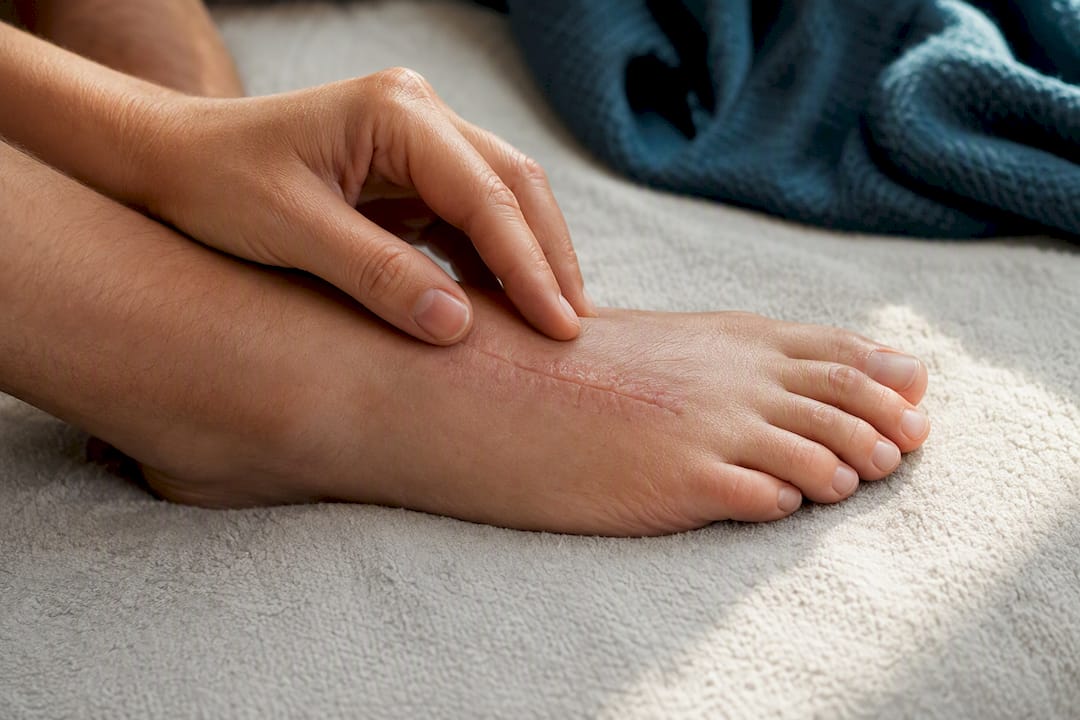
Pro Tip: Once your incision closes, gently massaging the scar in small circles helps prevent the tissue from binding down and restricting joint motion. Pair that with slow, staged increases in walking distance rather than jumping straight from short walks to a full workout.
What Complications Should You Watch For?
Infection and persistent joint stiffness are the two most common complications after cheilectomy, though both are manageable when caught early. Mechanical issues like recurrent bone spur formation are rare but possible over the long term.
- Fever above 101°F, spreading redness, or drainage soaking through the dressing
- Pain that worsens after day 3 instead of steadily improving
- Numbness that increases rather than gradually fading
- Calf pain, leg swelling, or warmth in the leg, which can signal a blood clot and needs urgent attention
Ordinary post-op swelling that lingers for weeks is normal and different from true infection. Most surgeons triage by asking whether pain is trending down overall, even with day-to-day fluctuation.
What Can You Do to Speed Up Recovery?
Elevate and ice on a consistent schedule, start gentle motion as soon as your surgeon allows, and skip nicotine entirely. Those three habits do more for cheilectomy healing than almost anything else you control.
- Elevate above heart level for 20 to 30 minutes several times a day through week two
- Avoid smoking or vaping, since nicotine measurably slows bone and soft-tissue healing
- Progress footwear gradually: surgical shoe, then roomy sneaker, then regular shoes, never skipping a stage
- Check swelling daily and back off activity if it spikes rather than pushing through it
Pro Tip: Clinicians commonly recommend tracking your swelling with a simple daily check, morning versus evening. If swelling climbs several days in a row instead of trending down, that’s your cue to dial back activity before it becomes a setback.
What Should Stride Foot & Ankle Patients Expect During Recovery?
At Stride Foot & Ankle, Dr. Nahad Wassel and the care team handle your recovery through in-person wound checks, staged shoe transitions, and a rehab plan built around your specific job and activity goals, not a one-size-fits-all handout.
- Your first post-op visit is typically scheduled around the two-week mark for suture removal and shoe transition
- Follow-up visits continue at intervals based on healing progress, with imaging ordered if motion or pain isn’t improving as expected
- Physical therapy referrals happen when home exercises alone aren’t restoring adequate motion by six weeks
Every patient heals on a slightly different clock. Timelines shift based on job demands, activity goals, and any underlying arthritis severity, so your actual schedule may run faster or slower than the general ranges above.
A Realistic Look at Patient Recovery Experiences
Most patients tell us the physical healing goes faster than expected but the swelling lingers longer than they imagined. A desk worker often returns within a week or two feeling mostly normal, while a recreational runner typically spends two to three months managing patience more than pain.
Schedule Your Post-Op Care With Stride Foot & Ankle
Unlike generic recovery handouts, Stride Foot & Ankle in Las Vegas gives you in-person wound checks, hands-on shoe-transition guidance, and a rehab plan built around your actual job and activity level, not a printed timeline you’re left to interpret alone.
If you’re preparing for cheilectomy or you’re a few weeks into recovery and want a professional read on your progress, reach out through general foot and ankle care to schedule a visit. Bring your surgical paperwork, current footwear, and a list of questions about your specific timeline to your first appointment. Same-day scheduling requests are typically accommodated for post-op patients who need a wound check sooner rather than later.
Sources
- Cheilectomy: Surgery, Procedure Details & Recovery — Cleveland Clinic
- Cheilectomy (patient leaflet) — Kent Community Health NHS Foundation Trust
- 1st MTP Cheilectomy rehab/recovery protocol — Institute for Foot and Ankle Reconstruction / Seybold (2020)
- 1st MTP joint cheilectomy (minimally invasive) — Dr Simon Zilko (post-op PDF, 2024)
- Cheilectomy patient instructions (2022) — Robert Dekker, MD (PDF)
This article is general information, not a substitute for advice from a qualified doctor. Consult a qualified healthcare professional about your own circumstances before acting on anything here.
FAQ
How painful is cheilectomy surgery?
Pain peaks in the first two days after surgery and typically starts improving by day three, well controlled with scheduled acetaminophen or NSAIDs and brief opioid use for the first few nights if needed.
Does hallux rigidus go away on its own?
Hallux rigidus is a progressive arthritic condition that doesn’t reverse on its own, though cheilectomy can relieve pain and improve motion in early to moderate cases before the joint advances further.
Is cheilectomy considered major surgery?
Cheilectomy is a same-day outpatient procedure, generally less invasive than joint fusion or replacement surgery, with most patients walking in a surgical shoe the same day.
What are the advantages and disadvantages of hallux rigidus surgery?
Cheilectomy offers pain relief and preserved joint motion with a shorter recovery than fusion surgery, but it doesn’t stop arthritis progression and some patients eventually need further surgery if symptoms return.
How long until I can return to work after cheilectomy?
Desk jobs often resume within one to two weeks, while physically demanding work can take six to twelve weeks depending on the role and how recovery progresses.
Recommended
- Post-Surgery Foot Care Steps for Safe Recovery – Stride Foot & Ankle – Dr. Nahad Wassel
- Ankle Sprain Recovery Process: Your 2026 Rehab Guide – Stride Foot & Ankle – Dr. Nahad Wassel
- Step by Step Ankle Rehab: Your Complete Recovery Guide – Stride Foot & Ankle – Dr. Nahad Wassel
- How to prepare for foot surgery: steps, recovery, and expert tips – Stride Foot & Ankle – Dr. Nahad Wassel
Recent Comments