

Short answer: Original Medicare Part B usually does not pay for routine foot care, but it does pay for medically necessary podiatry and specific diabetic foot services when documented criteria are met. Three exceptions cover most patients:
- Systemic disease with class findings (like diabetes or peripheral vascular disease with documented risk signs)
- Peripheral neuropathy with loss of protective sensation (LOPS), confirmed through diabetic foot exams
- Therapeutic shoes for qualifying diabetic patients with foot complications
In 2026, the Part B deductible is $283, and you’ll typically owe 20% coinsurance after that on covered services. Bring your documentation. It’s the difference between a paid claim and a denied one.
Key Takeaways
Medicare Part B pays for medically necessary podiatry and diabetic foot services, but routine foot care requires documented class findings, LOPS, or a qualifying systemic disease to be reimbursed.
| Point | Details |
|---|---|
| Routine care is excluded | Nail trims, callus removal, and hygienic foot care are paid 100% out of pocket without a qualifying condition. |
| Documentation drives approval | Class findings, LOPS testing, and six months of active physician care must be on record before billing. |
| Know your 2026 costs | Expect the $283 Part B deductible, then 20% coinsurance on covered podiatry services. |
| Shoes come with limits | One pair of therapeutic shoes and inserts per year, ordered through a certifying doctor and Medicare-enrolled supplier. |
| Stridefootankle documents claims | The Las Vegas clinic verifies insurance, performs monofilament testing, and certifies therapeutic shoe eligibility for Medicare patients. |
Table of Contents
- What Does Medicare Podiatry Coverage Actually Pay For?
- What Are Class Findings and LOPS, and Why Do They Matter?
- How Much Will You Pay for Podiatry Under Medicare?
- How Do You Document Medical Necessity for Podiatry Claims?
- Who Qualifies for Medicare-Covered Therapeutic Shoes?
- What Happens If Medicare Denies Your Podiatry Claim?
- What Seniors Get Wrong About Medicare and Foot Care
- Get Medicare-Compliant Foot Care in Las Vegas
- Where to Verify Medicare Podiatry Rules Directly
- Sources
- FAQ
What Does Medicare Podiatry Coverage Actually Pay For?
Medicare Part B pays for podiatry services tied to disease, injury, or a defined medical condition, not general foot maintenance. Covered examples include treatment for foot ulcers, infections, surgical care, wound debridement, and medically necessary bunion or hammer toe correction. If a doctor documents that a service treats or prevents a health problem, Part B is far more likely to cover it.
Here’s where it gets confusing for a lot of patients: nail trimming, callus removal, and general hygienic foot care are excluded almost across the board, even for seniors who genuinely struggle to reach their own feet. Medicare treats these as personal maintenance, not medical treatment, unless a systemic condition changes the risk calculus.
Covered under medical necessity:
- Debridement of infected or ulcerated tissue
- Surgical treatment of bunions, hammer toes, or heel spurs causing functional pain
- Diabetic foot exams when LOPS is documented
- Treatment of fungal nail infections causing pain or secondary infection risk (see our guide on foot fungus and when to seek help)
Generally excluded as routine care:
- Routine nail trimming or cutting
- Callus and corn removal without a qualifying condition
- Basic hygienic foot care
Picture two patients on the same day. One has thick, uncomfortable calluses and wants them shaved down; no diabetes, no circulation issues. That’s routine care, and Medicare won’t touch it. The other has diabetes with documented neuropathy and a callus that’s becoming a pressure point near a healed ulcer site. Same-looking problem, completely different coverage outcome, because the underlying disease changes everything.
What Are Class Findings and LOPS, and Why Do They Matter?
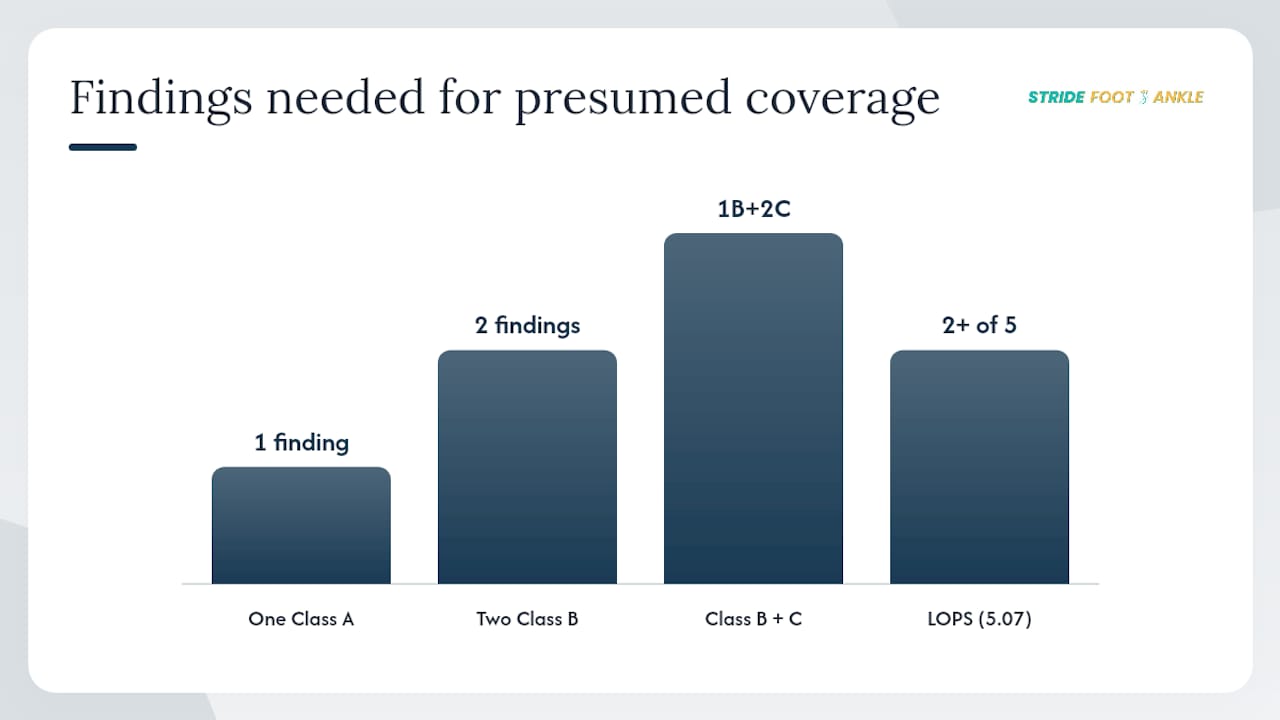
CMS uses a specific classification system to decide when routine-looking foot care becomes medically necessary. Class A, B, and C findings describe physical signs of vascular or neurological disease, and certain combinations trigger what’s called a “presumption of coverage.”
Under LCD 34246, coverage is generally presumed when a patient has:
- One Class A finding (such as absent posterior tibial pulse), or
- Two Class B findings (such as absent dorsalis pedis pulse plus advanced trophic changes), or
- One Class B finding plus two Class C findings (such as claudication, temperature changes, or edema)
Separately, patients with diabetic peripheral neuropathy and LOPS qualify for foot exams every six months. LOPS is diagnosed using the 5.07 monofilament testing procedure, a simple in-office test where a thin nylon filament is pressed against specific points on the foot. If the patient can’t feel it at two or more of five tested sites, that’s LOPS under CMS’s own decision memo.
There’s a catch many patients miss: Medicare also requires proof of “active care.” That means documentation showing an M.D. or D.O. actively managed the complicating disease within the six months before the foot service. A diabetes diagnosis sitting in your chart from three years ago, with no recent visits, usually isn’t enough. Routine-type services covered under these exceptions are also capped at once every 60 days.
Pro Tip: Ask your physician directly: “Can you document my class findings or LOPS status in today’s note?” Vague chart language is one of the top reasons claims get denied even when the underlying care was appropriate.
How Much Will You Pay for Podiatry Under Medicare?
For 2026, you’ll pay the $283 Part B deductible first, then typically 20% coinsurance on the Medicare-approved amount for covered podiatry services. Routine foot care that Medicare excludes means you pay 100% out of pocket, so understanding the coverage line matters as much as the treatment itself.
Assignment matters too. When a provider or supplier “accepts assignment,” they agree to charge only the Medicare-approved rate. Suppliers of therapeutic shoes who don’t accept assignment can charge above that rate, and you absorb the difference.
Billing errors that trigger denials:
- Missing Q modifiers (Q7, Q8, Q9) on claims tied to systemic-condition exceptions
- Incorrect or mismatched ICD-10 codes that don’t support the billed service
- No documentation of active physician care in the prior six months
- Claims for routine-type services filed within 60 days of the last covered visit
Most denials aren’t about whether you deserved coverage. They’re paperwork failures.
How Do You Document Medical Necessity for Podiatry Claims?
Getting Medicare to pay starts with what you bring to the appointment, not what happens during it. Walk in prepared, and your provider has everything needed to code the claim correctly the first time.
- Bring recent physician notes. Records from your M.D. or D.O. covering the last six months, especially anything mentioning diabetes, vascular disease, or neuropathy.
- Bring your diabetes care plan, if you have one, along with any wound or ulcer history and prior amputation records.
- Ask for monofilament testing if you have diabetes and haven’t had a recent sensation check. Request that the result be documented in writing.
- Confirm the coding. Ask the clinician to record the qualifying ICD-10 code, note class findings or LOPS status explicitly, and apply the correct Q modifier if billing under the systemic-condition exception.
- Ask about claim submission. Confirm the clinic will submit supporting notes along with the claim, not just the billing code.
Remember the frequency rules: one routine-type covered service every 60 days, and a diabetic foot exam every six months if LOPS is present and you haven’t seen another foot specialist in between.
Pro Tip: Keep a simple folder, paper or digital, with your diabetes diagnosis date, last A1C result, and any prior foot exam notes. Handing this to a new provider saves an entire visit’s worth of information-gathering.
Who Qualifies for Medicare-Covered Therapeutic Shoes?
Medicare Part B covers one pair of therapeutic shoes and a set of inserts per year for patients with diabetes and severe diabetes-related foot disease, provided a qualified provider orders them and the patient follows a documented diabetes care plan, according to Medicare’s therapeutic shoe benefit.
You likely qualify if you have diabetes plus at least one of the following:
- History of a foot ulcer
- Prior partial or full foot amputation
- Foot deformity
- Peripheral neuropathy with callus formation
- Poor circulation in the feet
The process runs through two providers: your treating doctor certifies your eligibility and diabetes management, then a podiatrist or Medicare-enrolled supplier handles the fitting. Confirm the supplier accepts Medicare assignment before you order anything; otherwise you may pay significantly more than the approved rate. The benefit covers one pair and one set of inserts annually, not an open-ended supply.
What Happens If Medicare Denies Your Podiatry Claim?
If Medicare denies your claim, ask the provider for the specific denial reason and request the medical records used to make the decision. Often, a resubmission with clearer documentation of class findings or LOPS resolves it without a formal appeal.

Also check whether your area’s Medicare Advantage plans include routine foot care as an added benefit; some do, though networks and costs vary widely by plan. If a service genuinely isn’t covered, community health clinics and local senior service programs sometimes offer low-cost foot care options. Never ignore a foot ulcer, open wound, or signs of infection while waiting on a coverage decision. Get seen.
What Seniors Get Wrong About Medicare and Foot Care
Most guidance on this topic treats coverage as a yes-or-no question. It isn’t. It’s a documentation question dressed up as a coverage question. The same callus, the same ingrown nail, the same exam can be billed and paid completely differently depending on what’s written in the chart six months earlier.
The conventional advice, “ask if Medicare covers it,” undersells what actually moves a claim from denied to paid: specific tests (the 5.07 monofilament), specific language (class findings, LOPS), and specific timing (the six-month active-care window). Patients who show up with their own diabetes records and ask direct questions about coding get approved more consistently than patients who simply hope the front desk handles it.
If you take one thing from this, it’s that you’re not just a patient in this process, you’re a documentation partner. A clinic experienced with Medicare-compliant podiatric care can carry most of that burden, but the records you bring in the door still shape the outcome.
Get Medicare-Compliant Foot Care in Las Vegas
If you’ve read this far, you already know that getting Medicare to pay for podiatry comes down to documentation, testing, and coding done right the first time. That’s exactly where Stridefootankle fits in for Las Vegas patients. Dr. Nahad Wassel, a board-certified foot and ankle surgeon, works directly with Medicare’s class findings and LOPS criteria daily, not as an occasional billing exercise but as standard practice for every diabetic or at-risk patient who walks through the door.

The clinic verifies your insurance before treatment, performs and documents monofilament testing when indicated, and handles therapeutic shoe certification and fitting for patients who qualify. Staff will confirm Medicare assignment status upfront so you’re never surprised by a supplier charging above the approved rate. If you’re dealing with diabetic foot changes, a wound that won’t heal, or you simply need a foot exam properly documented for Medicare, schedule an appointment and bring your recent physician notes with you.
Where to Verify Medicare Podiatry Rules Directly
- Medicare for exam frequency rules
- CMS LCD 34246 for class findings and billing criteria
- CMS Medicare Learning Network for active-care documentation standards
This article is general information, not a substitute for advice from a qualified doctor. Consult a qualified healthcare professional about your own circumstances before acting on anything here.
Sources
FAQ
Does Medicare Cover Routine Foot Care for Seniors?
No, Original Medicare generally excludes routine nail trims and callus removal unless a systemic disease with documented class findings or LOPS makes the service medically necessary.
How Often Does Medicare Cover a Diabetic Foot Exam?
Medicare covers a diabetic foot exam every six months for patients with diagnosed peripheral neuropathy and LOPS, as long as no other foot specialist visit occurred in between.
What Is the 2026 Medicare Part B Deductible for Podiatry?
The 2026 Part B deductible is $283, after which you typically pay 20% coinsurance on Medicare-approved podiatry services.
Does Medicare Pay for Diabetic Shoes and Inserts?
Yes, Medicare covers one pair of therapeutic shoes and one set of inserts annually for qualifying diabetic patients with documented foot complications, ordered under a comprehensive diabetes care plan.
Can Stridefootankle Help Document My Medicare Podiatry Claim?
Yes, Stridefootankle in Las Vegas performs monofilament testing, documents class findings and LOPS, and verifies Medicare assignment before treatment or therapeutic shoe fitting.
Recommended
- How podiatry helps seniors stay mobile and pain-free – Stride Foot & Ankle – Dr. Nahad Wassel
- Best Footcarenv.com Alternatives for Foot Care in 2026 – Stride Foot & Ankle – Dr. Nahad Wassel
- General Foot & Ankle Care – Stride Foot & Ankle
- Why See a Podiatrist? Your Complete Foot Health Guide – Stride Foot & Ankle – Dr. Nahad Wassel
Recent Comments