

TL;DR:
- Animal bites cause injuries that require prompt medical attention to prevent infection and serious health complications. Most bites come from animals known to the victim, especially family pets, and bites from dogs and cats are most common. Proper wound care, timely vaccination, and reporting to authorities are essential for safe recovery and community protection.
Animal bites are physical injuries caused by the teeth or claws of domestic or wild animals, and they require prompt medical attention to prevent infection and serious complications. Approximately 4 to 5 million people are bitten by animals each year in the United States, with 85%–90% of those bites caused by dogs. Beyond the visible wound, bites carry real risks of bacterial infection, rabies exposure, and tetanus. Knowing how to respond quickly, what signs to watch for, and when to see a doctor can make a significant difference in your recovery.
What are the most common types of animal bites?
Dog bites account for the vast majority of animal bite injuries in the United States. 85%–90% of bites are dog-related, making dog bite risks the most pressing concern for public health officials and clinicians alike. Cat bites are the second most common type, and they carry a deceptively high infection rate because cat teeth are narrow and sharp, driving bacteria deep into tissue with little surface damage.
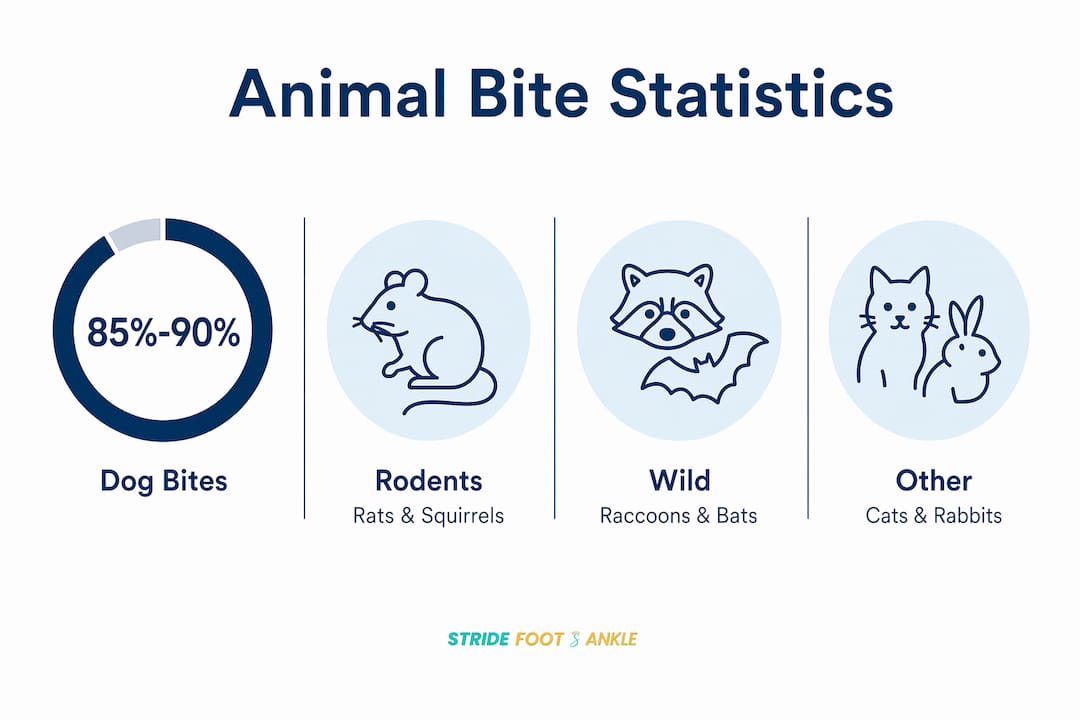
Other sources of bites include rodents such as rats and squirrels, rabbits, and wild animals including raccoons, bats, and foxes. Bites from exotic pets like ferrets, iguanas, and large parrots are less common but present unique infection and reporting challenges. Each animal species carries its own bacterial profile, which affects treatment decisions.
One of the most important facts about bite injuries is that most bites come from animals known to the victim, frequently family pets. This contradicts the widespread assumption that stray or unfamiliar animals are the primary danger. The real risk often lives in your own home.
Common bite sources and their key risks
- Dogs: High crushing force, deep lacerations, risk of Pasteurella multocida and Capnocytophaga bacteria
- Cats: Narrow puncture wounds, high rate of Pasteurella multocida infection, cat scratch disease from scratches
- Rodents: Rat-bite fever caused by Streptobacillus moniliformis, low rabies risk in domesticated species
- Bats: High rabies concern even from minor or unnoticed contact; post-exposure prophylaxis often recommended
- Raccoons and foxes: Significant rabies vectors in North America; bites require immediate medical evaluation
- Exotic pets: Variable bacterial flora; reporting requirements differ by jurisdiction
Why animals bite
Animals bite when they feel threatened, cornered, or in pain. Dogs show warning signals before biting, including stiff posture, a fixed stare, raised hackles, and a low growl. Misreading these stress signals is one of the leading causes of preventable bites. Children are especially vulnerable because they often approach animals at face level and miss or ignore warning behaviors.

How can animal bites be prevented effectively?
Animal bite prevention centers on education, supervision, and environmental management. The goal is not to avoid animals entirely but to interact with them safely and responsibly. Focusing on education and supervised interactions prevents bites while maintaining healthy human-animal relationships.
Follow these steps to reduce your risk significantly:
- Learn animal body language. Recognize warning signs in dogs and cats before a bite occurs. A dog that freezes, stares, or shows its teeth is communicating distress, not friendliness.
- Supervise children around all animals. Never leave a child under 10 years old alone with any dog, regardless of the animal’s history or temperament.
- Avoid approaching unfamiliar animals. Always ask an owner’s permission before touching a dog you do not know. Never approach a wild animal that appears disoriented or unusually calm.
- Do not disturb animals that are eating, sleeping, or caring for young. These are the moments when even gentle animals bite reflexively.
- Secure your environment. Use proper fencing, leashes, and enclosures to prevent unexpected animal contact in shared spaces.
- Report stray or aggressive animals. Contact local animal control when you observe animals behaving erratically or threatening people in public areas.
- Vaccinate your pets. Keeping dogs and cats current on rabies vaccinations protects both the animal and anyone they may contact.
Pro Tip: If a dog approaches you aggressively, stand still with your arms at your sides, avoid eye contact, and speak in a calm, low voice. Running triggers a chase response and increases the likelihood of a bite.
The psychological effects of animal bites, especially in children, are significant and often overlooked. Fear of animals after a bite can affect a child’s development and social behavior for years. Prevention education in schools and pediatric offices addresses both the physical and emotional dimensions of bite risk.
What is the appropriate first aid and medical treatment for animal bites?
Immediate wound care is the single most important action after any animal bite. Clean the wound thoroughly with soap and water for at least five minutes. This step alone reduces infection risk substantially. After washing, apply an antiseptic such as povidone-iodine or chlorhexidine, cover the wound with a clean bandage, and seek medical evaluation.
When to go to the emergency room or urgent care
- The wound is deep, gaping, or will not stop bleeding after 10 minutes of direct pressure
- The bite is on the face, hands, feet, or genitals
- The biting animal is wild, unvaccinated, or cannot be identified
- You have not had a tetanus booster within the last five years
- You are immunocompromised, diabetic, or have liver disease
- Signs of infection appear within 24 hours
1 in 5 dog bite victims requires formal medical treatment, and infections can emerge within 24 hours after injury. That timeline is faster than most patients expect, which is why waiting to “see how it looks” is a poor strategy.
Pro Tip: Photograph the wound immediately after cleaning it. This documents the injury’s initial severity and is useful for both medical providers and any legal or insurance reporting you may need to complete.
Should bite wounds be stitched closed?
Deep puncture wounds are typically left open for drainage rather than sutured immediately. Closing a contaminated wound traps bacteria and dramatically increases abscess risk. Physicians may use delayed primary closure after 3–5 days once infection risk decreases. Facial wounds are sometimes an exception because cosmetic outcomes matter and blood supply to the face is strong enough to fight infection.
Treatment decision summary
| Wound type | Immediate closure | Antibiotic recommendation | Tetanus booster |
|---|---|---|---|
| Superficial scratch, low risk | Yes | Usually not required | If overdue |
| Puncture wound, moderate depth | No, leave open | Often prescribed | Yes if overdue |
| Deep laceration, hand or foot | No, delayed closure | Strongly recommended | Yes |
| Face wound, clean edges | Often yes | Prescribed | Yes if overdue |
| Wild animal bite, any location | No | Always prescribed | Yes |
Tetanus boosters are needed for all animal bites if the patient has not been vaccinated within the last five years, regardless of how clean the wound appears. Clostridium tetani spores live in soil and environments animals frequent, so wound appearance is not a reliable indicator of tetanus risk.
What are the infection and disease risks from animal bites?
Animal bites introduce bacteria directly into tissue, and the infection risk depends on the animal species, wound depth, and the patient’s immune status. The three primary disease threats are bacterial infection, rabies, and tetanus.
Bacterial infections
Pasteurella multocida is the most common pathogen in both dog and cat bites. It causes rapid-onset redness, swelling, and pain, often within hours of the bite. Cat bites carry a higher rate of Pasteurella infection than dog bites because of wound depth. Capnocytophaga canimorsus, found in dog saliva, poses a serious risk to patients who are immunocompromised or have had their spleen removed.
Antibiotic prescriptions depend on wound location, depth, and patient health status, including immunocompromise. Amoxicillin-clavulanate is the standard first-line antibiotic for most bite wounds in adults. Patients allergic to penicillin require alternative regimens such as doxycycline or a fluoroquinolone combined with metronidazole.
Rabies risk and post-exposure prophylaxis
| Animal type | Rabies risk level | Post-exposure prophylaxis (PEP) typically needed |
|---|---|---|
| Vaccinated dog or cat | Low | No, if animal can be observed for 10 days |
| Unvaccinated dog or cat | Moderate | Yes, if animal tests positive or cannot be observed |
| Bat | High | Yes, in most cases of any contact |
| Raccoon, fox, skunk | High | Yes |
| Rodent (rat, squirrel) | Very low | Rarely, case-by-case basis |
Immediate documentation and identification of the biting animal is critical to avoid costly rabies post-exposure treatment if quarantine is not possible. Rabies PEP consists of a series of four vaccine doses over 14 days, plus rabies immune globulin at the first visit. It is highly effective when started promptly but is expensive and physically demanding. Identifying the animal eliminates the need for PEP in most domestic animal cases.
Tetanus
Clostridium tetani spores are commonly found in soil and environments animals frequent. Tetanus vaccination is critical after animal bites regardless of visible wound dirtiness. The standard recommendation is a booster if the patient has not received one within the last five years. Patients with no prior tetanus immunization series require both the vaccine and tetanus immune globulin.
What are the legal and reporting considerations after an animal bite?
Reporting an animal bite is both a public health responsibility and a legal requirement in most U.S. states. The reporting process protects you, the community, and the animal. Skipping this step can complicate your medical care and limit your legal options.
Steps to take after a bite
- Gather owner and animal information. Get the owner’s full name, address, and phone number. Confirm the animal’s vaccination status and ask for documentation.
- Report the bite to local animal control or public health authorities. Most jurisdictions require reporting within 24–72 hours. Contact your county health department if you are unsure of the local requirement.
- Request that the animal be quarantined. For domestic dogs and cats, a 10-day observation period is the standard protocol to rule out rabies.
- Document your injuries. Keep photographs, medical records, and all related expenses from the date of the bite forward.
- Consult an attorney if the bite caused significant injury. Pet owners are legally liable for bites in most states, particularly if the animal had a prior history of aggression.
Identifying and quarantining the biting animal is as medically crucial as initial wound care for managing rabies risk effectively. When the animal cannot be located or identified, the default medical recommendation shifts to full rabies PEP, which is both costly and physically demanding.
Reporting also serves the broader community. Animal control agencies use bite reports to track aggressive animals, identify rabies trends, and enforce vaccination laws. A single unreported bite can allow a dangerous animal to remain in circulation and injure someone else.
Key Takeaways
Prompt wound cleaning, medical evaluation, and animal identification are the three actions that most directly determine outcomes after an animal bite.
| Point | Details |
|---|---|
| Dog bites dominate bite statistics | 85%–90% of the 4–5 million annual U.S. bites are caused by dogs, most by familiar animals. |
| Clean wounds immediately | Wash with soap and water for at least five minutes before applying antiseptic and a bandage. |
| Leave deep punctures open | Physicians delay closure on puncture wounds to allow drainage and prevent abscess formation. |
| Tetanus booster is always needed | Any bite warrants a booster if your last tetanus shot was more than five years ago. |
| Report every bite | Reporting to animal control enables quarantine, rabies tracking, and legal documentation. |
Why education matters more than fear when it comes to bites
Most people assume animal bites are random, unpredictable events caused by dangerous or stray animals. That assumption is wrong, and it is the reason so many bites keep happening. The data is clear: the majority of bites come from animals the victim already knows, in familiar environments, during interactions that seemed routine.
What I have seen consistently is that the gap between a safe interaction and a bite is almost always a missed signal. A dog that is cornered, a cat that has been handled too long, a family pet that is in pain. These animals communicate discomfort before they bite. The problem is that most people, especially children, have never been taught what those signals look like.
The focus on fear-based messaging around animal bites is counterproductive. It leads people to avoid animals entirely or, worse, to become complacent around “safe” animals they know well. Neither response reduces bites. What actually works is teaching people to read animal behavior, supervise interactions, and respond calmly when an animal shows stress.
From a clinical standpoint, the wound care side of this is also misunderstood. Patients often want the wound closed immediately because an open wound feels more serious. The opposite is true for puncture wounds. Leaving it open is the medically correct choice. Trusting that process, and following up with a provider who understands wound management, is what prevents the infections that turn a minor bite into a weeks-long ordeal.
The role of podiatry in injury prevention is also underappreciated in bite cases. Bites to the feet and ankles are particularly prone to complications because of reduced circulation and the mechanical demands placed on that area during recovery. Getting the right specialist involved early makes a real difference.
— Ramil
Foot and ankle bite wounds deserve specialized care
Animal bites to the feet and ankles carry a higher complication risk than bites elsewhere on the body. Reduced circulation, constant mechanical stress, and proximity to tendons and joints make these wounds more likely to become infected or heal poorly without proper management.

Stridefootankle, led by Dr. Nahad Wassel in Las Vegas, provides specialized wound care for the foot and ankle, including injuries from animal bites. Dr. Wassel’s approach combines conservative treatment with surgical expertise when needed, ensuring each patient receives care matched to the severity of their injury. Whether you need wound assessment, infection management, or follow-up care after an emergency visit, the team at Stridefootankle is equipped to help. For broader foot and ankle concerns related to bite injuries, the general foot and ankle care services at Stridefootankle cover the full range of recovery needs. Schedule a consultation to get back on your feet with confidence.
FAQ
How do I know if an animal bite is infected?
Signs of infection include increasing redness, warmth, swelling, pus, and red streaks spreading from the wound. Infections can appear within 24 hours of the bite, so monitor the wound closely and seek care at the first sign of change.
Do all animal bites require antibiotics?
Not all bites require antibiotics. Antibiotic use depends on wound depth, location, and patient health status, including whether the patient is immunocompromised. A physician makes this determination based on clinical risk factors, not wound appearance alone.
What should I do if I cannot identify the animal that bit me?
Report the bite to your local health department or animal control immediately. When the biting animal cannot be identified or quarantined, the standard medical recommendation is to begin rabies post-exposure prophylaxis as a precaution.
Are cat bites more dangerous than dog bites?
Cat bites are narrower and deeper than dog bites, which drives bacteria further into tissue and makes infection more likely. Pasteurella multocida infection rates are higher in cat bites, and cat scratch disease is an additional risk from scratches caused by cats.
When does a bite wound need stitches?
Most bite wounds, especially puncture wounds, are left open to drain rather than sutured immediately. Deep puncture wounds left open reduce abscess risk. Facial wounds may be closed sooner due to strong blood supply and cosmetic considerations.
Recommended
- Sports Injuries: Treatment, Prevention, and Recovery Guide – Stride Foot & Ankle – Dr. Nahad Wassel
- Ingrowing Toenails: Causes, Relief, and Treatment – Stride Foot & Ankle – Dr. Nahad Wassel
- Warts: Causes, Types, Treatment, and Prevention – Stride Foot & Ankle – Dr. Nahad Wassel
- Joint Pain: Causes, Relief Options, and Treatment – Stride Foot & Ankle – Dr. Nahad Wassel
Recent Comments