

TL;DR:
- Most pediatric foot pain is due to common, manageable conditions that respond well to early conservative care. Recognizing signs of serious issues, such as persistent limping or swelling, prompts timely professional evaluation to ensure proper treatment. Proper footwear, targeted stretches, and supportive orthotics play crucial roles in preventing and alleviating discomfort during foot development.
When your child starts limping, refusing to walk, or complaining about sore feet after school, it’s natural to worry. Understanding what is pediatric foot pain — and what it isn’t — can spare you a great deal of anxiety. Most foot discomfort in children is not a sign of serious deformity or lifelong damage. Many conditions are common, manageable, and respond well to early, targeted care. This guide walks you through the most frequent causes, the warning signs worth acting on, and the treatment paths available so you can make confident, informed decisions for your child.
Table of Contents
- What causes pediatric foot pain? Understanding common conditions
- Flexible flatfoot: when is it normal and when should you worry?
- How footwear affects your child’s foot pain and development
- When to seek professional evaluation for your child’s foot pain
- Treatment options and managing pediatric foot pain effectively
- A specialist’s perspective: why managing pediatric foot pain is about function, not just shape
- How Stride Foot & Ankle supports children’s foot health and pain relief
- Frequently asked questions
Key Takeaways
| Point | Details |
|---|---|
| Common causes vary | Pediatric foot pain often results from common, manageable conditions like flexible flatfoot, ingrown toenails, and warts. |
| Flexible flatfoot is normal | Most children’s flexible flatfoot is painless and part of normal development, needing evaluation only if symptomatic. |
| Proper shoe fit matters | Wearing shoes with adequate width reduces risk of painful deformities like bunions during childhood growth. |
| Recognize when to seek help | Persistent pain, limping, swelling, or systemic symptoms require prompt medical evaluation to rule out serious conditions. |
| Conservative care works | Stretching, orthotics, and physical therapy effectively manage most pediatric foot pain and prevent surgery. |
What causes pediatric foot pain? Understanding common conditions
Children’s feet are not simply small adult feet. They’re actively developing structures that go through significant changes from birth through adolescence. Because of this, the causes of foot pain in children differ meaningfully from what adults experience.
Common pediatric foot problems range from structural variations to localized skin conditions. Here’s a breakdown of what parents encounter most often:
- Flexible flatfoot: The arch appears flat when standing but forms when the child rises onto their toes. Extremely common and usually painless in younger children.
- Metatarsus varus (also called metatarsus adductus): The front of the foot curves inward. Often noticed in toddlers and younger children. Many cases resolve without intervention.
- Callosities: Thickened patches of skin that form from repeated friction or pressure, often from ill-fitting shoes.
- Ingrown toenails: The edge of a nail grows into the surrounding skin, causing redness, swelling, and sometimes infection.
- Plantar warts: Viral infections on the sole of the foot that can become painful with walking and standing.
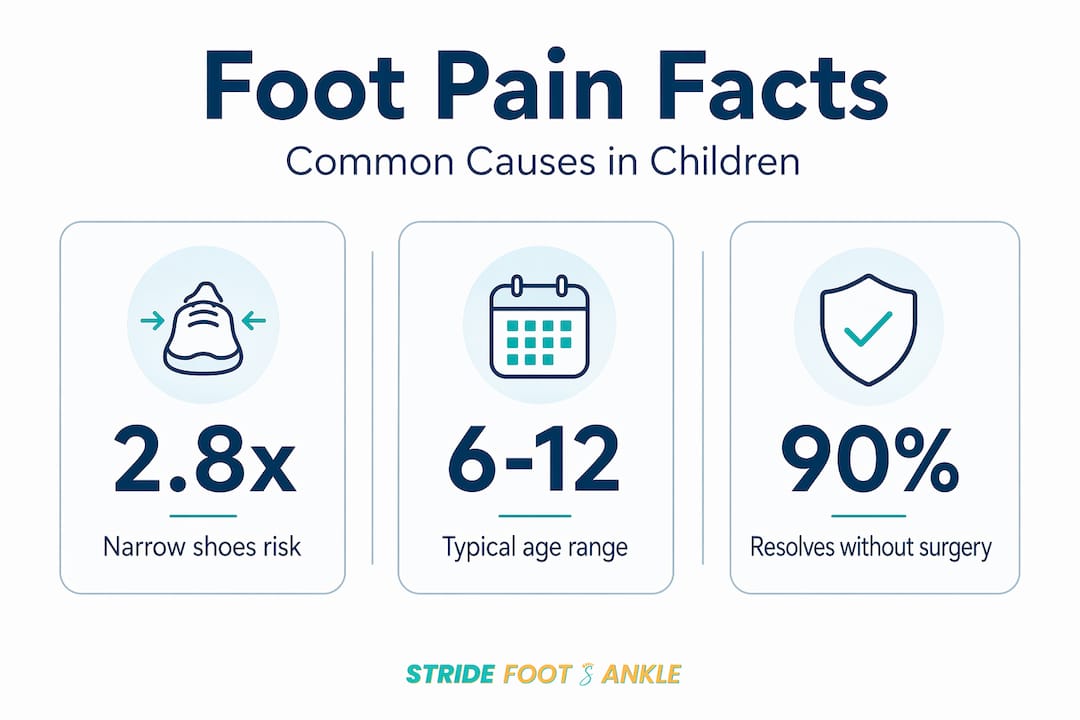
A 2026 Danish study found metatarsus varus and callosities to be the most common foot pathologies in children ages 6 to 16, with ingrown toenails and warts also frequently identified. This tells us something important: the majority of pediatric foot pain symptoms are caused by conditions that are well understood and respond to treatment.
Comparison table: Common child foot pain conditions at a glance
| Condition | Typical age range | Painful? | Resolves on its own? |
|---|---|---|---|
| Flexible flatfoot | 2 to 10 years | Often no | Frequently yes |
| Metatarsus varus | Infancy to age 5 | Rarely | Often yes |
| Callosities | School age and older | Sometimes | With footwear changes |
| Ingrown toenail | Any age | Yes | Needs treatment |
| Plantar warts | School age and older | Yes, with pressure | May need treatment |
Pro Tip: If your child’s foot pain is localized to one specific spot rather than spread across the whole foot, conditions like warts or ingrown toenails are a more likely culprit than a structural problem. A podiatrist can quickly distinguish between them.
Flexible flatfoot: when is it normal and when should you worry?
Flexible flatfoot (pes planus) is probably the condition parents ask about most. It’s also one of the most misunderstood. The key word here is flexible: the arch disappears when your child bears weight but reappears when they’re off their feet. That flexibility is what makes it generally benign in young children.
The arch develops gradually through childhood. Many children won’t show a well-formed arch until age 5 or later. Expecting an arch before that age is like expecting a two-year-old to have adult handwriting. Development takes time, and pushing intervention before it’s warranted can cause more harm than good.
That said, flexible flatfoot can become a problem when it causes pain, fatigue in the feet or legs, or changes in how a child moves. Here’s how to tell the difference:
Signs that warrant an evaluation:
- Your child complains of foot or leg pain after normal activity.
- They tire much more quickly than peers during walking or play.
- You notice they walk awkwardly, roll their ankles inward, or avoid running.
- Their shoes wear down unevenly, especially on the inner edge.
- They resist physical activity they previously enjoyed.
“Flexible flatfoot usually develops gradually and is often painless, but evaluation is recommended if pain or functional limitation appear.” — Washington University Pediatric Orthopedics
When evaluation does find symptomatic flexible flatfoot, treatment focuses on conservative foot care rather than surgery. Stretching the calf muscles and Achilles tendon (the tight tissues that often accompany flatfoot), wearing supportive footwear, and using custom or prefabricated orthoses (arch-supporting shoe inserts) are the front-line tools. Physical therapy may be added to build strength and improve biomechanics.
Pro Tip: A simple home observation: place your child on a hard floor and ask them to stand on their tiptoes. If an arch appears, that’s flexible flatfoot, not a structural deformity requiring aggressive intervention.
How footwear affects your child’s foot pain and development
You might not realize it, but the shoes you buy for your child carry real medical significance. Footwear during the growth years, roughly ages 3 through 12, directly influences how bones, tendons, and soft tissue develop. The wrong shoes don’t just cause temporary discomfort. They can set the stage for long-term problems.
The biggest offender? Narrow toe boxes. When the front of the shoe compresses the toes, it forces the big toe inward repeatedly, promoting the development of a bunion (a bony bump at the base of the big toe). Children wearing narrow shoes have a 2.8 times higher chance of developing bunions compared to those with properly fitting shoes. That’s a striking number for a problem most people assume is genetic.
Buying shoes “to grow into” is one of the most common parental mistakes in foot health. A shoe that’s too big shifts foot mechanics just as damagingly as one that’s too small.
What to look for in children’s footwear:
- Toe box width: There should be about a thumb’s width of space between the longest toe and the end of the shoe.
- Flexibility: The shoe should bend at the ball of the foot, not the arch.
- Heel stability: A firm heel counter (the back part of the shoe) prevents excessive inward rolling.
- Material: Breathable uppers reduce moisture and lower the risk of skin irritation and fungal infections.
- No excessive arch support in toddlers: Very young children benefit from learning to use their own foot muscles without over-engineered support.
| Footwear feature | Benefit | Risk if wrong |
|---|---|---|
| Wide toe box | Allows natural toe spread | Bunions, hammertoes |
| Flexible sole | Supports natural gait | Altered walking pattern |
| Firm heel counter | Stabilizes rearfoot | Ankle rolling, pain |
| Proper length | Reduces friction | Blisters, calluses |
| Breathable material | Reduces moisture | Fungal infections, warts |
Understanding foot care importance starts with something as everyday as shoe shopping. And learning how to prevent foot injuries in children often means correcting footwear before any clinical treatment is needed.
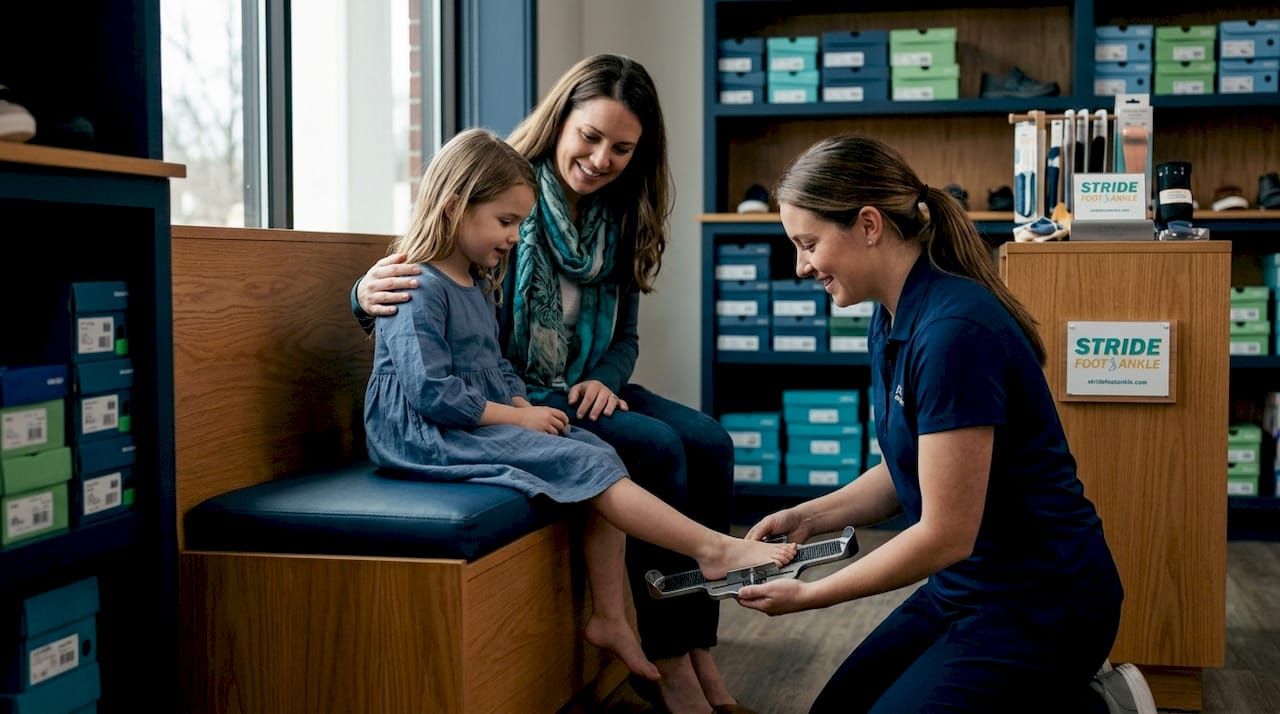
Pro Tip: Have your child’s feet measured every two to three months during peak growth phases. Children’s feet can change size faster than you’d expect, and wearing an outgrown shoe for even a few weeks adds up.
When to seek professional evaluation for your child’s foot pain
Most parents wait too long. Or they worry too soon about the wrong things. Understanding the signs of foot pain in kids that genuinely need a professional helps you act at the right moment.
The reassuring truth is that most foot discomfort in children is benign and temporary. But there is a category of red flags for serious conditions that includes persistent localized pain, limping, swelling, morning stiffness, fever, and activity avoidance. These signals are your cue to stop waiting.
When to call or visit a pediatric foot specialist:
- Pain that has lasted more than two weeks without a clear cause.
- Your child is limping or noticeably changing how they walk.
- Visible swelling, redness, or warmth in any part of the foot or ankle.
- Pain that wakes your child from sleep or is significantly worse in the morning.
- Fever alongside foot or joint pain (this could suggest infection or inflammatory arthritis).
- Your child actively refuses to walk or bear weight on the foot.
- Any rapid change in foot shape or the appearance of a new bump or lump.
What is typically safe to monitor at home:
- Mild soreness after a particularly active day.
- Temporary limping after an obvious minor injury that improves within 48 hours.
- Growing pains (diffuse, bilateral leg aches at night with no daytime symptoms).
Learning to recognize signs of foot pain in kids that cross from normal to concerning is the most important skill a parent can develop. When in doubt, a single evaluation is always worth the peace of mind.
For children dealing with recurring or chronic pain, physical therapy for foot pain can be both diagnostic and therapeutic, identifying movement patterns that contribute to discomfort while building the strength to correct them.
Pro Tip: Keep a simple one-week journal before your appointment. Note when the pain occurs (morning, after activity, at rest), how long it lasts, and what makes it better or worse. This information dramatically shortens the diagnostic process.
Treatment options and managing pediatric foot pain effectively
Here’s what most parents find genuinely reassuring: surgery is rarely the answer for pediatric foot pain. The body of a growing child has a remarkable capacity to adapt and heal, especially when given the right support early.
Treatment for pediatric foot pain almost always starts with the least invasive approach. How to relieve foot pain in children typically follows this progression:
Conservative treatment options (first-line approach):
- Stretching programs: Targeted stretches for the calf, Achilles tendon, and plantar fascia (the connective tissue on the bottom of the foot) address tightness that drives pain.
- Custom or prefabricated orthoses: Shoe inserts that redistribute pressure and support the arch. Custom versions are molded to the specific shape of your child’s foot.
- Supportive footwear adjustments: Often the single most impactful change a parent can make at home.
- Physical therapy: Builds muscle strength, corrects walking patterns, and teaches movement strategies that reduce strain.
- Activity modification: Temporary reduction in high-impact activities while tissues heal, followed by a gradual return.
When is surgery considered?
Surgery is reserved for persistent, symptomatic cases that have not responded to thorough conservative care. One procedure used for painful flexible flatfoot is subtalar arthroereisis, a minimally invasive technique where a small implant is placed in the hindfoot to limit excessive inward rolling. Research on return to sport after subtalar arthroereisis shows that activity level three months after the procedure predicts return to sport better than imaging or pain scores alone. The focus after surgery is on functional recovery, not just correcting how the foot looks on an X-ray.
A step-by-step approach to managing foot pain at home:
- Check and correct footwear immediately.
- Introduce gentle daily calf and Achilles stretching.
- Monitor activity level and reduce high-impact sports temporarily.
- Apply ice for 10 to 15 minutes after activity if swelling or soreness appears.
- Schedule an evaluation if symptoms persist beyond two weeks or worsen.
Conservative foot care approaches resolve the vast majority of child foot pain conditions without the need for procedures. However, when surgery does become necessary, understanding what to expect helps families prepare and reduces anxiety for both child and parent.
Pro Tip: Compliance with stretching and orthotics is the number one predictor of conservative treatment success. Build stretching into your child’s morning routine, the same as brushing teeth. Consistency over weeks makes the real difference.
A specialist’s perspective: why managing pediatric foot pain is about function, not just shape
Here’s something you won’t always hear in a brief clinic visit: the appearance of your child’s feet is rarely a reason to intervene on its own. Flat feet that don’t hurt, toes that point inward at age three, and arches that haven’t formed yet are not emergencies. They are, in most cases, normal variations on the path of development.
The instinct to “fix” what looks unusual is understandable. But when it drives treatment decisions ahead of symptoms, it creates problems. Orthoses placed in a pain-free child’s shoes don’t build a better arch. Neither does surgery on a flatfoot that causes no limitation. Clinicians commonly treat flexible flatfoot symptomatically, focusing on pain relief and functional improvement rather than foot shape. This approach is supported by the evidence, yet many parents still arrive in the office alarmed by what they see rather than what their child feels.
The more useful framework is this: ask your child what they can’t do because of their feet. If the answer is “nothing,” that’s information. If the answer is “I can’t keep up at recess” or “my feet hurt every night,” that’s your signal to act.
What families actually benefit from most is clear, honest communication about what to watch for over time and what truly requires intervention. Reassurance backed by thorough evaluation is itself a form of care. And for children who do need treatment, the goal isn’t a perfect-looking foot on an X-ray. The goal is a child who runs, plays, and moves through childhood without pain.
Developing a relationship with a trusted provider for pediatric foot problem expertise means you always have someone to call when a question comes up, rather than waiting until things have been uncomfortable for months.
How Stride Foot & Ankle supports children’s foot health and pain relief
If your child is experiencing foot pain that’s affecting daily life, you don’t have to figure it out alone. At Stride Foot & Ankle in Las Vegas, Dr. Nahad Wassel provides expert, compassionate evaluation for children dealing with a full range of pediatric foot problems. From the first visit, the focus is on understanding your child’s specific symptoms and building a treatment plan that matches their needs and activity level, not a one-size-fits-all protocol.
Whether your child needs conservative management through orthotics and physical therapy or guidance on something more specific like ingrown toenail treatment, the team at Stride Foot & Ankle is equipped to help. We also work with families on everyday prevention, including footwear guidance and home care strategies that support healthy development. Learn more about our approach to general foot and ankle care, or read about why seeing a podiatrist early makes a meaningful difference in outcomes. Your child’s comfort and mobility are worth taking seriously.
Frequently asked questions
Is flexible flatfoot always painful in children?
No. Flexible flatfoot is frequently normal and painless in children and typically resolves as they mature. A doctor’s evaluation is recommended if your child develops pain or difficulty with physical activity.
Can ill-fitting shoes cause my child’s foot pain?
Yes. Children in narrow shoes are 2.8 times more likely to develop bunions, and shoes that are too tight or too short contribute directly to calluses, ingrown toenails, and general foot discomfort, especially during growth phases.
When should I take my child to see a pediatric foot specialist?
Seek an evaluation if your child has foot pain lasting more than two weeks, is limping, has visible swelling, or shows red flags like fever, night pain, or morning stiffness in the foot or ankle.
Are there treatments available that can prevent surgery for my child’s foot pain?
Yes. Conservative care including orthoses and stretching resolves the majority of pediatric foot pain cases. Surgery is only considered when thorough non-surgical treatment has not provided adequate relief over time.
Can my child continue sports with foot pain?
Many children return to full activity after treatment. In cases requiring procedures, activity level three months post-surgery is the strongest predictor of return to sport, which reinforces that functional recovery and movement are prioritized over imaging results.
Recommended
- Guide to Common Pediatric Foot Problems: Causes, Signs, Care – Stride Foot & Ankle – Dr. Nahad Wassel
- Toe walking in children: Causes, treatments, and when to seek help – Stride Foot & Ankle – Dr. Nahad Wassel
- Why foot care matters: prevent pain, injuries, and complications – Stride Foot & Ankle – Dr. Nahad Wassel
- General Foot & Ankle Care – Stride Foot & Ankle
Recent Comments