

TL;DR:
- Nearly one-third of seniors with diabetes are classified as “at risk” for foot complications, which can significantly increase mortality without proper care. Regular podiatric attention reduces death risk by 69 percent, emphasizing early intervention and routine foot checks, especially in the desert climate of Las Vegas. Maintaining daily foot inspections, wearing appropriate footwear, and seeking professional evaluations are essential for all high-risk groups to prevent serious health consequences.
Nearly one-third of seniors with diabetes have feet classified as “at risk,” meaning they face a serious threat of wounds, infections, and worse without proper attention. Yet podiatric care reduces mortality odds by an extraordinary 69 percent in this group. For Las Vegas families, that number is not just a statistic. It is a reason to stop putting off routine foot checks, whether you are a senior managing a chronic condition, a parent watching your child limp after school, or someone who has been brushing off persistent heel pain for months. This guide cuts through the confusion and lays out exactly what you need to know.
Table of Contents
- The real risks of neglecting your feet
- Why foot care matters more in Las Vegas
- Foot care essentials for high-risk groups: seniors, diabetics, and kids
- How podiatric care and early action save lives
- What most people get wrong about foot care (and what actually works)
- Expert help for lasting foot health in Las Vegas
- Frequently asked questions
Key Takeaways
| Point | Details |
|---|---|
| Foot neglect has real risks | Ignoring foot care leads to preventable pain, injuries, and even life-threatening complications. |
| Las Vegas climate adds challenges | The desert environment increases fungal and injury risks, making foot hygiene crucial for locals. |
| Seniors, diabetics, and kids need extra care | These groups require daily routines and early intervention to avoid severe outcomes. |
| Podiatric support saves lives | Research shows regular podiatrist visits dramatically lower serious complications and mortality. |
| Consistent care outperforms quick fixes | Small, proactive steps and expert guidance work far better than ignoring pain or relying only on home remedies. |
The real risks of neglecting your feet
Most people think of foot problems as minor inconveniences. A sore heel. A corn that keeps coming back. A nail that looks a little off. But foot problems are rarely just foot problems. They send ripple effects through your entire body, disrupting balance, limiting mobility, and accelerating the progression of chronic diseases like diabetes and arthritis.
Neglect can take many forms. It might be ignoring a small cut because you did not think it was serious. It might be delaying a visit to a podiatrist because the pain is not unbearable yet. For people living with diabetes, reduced circulation and nerve damage (called peripheral neuropathy) mean that a blister or a tiny wound can go completely unnoticed until it has become a deep infection. For the elderly, a small balance issue caused by foot pain can trigger a fall that results in a hip fracture and months of recovery.
The consequences are not hypothetical. Research confirms that at-risk foot in diabetics is linked to significantly higher all-cause mortality (HR 2.05) and cardiovascular mortality (HR 2.49). In plain terms, someone with an at-risk foot is roughly twice as likely to die of heart-related causes compared to someone whose feet are properly managed. That connection between foot health and systemic health is something many patients never fully appreciate until a crisis happens.
Children face different but still real risks. Kids who complain of foot pain are often told to “walk it off,” but persistent pain, unusual gait patterns, or flat feet that do not resolve by school age can point to structural issues that only get harder to treat if left unaddressed.
Here are some of the most common complications of ignored foot health:
- Ulcers and open wounds that become infected, sometimes requiring hospitalization
- Osteomyelitis, a bone infection that can develop from an untreated wound
- Peripheral artery disease progression linked to poor circulation in the feet
- Increased fall risk in seniors due to balance problems, bunions, or pain
- Toe deformities like hammertoes or bunions worsening over years without treatment
- Amputation as a last resort when infection cannot be controlled
- Disability and reduced quality of life from chronic, unmanaged pain
“When foot pain goes unaddressed, patients often shift how they walk to compensate. That compensation pattern creates new problems in the knees, hips, and back over time.”
Starting with conservative foot care options early almost always leads to better outcomes than waiting until surgery becomes the only option. The evidence is clear. The choice is yours.
Why foot care matters more in Las Vegas
Las Vegas is not just any city. The Mojave Desert climate creates a specific set of challenges for foot health that residents need to understand. Summer temperatures routinely exceed 110 degrees Fahrenheit, and the dry air pulls moisture from skin quickly and relentlessly. That combination sets up conditions where foot problems develop fast and go unnoticed even faster.
For people with diabetes or reduced circulation, the hot climate increases sweating and creates the warm, moist environments inside shoes where fungal infections thrive. At the same time, reduced sensation from neuropathy means that skin breakdown, blisters, and friction injuries can develop without any pain signal to warn you. By the time there is visible damage, the wound may already be deep.

Seniors in Las Vegas face this challenge acutely. Many older adults are active, which is great, but extended time outdoors in the heat, wearing sandals or unsupportive footwear, increases exposure to burns from hot pavement, cuts from rocky terrain, and the constant foot stress of uneven surfaces. Fall prevention for seniors becomes critical when foot pain or instability is in the mix, because a fall in a dry desert climate far from medical services can be especially dangerous.
For children, the desert environment means more outdoor activity, more barefoot time, and greater exposure to surfaces that can cause plantar warts, cuts, and fungal infections. Parents sometimes dismiss foot complaints as growing pains. While some aches are normal, others signal real issues that deserve attention.
Pro Tip: Always check the soles of your feet at the end of the day during Las Vegas summers. Pavement temperatures can exceed 150 degrees Fahrenheit and cause burns within seconds, even through thin shoe soles. If you or a loved one has reduced foot sensation, check for redness or blisters every single evening.
Here is what Las Vegas residents should watch for specifically:
- Athlete’s foot and nail fungus due to sweaty, enclosed footwear in heat
- Pavement burns from briefly walking on summer asphalt or pool decks
- Dry, cracked heels caused by low humidity pulling moisture from skin
- Plantar warts in children who use public pools and play areas
- Ingrown toenails aggravated by ill-fitting sandals common in warm months
- Unnoticed blisters in diabetics or seniors with neuropathy
Understanding the foot fungus risks specific to this climate is one of the most underrated parts of local foot care. Staying proactive, especially during the hottest months, makes a measurable difference.
Foot care essentials for high-risk groups: seniors, diabetics, and kids
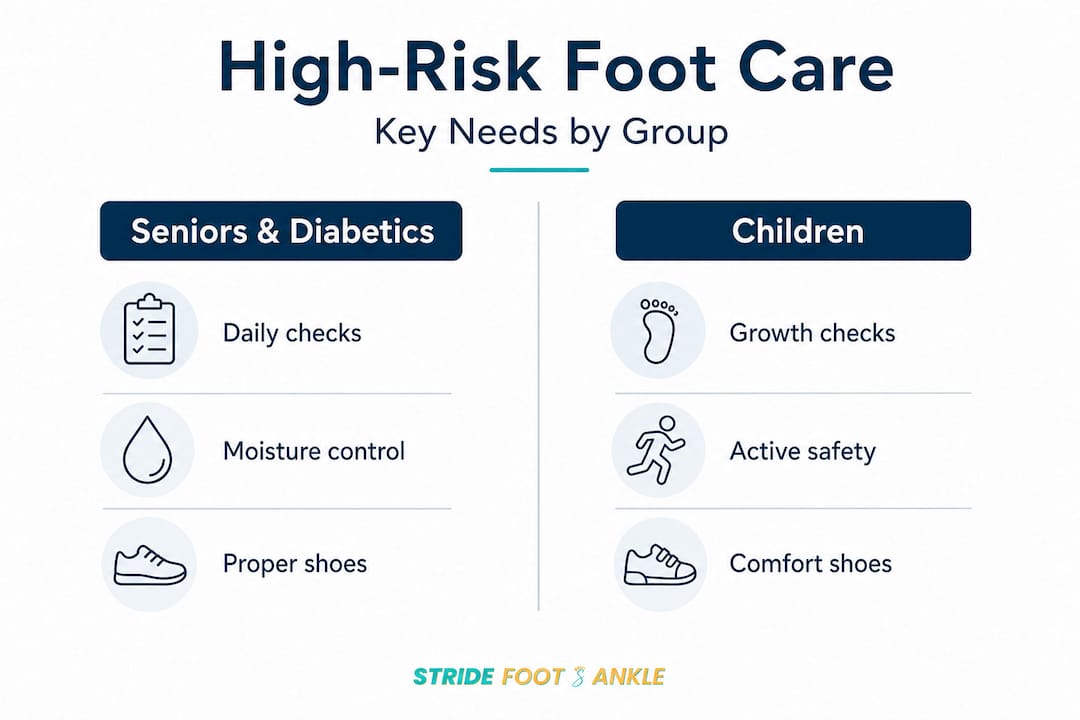
Different populations have different needs, and a one-size-fits-all approach to foot care falls short. Here is a practical breakdown for the three groups most vulnerable to foot health complications in Las Vegas.
Seniors
Aging changes the feet in ways most people do not expect. The fat pads under the heels and balls of the feet thin out over time, reducing natural cushioning. Joints lose flexibility. Circulation slows. Skin becomes thinner and dries out more easily. According to senior foot care research, these age-related changes significantly increase the risk of injuries, fall-related fractures, diabetes complications, and arthritis pain. Good foot care is not optional for older adults. It is essential.
For seniors, the focus should be on daily habits that catch problems early and reduce injury risk. Learning how to age safely at home means paying close attention to the feet as part of a broader safety routine.
Diabetics
Detection matters enormously. Studies show that high-risk foot prevalence in elderly T2DM patients reaches 51.7 percent, with age and HbA1c levels as the most significant contributing factors. That means more than half of older adults with type 2 diabetes already have feet that require careful management. Regular HbA1c control and consistent foot inspection are not optional extras. They are core to survival.
Children
Children’s feet are still developing, and many parents are unsure what is normal versus what needs professional evaluation. Flat feet, for example, are normal in toddlers and young children. The arch typically develops between ages six and ten. Flexible flat feet that do not cause pain are generally not a concern. Rigid flat feet, persistent limping, or pain during or after activity at any age warrants evaluation by a podiatrist.
| Group | Key risk factors | Daily care priorities | When to see a specialist |
|---|---|---|---|
| Seniors | Thin skin, reduced circulation, arthritis | Daily inspection, moisturizing, proper footwear | Sores, swelling, sudden pain |
| Diabetics | Neuropathy, poor circulation, high HbA1c | Daily inspection, blood sugar control, clean dry feet | Any wound, numbness, or color change |
| Children | Developing arches, active play, barefoot time | Check for warts, blisters, and pain after activity | Limp, rigid flat feet, pain over age 10 |
Here is a step-by-step daily routine for anyone in a high-risk group:
- Inspect your feet every day. Use a mirror or ask a family member to check the soles, between the toes, and the heels for cuts, blisters, redness, or swelling.
- Wash feet with mild soap and warm water. Avoid soaking, which dries out the skin excessively.
- Dry thoroughly, especially between the toes. Moisture left between the toes creates conditions for fungal infections.
- Apply a fragrance-free moisturizer to the tops and soles of the feet. Avoid the skin between the toes.
- Trim toenails straight across, not curved at the corners, to prevent ingrown toenails.
- Wear properly fitting shoes and moisture-wicking socks every day, even indoors if you have diabetes or reduced sensation.
- Never walk barefoot on hot pavement or around public pools and locker rooms.
Pro Tip: For seniors and diabetics, make your foot inspection part of another daily habit, like brushing your teeth at night. Pairing it with an existing routine makes it easier to remember and reduces the chance of missing warning signs.
Protecting feet also means making smart choices about shoes. Visit a professional who can assess gait and arch type before buying footwear if you have recurring pain or a known condition. The guidelines around preventing foot injuries consistently point to footwear as one of the most controllable risk factors. Combining good shoes with consistent foot care routines gives you the strongest foundation, literally and figuratively, for long-term foot health.
How podiatric care and early action save lives
Home care is essential, but professional oversight is what takes outcomes from good to excellent. There is a dramatic difference between catching a problem at a routine checkup and catching it in the emergency room after it has spiraled out of control.
Consider this: routine podiatric care reduces mortality odds by 69 percent in at-risk patients. That is not a minor improvement. That is a near-elimination of the most catastrophic outcomes associated with diabetic and senior foot complications. No pill, no supplement, no shoe insert delivers that kind of result on its own. Regular professional care does.
Key stat: Patients with at-risk feet who receive regular podiatric care have a 69% lower chance of dying from related complications compared to those who do not.
Here is what differentiates home care from professional podiatric care:
| Care type | What it covers | What it misses |
|---|---|---|
| Home care | Daily inspection, hygiene, moisture management | Structural problems, early nerve damage, circulation issues |
| Podiatric care | Full assessment, imaging, orthotics, treatment planning | Daily maintenance between visits |
| Combined approach | Full prevention and early intervention strategy | Nothing significant |
At your first podiatry appointment in Las Vegas, you can expect a thorough medical history review, a visual inspection of the feet and ankles, and in many cases an assessment of your gait (how you walk) and circulation. Your podiatrist may recommend imaging if a structural issue is suspected, custom orthotics (shoe inserts designed for your specific foot), or a treatment plan for a current condition.
General foot checkups are appropriate for anyone who wants to establish a baseline, has a family history of foot problems, or is managing diabetes, arthritis, or another chronic condition. You do not have to be in crisis to benefit from a professional evaluation. In fact, the patients who do best are the ones who come in before a crisis develops.
Patient-centered podiatry means your podiatrist will work with you based on your lifestyle, activity level, and personal goals, not just your diagnosis. That approach is especially valuable for Las Vegas residents who are active outdoors or manage complex chronic conditions.
For those exploring treatment options before committing to more intensive interventions, non-surgical plantar fasciitis care and other conservative treatments can be highly effective when started early enough. The window for conservative success is wider than most people realize.
What most people get wrong about foot care (and what actually works)
Here is something we see constantly: patients arrive at a podiatry office only after the pain has become unbearable, after they have tried every home remedy they could find, after weeks or months of limping through their day. By that point, what could have been managed with simple intervention sometimes requires surgery or extended rehabilitation.
The most common misconception is that foot pain is just part of getting older or staying active. It is not. Pain is a signal. A small, persistent ache in the heel is your body’s early warning system, not a rite of passage. The same goes for children. Parents sometimes over-correct by immediately seeking orthotics for a child with flat feet, or under-correct by dismissing legitimate pain because “kids are dramatic.” The truth is more nuanced.
Foot health specialists consistently emphasize starting with conservative care before moving to more aggressive treatments, but also stress that ignoring even minor symptoms leads to deformities and interventions that could have been avoided entirely. Podiatric care dramatically reduces the risk of major amputation when conditions are caught early and managed proactively.
The other thing most people get wrong is thinking that treating one issue solves everything. A bunion, for example, is not just a cosmetic problem. It shifts the distribution of weight across the foot, leading to compensatory pain in the second and third toes, the ball of the foot, and eventually the knees and hips. Addressing arthritis and foot pain early prevents that cascade of secondary problems.
What actually works is simple but requires consistency. Daily inspection, appropriate footwear, managing underlying conditions like diabetes, and scheduled podiatric visits. That combination, done faithfully, is what keeps people mobile, independent, and out of the hospital. There is no shortcut, but there is also no mystery. The evidence is there. The tools are available. The only variable is whether you act on it.
Expert help for lasting foot health in Las Vegas
You have the knowledge now. You understand the risks, the routines, and the real difference that professional care makes for people of every age. The next step is putting that knowledge into action with the right support behind you.

At Stride Foot & Ankle, Dr. Nahad Wassel and the team provide general foot and ankle care tailored to Las Vegas patients, from seniors managing diabetes to parents concerned about their child’s gait. Whether you need conservative foot pain relief for a nagging injury or a structured plan through personalized custom foot care routines, the practice is built around your unique needs. Do not wait for a small problem to become a serious one. Contact Stride Foot & Ankle today to schedule your evaluation and start striding confidently again.
Frequently asked questions
How often should I inspect my feet if I have diabetes?
Daily foot inspection is recommended for people with diabetes to catch minor injuries or changes before they escalate. Research on senior foot care in Las Vegas shows that fewer than half of diabetic patients currently inspect their feet daily, which leaves a significant gap in prevention.
What are red flags in children’s foot health?
Persistent pain, limping, or rigid flat feet after age 10 should be evaluated by a specialist. According to pediatric flat foot research, flexible flat feet are normal until ages six to ten, but any rigid or painful presentation at any age warrants professional attention.
When is foot pain an emergency?
Seek immediate care if there is infection, loss of sensation, or a wound that is not healing. Given that podiatric care reduces mortality odds by 69 percent in at-risk patients, delaying care for serious symptoms is a risk no one should take.
Is it normal for seniors’ feet to change shape?
Yes, aging naturally reduces flexibility and cushion in the feet, but sudden swelling, new pain, or any open sores should be checked by a professional promptly. The senior foot care guidelines for Las Vegas emphasize that gradual changes are expected while acute changes require evaluation.
What foot care do doctors recommend in Las Vegas?
Local doctors advise daily foot checks, active moisture management, and prompt care for any pain or injury, given the hot and dry desert climate. The Las Vegas podiatric care guidance specifically highlights the importance of in-home routines combined with regular professional visits to avoid emergency interventions.
Recommended
- How to prevent foot injuries: expert strategies for healthy feet – Stride Foot & Ankle – Dr. Nahad Wassel
- General Foot & Ankle Care – Stride Foot & Ankle
- Step-by-step foot care routines for pain relief – Stride Foot & Ankle – Dr. Nahad Wassel
- How Conservative Foot Care Relieves Pain and Prevents Surgery – Stride Foot & Ankle – Dr. Nahad Wassel
Recent Comments