

TL;DR:
- Proper daily foot care in Las Vegas is essential for preventing infections and managing chronic conditions. Visual inspection, proper hygiene, moisturizing, and appropriate footwear are key routines to detect and address issues early. Professional podiatric care becomes necessary when symptoms worsen or wounds show signs of infection for optimal healing and complication prevention.
Your feet carry you through every step of life in Las Vegas, from long days on casino floors to scorching sidewalks in summer heat. Yet foot problems rarely announce themselves loudly at first. A small blister, a bit of dryness, a nagging ache under your heel — these minor issues can escalate quickly without proper foot home care, sometimes leading to infections, ulcers, or even surgical intervention. Early detection and timely home care can prevent serious complications in conditions ranging from diabetic foot ulcers to plantar fasciitis. This guide walks you through what actually works, what to avoid, and when it is time to call a podiatrist.
Table of Contents
- Why effective foot home care matters for foot health and pain prevention
- Proven home care steps to manage foot pain and prevent ulcers
- At-home remedies for foot inflammation and swelling relief
- Choosing and using foot massagers safely for pain relief and circulation
- When and how to seek professional podiatric care while doing home foot care
- Reimagining foot home care: Why coordinated, patient-centered approaches matter most
- Get expert foot care support in Las Vegas for lasting relief
- Frequently asked questions
Key Takeaways
| Point | Details |
|---|---|
| Daily inspection critical | Check every part of your feet daily to catch problems early and prevent complications. |
| Proper hygiene matters | Wash and dry your feet carefully, moisturizing appropriately but never between toes. |
| Use correct footwear | Wear well-fitting, cushioned shoes and soft socks to reduce injury and ulcer risk. |
| Manage inflammation smartly | Use ice for acute swelling and heat for chronic stiffness plus elevation and soaks to reduce inflammation. |
| Seek professional care | Consult a podiatrist promptly if you notice any signs of infection or non-healing wounds. |
Why effective foot home care matters for foot health and pain prevention
Understanding the importance of foot care goes well beyond keeping your feet looking presentable. For people living with diabetes, peripheral artery disease, or neuropathy (nerve damage that reduces sensation in your feet), a tiny cut or blister can go unnoticed for days. Without proper attention, that small wound can turn into an infected ulcer within a week.
Las Vegas residents face some unique pressures on their feet. The heat dries skin rapidly. Long shifts in hospitality and service industries mean many people stand for eight or more hours daily. Add to that the prevalence of diabetes in Nevada, and it becomes clear why daily foot home care is not optional for many people here — it is a genuine health necessity.
People at risk should follow these core practices every single day:
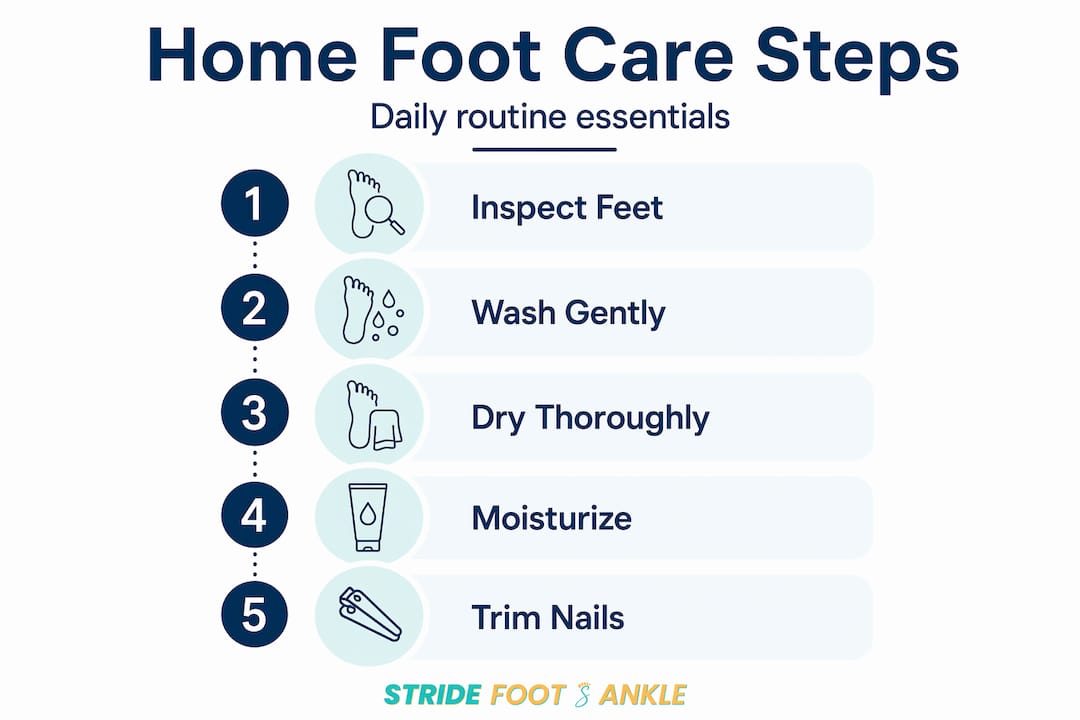
- Inspect your feet daily. Check the tops, bottoms, heels, and spaces between toes. If you cannot bend far enough to see your soles, use a handheld mirror or ask someone to help.
- Wash with mild soap and warm water. Avoid soaking too long, which softens skin and increases the risk of breakdown.
- Dry thoroughly, especially between toes. Moisture trapped between toes creates the perfect environment for fungal infections.
- Moisturize dry skin on your soles and heels. Skip the spaces between your toes, as lotion there can breed bacteria and fungi.
- Trim toenails carefully. Cut straight across, not curved, to prevent ingrown nails.
- Wear well-fitting shoes and clean socks. Footwear that is too tight or too loose causes friction and pressure that lead to sores.
This is not about spending an hour on your feet every night. A consistent five-minute routine, done daily, catches problems before they spiral.
Having understood the importance of foot care, let’s explore proven home care steps that protect your foot health.
Proven home care steps to manage foot pain and prevent ulcers
A good foot home care routine works best when it is specific, not vague. “Take care of your feet” is not a plan. Here is what best foot care practices look like in practice, structured into clear daily steps.
Inspect every surface. Examine every part of your feet using a mirror if needed, including heels, soles, and between each toe. Look for redness, blisters, cracks, swelling, or any discoloration. People with neuropathy may feel nothing even when an injury is significant, so visual inspection is non-negotiable.
Wash daily with mild soap. Use lukewarm water, not hot. Hot water can burn feet with reduced sensation without you realizing it. Mild soap cleans without stripping the natural oils your skin needs for protection.
Dry completely. Pat gently rather than rubbing, paying close attention to the spaces between toes. Even five minutes of residual moisture there can encourage athlete’s foot (a fungal infection) to take hold.
Moisturize the right areas. Apply a gentle, fragrance-free lotion to your heels and soles. Do not apply it between your toes. This is one of the most common mistakes people make during DIY foot treatments, and it directly contributes to fungal infections.
Handle nails carefully. Trim toenails straight across and file any sharp corners. Never cut down into the corners of the nail, which encourages ingrown toenails that can become seriously infected.
Leave corns and calluses to professionals. Over-the-counter corn removal products contain acids that can burn healthy skin and, in people with diabetes or poor circulation, create open wounds. These foot care routines for relief are better managed by a podiatrist who can safely and precisely remove the tissue.
Check your shoes before putting them on. Run your hand inside to feel for seams, foreign objects, or worn areas that could create pressure points.
Pro Tip: Keep a small basket near your bed with your inspection mirror, lotion, and nail file. Making foot care part of your wind-down routine at night is far easier than carving out time during a busy Las Vegas day.
With these routines in place, let’s learn how to address common foot inflammation using home remedies.
At-home remedies for foot inflammation and swelling relief
Foot inflammation (swelling and redness caused by injury or chronic conditions) responds differently to treatment depending on whether it is acute or chronic. Using the wrong approach can actually make things worse.
Here is a quick breakdown of the most effective soothing foot remedies based on your situation:
Ice for acute inflammation. Ice therapy works best during the first 24 to 72 hours after a sudden injury or flare-up. It constricts blood vessels, slowing blood flow to the area and reducing swelling and pain. Apply ice wrapped in a cloth for 15 to 20 minutes at a time, never directly on skin.
Heat for chronic stiffness. For ongoing conditions like arthritis or plantar fasciitis (inflammation of the tissue on the bottom of the foot), gentle heat improves blood circulation and loosens stiff tissue. Avoid heat if the area is visibly swollen or feels warm to the touch, which signals active inflammation.
Epsom salt foot soaks. Dissolve half a cup of Epsom salt in a basin of warm water and soak for 20 to 30 minutes. Epsom salt soaks help reduce swelling and provide noticeable relief for tired, achy feet. They are a solid home foot therapy option for people dealing with mild swelling after a long workday.
Elevation. Lie down and prop your feet above your heart level using pillows. This uses gravity to help your body drain excess fluid from swollen feet and ankles, reducing pressure and discomfort.
Compression socks. Wearing medical-grade compression socks during the day limits fluid accumulation in the lower legs and feet. They are especially useful for people who stand all day, have mild venous insufficiency, or experience recurring foot and ankle swelling.
Pro Tip: In Las Vegas heat, foot swelling is noticeably worse in summer. If you work outdoors or spend time in air-conditioned casinos that keep you stationary for hours, combining elevation in the evening with compression socks during the day makes a measurable difference.
Besides reducing inflammation, many find foot massagers beneficial. Let’s examine their role in home foot care.

Choosing and using foot massagers safely for pain relief and circulation
Foot massagers have become a popular home foot therapy tool, and for good reason. When chosen and used correctly, they offer real benefits for people dealing with chronic foot pain, tight muscles, and poor circulation. But not every device suits every condition.
Foot massagers improve blood flow, relieve chronic pain, and reduce muscle tension. The key is finding the right type and using it appropriately for your specific condition. Here is what to look for:
- Adjustable intensity settings. This is non-negotiable. Your feet’s tolerance changes day to day, especially during a flare-up. A device with multiple intensity levels lets you control how much pressure you receive.
- Appropriate size. A massager that does not fit your foot properly will not target the right areas and may cause discomfort or uneven pressure.
- Rolling massage function. Rolling-style massagers target the plantar fascia (the band of tissue on the bottom of the foot that commonly becomes inflamed) with consistent pressure. This makes them particularly useful for plantar fasciitis relief.
- Heat with caution. Heat settings feel wonderful for most users, but avoid heat settings if you have neuropathy or reduced sensation in your feet, as you may not detect dangerous temperatures until burns have occurred.
Here is a comparison of massager styles and their best uses:
| Massager type | Best for | Caution |
|---|---|---|
| Rolling foot massager | Plantar fasciitis, arch pain | Start at lowest setting |
| Shiatsu kneading massager | General fatigue, tension | Avoid on open wounds |
| Vibration massager | Neuropathy, poor circulation | Skip heat if sensation reduced |
| Water foot spa | Mild swelling, relaxation | Monitor water temperature |
| Compression massager | Edema (fluid swelling), arthritis | Not for deep vein thrombosis |
Foot massagers offer therapeutic benefits for conditions including plantar fasciitis, neuropathy, edema, and arthritis. However, they support general foot care rather than replace it. A massager is a helpful complement, not a treatment on its own for serious conditions.
Pro Tip: Start every massager session at the lowest intensity, even if you have used the device before. Foot sensitivity changes with conditions, medications, and the time of day. Five minutes at low intensity tells you how your feet are responding before you commit to a longer session.
While home tools offer relief, professional care remains critical for complex or severe foot issues.
When and how to seek professional podiatric care while doing home foot care
Home care is genuinely powerful for maintaining foot health and managing mild symptoms. But there are clear situations where pushing through with DIY foot treatments puts you at serious risk.
Watch for these warning signs that require immediate professional evaluation:
- Redness that spreads beyond a small area
- Swelling that does not improve after 24 to 48 hours of home treatment
- Blisters that break open or show signs of infection
- Any wound or sore that does not begin healing within a few days
- Unusual skin color changes, including dark or bluish patches
- Numbness, tingling, or burning sensations that are new or worsening
- Any bleeding from a wound that does not stop with basic first aid
Urgent consultation is needed for redness, swelling, bleeding, blisters, signs of reduced blood supply (called ischemia), or moderate to severe infection. For people with diabetes, these signs represent a potential limb-threatening emergency.
Professional podiatric care for complex conditions goes far beyond what you can do at home. It may include debridement (removing infected or dead tissue from a wound), offloading devices (custom boots or casts that redirect pressure away from the injured area), vascular evaluation (checking blood supply to your feet), wound dressings requiring clinical expertise, and surgical options when conservative care is not sufficient.
Daily foot inspection with prompt doctor contact if any problem arises is essential to prevent serious complications and reduce amputation risk. That is not alarmist — it reflects the clinical reality of what untreated diabetic foot conditions can become.
Understanding when seeing a podiatrist is the right call protects you from a situation that started as manageable and became serious. Knowing foot infection warning signs gives you the confidence to act at the right moment rather than waiting too long.
Having explored signs needing professional care, let’s discuss a unique perspective on integrating home and clinical foot care.
Reimagining foot home care: Why coordinated, patient-centered approaches matter most
Here is something most foot care articles will not tell you plainly: the patients who do best are not the ones who do the most at home. They are the ones whose home routines connect meaningfully to a professional care plan.
We have seen patients in Las Vegas who spent months faithfully soaking their feet, applying creams, and following every tip they found online, yet their wounds were not healing. Not because they were doing things wrong necessarily, but because their condition required offloading, vascular assessment, or debridement that no pedicure at home or foot massager can provide. Home care in isolation has real limits.
What changes outcomes is coordinated management among podiatrists, vascular surgeons, nurses, and orthotists (specialists who design custom footwear and bracing). This kind of team-based care dramatically reduces amputation risk in diabetic foot ulcers, but it requires patients to show up consistently, communicate what they observe at home, and follow through with prescribed offloading.
The second piece is patient education. Not generic advice, but specific instruction tailored to your condition, your footwear, your daily activity level, and your Las Vegas lifestyle. A patient who understands why they should never skip the daily foot inspection, and what they are looking for, is infinitely more effective than one following a checklist they do not fully understand.
Custom footwear and specialized offloading devices also deserve more attention than they typically receive. Many foot ulcer recurrences happen because patients return to ill-fitting shoes after healing. Customized insoles (called orthotics) and therapeutic footwear are not luxuries. For the right patients, they are the single biggest factor in preventing re-injury.
This is why we think of home care not as a standalone program, but as the patient’s active contribution to a larger treatment partnership. The best outcomes come when both sides are showing up. You manage your daily routine with discipline and precision. Your care team manages the clinical complexity. Together, it works. Separately, gaps appear.
Patient-centered podiatry treats you as an informed participant in your own recovery, not just a recipient of treatments. That philosophy produces better healing, fewer complications, and patients who feel genuinely supported throughout the process.
Get expert foot care support in Las Vegas for lasting relief
You now have a clear picture of what effective foot home care looks like, when it is sufficient, and when professional support becomes essential. The next step is making sure you have the right clinical partner alongside your daily routine.

At Stride Foot & Ankle, Dr. Nahad Wassel and the team provide general foot and ankle care that meets you where you are, whether you are managing a chronic condition, recovering from an injury, or dealing with a foot problem that has not responded to home treatment. From advanced wound care to surgical options, the practice offers personalized evaluations tailored to your specific needs and Las Vegas lifestyle. Discover how patient-centered foot care can change your recovery experience. Use the foot health guide to understand your options, then request an appointment today. Your feet deserve expert attention — not just good intentions.
Frequently asked questions
How often should I inspect my feet at home to prevent complications?
You should examine your feet daily, using a mirror or assistance if needed, especially if you have diabetes or neuropathy. Report any skin changes, wounds, or unusual findings to your doctor promptly.
Can I use heat therapy for sudden foot swelling?
No. Ice is best for acute inflammation during the first 24 to 72 hours of sudden swelling. Heat is appropriate for chronic stiffness and circulation issues, not new or active inflammation.
Are foot massagers safe for diabetic neuropathy?
Foot massagers can help improve circulation and relieve discomfort, but you should avoid heat settings if you have diabetic neuropathy with reduced sensation, as burns can occur without you feeling them.
When should I see a podiatrist for foot problems?
See a podiatrist promptly if you notice redness, swelling, blisters, or any wound that does not begin improving within a few days. Early intervention consistently prevents minor issues from becoming serious complications.
How does offloading help in diabetic foot ulcer healing?
Offloading removes pressure from the affected area, which is the cornerstone of healing neuropathic plantar ulcers. Special footwear, casts, or braces redistribute weight so the wound can heal without constant re-injury.
Recent Comments