

TL;DR:
- Trauma is the brain and body’s response to overwhelming events that cause fear, helplessness, or loss of control. Most people experience at least one traumatic event in their lifetime, making trauma a common human experience that requires understanding and appropriate care.
Trauma is the brain and body’s overwhelming response to events that cause intense fear, helplessness, or loss of control. The American Psychological Association defines it as an emotional injury that disrupts a person’s sense of safety and well-being. Around 61% of men and 51% of women experience at least one traumatic event in their lifetime. That prevalence means trauma is not a rare clinical edge case. It is a common human experience that demands clear, practical understanding.
What are the different types of trauma?
Trauma falls into several distinct categories, and identifying the type you or someone you care about has experienced shapes the path to recovery. The DSM-5-TR, the American Psychiatric Association’s diagnostic standard, distinguishes between acute stress responses and longer-term conditions like PTSD. Understanding these categories removes confusion and helps you ask the right questions when seeking care.
Acute trauma
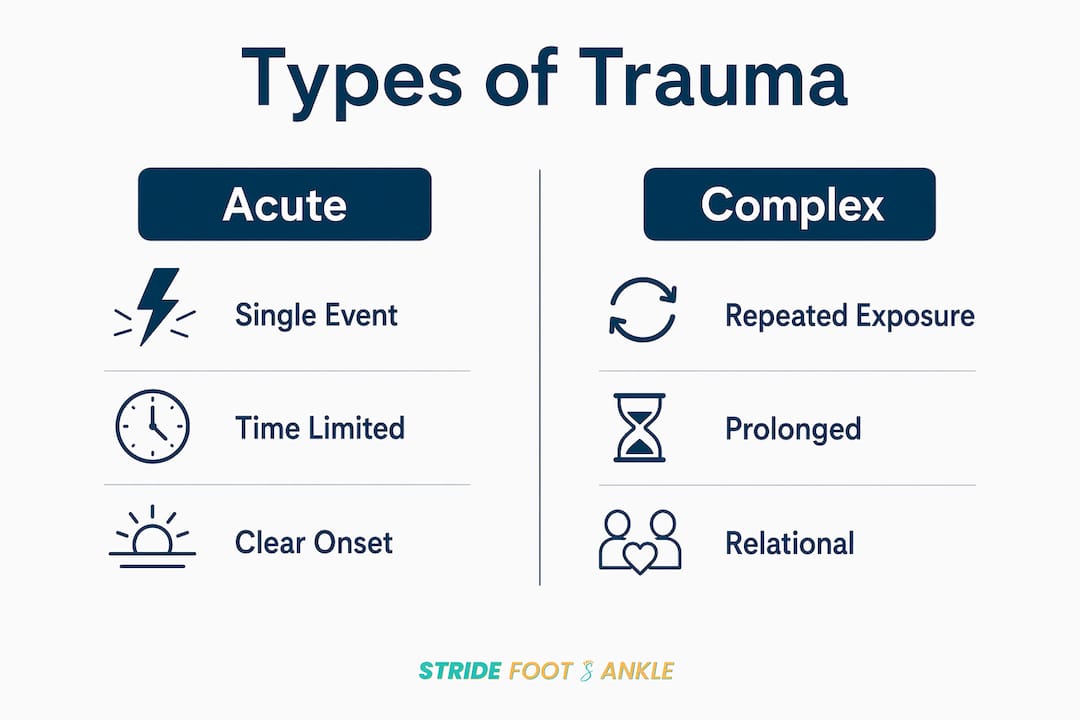
Acute trauma results from a single, time-limited event. A car accident, a natural disaster, a violent assault, or a sudden medical emergency all qualify. The nervous system responds with a flood of stress hormones, and symptoms typically appear within hours or days. DSM-5-TR criteria define acute stress disorder as lasting 3 days to 1 month after the event. That window matters because it separates a normal stress response from a condition that needs clinical attention.
Complex and developmental trauma
Complex trauma develops from repeated or prolonged exposure to harmful events, often within relationships where escape feels impossible. Childhood abuse, domestic violence, and chronic neglect are the most common sources. The effects of childhood trauma are particularly far-reaching because the developing brain is especially vulnerable to repeated stress. Developmental trauma disrupts attachment patterns, emotional regulation, and even physical development in ways that can persist into adulthood without targeted treatment.
Other recognized forms
Beyond acute and complex trauma, several other forms deserve recognition:
- Combat trauma: Experienced by military personnel exposed to life-threatening situations, combat loss, and moral injury during service.
- Medical trauma: Triggered by serious illness, invasive procedures, or traumatic childbirth. Patients often report feeling helpless and out of control during medical events.
- Relational trauma: Caused by betrayal, emotional abuse, or abandonment within close relationships, including family, romantic partners, or trusted figures.
- Violence-based trauma: Results from assault, community violence, or witnessing harm to others.
- Vicarious trauma: Professionals like first responders, therapists, and journalists who regularly encounter traumatic material can develop physiological stress responses similar to those of direct trauma survivors. That finding is significant because it means secondary exposure is not simply emotional fatigue. It is a genuine physiological event.
| Trauma type | Primary cause | Key feature |
|---|---|---|
| Acute | Single event | Time-limited, clear onset |
| Complex | Repeated exposure | Disrupts identity and relationships |
| Developmental | Childhood adversity | Affects brain and attachment patterns |
| Combat | Military service | Includes moral injury component |
| Vicarious | Exposure to others’ trauma | Produces real physiological stress |
What are the common psychological and physical effects of trauma?
Trauma rewires the brain and body in measurable ways. The amygdala, the brain’s threat-detection center, becomes hyperactivated after traumatic exposure. This keeps the nervous system in a near-constant state of alert, even when no real danger is present. Understanding these effects helps you recognize symptoms in yourself and others without judgment.
Psychological effects
The psychological impact of trauma spans a wide range of symptoms. These include:
- Post-traumatic stress disorder (PTSD): Flashbacks, nightmares, and intrusive memories that replay the event involuntarily.
- Anxiety and hypervigilance: A persistent sense that danger is imminent, even in safe environments.
- Emotional dysregulation: Sudden mood swings, intense anger, or emotional numbness that feel impossible to control.
- Dissociation: A sense of detachment from one’s body, surroundings, or sense of self. This is the nervous system’s attempt to manage overwhelming input.
- Survivor’s guilt: A painful belief that one should have done more or did not deserve to survive when others did not.
- Depression and withdrawal: Loss of interest in relationships, activities, and future planning.
Mental health and trauma are deeply intertwined. Untreated trauma raises the risk of substance use disorders, eating disorders, and chronic depression. The longer symptoms go unaddressed, the more entrenched the neural pathways that sustain them become.
Physical effects
The body keeps score alongside the mind. Trauma rewires the amygdala to remain in hypervigilance, and that constant activation has real physical consequences. Elevated cortisol and adrenaline levels suppress immune function over time, making trauma survivors more susceptible to infections and inflammatory conditions. Chronic pain, gastrointestinal problems, cardiovascular strain, and disrupted sleep are all documented physical effects of prolonged stress responses.
Physical trauma, such as injuries from accidents or violence, adds another layer. Foot and ankle injuries sustained during traumatic events, for example, can limit mobility and compound the psychological burden of recovery. The body’s inability to move freely reinforces feelings of helplessness, which deepens emotional distress.
Pro Tip: If you notice physical symptoms like chronic fatigue, persistent pain, or frequent illness alongside emotional distress, tell your doctor about both. Trauma’s physical effects are often treated in isolation when they need to be addressed together.
How symptoms evolve over time
Symptoms do not always appear immediately. The DSM-5-TR recognizes delayed-onset PTSD, where full symptom criteria are not met until 6 months or more after the traumatic event. That delay often confuses both patients and their families, who assume that feeling “fine” initially means the trauma has passed. Chronicity depends on factors including the severity of the event, prior trauma history, available social support, and access to care.
What evidence-based strategies support trauma recovery?
Recovery from trauma follows a structured path, though the pace is personal. Clinical frameworks and practical trauma recovery tips both point to the same core principle: the nervous system must be stabilized before deeper processing can begin. Skipping that step is one of the most common and costly mistakes in trauma healing.
The three-stage clinical recovery framework
Natural recovery from trauma often occurs over days or weeks. Clinical recovery, however, follows a three-stage process:
- Safety and stabilization: The first priority is creating physical and emotional safety. This means establishing predictable routines, reducing exposure to ongoing stressors, and building basic coping skills. Without this foundation, deeper work causes more harm than good.
- Processing and meaning-making: Once stabilized, you can begin to examine the traumatic experience with professional support. This stage involves processing memories, emotions, and distorted beliefs that formed during the event. Evidence-based therapies like Cognitive Processing Therapy (CPT) and Eye Movement Desensitization and Reprocessing (EMDR) are used at this stage.
- Integration and reconnection: The final stage involves weaving the experience into your life story without being defined by it. This includes rebuilding relationships, returning to meaningful activities, and reconstructing a sense of identity and purpose.
Pro Tip: Do not rush from stage one to stage two. Rushing into memory processing without adequate stabilization often re-traumatizes rather than heals. A qualified trauma therapist will pace this process deliberately.
Nervous system regulation strategies
Regulation is the foundation of every recovery stage. Trauma recovery requires autonomic nervous system regulation through non-verbal techniques that calm the body’s alarm system. These include:
- Deep rhythmic breathing, such as box breathing or diaphragmatic breathing
- Consistent sleep and meal schedules that signal safety to the brain
- Regular physical movement, including walking, swimming, or yoga
- Limiting media exposure to traumatic content during stabilization
The ankle sprain recovery process offers a useful parallel: just as physical rehabilitation requires staged progression, emotional recovery demands the same disciplined, phased approach.
Common pitfalls to avoid
| Pitfall | Why it harms recovery | Better approach |
|---|---|---|
| Avoiding all trauma-related thoughts | Delays processing and prolongs symptoms | Allow gradual, supported processing |
| Excessive media exposure to trauma | Keeps nervous system in alert state | Limit news and triggering content |
| Rushing to memory processing | Risk of re-traumatization | Stabilize first, process second |
| Isolating from social support | Removes a key buffer against chronicity | Maintain at least one trusted connection |
Avoiding trauma-related thoughts delays healing, but excessive media exposure to trauma reminders impedes stabilization. The balance is deliberate, supported processing within a safe environment.
How can you apply trauma-informed care in daily life?
Trauma-informed care is a framework, recognized by the Substance Abuse and Mental Health Services Administration (SAMHSA), that prioritizes safety, trustworthiness, peer support, collaboration, empowerment, and cultural sensitivity in all interactions. It applies not just in clinical settings but in how you structure your own daily life and how you choose the professionals who support you.
Self-care strategies grounded in trauma-informed principles
Applying trauma-informed care to your daily routine means building predictability and safety into your environment. Practical strategies include:
- Establish anchoring routines: Fixed wake times, regular meals, and consistent bedtimes regulate the nervous system. Rebuilding via routines helps reconstruct the worldview of safety and predictability that trauma disrupts.
- Identify and manage triggers: Keep a simple log of situations, sounds, or interactions that provoke a stress response. Awareness reduces the element of surprise, which itself reduces reactivity.
- Cultivate social support: Even one trusted person who listens without judgment significantly buffers the impact of trauma. Isolation is a risk factor for chronicity, not a coping strategy.
- Limit stimulants and alcohol: Both interfere with sleep architecture and nervous system regulation, two pillars of recovery.
- Engage in body-based practices: Gentle movement, grounding exercises, and evidence-based pain relief routines all support the physical dimension of healing.
How to identify trauma-informed professionals
Not every therapist or healthcare provider is trained in trauma-specific approaches. When selecting a professional, look for these markers:
- Explicit training in trauma-focused modalities such as EMDR, CPT, Somatic Experiencing, or Trauma-Focused Cognitive Behavioral Therapy (TF-CBT)
- A practice that emphasizes your control over the pace and content of sessions
- Clear communication about what treatment involves before it begins
- Sensitivity to cultural background and prior experiences with healthcare systems
Professional trauma-informed support ensures safe processing of memories, preventing overwhelm and re-traumatization, especially when symptoms include dissociation or emotional instability. That protection is not a luxury. For complex trauma, it is a clinical necessity.
Physical healthcare providers also play a role. Foot and ankle injuries sustained during traumatic events require providers who understand that pain and mobility limitations interact with psychological recovery. Post-surgery foot care and structured rehabilitation programs reflect the same phased, patient-centered principles that define trauma-informed mental health care.
The role of complementary approaches
Complementary methods support but do not replace evidence-based therapy. Mindfulness meditation reduces amygdala reactivity over time with consistent practice. Journaling helps externalize and organize fragmented memories. Creative expression through art, music, or movement gives the nervous system non-verbal outlets. Auto injury recovery approaches that combine physical and neurological care reflect how integrated treatment accelerates healing across both body and mind.
Recovery is non-linear. Patients may cycle back through recovery stages and experience triggers. That cycling is a normal part of healing, not a sign of failure. Expecting a straight line sets you up for unnecessary discouragement.
Key Takeaways
Effective trauma recovery requires nervous system stabilization before memory processing, professional guidance for complex cases, and consistent daily routines that rebuild safety and predictability.
| Point | Details |
|---|---|
| Trauma is widespread | Around 61% of men and 51% of women experience at least one traumatic event in their lifetime. |
| Recovery follows three stages | Safety and stabilization must come before processing and integration, in that order. |
| The body is always involved | Trauma dysregulates the amygdala and immune system, producing real physical symptoms alongside emotional ones. |
| Trauma-informed care applies daily | Anchoring routines, trigger awareness, and social connection are practical tools anyone can use. |
| Non-linear recovery is normal | Cycling back through stages or experiencing triggers does not mean treatment has failed. |
What I’ve learned about trauma that most articles get wrong
People expect trauma recovery to feel like progress. They expect to feel better week by week, with each session moving them further from the event. That is not how it works, and the gap between expectation and reality causes real harm.
What I have observed, again and again, is that the most damaging phase of recovery is not the trauma itself. It is the period when someone feels “almost better” and decides to stop. They skip the integration stage entirely. They return to old environments, old relationships, and old habits before the nervous system has actually recalibrated. Then something triggers them, and they conclude that therapy failed or that they are broken.
The three-stage framework exists precisely because healing has a sequence. You cannot shortcut it any more than you can skip physical therapy after surgery and expect full function. The step-by-step care routines that guide physical recovery are a useful mental model here. Consistency and sequencing matter more than intensity.
The second thing most articles miss is the body. Trauma is not a thought disorder. It is a physiological event that changes how the brain and nervous system operate. Breathing exercises, movement, and sleep schedules are not soft add-ons to “real” therapy. They are the foundation that makes therapy possible. Without nervous system regulation, talk therapy often produces more distress than relief.
My honest recommendation: find a provider who treats the whole person, asks about your physical symptoms alongside your emotional ones, and does not rush you through stages because a treatment protocol says so. Patience is not passivity. It is the most clinically sound thing you can do.
— Ramil
Physical trauma care at Stridefootankle
Physical trauma and emotional trauma rarely travel alone. An injury to the foot or ankle during an accident, fall, or traumatic event can limit mobility for months, compounding the psychological weight of recovery. At Stridefootankle, Dr. Nahad Wassel provides general foot and ankle care grounded in the same patient-centered principles that define trauma-informed practice: clear communication, personalized treatment plans, and respect for each patient’s pace.

Whether you need wound care, nonsurgical treatment for tendon or ligament injuries, or structured rehabilitation after a traumatic event, Stridefootankle offers the expertise and compassionate approach that physical recovery demands. Patients in Las Vegas can request an appointment directly through the site and take the first concrete step toward getting back on their feet.
FAQ
What is trauma, exactly?
Trauma is the brain and body’s overwhelming response to an event that causes intense fear, helplessness, or loss of control. The American Psychological Association defines it as an emotional injury that disrupts a person’s sense of safety and well-being.
How long does trauma recovery take?
Recovery timelines vary widely. Natural recovery from acute trauma often occurs over days or weeks, while complex or developmental trauma may require months or years of structured clinical support.
What are the main types of trauma?
The main types include acute trauma from single events, complex trauma from repeated exposure, developmental trauma from childhood adversity, combat trauma, medical trauma, relational trauma, and vicarious trauma from secondary exposure.
What is trauma-informed care?
Trauma-informed care is a framework, recognized by SAMHSA, that prioritizes safety, trustworthiness, empowerment, and cultural sensitivity in clinical and everyday interactions. It shapes both how professionals treat patients and how individuals can structure their own recovery environment.
When should you seek professional help for trauma?
Seek professional support when symptoms such as flashbacks, dissociation, emotional instability, or physical health changes persist beyond a few weeks or significantly disrupt daily functioning. Complex trauma involving repeated events almost always requires professional guidance to process safely.
Recent Comments