

TL;DR:
- Most ankle sprains are successfully managed with proper grading, immediate protection, and comprehensive rehabilitation. Failure to complete neuromuscular retraining often leads to chronic instability and re-injury. Structured rehab, not just pain relief, is essential for long-term ankle health and function.
An ankle sprain is defined as a ligament injury caused by the ankle rolling, twisting, or turning beyond its normal range of motion, resulting in pain, swelling, bruising, and reduced mobility. Sprains are among the most common musculoskeletal injuries worldwide, affecting athletes, active adults, and everyday patients alike. Understanding the grade of your injury, applying the right immediate care, and following a structured rehabilitation program are the three factors that determine whether you recover fully or develop chronic ankle instability. This guide covers everything from first-aid steps to surgical considerations, grounded in the latest 2026 clinical evidence.
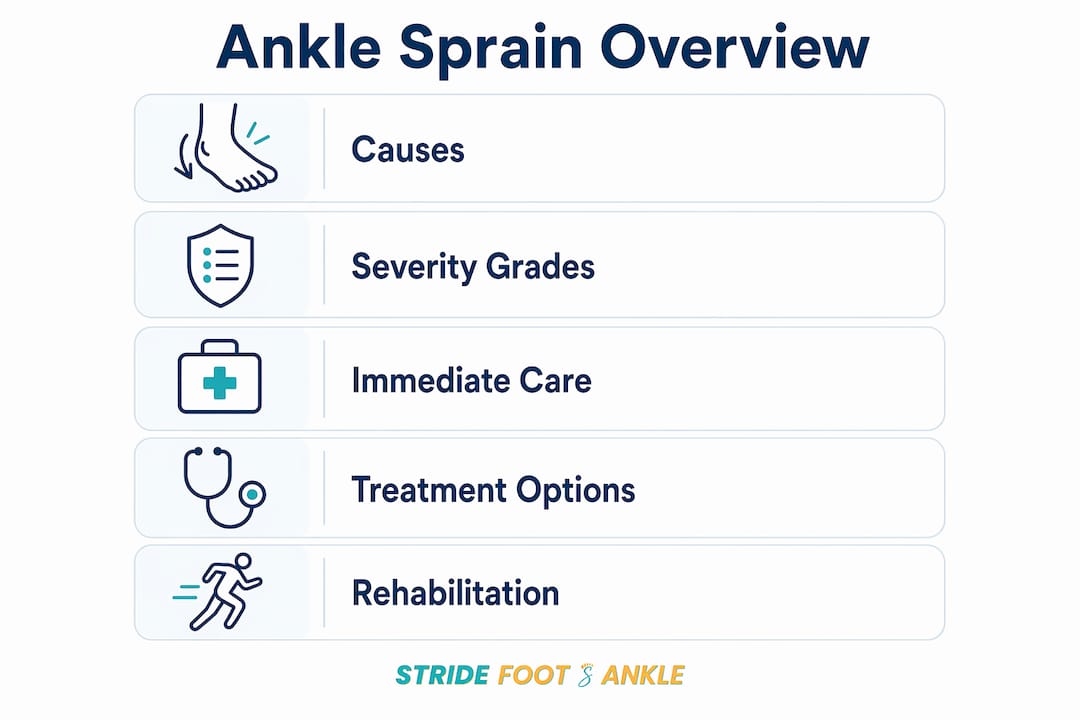
What causes an ankle sprain and how do you grade its severity?
An ankle sprain occurs when the ligaments connecting the ankle bones are stretched or torn, most often during an inversion injury where the foot rolls inward. Recognizing the cause and grade of your sprain within the first hours after injury is the single most important step toward choosing the right treatment path.
Common causes of ankle sprains
The lateral ligaments on the outside of the ankle are the most frequently injured structures. The anterior talofibular ligament is the most commonly torn ligament in ankle sprains, followed by the calcaneofibular ligament. Inversion injuries account for the majority of cases, occurring when the foot plants awkwardly on uneven ground, during sports like basketball or soccer, or simply when stepping off a curb. Eversion injuries, where the ankle rolls outward, are less common but tend to involve the stronger deltoid ligament on the inside of the ankle and often signal a more serious injury.

Symptoms to watch for
The classic symptoms of ankle sprains include localized pain along the outer or inner ankle, swelling that develops within minutes, bruising that may appear within 24 to 48 hours, and a feeling of instability when bearing weight. Some patients report hearing or feeling a “pop” at the moment of injury. Significant swelling combined with an inability to bear any weight suggests a higher-grade injury and warrants prompt professional evaluation to rule out fracture.
Understanding grades I, II, and III
Ankle sprains are classified into three grades based on ligament damage:
- Grade I (mild): The ligament is overstretched but intact. Mild pain and swelling, full weight-bearing is usually possible within days.
- Grade II (moderate): A partial ligament tear with moderate pain, swelling, bruising, and some joint instability. Recovery typically takes two to six weeks.
- Grade III (severe): A complete ligament rupture with significant instability, marked swelling, and an inability to bear weight. This grade may require immobilization or surgical consultation.
Early professional assessment is the most reliable way to confirm the grade of your sprain. A clinician can use the Ottawa Ankle Rules, a validated clinical tool, to determine whether imaging is needed to exclude fractures. Skipping this step and self-diagnosing often leads to undertreated Grade II or III injuries that progress to chronic problems.
How to provide immediate care after an ankle sprain
The first 72 hours after an ankle sprain are the most critical window for limiting tissue damage and setting the stage for faster recovery. Applying the right first-aid protocol immediately reduces swelling, controls pain, and protects the healing ligament.
The traditional approach is the R.I.C.E. protocol, which stands for Rest, Ice, Compression, and Elevation. A 2026 Bone & Joint review confirms that rest, ice, compression, and elevation remain the foundation of emergency ankle sprain management. More recently, the PEACE & LOVE framework has expanded on R.I.C.E. by adding Protection, Education, and Load management in the early phase, followed by Optimism, Vascularization, and Exercise in the recovery phase. PEACE & LOVE is not a replacement for R.I.C.E. but a more complete clinical model that addresses the full recovery arc.
Here is a step-by-step guide for the first 72 hours:
- Rest and protect the ankle. Avoid putting weight on the injured foot. Use crutches if walking causes significant pain. The goal is protection, not complete immobilization.
- Apply ice. Use an ice pack wrapped in a thin cloth for 15 to 20 minutes every two to three hours during the first 48 hours. Do not apply ice directly to skin.
- Apply compression. Wrap the ankle with an elastic bandage such as an ACE wrap, starting at the toes and working upward. Compression limits swelling without cutting off circulation.
- Elevate the ankle. Keep the ankle raised above the level of your heart as much as possible, especially during the first 24 hours. Elevation uses gravity to reduce fluid accumulation in the joint.
- Seek professional evaluation. If you cannot bear weight, if swelling is severe, or if pain is intense, see a clinician within 24 hours to rule out fracture and confirm the sprain grade.
Pro Tip: The PEACE protocol specifically advises against routine use of anti-inflammatory medications and prolonged icing in the first 72 hours. Avoiding anti-inflammatories early preserves the natural inflammatory response that initiates tissue repair. Use ice primarily for pain control, not as a substitute for professional care.
One of the most common mistakes patients make is resting too long. Complete immobilization beyond the first few days slows recovery by reducing blood flow and delaying tissue remodeling. Controlled, protected movement introduced early, under clinical guidance, produces better outcomes than prolonged bed rest.
What non-surgical treatment options exist for ankle sprain recovery?
Non-surgical treatment is the standard approach for the vast majority of ankle sprains, including most Grade II injuries. The goal is to restore full range of motion, strength, and neuromuscular control through a structured progression of support, rehabilitation, and loading.
Functional support and bracing
Functional ankle braces, lace-up supports, and semi-rigid orthoses protect the healing ligament while allowing controlled movement. The 2026 Bone & Joint review confirms that short-duration functional support combined with early passive rehabilitation produces better outcomes than cast immobilization for most sprains. Bracing duration depends on grade: Grade I injuries may need support for one to two weeks, while Grade II injuries often benefit from four to six weeks of bracing during activity. Lace-up braces from brands like Aircast and DonJoy are widely used in clinical settings and provide measurable proprioceptive feedback during the healing phase.
Early passive rehabilitation and weight-bearing
Passive rehabilitation, including gentle range-of-motion exercises, soft tissue massage, and manual therapy, begins as soon as acute pain allows, typically within the first week. Early weight-bearing, even partial, stimulates the mechanoreceptors in the ligament and surrounding tissue, which accelerates healing. Physical therapists use progressive loading protocols that move from non-weight-bearing exercises to partial weight-bearing and then full weight-bearing activities over a structured timeline.
Neuromuscular and proprioceptive training
Neuromuscular training is the most evidence-backed component of ankle sprain rehabilitation. Proprioception, the body’s ability to sense joint position, is disrupted after ligament injury. Without targeted retraining, this deficit persists and significantly increases the risk of re-injury. Balance board exercises, single-leg stance progressions, and perturbation training on unstable surfaces are the primary tools for restoring proprioception. These exercises also rebuild the peroneal muscles, which act as the ankle’s dynamic stabilizers.
Injection therapies: what the evidence says
Injection therapies represent an emerging area of ankle sprain treatment, but clinical consensus has not yet been established. The following table summarizes the current evidence:
| Injection type | Current evidence | Clinical status |
|---|---|---|
| Platelet-rich plasma (PRP) | Some studies show improvements up to 24 weeks | Investigational; not standard care |
| Hyaluronic acid | Limited data on pain reduction in acute sprains | Investigational; not standard care |
| Local anesthetics | Primarily used for short-term pain management | Adjunct use only |
| Corticosteroids | May reduce acute inflammation but risks tissue weakening | Generally avoided in ligament injuries |
A 2026 systematic review found that PRP and hyaluronic acid injections show potential but lack sufficient high-quality evidence for routine clinical use. This means injections may be appropriate in select cases under specialist guidance, but they should not replace structured rehabilitation.
Pro Tip: If a clinician recommends injection therapy for your ankle sprain, ask specifically about the evidence base and how it fits into your overall rehab plan. Injections work best as a complement to nonsurgical ligament treatment, not as a standalone solution.
When is surgery considered for an ankle sprain?
Surgery is reserved for a specific subset of ankle sprain patients and is not the default path even for severe Grade III injuries. Most patients, including those with complete ligament ruptures, recover successfully with conservative care.
The criteria for surgical consideration include:
- Failed conservative treatment: Persistent instability, pain, or functional limitation after three to six months of structured rehabilitation.
- Recurrent severe sprains: Multiple Grade II or III sprains that have resulted in chronic ankle instability (CAI), a condition affecting about 40% of patients who do not complete adequate rehabilitation.
- Associated injuries: Osteochondral lesions, peroneal tendon tears, or loose bodies within the joint that cannot be managed conservatively.
- High-demand athletes: Competitive athletes with complete ligament ruptures who require rapid return to sport may be candidates for earlier surgical intervention.
The two primary surgical procedures are ligament repair and ligament reconstruction. Repair involves directly suturing the torn ligament back to the bone, typically using the Broström technique, which is the gold standard for lateral ankle stabilization. Reconstruction uses a graft, either from the patient’s own tissue or a donor, to replace a ligament that cannot be repaired. Both procedures are performed under anesthesia and require a period of immobilization followed by progressive rehabilitation.
Ankle surgery recovery typically spans four to six months before return to full activity, though this varies by procedure and individual factors. Post-surgical rehabilitation is non-negotiable. Research confirms that dynamic balance may remain impaired after surgery without dedicated neuromuscular retraining, meaning the operation alone does not restore full function.
What rehabilitation exercises help prevent re-injury and chronic instability?
Rehabilitation is the most powerful tool for preventing chronic ankle instability and ensuring a full return to activity. Stopping rehab once pain and swelling resolve is the single most common mistake patients make, and it is the primary reason re-injury rates remain high.
A structured rehab program progresses through three stages:
- Stage 1: Restore range of motion (weeks 1 to 2). Gentle ankle alphabet exercises, where you trace the letters of the alphabet with your toes, restore mobility without stressing the healing ligament. Towel scrunches and seated calf raises begin rebuilding the intrinsic foot muscles. The goal is pain-free movement through the full range of motion.
- Stage 2: Build strength (weeks 2 to 6). Resistance band exercises targeting dorsiflexion, plantarflexion, inversion, and eversion rebuild the muscles that support the ankle. Eccentric calf raises, where you lower slowly on one leg, are particularly effective for strengthening the Achilles tendon and peroneal complex. Progressive loading through strength training also triggers mechanical signaling pathways in the ligament itself, accelerating tissue remodeling.
- Stage 3: Restore neuromuscular control (weeks 4 to 12). Single-leg balance on a flat surface progresses to a foam pad, then to a BOSU ball or balance board. Perturbation training, where a therapist or training partner introduces unexpected surface changes, retrains the reflexive stabilization response. Sport-specific drills such as lateral shuffles, cutting movements, and jump-landing mechanics are introduced in the final phase before return to full activity.
Pro Tip: Blood flow restriction (BFR) training, using a specialized cuff to reduce venous outflow during low-load exercise, allows you to build muscle strength without heavy loading on the healing ligament. BFR is increasingly used in clinical settings and is particularly useful in the early strength phase when the ankle cannot yet tolerate high resistance.
Patients who complete all three stages of rehabilitation, including the neuromuscular phase, reduce their risk of developing chronic ankle instability significantly. Inadequate rehabilitation that neglects proprioception training is directly linked to post-traumatic arthritis and long-term joint degeneration. Staying engaged with your care provider through the full program, even when the ankle feels fine, is the decision that separates a complete recovery from a recurring problem.
Key takeaways
Ankle sprain recovery depends on accurate grading, immediate protection, and completing the full rehabilitation program, including neuromuscular retraining, not just waiting for pain to resolve.
| Point | Details |
|---|---|
| Grade determines treatment | Sprains classified as Grade I, II, or III guide bracing duration, rehab intensity, and surgical decisions. |
| PEACE & LOVE over rest alone | Avoid prolonged immobilization and early anti-inflammatories; protected movement speeds healing. |
| Neuromuscular training is non-negotiable | Proprioception deficits persist after pain resolves and drive chronic instability if untreated. |
| Injections are investigational | PRP and hyaluronic acid show promise but lack sufficient evidence for routine clinical use in 2026. |
| Surgery is a last resort | Most Grade III sprains respond to conservative care; surgery is indicated after failed rehab or recurrent instability. |
Why I think most ankle sprain patients are discharged too soon
After reviewing the 2026 clinical literature and working through what the evidence actually shows, one pattern stands out clearly: the majority of ankle sprain patients are functionally discharged the moment their pain and swelling resolve. That is the wrong endpoint.
Pain resolution and full recovery are not the same thing. The neuromuscular deficits that drive re-injury, specifically the loss of proprioception and the delayed peroneal muscle response, persist for weeks to months after the ankle looks and feels normal. Patients who stop rehab at the pain-free stage are essentially walking around with a structurally healed but neurologically compromised ankle. That is why re-injury rates remain so high even among people who followed initial treatment correctly.
The other pattern I find underappreciated is the role of patient education in the early phase. The PEACE protocol’s emphasis on education is not a soft add-on. Patients who understand why they are doing each exercise, and what happens if they skip the proprioception phase, are far more likely to complete the full program. Compliance is a clinical outcome, and it starts with honest, specific communication from the first appointment.
On injection therapies, I would urge caution without dismissal. PRP and hyaluronic acid are genuinely interesting tools, and the early data has some signal. But recommending them before the evidence base matures does patients a disservice. The risk is not just financial. It is that patients substitute an injection for the structured rehab that actually works. Use injections as an adjunct when conservative care alone is insufficient, not as a shortcut.
The bottom line is this: treat the whole injury, not just the symptoms. Get graded properly, follow the full rehab program, and do not stop at pain-free. Your ankle will thank you for the next 30 years.
— Ramil
Get expert ankle sprain care at Stride Foot & Ankle
If you are dealing with ankle pain and want a clear diagnosis and a personalized recovery plan, Stridefootankle is here to help.

Dr. Nahad Wassel and the team at Stride Foot & Ankle in Las Vegas specialize in the full spectrum of foot and ankle care, from accurate sprain grading and advanced imaging to customized rehabilitation programs and surgical consultation when needed. Whether your injury is a mild Grade I sprain or a complex Grade III rupture with chronic instability, you deserve a care plan built around your specific condition and goals. Schedule your appointment today and take the first step toward getting back on your feet with confidence.
FAQ
What is an ankle sprain?
An ankle sprain is a ligament injury caused by the ankle rolling or twisting beyond its normal range, most commonly affecting the lateral ligaments on the outside of the ankle. Severity is graded from mild overstretching (Grade I) to complete rupture (Grade III).
How long does ankle sprain recovery take?
Ankle sprain recovery time ranges from one to two weeks for Grade I injuries to three to six months for Grade III sprains requiring surgery or extensive rehabilitation. Completing the full neuromuscular rehab program, not just waiting for pain to resolve, determines the final outcome.
How do you treat an ankle sprain at home?
Immediate ankle injury treatment at home follows the R.I.C.E. protocol: rest, ice for 15 to 20 minutes every two to three hours, compression with an elastic bandage, and elevation above heart level. Seek professional evaluation within 24 hours if you cannot bear weight or swelling is severe.
What are the symptoms of a severe ankle sprain?
Symptoms of a Grade III ankle sprain include intense pain, significant swelling and bruising, a feeling that the ankle “gave out,” and an inability to bear weight. These signs indicate a possible complete ligament rupture and require prompt clinical assessment to rule out fracture.
Can ankle sprains lead to long-term problems?
Yes. Chronic ankle instability develops in about 40% of patients who do not complete adequate rehabilitation, and inadequate treatment can also contribute to post-traumatic arthritis over time. Completing the full rehab program, including proprioception training, is the most effective way to prevent these outcomes.
Recommended
- Ankle Sprain Recovery Process: Your 2026 Rehab Guide – Stride Foot & Ankle – Dr. Nahad Wassel
- What Is Ankle Surgery? Types, Risks, and Recovery – Stride Foot & Ankle – Dr. Nahad Wassel
- Why Do Kids Need Ankle Surgery? A Parent’s Guide – Stride Foot & Ankle – Dr. Nahad Wassel
- Ingrowing Toenails: Causes, Relief, and Treatment – Stride Foot & Ankle – Dr. Nahad Wassel
Recent Comments