

TL;DR:
- Choosing a foot specialist provides targeted evaluation and advanced treatment options that general doctors lack. Early, accurate diagnosis and personalized care from experts prevent worsening conditions and reduce the need for invasive procedures. Specialized tools and approaches ensure better long-term outcomes and help restore mobility and quality of life more effectively.
Foot pain is easy to dismiss. You tell yourself it will go away, try rest, maybe pick up some insoles at a pharmacy, and hope for the best. But when the pain lingers for weeks, when walking to your car feels like a chore, or when a swollen ankle keeps you off your feet, self-care stops being enough. Knowing why choose a foot specialist is the first step toward real answers. Specialists bring targeted training, advanced tools, and personalized treatment plans that general practitioners simply are not equipped to match.
Table of Contents
- Key takeaways
- Why choose a foot specialist over a general doctor
- Foot conditions that actually require specialist care
- Diagnostic tools and treatment options specialists offer
- Benefits of choosing a foot specialist
- How to find the right foot specialist
- My perspective on why specialist care changes everything
- Start striding confidently with Stridefootankle
- FAQ
Key takeaways
| Point | Details |
|---|---|
| Specialists outperform general care | Foot specialists bring focused training in anatomy, biomechanics, and pathology that general doctors lack. |
| Conditions get worse without treatment | Early intervention prevents progression and reduces the need for more invasive procedures later. |
| Most cases avoid surgery | Conservative treatments like orthotics, physical therapy, and injections resolve the majority of foot and ankle problems. |
| Selection matters as much as timing | Board certification, patient reviews, and communication style are the key factors when choosing your specialist. |
| Personalized care drives better outcomes | Specialists review your history, biomechanics, and lifestyle to build a treatment plan designed specifically for you. |
Why choose a foot specialist over a general doctor
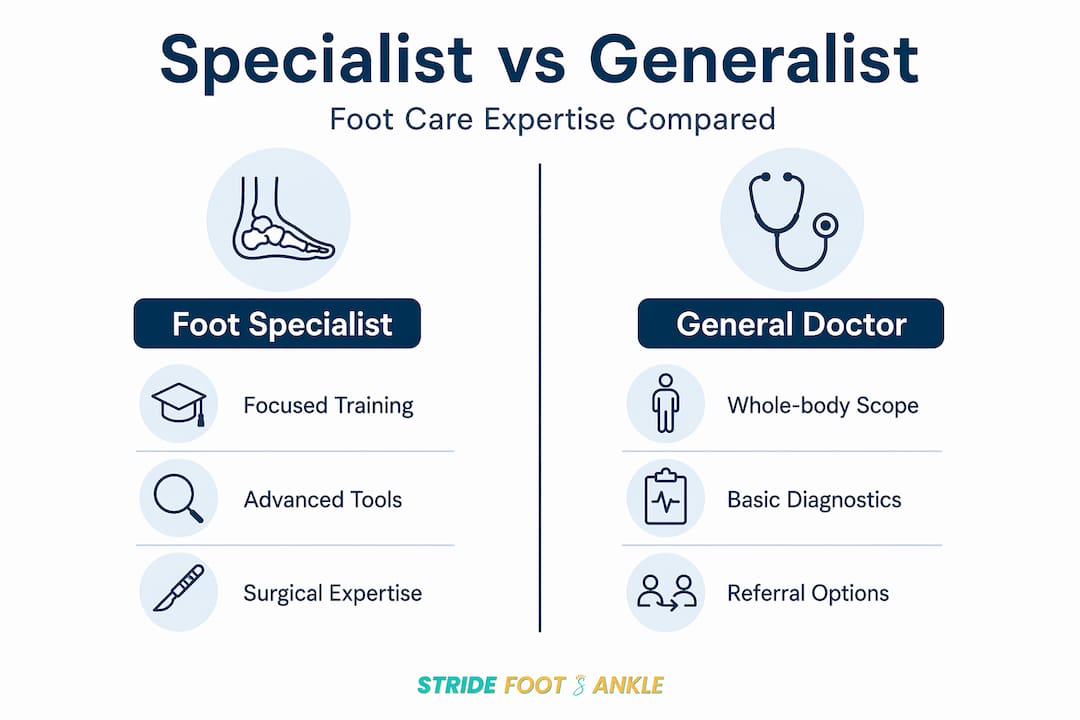
A foot specialist is a physician with training focused entirely on the foot, ankle, and lower leg. There are two main types: podiatrists, who complete a four-year podiatric medical degree followed by residency training, and orthopedic foot and ankle surgeons, who go through medical school, orthopedic surgical residency, and often an additional fellowship year dedicated to foot and ankle surgery. Both carry expertise that no general practitioner develops through standard medical training.
General practitioners handle a broad range of conditions across the entire body. That breadth is valuable for routine health maintenance, but it leaves limited room to develop the depth that foot conditions require. The foot contains 26 bones, 33 joints, and more than 100 muscles, tendons, and ligaments. Getting a diagnosis wrong or undertreating a problem in that structure can cascade into knee, hip, and back issues over time.
Foot specialists go beyond a surface-level look. They assess biomechanics, which means they study how you walk, how your weight distributes across your foot with each step, and how structural abnormalities might be feeding your pain. That kind of analysis simply does not happen in a ten-minute primary care visit.
Here is what foot specialists are specifically trained to evaluate and treat:
- Structural deformities like bunions, hammertoes, and flat feet
- Nerve conditions including neuromas and peripheral neuropathy
- Tendon injuries such as Achilles tendonitis and posterior tibial tendon dysfunction
- Bone pathology including stress fractures and arthritis
- Skin and nail conditions like ingrown toenails, plantar warts, and fungal infections
- Sports injuries affecting the ankle and midfoot
- Diabetic foot complications, which carry serious risk of infection and amputation if mismanaged
The combination of anatomical focus, surgical training (where applicable), and biomechanical expertise is what separates a foot specialist from a physician who simply has more general knowledge.
Foot conditions that actually require specialist care
Not every ache needs a specialist. But common foot conditions like plantar fasciitis, bunions, heel spurs, arthritis, fractures, tendonitis, and neuromas all benefit from specialist evaluation. The real issue is that these conditions often masquerade as each other in their early stages, and a misdiagnosis leads to months of ineffective treatment.

Plantar fasciitis, for example, is the most common cause of heel pain. But heel pain can also come from a stress fracture, a nerve entrapment, or Achilles insertional tendinopathy. Each condition requires a different treatment approach. If you are treating the wrong problem, you will not get better. That is where specialist evaluation pays for itself.
Symptoms that should prompt you to see a foot specialist include:
- Heel or arch pain that does not improve after two to three weeks of rest
- Swelling, bruising, or tenderness that follows an injury
- A bump or bony prominence on your foot that grows or becomes painful
- Numbness, burning, or tingling in any part of the foot
- Difficulty bearing weight on the foot or ankle
- Pain that wakes you up at night or disrupts your sleep
- Any foot concern if you have diabetes, as complications can develop rapidly
Delays in specialist care can result in worsening symptoms and more invasive treatments. A bunion that causes mild discomfort at age 40 can become a structural deformity requiring surgery at 55 if never addressed. The same pattern holds for tendon tears, unmanaged arthritis, and untreated stress fractures that progress into full breaks.
Pro Tip: If your foot pain has lasted more than three weeks and has not responded to rest and over-the-counter anti-inflammatories, book a specialist appointment rather than waiting longer. Three weeks is the threshold where self-care typically stops being enough.
The importance of foot health goes beyond comfort. Chronic foot pain changes how you walk, which shifts load onto your knees and hips. Over time, altered gait mechanics contribute to problems well beyond the foot. Addressing the source early protects the whole kinetic chain.
Diagnostic tools and treatment options specialists offer
A foot specialist has access to a diagnostic and treatment toolkit that goes well beyond what a general practice provides. Precise diagnosis drives everything. Getting it right on the first attempt saves you months of trial and error.
Advanced imaging for accurate diagnosis
Specialists use advanced imaging tools including X-rays, diagnostic ultrasound, and MRI to identify pathology that a physical exam alone cannot confirm. A weight-bearing X-ray shows how bones align under load, which reveals deformities that vanish when you are lying on an exam table. Ultrasound can visualize soft tissue structures like tendons and ligaments in real time, and MRI provides detailed imaging of bone marrow changes, cartilage damage, and small ligament tears. Each tool gives a different layer of information, and specialists know which to use based on your specific presentation.
Conservative treatment approaches
Most foot and ankle cases respond well to non-surgical care first, with surgery reserved only if needed. Conservative options include:
- Custom orthotics designed from a precise cast or 3D scan of your foot
- Targeted physical therapy to strengthen supporting musculature and improve flexibility
- Supportive footwear recommendations specific to your foot type and daily demands
- Anti-inflammatory medications and topical treatments
- Immobilization with boot walkers or bracing for acute injuries
Injections: a closer look
Injections are a category where specialist expertise makes a measurable difference. Corticosteroid injections can deliver short-term pain relief but carry risks including fascia rupture and fat pad atrophy if placed incorrectly. Ultrasound guidance significantly improves accuracy and reduces the chance of hitting surrounding nerves or blood vessels. Platelet-rich plasma (PRP) injections, which use a concentrated dose of growth factors from your own blood, are another option for chronic tendon conditions that have not responded to other treatments.
Here is a quick comparison of injection types used in foot care:
| Injection type | Best used for | Key benefit | Notable risk |
|---|---|---|---|
| Corticosteroid | Acute inflammation, bursitis, plantar fasciitis | Fast-acting pain relief | Fat pad atrophy, fascia rupture with repeated use |
| PRP (Platelet-Rich Plasma) | Chronic tendinopathy, slow-healing injuries | Stimulates natural tissue repair | Slower results, multiple sessions often needed |
| Hyaluronic acid | Ankle joint arthritis | Joint lubrication and cushioning | Variable effectiveness across patients |
Pro Tip: Always ask whether your injection will be performed under ultrasound guidance. Ultrasound-guided injections maximize accuracy and meaningfully reduce the risk of complications, especially around sensitive structures like the plantar fascia.
When surgery becomes the right choice
Surgery is not the first step, but it is sometimes the right one. Foot surgeons specialize in minimally invasive techniques that reduce recovery time, minimize scarring, and preserve surrounding tissue. Bunion correction, tendon reconstruction, and ankle arthroscopy are examples of procedures that, when performed by an experienced foot surgeon, carry very high success rates and can restore function that years of conservative care failed to recover.
Benefits of choosing a foot specialist
Choosing a foot specialist delivers clear advantages that go beyond what a general doctor can offer. Patients consistently choose podiatry because it provides board-certified, patient-focused evaluations and tailored treatment plans aimed at restoring function, not just suppressing symptoms.
Here is why specialist care produces better outcomes:
- Accurate diagnosis from the start. Foot specialists have the training to distinguish between conditions that look similar on the surface. Getting the right diagnosis immediately prevents months of failed treatment.
- Personalized treatment plans. Specialists review your full medical history, conduct detailed physical exams, and factor in your biomechanics, lifestyle, and goals. The plan they build is designed around you, not a generic protocol.
- Access to advanced tools. From diagnostic imaging to ultrasound-guided injections and surgical options, specialists offer a wider range of solutions than a general practitioner.
- Reduced risk of complications. Conditions like diabetic foot ulcers or progressive tendon tears require expert oversight. Mismanagement carries serious consequences that specialist care actively prevents.
- Better long-term outcomes. Foot pain and mobility problems significantly impact daily life, and specialist care restores movement and function more effectively than general treatment approaches.
“Foot specialists provide comprehensive assessments and personalized treatment plans to restore movement and reduce pain in ways that general practitioners are not trained to replicate.”
One thing patients often underestimate is the psychological dimension of chronic foot pain. When you are told your pain is something you just have to live with, and then a specialist identifies the exact mechanical cause and offers a clear path forward, the shift in confidence and motivation is significant. That clarity is itself part of the healing process.
How to find the right foot specialist
Finding the right foot specialist takes more than a quick internet search. Choosing a qualified specialist improves outcomes by providing expertise and personalized care tailored to your specific condition. Here is what to look for:
- Board certification. In podiatry, look for certification from the American Board of Foot and Ankle Surgery or the American Board of Podiatric Medicine. For orthopedic surgeons, board certification from the American Board of Orthopaedic Surgery with a foot and ankle subspecialty is the standard.
- Relevant experience. If you need tendon reconstruction, look for a surgeon who performs that procedure regularly, not one who does it occasionally. Volume and recency of experience with your specific condition matter.
- Patient reviews. Look beyond star ratings. Read what patients say about communication, wait times, follow-up care, and whether they felt heard. Those details tell you more than a five-star average.
- Treatment philosophy. A good specialist lays out all your options, explains the trade-offs honestly, and respects your preferences. If a provider pushes immediately to surgery without discussing conservative options, that is worth questioning.
- Insurance and logistics. Verify that the specialist is in-network with your plan and understand what costs you are responsible for before your first visit.
Pro Tip: Prepare three to five questions before your first appointment. Ask about your diagnosis, the evidence behind the recommended treatment, and what the recovery timeline looks like. A specialist who answers those questions clearly and without impatience is someone you can trust with your care.
It also helps to think about location and availability. Foot conditions often require multiple visits, especially if physical therapy or follow-up imaging is involved. A specialist who is geographically convenient and offers reasonable scheduling reduces the friction that causes patients to drop out of treatment before they fully recover.
My perspective on why specialist care changes everything
I’ve seen a pattern repeat itself more times than I can count. A patient comes in having dealt with heel pain for two years. They tried stretching videos, three different pairs of shoes, a round of anti-inflammatories from their family doctor, and an insole from the pharmacy. None of it worked, and they had started to believe the pain was just part of getting older.
In my experience, the problem was never that those treatments were wrong in principle. The problem was that they were treating a guess, not a confirmed diagnosis. Once you have a precise picture of what is actually happening structurally, treatment becomes straightforward. That two-year patient often turns around in eight to twelve weeks.
What I’ve learned about foot care is that most people wait far too long. They underestimate how much chronic pain costs them in energy, mobility, and quality of life. They also underestimate how fixable most foot problems are when addressed properly and early. The foot is a complex structure, but it responds well to the right intervention. The word I would use is resilient.
I also want to be honest about expectations. Not every condition resolves completely. Some patients with severe arthritis or longstanding tendon damage will manage rather than cure. But even in those cases, a specialist can reduce pain, slow progression, and help you stay active in ways that feel meaningful. That is a very different outcome than being told to rest and come back if it gets worse.
The patients I find most rewarding to work with are the ones who come in ready to understand their condition and participate in their recovery. Specialist care works best as a partnership.
— Ramil
Start striding confidently with Stridefootankle
If foot pain has been holding you back, you deserve care built around your specific needs, not a generic referral and a wait-and-see approach.

Stridefootankle offers board-certified foot and ankle care in Las Vegas, led by Dr. Nahad Wassel, a specialist with advanced surgical training and a patient-centered approach to treatment. Whether you are dealing with a painful bunion, persistent heel pain, a tendon injury, or a condition that has gone unresolved for months, the practice offers the full range of foot and ankle care services from conservative options through to surgical solutions when they are genuinely needed. You can also explore conservative pain relief options that have helped many patients avoid surgery entirely. Scheduling is straightforward, and the team is ready to answer your questions from the first call.
FAQ
What does a foot specialist treat that a general doctor cannot?
Foot specialists diagnose and treat conditions like plantar fasciitis, bunions, neuromas, tendon tears, and stress fractures with a level of anatomical precision and treatment depth that general practitioners are not trained to provide. They also perform or coordinate advanced procedures including ultrasound-guided injections and minimally invasive surgery.
When should you see a foot specialist instead of waiting?
See a foot specialist if your foot pain has lasted more than two to three weeks without improvement, if you have swelling or bruising after an injury, or if you have diabetes and notice any foot changes. Early intervention prevents conditions from progressing into more serious problems requiring invasive treatment.
What are the benefits of foot surgery when it is recommended?
The benefits of foot surgery include permanent correction of structural problems like severe bunions or tendon ruptures, restored function, and long-term pain relief that conservative care cannot achieve in advanced cases. Modern minimally invasive techniques reduce recovery time and lower the risk of complications significantly.
How do I choose between a podiatrist and an orthopedic foot surgeon?
Podiatrists handle the full spectrum of foot and ankle conditions, including medical management, biomechanics, and surgery. Orthopedic foot surgeons specialize more narrowly in surgical reconstruction. For most foot problems, a podiatrist is the right starting point. Complex structural or joint surgery may warrant an orthopedic foot and ankle specialist.
Does specialist foot care cost more than seeing a general doctor?
The upfront cost may be slightly higher, but specialist care typically results in faster, more accurate diagnosis and fewer wasted treatments over time. Most foot specialists accept major insurance plans, and a correct diagnosis at the first visit can save significant money and time compared to months of ineffective general care.
Recent Comments