

Facing foot surgery can feel overwhelming, especially when you are unsure what to expect before, during, and after the procedure. The good news is that with the right preparation, you can significantly reduce your risk of complications and set yourself up for a faster, smoother recovery. This guide walks you through every critical stage, from understanding your specific procedure and gathering supplies to navigating recovery milestones and knowing when to call your provider. Whether you are managing a bunion correction, tendon repair, or fracture fixation, these steps apply directly to you.
Table of Contents
- Understanding your foot surgery: Procedure basics and risks
- Pre-operative preparation: What you need before surgery
- Day-of surgery: Checklist and common mistakes to avoid
- Recovery expectations: Steps, timelines, and when to seek help
- Why personalized foot surgery prep matters more than generic checklists
- Next steps: Connect with Las Vegas’s foot surgery specialists
- Frequently asked questions
Key Takeaways
| Point | Details |
|---|---|
| Know your risks | Diabetics face higher infection and complication rates, so identifying risk factors early is crucial. |
| Prepare smart | Advance planning—supplies, medical checks, provider consultations—sets the stage for smoother surgery. |
| Follow expert advice | Personalized rehab and specialist care dramatically lower the odds of complications after foot surgery. |
| Monitor recovery closely | Watch for warning signs and keep follow-up appointments to ensure optimal healing. |
Understanding your foot surgery: Procedure basics and risks
Before anything else, you need to understand exactly what procedure you are having and what risks apply to your health profile. Foot surgeries vary widely in complexity and recovery demands.
Common foot and ankle procedures include:
- Bunionectomy (removal of a bony bump at the base of the big toe)
- Hammertoe correction (straightening a bent toe joint)
- Achilles tendon repair (reattaching or reconstructing the tendon)
- Fracture fixation (using screws or plates to stabilize broken bones)
- Plantar fascia release (cutting tissue to relieve chronic heel pain)
- Ankle fusion or replacement (for advanced arthritis)
Each procedure carries its own healing timeline and risk profile. Generally, risks across all foot surgeries include infection, poor wound healing, nerve damage, blood clots, and hardware failure. However, your personal health history changes those risks considerably.
Diabetic patients face a significantly higher risk. Research shows that diabetic patients have a 13.2% postoperative infection rate compared to just 2.8% in non-diabetic patients, and poor glucose control can raise that risk tenfold. This is not a minor difference. It means that if you have diabetes, your pre-surgical preparation needs to go well beyond the standard checklist.
| Risk Factor | Diabetic Patients | Non-Diabetic Patients |
|---|---|---|
| Infection rate | 13.2% | 2.8% |
| Slow wound healing | High | Low to moderate |
| Amputation risk | Elevated | Rare |
| Glucose-linked complications | Significant | Minimal |
“Understanding your individual risk factors before surgery is not optional. It is the foundation of safe surgical planning.” This is especially true for patients managing chronic conditions like diabetes, peripheral neuropathy (reduced nerve sensation in the feet), or vascular disease.
Before your procedure, ask your provider these key questions: What are the specific risks for my health profile? What does a normal recovery look like for this procedure? What signs of complications should I watch for? How will my diabetes or other conditions affect healing?
Good wound care for surgery patients starts before the first incision. And choosing a top foot doctor with surgical expertise in your specific condition is one of the most important decisions you will make.
Once you understand the basics and risks of your surgery, it is time to start preparing for your procedure.
Pre-operative preparation: What you need before surgery
Preparation is where outcomes are often decided. Patients who arrive at surgery well-prepared, with optimized health markers and a ready home environment, consistently do better than those who show up unprepared.
Your pre-operative medical checklist:
- Complete all required lab work, including blood glucose, complete blood count, and metabolic panel
- Confirm your A1c (a three-month average of blood sugar levels) is below 7% if you have diabetes
- Review all medications with your surgeon, including blood thinners, anti-inflammatories, and supplements
- Stop smoking at least two weeks before surgery, as smoking significantly slows wound healing
- Arrange transportation to and from the surgical facility
- Confirm your insurance authorization and pre-surgical paperwork
Home supply checklist:
| Supply | Purpose |
|---|---|
| Crutches or knee scooter | Non-weight-bearing mobility |
| Wound dressings and gauze | Post-op wound management |
| Ice packs or cold therapy wrap | Swelling and pain control |
| Waterproof cast cover | Keeping the surgical site dry |
| Glucose monitor (diabetic patients) | Tracking blood sugar during recovery |
| Elevated leg pillow or wedge | Reducing swelling through elevation |
Optimizing blood glucose before surgery is one of the most evidence-backed steps you can take. Poor glucose control is directly linked to higher infection rates and increased amputation risk. Work with your endocrinologist or primary care physician alongside your podiatrist to get your numbers in range before your scheduled date.
Pro Tip: Set up a recovery station at home before your surgery day. Choose a comfortable chair or couch with easy access to your supplies, phone charger, water, and medications. You will not want to be searching for things when you are post-op and in pain.
Your home environment matters more than most patients realize. Clear pathways of clutter, move frequently used items to lower shelves, and install a shower chair if your bathroom requires stepping over a tub. These small changes prevent falls during the first critical days of recovery.

Review foot and ankle care tips to understand what conservative post-surgical care looks like. And if you are still weighing whether surgery is necessary, explore nonsurgical options that your podiatrist may recommend first.
With your preparations underway, focus next on day-of surgery instructions.
Day-of surgery: Checklist and common mistakes to avoid
The day of your surgery is not the time to improvise. Having a clear plan reduces anxiety and prevents avoidable errors that can delay your procedure or create complications.
Step-by-step day-of checklist:
- Follow your fasting instructions precisely. Most facilities require nothing by mouth for at least 8 hours before general anesthesia
- Take only the medications your surgeon approved for the morning of surgery, with a small sip of water
- Wear loose, comfortable clothing, especially loose pants or shorts that fit over a surgical boot
- Remove nail polish from the affected foot and all jewelry before arriving
- Bring your photo ID, insurance card, and any forms your facility requested
- Arrive at least 30 minutes early to complete check-in paperwork
- Check your blood glucose if you are diabetic and report the reading to your care team immediately
“Never assume the surgical team has your full medical history. Speak up about any health changes, new medications, or concerns that have developed since your last pre-op appointment.”
Common mistakes patients make on surgery day:
- Forgetting to skip their morning blood thinner or anti-inflammatory medication
- Eating or drinking after the cutoff time, which can result in procedure cancellation
- Not disclosing a recent cold, infection, or change in blood sugar levels
- Arriving without a driver, which is required for any procedure involving sedation or anesthesia
- Wearing tight clothing that cannot accommodate a surgical dressing or boot
For diabetic patients specifically, surgery-day glucose management is critical. Personalized rehab protocols cut diabetic foot complications to 15% compared to 30% with standard care, and amputation rates drop from 18% to just 5% when A1c is kept below 7%. That data should motivate every diabetic patient to take glucose monitoring seriously on surgery day and throughout recovery.
Pro Tip: Write down your current medications, dosages, and any allergies on a card and bring it with you. Even if your chart is in the system, having this information in hand speeds up intake and prevents errors.
Consult expert podiatrist advice to understand what your specific surgical team will need from you on the day of your procedure. You can also review practical surgery day tips from our team’s experience with Las Vegas patients.
The day itself is handled. Now let’s look at what to expect during the recovery phase.
Recovery expectations: Steps, timelines, and when to seek help
Recovery from foot surgery is not a passive process. It requires active participation, consistent follow-through, and close communication with your care team. Most patients want a clear timeline. Here is a realistic one.
Week-by-week recovery overview:
- Week 1: Expect significant swelling, bruising, and pain. Keep the foot elevated above heart level as much as possible. Strictly follow weight-bearing restrictions. Change dressings as instructed.
- Weeks 2 to 3: Swelling begins to decrease. Sutures may be removed. You may transition from a splint to a surgical boot. Physical therapy or guided range-of-motion exercises may begin.
- Weeks 4 to 6: Most patients see meaningful improvement. Weight-bearing often increases with provider approval. Wound should be well-closed with no signs of infection.
- Weeks 6 to 12: Return to normal footwear may begin for simpler procedures. More complex surgeries like tendon repairs or fusions may require continued immobilization.
- 3 to 6 months: Full functional recovery for most procedures. Bone healing continues internally even after external symptoms resolve.
Warning signs that require immediate contact with your provider:
- Increasing redness, warmth, or swelling around the incision
- Discharge or odor from the wound
- Fever above 101°F
- Severe or worsening pain not controlled by prescribed medication
- Numbness or color changes in the toes
| Recovery Milestone | Typical Timeline | Key Action |
|---|---|---|
| Wound closure | 2 to 3 weeks | Suture removal, dressing change |
| Reduced swelling | 3 to 6 weeks | Elevation, compression |
| Return to boot or shoe | 4 to 8 weeks | Provider-guided transition |
| Full weight-bearing | 6 to 12 weeks | Physical therapy |
| Complete healing | 3 to 6 months | Follow-up imaging if needed |
Personalized rehab and tight glucose control sharply reduce complication and amputation rates after surgery, particularly for diabetic patients. This is not generic advice. It is a clinically supported standard that your care team should be implementing from day one.
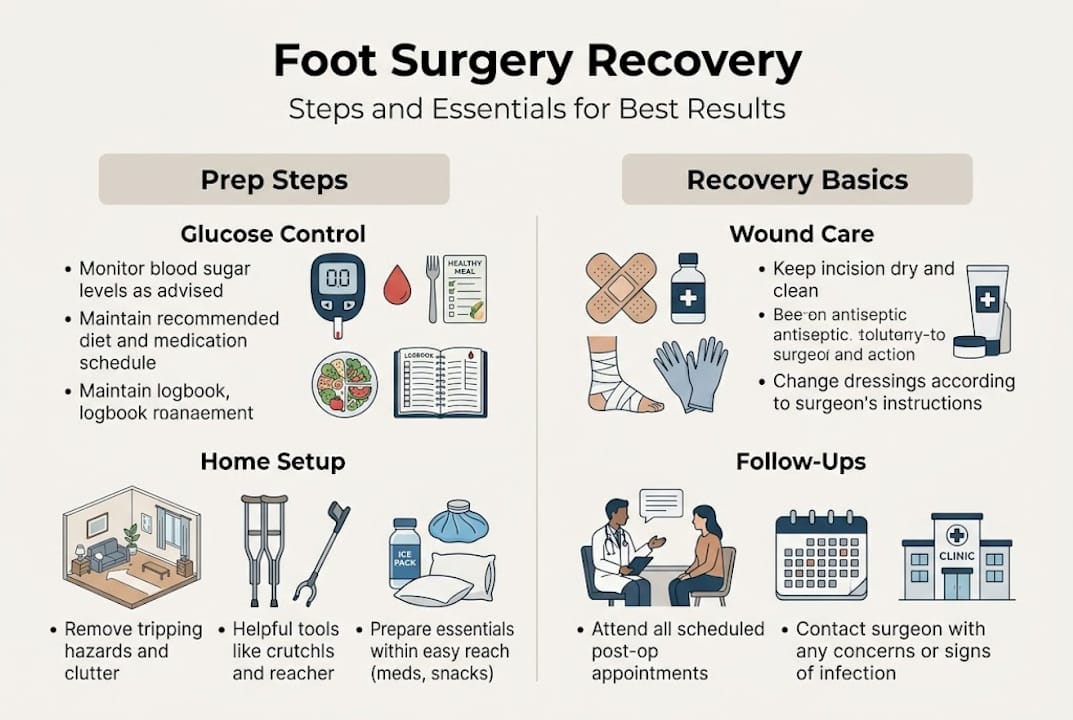
Follow-up appointments are not optional. Most surgeons schedule visits at one week, two to three weeks, six weeks, and three months post-op. Missing these appointments means missing the chance to catch complications early.
Review ongoing foot care strategies to support your healing between appointments. And if you have any wound concerns, learn more about post-op wound care options available to Las Vegas patients.
Why personalized foot surgery prep matters more than generic checklists
Here is something most pre-surgical guides will not tell you directly: generic preparation checklists are designed for the average patient. But in foot surgery, the average patient does not exist.
Every person who walks into a surgical center brings a unique combination of health history, lifestyle factors, circulation quality, and healing capacity. A 45-year-old with well-controlled Type 2 diabetes and a bunionectomy is not the same patient as a 70-year-old with peripheral neuropathy undergoing Achilles tendon repair. Treating them with the same protocol is not just inadequate. It is a risk.
The data backs this up clearly. For patients with complicated diabetes, infection risk rises up to 10 times compared to non-diabetic patients, and personalized rehab programs cut major complications in half. These are not marginal improvements. They represent the difference between a successful recovery and a serious setback.
What does personalized care actually look like in practice? It means your podiatrist reviews your A1c trends, not just your most recent reading. It means your rehab plan accounts for neuropathy-related balance issues. It means your wound care protocol is adjusted based on your circulation status, not just the type of incision made.
Las Vegas patients deserve to ask for this level of specificity. If your provider hands you a printed sheet and sends you home without discussing your individual risk factors, that is a signal to ask more questions or seek a second opinion.
Finding a specialist who takes time to individualize your protocol is worth the effort. And understanding foot complications before they occur is always better than managing them after the fact.
The patients who do best are not necessarily the healthiest ones. They are the most prepared and the most engaged with their care team.
Next steps: Connect with Las Vegas’s foot surgery specialists
Preparing for foot surgery is a process that benefits enormously from expert, personalized guidance at every stage. At Stride Foot & Ankle, we support Las Vegas patients from initial evaluation through full recovery, with protocols tailored to your specific procedure and health profile.

Dr. Nahad Wassel and our team offer comprehensive foot care services that address both surgical and non-surgical needs. Whether you need advanced wound care post-operatively or are still deciding on the right treatment path, we are here to help you move forward with confidence. Schedule a consultation today and get a care plan built specifically for you, not a generic template.
Frequently asked questions
What should diabetics do before foot surgery?
Diabetic patients should optimize blood glucose control to reduce infection risk, targeting an A1c below 7% before the scheduled procedure date. Work with both your podiatrist and primary care provider to reach and maintain that benchmark.
How long does foot surgery recovery usually take?
Recovery varies by procedure, but most patients see significant healing within 4 to 8 weeks with proper wound care, elevation, and follow-up appointments. More complex surgeries like tendon repairs or ankle fusions may require 3 to 6 months for full functional recovery.
What supplies are essential for post-surgery care?
Key supplies include wound dressings, crutches or a knee scooter, ice packs, a waterproof cast cover, and an elevated leg pillow. Diabetic patients should also have a glucose monitor readily available throughout the recovery period.
When should I contact my doctor after surgery?
Contact your podiatrist immediately if you notice signs of infection such as increasing redness, warmth, discharge, or odor from the wound, or if you develop a fever above 101°F. Severe or worsening pain that is not controlled by your prescribed medication also warrants an urgent call.
Why is personalized rehab important for diabetic patients?
Personalized rehab lowers complication rates from 30% to 15% and amputation rates from 18% to 5% by tailoring protocols to individual glucose levels, circulation status, and neuropathy severity. Standard protocols simply do not account for the unique risks diabetic patients carry into surgery.
Recent Comments