

TL;DR:
- Conservative care, including physical therapy and orthotics, is the first recommended step for most foot and ankle conditions. When necessary, minimally invasive procedures like arthroscopy or orthobiologics serve as effective alternatives before considering ankle fusion or replacement. Choosing the right treatment depends on diagnosis, activity goals, and individual health factors, with expert consultation guiding optimal care.
If you’re looking for footanklesurgicalgroup.com alternatives, the fastest paths are structured conservative care (physical therapy, orthotics, bracing), interventional orthobiologics (PRP), and less-invasive surgical options like arthroscopy or fusion. ACFAS guidelines recommend exhausting conservative measures before ankle replacement or fusion. Up to 90% of plantar fasciitis patients improve without surgery.
Quickest options to pursue:
- Structured conservative care (PT, orthotics, NSAIDs): Best for early-stage overuse injuries, plantar fasciitis, mild arthritis, and post-injury recovery. Up to 90% of plantar fasciitis patients improve without surgery.
- Interventional orthobiologics (PRP, shockwave therapy): Worth exploring for tendon and ligament conditions that haven’t responded to standard PT.
- Arthroscopy or debridement: A minimally invasive surgical option for joint impingement, loose bodies, or early arthritis.
- Arthrodesis (fusion): The gold-standard surgical alternative to ankle replacement for end-stage arthritis with high pain burden.
- Second opinion at a local practice: Stride Foot & Ankle in Las Vegas offers board-certified evaluation, conservative care, and surgical expertise under one roof.
Table of Contents
- What are the best alternatives to footanklesurgicalgroup.com?
- How do you choose the right provider or treatment for your condition?
- What non-surgical options actually work for foot and ankle conditions?
- What surgical alternatives exist besides ankle replacement?
- When is surgery still the right call?
- Why Stride Foot & Ankle is a strong local alternative in Las Vegas
- Key Takeaways
- What patients often overlook about foot and ankle care decisions
- Ready to get a second opinion or start conservative care in Las Vegas?
- Useful sources and clinical guidelines
- FAQ
What are the best alternatives to footanklesurgicalgroup.com?
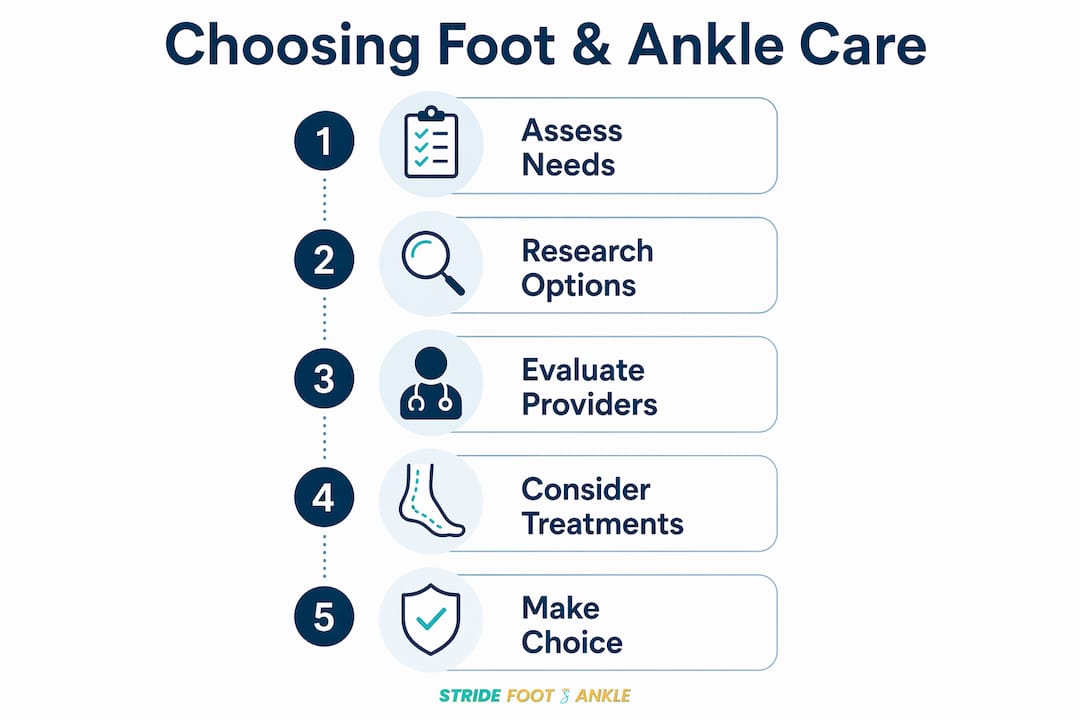
The four main provider categories below cover the full spectrum of foot and ankle care, from conservative clinics to academic referral centers. Choosing the right one depends on your diagnosis, activity goals, and how far your condition has progressed.
| Category | Best for | Invasiveness / Recovery | Expected Outcomes | Typical Cost & Insurance | Availability | Evidence Level |
|---|---|---|---|---|---|---|
| Conservative care clinics | Early-stage overuse, plantar fasciitis, mild arthritis | Non-invasive; 4–12 weeks | High success for overuse conditions; 90% for plantar fasciitis | Low; most plans cover PT and orthotics | Widely available nationally and locally | Strong; guideline-supported |
| Interventional orthopedics | Tendon/ligament injuries, early arthritis, athletes | Minimally invasive; 2–6 weeks | Promising but mixed evidence; best as shared-decision option | Moderate; PRP often not covered by insurance | Growing network; telehealth consults available | Emerging; limited RCT data |
| Community podiatry / surgical practices | Bunions, ingrown nails, ankle instability, second opinions | Low to moderate; varies by procedure | Strong for most common conditions; outcomes depend on surgeon experience | Moderate; most procedures covered | Local clinics in most metro areas | Moderate to strong |
| Academic referral centers | Complex deformity, failed prior surgery, rare conditions | Moderate to high; longer recovery | Best for complex cases; multidisciplinary support | Higher; may require referral | Major metro areas; limited rural access | Highest for complex cases |
One-line guidance per category:
- Conservative clinic: Start here for any overuse or early-stage condition before considering surgery.
- Interventional orthopedics: Consider when PT has plateaued and you want to avoid surgery; discuss evidence limitations openly with your provider.
- Community podiatry/surgical practice: The practical choice for most patients needing both conservative and surgical expertise in one place, including second opinions.
- Academic center: Reserve for cases involving prior failed surgery, complex deformity, or conditions requiring multidisciplinary input.
How do you choose the right provider or treatment for your condition?
The right match depends on five factors: your confirmed diagnosis, activity and functional goals, comorbidities (especially diabetes or obesity), the evidence level behind each option, and your insurance coverage. Skipping any one of these leads to mismatched care.
Questions to ask any provider:
- What is my specific diagnosis, and what imaging supports it?
- How many patients with my exact condition have you treated, and what were their outcomes?
- Are you board-certified in foot and ankle surgery or podiatric medicine?
- What is your documented complication rate for this procedure or protocol?
- What does my rehabilitation plan look like, and how long before I return to my activity goals?
- What happens if conservative care doesn’t work? What is the surgical pathway?
- What will my out-of-pocket cost be, and does my insurance cover this?
State practice resources recommend a documented 3–4 week structured conservative trial before reassessing surgical need. Bringing a written log of your prior treatments helps any new provider evaluate what has already been tried.
Red flags to watch for:
- Guaranteed results or promised cure rates without documented outcomes data.
- No clear rehabilitation plan after a procedure.
- Vague or unavailable cost estimates before treatment begins.
- Pressure to proceed to surgery without a documented conservative trial.
- No mention of comorbidity screening (diabetes, obesity) before arthroplasty. Obesity and diabetes raise complication risk after ankle arthroplasty significantly, and any reputable provider will screen for these.
What non-surgical options actually work for foot and ankle conditions?
Non-surgical care is the right first step for most foot and ankle conditions. A structured conservative program should be tried before surgery unless you have a structural emergency, nonhealing wound, or progressive deformity. Systematic reviews confirm no single treatment is universally superior; individualized plans consistently outperform one-size-fits-all protocols.
Physical therapy and foot-core training
Exercise-based rehabilitation is the backbone of conservative care. Eccentric strengthening, manual therapy, and foot-core training restore biomechanics and reduce injury recurrence. Patients who commit to structured rehab tend to have the best functional outcomes regardless of whether they ultimately need surgery. A foot mobility program is often the first thing a good podiatrist prescribes.
Orthotics, bracing, and offloading
Custom orthotics and bracing redistribute load away from painful structures. For diabetic patients with Charcot arthropathy, accommodative orthotic management achieved acceptable functional endpoints in approximately 59% of midfoot cases without surgery in a 6-year series. Offloading devices like total contact casts are commonly used for neuropathic forefoot ulcers.
Injections and orthobiologics
Corticosteroid injections reduce acute inflammation quickly but are generally limited to a few cycles to avoid tissue damage. PRP and stem-cell-style orthobiologic therapies are emerging options, but evidence remains mixed; they work best as part of a shared decision-making conversation where your provider is transparent about what the data does and does not support.
Extracorporeal shockwave therapy (ESWT)
ESWT delivers acoustic energy to stimulate tissue healing and is particularly useful for chronic plantar fasciitis and insertional Achilles tendinopathy that hasn’t responded to PT alone.
| Modality | Typical timeline to improvement | Notes |
|---|---|---|
| Physical therapy / foot-core training | 4–12 weeks | First-line; guideline-supported for most overuse conditions |
| Custom orthotics / bracing | 4–8 weeks | Highly effective for Charcot midfoot; essential for diabetic offloading |
| Corticosteroid injection | 3–4 weeks | Short-term relief; limit cycles to avoid tissue damage |
| PRP / orthobiologics | 6–12 weeks | Promising; evidence still emerging; discuss limitations with provider |
| Extracorporeal shockwave therapy | 6–12 weeks | Best for chronic plantar fasciitis and insertional tendinopathy |
Key stat: 90% of plantar fasciitis patients improve with conservative care alone, making surgery a last resort for the vast majority.
Who benefits most from non-surgical care:
- Runners and athletes with overuse injuries (stress fractures, tendinopathy, plantar fasciitis)
- Older adults with mild-to-moderate arthritis and manageable pain levels
- Diabetic patients with neuropathic ulcers amenable to offloading (with close monitoring)
- Post-injury patients recovering from sprains or minor fractures
What surgical alternatives exist besides ankle replacement?
When conservative care has been exhausted and surgery is necessary, ankle replacement is not the only option. Five procedures cover most clinical scenarios, each with distinct trade-offs in invasiveness, recovery, and long-term function.
Arthrodesis (fusion) remains the most evidence-supported surgical alternative to total ankle replacement for end-stage arthritis. The joint is permanently fused, eliminating pain at the cost of motion. Recovery typically runs 10–16 weeks non-weight-bearing, with most patients returning to daily activities by 6 months. It suits older, lower-demand patients or those with significant bone loss.
Arthroscopy and debridement is the least invasive option. A surgeon removes loose bodies, inflamed tissue, or bone spurs through small incisions. Recovery is 2–6 weeks. It works best for impingement syndromes, early arthritis, and osteochondral lesions rather than end-stage joint destruction.
Distraction arthroplasty is a joint-preserving procedure that focuses on restoring joint biology rather than removing or replacing the joint. An external fixator unloads the ankle for several weeks, allowing cartilage to recover. It suits younger, active patients with moderate arthritis who want to preserve motion and delay or avoid fusion.
Allograft arthroplasty uses donor tissue to resurface the joint. Evidence is still accumulating, but it offers a biologic alternative for patients who are too young for a metal implant and have focal cartilage defects.
Osteotomy realigns the bones to redistribute load away from damaged cartilage. It is most effective when arthritis is localized to one compartment and the deformity is correctable.
Patient factors that guide the choice:
- Age and activity level: younger, active patients lean toward joint-preserving options (distraction, osteotomy).
- Comorbidities: diabetes and obesity push clinicians away from arthroplasty due to elevated complication and revision risk.
- Bone stock and deformity severity: significant bone loss or deformity usually requires fusion.
- Prior surgical history: failed prior procedures narrow the viable options considerably.
When is surgery still the right call?
Surgery is appropriate when structural instability, progressive deformity, nonhealing wounds, severe infection, or a well-documented failure of conservative care is present. ACFAS guidelines are clear: exhaust conservative measures first, especially in patients with diabetes or obesity. But some presentations make delay dangerous.
Clinical signs that warrant prompt surgical referral:
- Nonplantigrade foot (the foot cannot be positioned flat for weight-bearing)
- Unresolving or worsening soft-tissue infection with systemic signs
- Progressive Charcot neuroarthropathy with deformity
- Mechanical instability that fails bracing and structured PT
- Nonhealing diabetic foot ulcer with underlying structural deformity
For context on diabetic foot ulcers specifically: surgical offloading achieved a 96% healing rate within one month in one comparative analysis, versus 68% within three months using standard conservative care. That gap matters when infection risk is high.
Typical recovery phases after common procedures:
Arthroscopy patients are usually weight-bearing within 2–3 weeks and back to full activity by 6–8 weeks. Fusion (arthrodesis) requires 10–16 weeks non-weight-bearing, with full functional recovery often taking 6–12 months. Distraction arthroplasty involves wearing an external fixator for roughly 12 weeks, followed by a rehabilitation phase of several months. Understanding these timelines before committing to a procedure is part of what ankle surgery types, risks, and recovery planning should cover with your surgeon.
Why Stride Foot & Ankle is a strong local alternative in Las Vegas
Stride Foot & Ankle offers board-certified foot and ankle surgical expertise alongside a full conservative care program, making it a practical local option for second opinions, initial evaluations, and ongoing care. For Las Vegas patients who want one provider capable of managing both non-surgical and surgical pathways, it removes the need to coordinate across multiple specialists.
Dr. Nahad Wassel leads the practice with training in both podiatric medicine and foot and ankle surgery. His approach prioritizes individualized care plans over protocol-driven treatment, which aligns with evidence showing no single therapy is universally superior across foot and ankle conditions.
What to expect at your first visit:
- A thorough clinical history and physical examination focused on your functional goals, not just your imaging.
- Weight-bearing X-rays and, when indicated, advanced imaging to confirm the diagnosis.
- A clear explanation of your options, including conservative care protocols, orthobiologic considerations, and surgical pathways if relevant.
- A documented care plan with realistic timelines and defined milestones.
- Transparent scheduling, billing guidance, and insurance verification support.
Stride Foot & Ankle also provides general foot and ankle care for the full range of podiatric conditions, from ingrown toenails and bunions to diabetic wound care and ankle instability. If you’re weighing a second opinion on a surgical recommendation, this is a practical first call.
Key Takeaways
Conservative care should be the first step for most foot and ankle conditions, with surgery reserved for structural emergencies, progressive deformity, or documented failure of a structured non-surgical program.
| Point | Details |
|---|---|
| Try conservative care first | 90% of plantar fasciitis patients improve with conservative care alone; PT, orthotics, and offloading are guideline-supported first-line options. |
| Document your conservative trial | A 3–4 week structured log of exercises and orthotic use helps any new provider evaluate prior efforts and plan next steps. |
| Know the surgical alternatives | Arthrodesis, arthroscopy, distraction arthroplasty, and osteotomy each suit different diagnoses; ankle replacement is not the only surgical path. |
| Screen for comorbidities | Diabetes and obesity raise complication risk after arthroplasty; ACFAS guidelines recommend exhausting conservative care in these patients first. |
| Stride Foot & Ankle | Las Vegas patients can schedule a second opinion or initial evaluation with Dr. Nahad Wassel for both conservative and surgical expertise in one practice. |
What patients often overlook about foot and ankle care decisions
Most people searching for alternatives to a specific provider are really asking a deeper question: “Was the recommendation I received the right one for me?” That instinct is worth following. The evidence base for many foot and ankle interventions is genuinely limited, and individualized clinical judgment matters more than any single protocol. What I find most telling is that patients who arrive with a documented conservative-care history, including exercise logs and orthotic wear records, get better second opinions. Their prior effort is visible, which means the next provider can make a real decision rather than starting from scratch.
Pro Tip: Before any second-opinion appointment, write down every treatment you’ve tried, how long you did it, and what changed. A two-page summary of your conservative-care history is more useful to a surgeon than a stack of imaging reports.
Ready to get a second opinion or start conservative care in Las Vegas?
Stride Foot & Ankle provides same-city access to a board-certified foot and ankle specialist who handles both conservative and surgical care, so you’re not bounced between providers when your needs change.
Stride Foot & Ankle is the local alternative for Las Vegas patients who want a clear, honest evaluation before committing to any procedure. Dr. Wassel’s practice combines conservative foot care protocols with full surgical capability, meaning your care plan can evolve without switching providers.
What to bring to your appointment:
- All prior imaging (X-rays, MRI, CT scans) on disc or digital transfer.
- A written log of conservative treatments tried, including duration and outcomes.
- Your current medication list and a summary of relevant medical history (diabetes, prior surgeries).
- Your insurance card and a list of questions about your diagnosis and options.
To book an evaluation or request a second opinion, visit the Stride Foot & Ankle scheduling page or call the Las Vegas office directly. You can also review the full range of services at stridefootankle.com/general-foot-ankle-care.
Useful sources and clinical guidelines
| Source | What it covers | Year |
|---|---|---|
| ACFAS Ankle Arthritis Clinical Consensus Statement | Guideline recommendations for conservative care before arthroplasty or arthrodesis | Current |
| WA L&I Foot & Ankle Surgical Guideline | Complication risk data for arthroplasty in obese and diabetic patients | — |
| WA L&I Conservative Care Resource | Staged conservative trial protocols and documentation workflows | — |
| Plantar Fasciitis Treatment Options (QS Journal) | 90% conservative success rate; individualized care evidence | — |
| Springer: Running Foot & Ankle Injuries | Foot-core training, orthobiologics evidence, rehabilitation protocols | — |
| HSS: Ankle Distraction Arthroplasty | Joint-preserving surgical alternative to fusion or replacement | Current |
| Charcot Arthropathy: Surgical vs. Accommodative (SAGE) | 59% of midfoot Charcot cases resolved without surgery over 6 years | — |
| Diabetic Foot Ulcer: Conservative vs. Surgical (UTRGV) | Surgical offloading outcomes vs. conservative care for DFUs | — |
| ACOEM Ankle and Foot Disorders Guideline | Evidence-based recommendations across ankle and foot conditions | — |
FAQ
Is there a non-surgical alternative to ankle replacement?
Yes. Structured conservative care (physical therapy, orthotics, bracing, injections) is the recommended first step, and ACFAS guidelines advise exhausting these options before arthroplasty or fusion. For patients who need surgery, joint-preserving procedures like distraction arthroplasty or arthroscopy may be appropriate alternatives depending on the severity of arthritis.
How long should I try conservative care before considering surgery?
Most specialists require a documented 3–4 week structured conservative trial before reassessing surgical need, though many conditions warrant longer programs of 8–12 weeks. Bringing a written log of your treatments and outcomes to any surgical consultation helps the provider evaluate what has genuinely been tried.
Does PRP or stem-cell therapy work for foot and ankle conditions?
Orthobiologic therapies like PRP show promise for tendon and ligament injuries, but evidence remains mixed and most are not covered by insurance. They work best as part of a transparent shared decision-making process where your provider explains both the potential benefits and the current limitations of the data.
When should I get a second opinion on a foot or ankle surgery recommendation?
Any time you are uncertain about a surgical recommendation, a second opinion is appropriate and encouraged. Stride Foot & Ankle in Las Vegas offers second-opinion evaluations with a board-certified foot and ankle specialist who can review your imaging, prior treatments, and goals before recommending a care path.
What is the difference between ankle fusion and ankle replacement?
Ankle fusion (arthrodesis) permanently joins the bones of the ankle joint to eliminate pain, sacrificing motion for stability. Ankle replacement inserts a prosthetic joint to preserve some motion. Fusion has a longer evidence record and is often preferred for younger patients, those with significant bone loss, or patients with diabetes and obesity where implant failure risk is elevated.
This article provides general health information and is not a substitute for professional medical advice. Please consult a qualified foot and ankle specialist for guidance specific to your condition.
Recent Comments