

TL;DR:
- Most children outgrow toe walking by age 2 to 3, but persistence beyond age 5 warrants evaluation.
- Causes include habit, tight muscles, sensory factors, or underlying conditions like cerebral palsy or autism.
- Early conservative treatment, such as stretching and physical therapy, is often effective, with surgery reserved for severe cases.
If your child walks on their tiptoes, you may have wondered whether it signals something serious or is just a quirky phase. The answer depends on age, pattern, and a few key details that most parents don’t know to look for. Toe walking is common in toddlers and most children outgrow it naturally by age 2 to 3, but when the pattern persists beyond age 5, a closer look is warranted. This article walks you through what causes toe walking, what the research actually says about outcomes, and when it is time to talk to a specialist.
Table of Contents
- What is toe walking and why do children do it?
- Understanding causes: Idiopathic versus underlying conditions
- Natural course and prognosis: When will toe walking resolve?
- Treatment approaches: From stretches to surgery
- Monitoring progress and when to seek professional help
- Our perspective: What most toe walking guides miss
- Get expert help for toe walking
- Frequently asked questions
Key Takeaways
| Point | Details |
|---|---|
| Most toe walking resolves naturally | Most children outgrow toe walking by age 5-10, especially without muscle contractures. |
| Identify underlying causes early | Persistent toe walking beyond toddler years warrants evaluation to rule out medical conditions. |
| Home care is often effective | Stretching, heel walking, and monitoring progress are proven first steps for many families. |
| Surgery is last resort | Surgical treatment is typically reserved for older children or those not improving with conservative care. |
| Professional help is key for persistent cases | Consult a specialist when toe walking continues past age 2-5 or if other symptoms appear. |
What is toe walking and why do children do it?
Toe walking means walking on the balls of the feet and toes without the heel touching the ground. It is one of those patterns that looks alarming to parents but is actually a normal part of early walking development for many children.
When a toddler first starts to walk, their gait is exploratory and inconsistent. They are building balance, strength, and coordination all at once. Tiptoeing is simply one variation of that process. Most children naturally shift to a heel-to-toe walking pattern as their muscles and neurological wiring matures.
Here is what makes toe walking normal versus concerning:
- Normal: A child under age 2 to 3 who occasionally toe walks but can also place their heels flat on the floor
- Normal: Toe walking that appears only when a child is excited, tired, or barefoot
- Worth watching: Persistent toe walking in a child over age 3 who never places heels on the ground
- Warrants evaluation: Toe walking after age 5, especially if paired with muscle tightness, balance issues, or developmental delays
“Toe walking is common in toddlers learning to walk, and most children outgrow it by age 2 to 3. However, persistent toe walking beyond age 2 to 5 may require evaluation to rule out underlying causes.”
Prevalence data helps put the issue in perspective. Idiopathic toe walking affects up to 5% of children in the general population. The term “idiopathic” means no identifiable medical cause. Among children with autism spectrum disorder, however, the prevalence of toe walking rises to 20 to 30%, making it an important behavioral pattern for specialists to assess in that context.
There are three broad categories that explain why children toe walk:
- Habitual pattern: Some children simply develop the habit, often with a family history of toe walking, and continue it out of comfort or muscle memory.
- Tight muscles: Short or tight calf muscles and Achilles tendons can physically limit ankle flexibility, making heel strike uncomfortable or difficult.
- Sensory and neurological factors: Children with sensory processing differences may prefer the proprioceptive (body position awareness) input that comes from walking on the toes.
If you are learning more about how feet and ankles develop and how problems are addressed, exploring general foot and ankle care offers a helpful foundation for understanding pediatric concerns like this one.
Understanding causes: Idiopathic versus underlying conditions
Not all toe walking looks the same, and not all of it has the same cause. The most important distinction is whether the pattern is idiopathic (no known cause) or secondary to an identifiable condition.
Idiopathic toe walking (ITW) is a diagnosis of exclusion, meaning a doctor arrives at this conclusion only after ruling out neurological, muscular, and orthopedic conditions such as cerebral palsy, muscular dystrophy, and autism spectrum disorder. It sounds counterintuitive, but ITW is actually the most common type.
Here is how the different causes compare:
| Cause | Mechanism | Key features |
|---|---|---|
| Idiopathic (habitual) | Habit and possible tight muscles | No neurological signs, flexible ankles, family history common |
| Cerebral palsy (CP) | Spasticity from brain injury | Muscle stiffness, asymmetry, developmental delays |
| Autism spectrum disorder | Sensory or motor planning differences | Social/communication differences, sensory sensitivities |
| Muscular dystrophy | Muscle weakness | Proximal weakness, difficulty rising from floor |
| Tight Achilles tendon | Structural shortening | Limited ankle dorsiflexion, no neurological signs |
In cerebral palsy, toe walking results from spasticity, which is increased muscle tone caused by damage to the parts of the brain that control movement. In autism, it is more often tied to sensory preferences or difficulties with motor planning. In idiopathic toe walking, neither of those mechanisms is present. The muscles may simply be tight, or the habit may have started early and persisted without any underlying driver.
When a specialist evaluates a toe walking child, they typically look for:
- Range of motion: How far can the ankle flex upward (dorsiflexion)? Limited range suggests muscle or tendon tightness.
- Gait pattern: Is toe walking present on both sides or just one? One-sided toe walking is more likely to have a structural or neurological cause.
- Developmental milestones: Are language, social, and motor skills on track?
- Neurological signs: Is muscle tone normal? Are reflexes symmetric?
- Family history: Does a parent or sibling have a history of toe walking?
Conservative approaches like physical therapy for foot pain and conservative foot care are often the starting point once a diagnosis is established, with foot and ankle orthotics sometimes added to support proper gait mechanics.
Pro Tip: Keep a simple written log of when and how often your child toe walks. Note whether it happens more when they are barefoot, wearing shoes, tired, or focused on an activity. This information is genuinely useful to a specialist and can shorten the diagnostic process significantly.
Natural course and prognosis: When will toe walking resolve?
After diagnosis, the first question most parents ask is: will this go away on its own? For many children, the answer is yes, especially when there are no underlying contractures (permanent muscle shortening).
A contracture occurs when a muscle or tendon becomes so shortened over time that it physically restricts joint movement even when the child tries to place their heel down. Children with contractures tend to have a more persistent course and benefit from earlier intervention.
Here is what the data says about natural resolution of idiopathic toe walking:
| Age milestone | Percentage who resolve without treatment |
|---|---|
| By age 5.5 | 59% |
| By age 10 | 79% |
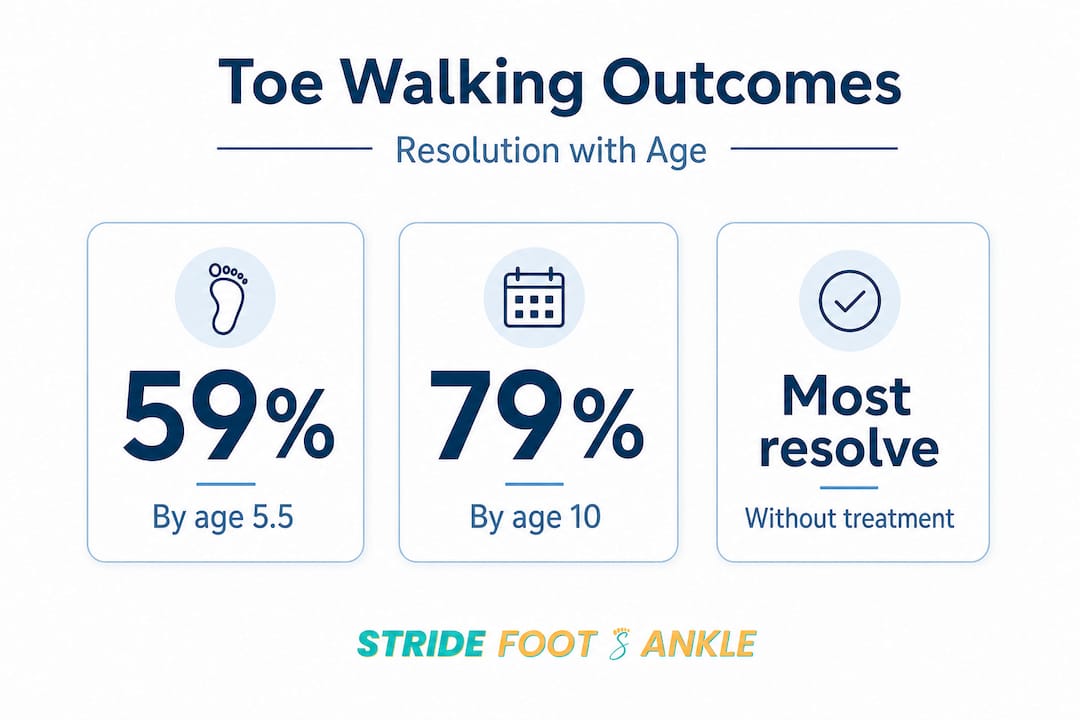
These resolution rates come from research that followed children with ITW over time without aggressive intervention. The takeaway is genuinely reassuring for most families: the majority of children improve naturally as their muscles lengthen and gait patterns mature.
That said, the 21% who do not resolve by age 10 are not a small group in absolute numbers, and those children are more likely to develop foot deformities, gait abnormalities, and secondary pain if left untreated. Early awareness makes a meaningful difference.
“Children who toe walk and have no muscle contractures have a favorable natural history, with nearly 4 in 5 resolving by age 10. But waiting too long without monitoring can mean missing the window for simpler, less invasive treatments.”
Key factors that predict a more persistent course include:
- Reduced ankle dorsiflexion (less than 5 degrees of passive range of motion)
- Consistent bilateral toe walking with no heel contact at any point
- A family history of toe walking in multiple relatives
- Toe walking that worsens rather than improves between ages 3 and 5
- Associated sensory processing difficulties or neurodevelopmental differences
If your child falls into one or more of these categories, early evaluation gives you the most options and the most time to use conservative treatments effectively before the window for simpler interventions narrows.
Treatment approaches: From stretches to surgery
If toe walking persists or is accompanied by tight muscles, there are clear treatment steps that range from simple home exercises to surgical procedures. The good news is that most children never reach the surgical stage.
Here is the stepwise approach specialists typically follow:
Home stretching exercises: Calf and Achilles tendon stretches performed daily help lengthen the muscles most responsible for toe walking. Daily heel walking exercises are effective first-line approaches and can be taught to parents in a single appointment. Simple moves like seated towel stretches, standing calf stretches against a wall, and heel walks across a room are low-risk and easy to build into a daily routine.
Physical therapy: A physical therapist trained in pediatric gait can progress your child through a structured program that addresses flexibility, strength, and motor patterns. This is especially helpful for children who struggle to perform stretches independently or who have associated balance challenges.
Orthotics and ankle-foot orthoses (AFOs): Custom or prefabricated orthotics can help hold the ankle in a position that encourages heel contact during walking. AFOs, which are rigid or semi-rigid braces that support the ankle and foot, are used when flexibility is limited or when the child needs ongoing structural support.
Serial casting: This approach involves applying a series of plaster or fiberglass casts over several weeks, each one gradually stretching the calf and Achilles tendon into a more corrected position. Serial casting does improve dorsiflexion in many children, though some research notes that improvement can be temporary without consistent follow-up therapy.
Botulinum toxin injections (Botox): In some cases, injections into the calf muscles can temporarily reduce muscle tone and allow the ankle to be stretched more effectively. This approach is more commonly used in children with underlying neurological conditions like cerebral palsy.
Surgery: For children who have not responded to conservative measures and have significant contractures, surgical lengthening of the Achilles tendon or gastrocnemius muscle is an option. Surgical outcomes, particularly zone III lengthening, show 100% improvement rates in severe idiopathic toe walking cases with a low relapse rate.
Surgery is not a first response. It is reserved for children who have failed conservative treatment, are typically older with established contractures, and continue to walk on their toes despite consistent effort with less invasive options. Outcomes are generally very good, but some relapse is possible, especially if post-surgical stretching and therapy are not maintained.
You can learn more about the full range of general foot care approaches used for children, explore conservative treatments in more detail, or read about preparing for foot surgery if your child is approaching that stage.
Pro Tip: Consistency with home stretching is the single biggest predictor of conservative treatment success. Set a specific time each day, pair it with a routine your child already has (like before bath time or after school), and track improvement using simple markers like how far the heel drops during a seated ankle stretch.
Key reminders for parents navigating treatment decisions:
- Start early but do not panic. Most children benefit from watchful waiting combined with home exercises before moving to more intensive options.
- Progress matters more than perfection. Gradual improvement, even slow, is a positive sign that conservative treatment is working.
- Consistency is everything. Stretching done three times daily over weeks and months is far more effective than occasional intensive efforts.
- Communication with your provider helps. Report changes in flexibility, pain, or gait pattern at every visit.
Monitoring progress and when to seek professional help
One of the most practical skills a parent can develop is learning how to observe and track their child’s toe walking over time. You do not need specialized equipment. You need good observation habits and a record to bring to appointments.
Parental reports are reliable for assessing toe walking severity, and emerging quantitative gait analysis tools are now offering more precision for clinical settings. But for most families managing toe walking at home, your observations carry real clinical weight. Specialists value what you see day to day far more than a single snapshot in a clinical setting.
Here is what to observe and document:
- Frequency: Does your child toe walk all the time, most of the time, or only sometimes?
- Context: Does it happen more when running, walking slowly, or when concentrating on something else?
- Footwear effect: Does toe walking decrease when shoes are on or when using a particular type of shoe?
- Heel contact: Can your child voluntarily place their heels flat when asked, or does it feel impossible or painful?
- Progress over weeks: Is the pattern improving, staying the same, or getting worse?
Signs that warrant a professional evaluation sooner rather than later:
- Toe walking is consistent and your child never places heels down naturally
- Your child complains of foot, ankle, calf, or knee pain
- One leg toe walks while the other does not
- You notice balance problems, stumbling, or frequent falls
- Toe walking appears or worsens after a period of normal heel-to-toe walking
- Your child is over age 5 and still toe walking consistently
For families in Las Vegas, a visit to a foot and ankle care guide resource can help you understand what to expect from a clinical evaluation and what questions to bring to your first appointment.
Pro Tip: Use your phone to video your child walking naturally in an open space, ideally barefoot and from the side and behind. A 30-second clip captured when they are relaxed and not thinking about walking gives a specialist far more useful information than an in-office walk, where children often self-correct out of self-consciousness.
Our perspective: What most toe walking guides miss
Most toe walking articles give parents the same message: intervene early, stretch diligently, and escalate if things do not improve. That advice is not wrong. But it misses something important.
The research on idiopathic toe walking tells a story that fewer guides are willing to tell directly. Most children resolve on their own. The majority of children with no contractures, no neurological findings, and no developmental concerns will simply grow out of it. Pushing families toward early intensive treatment in these cases does not necessarily change outcomes. It does create anxiety, and it can put young children through discomfort that may not have been necessary.
What we see clinically is that the families who navigate toe walking best are not the ones who intervened earliest or most aggressively. They are the families who stayed informed, stayed calm, and stayed consistent with simple home strategies while keeping their child’s provider in the loop. That combination is more powerful than any single intervention.
We also want to push back gently on the idea that high-tech assessment tools are what families need most. The quantitative gait tools emerging for precision are genuinely exciting for clinical research and for complex cases. But for most families, a parent who has been watching carefully for months and has videos and notes brings more diagnostic value to an appointment than any single clinical snapshot.
This is not an argument against seeking care. It is an argument for being a thoughtful, informed, engaged parent rather than a panicked one. When you understand the natural history of toe walking, you can approach evaluation from a position of confidence rather than fear. You can ask better questions. You can recognize when conservative treatment is working and when it is time to consider the next step.
Our recommendation, backed by both evidence and clinical experience, is to explore insights from an expert podiatrist early enough to establish a baseline, then trust the process. Most children improve. The ones who need more support can almost always be helped. Knowledge is genuinely your best starting point.
Get expert help for toe walking
Watching your child toe walk and wondering what to do next is stressful. You deserve clear answers from a provider who understands pediatric foot mechanics and can offer a real plan tailored to your child’s specific situation.

At Stride Foot & Ankle in Las Vegas, Dr. Nahad Wassel provides specialized evaluations for children with toe walking concerns. Whether your child is just starting to show the pattern or has been toe walking for years, our team can assess range of motion, rule out underlying causes, and build a personalized treatment plan that starts with the most conservative approach that makes sense. From foot and ankle care specialists to structured conservative foot care programs, we are here to help your child stride forward confidently. Contact us today to request an appointment.
Frequently asked questions
Is toe walking always a sign of a medical problem?
No. Toe walking is common in toddlers and most children outgrow it naturally by age 2 to 3, but persistent toe walking past age 2 to 5 should be evaluated to rule out underlying conditions.
What are the common causes of toe walking?
Causes include habit, tight calf muscles, sensory processing differences, or medical conditions. Idiopathic toe walking is a diagnosis of exclusion made after ruling out cerebral palsy, muscular dystrophy, autism spectrum disorder, and orthopedic causes.
When should I contact a specialist about my child’s toe walking?
If toe walking persists past age 2 to 5, is present on only one side, is getting worse, or is paired with pain or developmental concerns, it is time to consult a foot and ankle specialist.
Are home exercises effective for toe walking?
Yes. Home stretches and heel walking exercises targeting the calf and Achilles tendon are effective first-line treatments and are appropriate for most children with idiopathic toe walking.
Does toe walking always require surgery?
No. Most cases respond well to stretching, physical therapy, or casting. Surgery is reserved for children who have not responded to conservative treatment and have significant contractures, with outcomes generally very successful.
Recent Comments