

TL;DR:
- Children often require ankle surgery when fractures threaten growth plates or cause displacement uncorrectable by casting. Such injuries can disrupt bone growth, leading to deformity, leg length discrepancies, or arthritis if untreated. Prompt specialist assessment ensures appropriate treatment to protect long-term ankle health and development.
Ankle injuries in children are more common than most parents expect, but understanding why do kids need ankle surgery separates a concerning diagnosis from a catastrophic one. Not every sprained or fractured ankle requires an operating room. However, some injuries in children carry risks that simply cannot be managed with a cast and rest alone. The key difference almost always comes down to one thing: growth plates. When fractures displace bones, compromise joint alignment, or threaten the zones where children’s bones still grow, surgery becomes the responsible choice, not a last resort.
Table of Contents
- Key takeaways
- Why do kids need ankle surgery? The growth plate factor
- Types of ankle injuries that often require surgery
- When ankle surgery is actually necessary
- What to expect from pediatric ankle surgery and recovery
- Non-surgical options versus surgery
- My perspective: kids are not small adults, and their ankle care should reflect that
- Expert pediatric ankle care at Stridefootankle
- FAQ
Key takeaways
| Point | Details |
|---|---|
| Growth plates are the priority | Children’s growth plates are more vulnerable than ligaments, making certain fractures uniquely risky for long-term bone development. |
| Displacement drives surgery decisions | Displaced fractures that cannot be realigned with a cast require surgical fixation to restore proper joint alignment. |
| Triplane fractures are high-risk | These complex pediatric fractures often require surgery to achieve the precise reduction needed for optimal healing. |
| Surgery protects future growth | Without surgical correction, some fractures cause growth arrest, leg length differences, or permanent ankle deformity. |
| Early specialist evaluation matters | Seeing a pediatric foot and ankle specialist quickly gives your child the best chance at full recovery without complications. |
Why do kids need ankle surgery? The growth plate factor
Kids need ankle surgery primarily when a fracture or joint injury threatens the growth plate, displaces bones beyond what casting can correct, or creates instability that prevents safe healing without fixation. The goal is always to protect alignment and future bone growth. Surgery is never the first choice, but in specific scenarios, it is the most protective one.
To understand why some ankle injuries in children require surgery, you first need to understand what makes a child’s ankle fundamentally different from an adult’s.
What growth plates are and why they matter
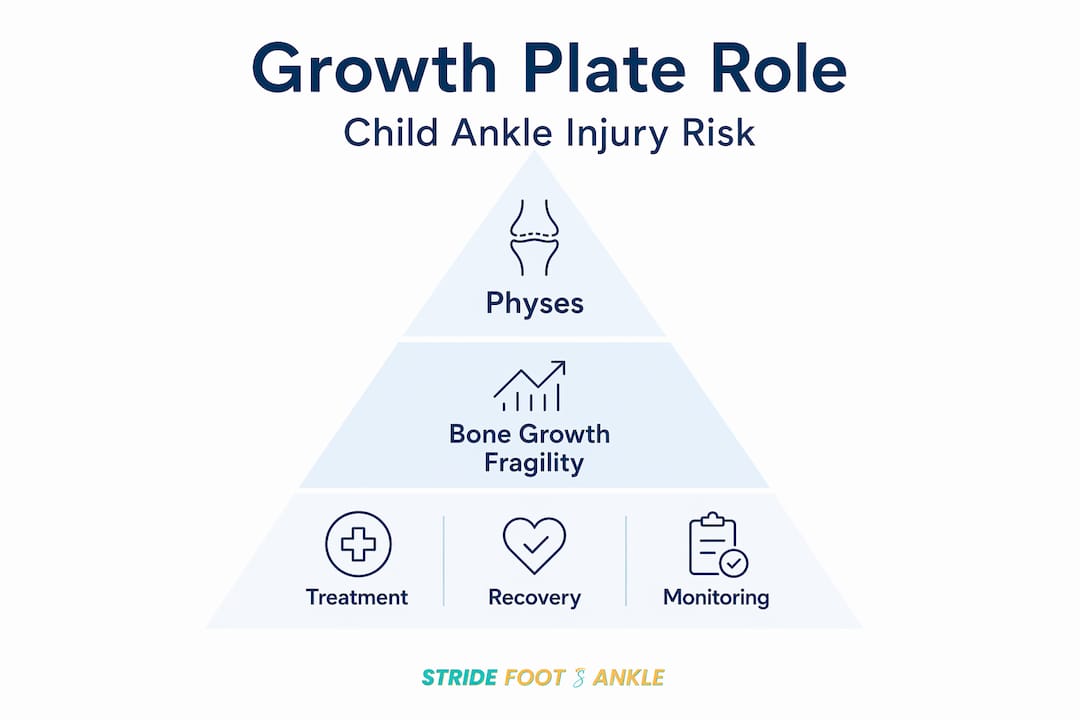
Growth plates, also called physes, are areas of developing cartilage tissue near the ends of long bones. In the ankle, the growth plate sits at the lower end of the tibia, the large shin bone. These zones are where bones lengthen as your child grows, and they remain open and active until skeletal maturity, which typically occurs between ages 14 and 18 depending on the child.
The problem is that growth plate cartilage is structurally weaker than the surrounding ligaments and bone. That creates a counterintuitive reality in pediatric ankle injuries: a force that would simply sprain an adult’s ankle may actually fracture a child’s growth plate instead, because the ligaments hold firm while the weaker cartilage gives way.
Here is what that means practically for your child’s treatment:
- Growth plate fractures can disrupt the “growth signal” that tells bone how to develop, potentially causing one part of the bone to stop growing while the rest continues.
- Misaligned growth plates can cause angular deformity, meaning the ankle or leg may grow unevenly if the fracture heals in the wrong position.
- Leg length discrepancy is another documented risk when significant growth plate damage goes untreated or is inadequately managed.
- Cartilage damage at the joint surface during a fracture can set the stage for early arthritis if joint alignment is not restored precisely.
This is why children’s bone biology demands specialized treatment that differs significantly from adult fracture care. The bones are still building themselves. Any injury that interferes with that process carries consequences that extend years beyond the original event.
Pro Tip: If your child’s ankle X-ray is read as a “sprain” but pain persists beyond a week or two, ask specifically whether the growth plate was assessed. Growth plate injuries can appear subtle on initial imaging and may need a specialist’s review.
Types of ankle injuries that often require surgery
Most ankle injuries in children fall somewhere on a spectrum from simple to complex. Where they land on that spectrum determines whether surgery is needed.
Sprains versus fractures in children
A sprain means a ligament is stretched or torn. A fracture means a bone is broken. In adults, sprains are far more common ankle injuries. In children, the math is different. Because ligaments are often stronger than growth plates in growing bones, what presents as an ankle “sprain” in a child is actually a growth plate fracture more often than parents realize.
The following table shows how pediatric and adult ankle injuries compare in key areas:
| Factor | Adult ankle injuries | Pediatric ankle injuries |
|---|---|---|
| Most common injury type | Ligament sprain | Growth plate fracture |
| Bone flexibility | Rigid, fully mineralized | Flexible, can bend (greenstick fractures) |
| Surgery threshold | Displaced fractures, instability | Displaced fractures, growth plate involvement |
| Ligament vs. bone strength | Bone typically stronger | Ligaments often stronger than growth plate |
| Long-term risk | Arthritis, chronic instability | Growth arrest, deformity, leg length difference |
Salter-Harris fractures
Salter-Harris fractures are the most widely used classification for growth plate injuries. The system grades fractures from Type I through Type V based on how the fracture line intersects the growth plate. Type I fractures pass through the growth plate itself and may look nearly normal on a plain X-ray. Type III and IV fractures extend into the joint surface and carry a higher risk of disrupting normal bone growth.
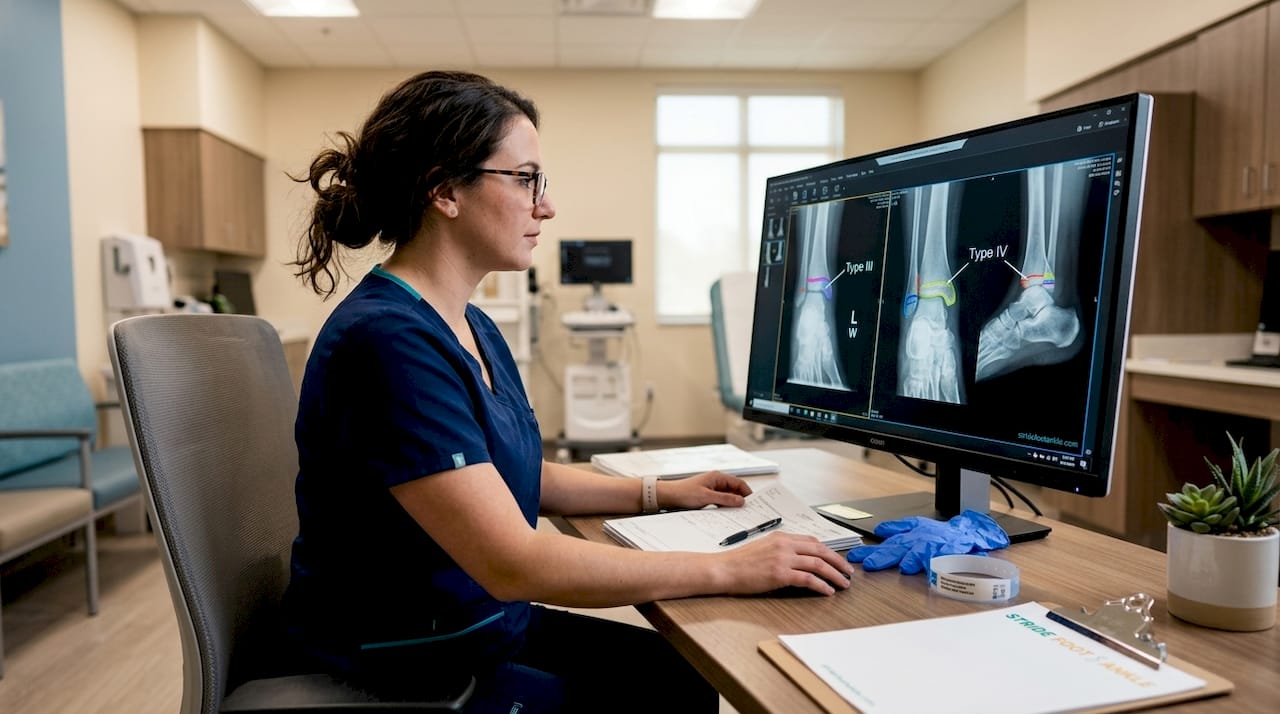
Surgery is most commonly considered for Salter-Harris Type III and IV fractures when the bone fragments are displaced. The reason is straightforward: casting cannot physically move the fragments back into place when they have shifted significantly.
Triplane ankle fractures
Triplane fractures deserve special attention because they are unique to children and among the most surgically demanding ankle injuries in the pediatric population. These fractures occur in three planes simultaneously, meaning the fracture runs through the growth plate, the bone shaft, and the joint surface at the same time. They happen most often between ages 12 and 15, during the period when the growth plate is asymmetrically closing.
Triplane fractures represent 5 to 10% of pediatric intra-articular ankle fractures, and surgical treatment is typically required when the fragments are displaced more than 2 mm. That 2 mm threshold is not arbitrary. Even small misalignments at the joint surface significantly increase the risk of post-traumatic arthritis over time. When casting cannot achieve that level of precision, surgery is the responsible path.
Key signs that any ankle fracture in a child may require surgical attention include:
- Bones visibly displaced or out of alignment on imaging
- Fracture lines extending into the joint surface
- Inability to maintain stable positioning with conservative methods
- Skin puncture or open fracture (always requires surgical management)
- Growth plate involvement with displacement over 2 mm
When ankle surgery is actually necessary
Surgery is indicated when a fracture is unstable, significantly displaced, or involves the joint surface or growth plate in ways that cannot be corrected through casting alone. The surgical decision for ankle injuries depends primarily on three factors: the degree of displacement, the involvement of the growth plate, and whether the injury is stable enough to heal in proper alignment without fixation.
Here is how specialists typically work through that decision:
Assess displacement. Imaging, usually X-ray and sometimes CT scan, reveals exactly how far bone fragments have moved. Fractures with significant displacement cannot realign themselves during healing.
Evaluate growth plate involvement. Salter-Harris Types III and IV, and triplane fractures, carry the highest risk of growth disturbance and usually require surgical correction to protect the growth plate’s long-term function.
Determine stability. Unstable or displaced fractures that fail to maintain alignment under casting need fixation. Fixation typically involves screws or pins placed to hold fragments in the correct position while the bone heals.
Consider joint alignment. Surgical fixation of displaced pediatric fractures aims for intra-articular reduction within 2 mm to minimize the risk of future arthritis at the ankle joint.
Act quickly. Bone begins its healing process rapidly in children. Timely evaluation by a specialist increases the window for achieving ideal alignment before fracture consolidation limits what is surgically possible.
The long-term consequences of skipping surgery when it is truly needed can be serious. Delayed or inadequate management of growth plate fractures increases the risk of growth arrest, angular deformity, leg length discrepancy, and chronic ankle instability. These are not abstract risks. They can affect how your child walks, runs, and participates in sports for the rest of their life.
Pro Tip: If your child’s fracture is near the ankle and a general emergency room physician reads the X-ray, ask for a referral to a foot and ankle specialist before accepting a final treatment plan. Subtle growth plate involvement is easy to miss without the right expertise.
What to expect from pediatric ankle surgery and recovery
Understanding what actually happens during and after surgery helps take the fear out of the process. Pediatric ankle surgery often uses minimally invasive techniques specifically designed to protect still-growing bones.
The surgical procedure
Most pediatric ankle fracture surgeries involve placing small screws or pins across the fracture to hold the fragments in correct alignment. Surgeons take care to avoid crossing the growth plate with hardware when possible, or use specially designed implants that minimize growth disruption when crossing is unavoidable. Arthroscopy, a minimally invasive technique that uses a tiny camera inserted through small incisions, is sometimes used to directly visualize the joint surface and confirm that alignment has been achieved accurately.
Minimally invasive techniques tailored for pediatric patients protect open growth plates while providing effective fracture fixation and typically support quicker functional recovery. Smaller incisions mean less soft tissue disruption, which matters especially in growing children.
Recovery and monitoring
Recovery after pediatric ankle surgery typically follows this progression:
- Weeks 1 to 2: Non-weight-bearing with casting or splinting; elevation and rest to manage swelling.
- Weeks 3 to 6: Gradual transition to protected weight-bearing; cast or boot depending on healing progress.
- Weeks 6 to 12: Begin physical therapy to restore range of motion, strength, and balance.
- Months 3 to 6: Return to sport or full activity based on clinical and imaging assessment.
- Beyond 6 months: Periodic monitoring, especially if the growth plate was involved, to watch for growth disturbances.
Routine imaging before and after surgery is critical in growing children. Subtle alignment or leg length changes can develop over months without causing obvious symptoms, and catching them early expands the treatment options significantly.
Physical therapy after surgery is not optional for most children. Rebuilding neuromuscular control, meaning the body’s ability to sense and stabilize the ankle joint, is a key part of preventing reinjury. Children who complete supervised rehabilitation after ankle surgery return to full activity more successfully than those who skip it.
Non-surgical options versus surgery
Not every ankle injury in a child needs an operating room. Understanding conservative management approaches helps you ask better questions and understand your child’s treatment options clearly.
Conservative treatments that work well for appropriate injuries include:
- Casting or splinting for stable, non-displaced fractures that hold their alignment without fixation.
- Bracing and activity modification for mild sprains or stress fractures without displacement.
- Rest and gradual rehabilitation for low-grade ligament injuries confirmed by imaging to have no significant bone involvement.
- Non-surgical immobilization for Salter-Harris Type I fractures, which often heal well with protected weight-bearing.
The critical distinction is stability. When a fracture is stable and non-displaced, bone fragments will heal in the correct position without surgical help. Treatment choice depends on injury severity, displacement, and growth plate involvement. Surgery is not about preference. It is about whether the injury can achieve proper alignment through conservative means alone.
You can read more about non-surgical treatment options for tendon and ligament injuries to understand where conservative care begins and ends. The most important takeaway is that the treatment decision should always come from a specialist who has reviewed your child’s imaging and understands pediatric bone biology. A general practitioner’s initial assessment is a starting point, not a final verdict.
My perspective: kids are not small adults, and their ankle care should reflect that
I have seen too many children come in after weeks of persistent pain because a well-meaning provider assumed their injury would resolve on its own. The phrase “kids heal fast” is true in many contexts, but it creates a false sense of security when growth plate injuries are involved.
In my experience, the biggest mistake parents make is waiting. A child who cannot put full weight on their ankle two to three days after an injury needs imaging and a specialist’s eyes on that imaging. Growth plate fractures can look deceptively minor on a standard X-ray, particularly Type I injuries. If your gut says something is wrong, pursue it.
What I find genuinely encouraging is how far pediatric ankle surgery has come. Minimally invasive fixation, better imaging protocols, and structured rehabilitation programs mean that children who need surgery and receive it promptly do remarkably well. Most return to full athletic activity. The outcomes I worry about are the ones where surgery was delayed or avoided when it was clearly indicated, because the window for optimal correction is not unlimited when a child is still growing.
My practical advice: get a pediatric foot and ankle evaluation at the first sign of significant injury. Do not let the fear of surgery prevent you from getting a clear picture. Sometimes the evaluation confirms your child does not need surgery, and that reassurance is genuinely valuable. When surgery is recommended, understanding why it protects your child’s future growth and function makes it easier to move forward with confidence.
Advocate for your child. Ask questions. Seek a second opinion if you need one. The specialists who work with pediatric ankle injuries understand that this is your child’s future mobility on the line, and they want to get it right as much as you do.
— Ramil
Expert pediatric ankle care at Stridefootankle
When your child is in pain and you are trying to understand whether surgery is truly necessary, you need a provider who combines clinical expertise with honest, patient-centered communication. At Stridefootankle, Dr. Nahad Wassel brings specialized training in foot and ankle surgery to every evaluation, including pediatric cases where growth plate protection and precise alignment are non-negotiable priorities.

Whether your child’s injury turns out to need surgery or can be managed conservatively, the path starts with a thorough specialist evaluation. Stridefootankle offers comprehensive foot and ankle care designed to assess injury severity accurately, explain your options clearly, and create a treatment plan centered on your child’s long-term health. If surgery is recommended, you can also review the preparation and recovery process so nothing comes as a surprise. Contact Stridefootankle in Las Vegas today to schedule an evaluation and get the answers your child deserves.
FAQ
Why do kids need ankle surgery more than adults?
Children need ankle surgery specifically when growth plate fractures are displaced, because growth plates are weaker than ligaments in growing bones. Adults typically face ligament tears, but children more often sustain fractures near the growth plate that require precise surgical realignment to prevent long-term deformity.
What are the signs a child needs ankle surgery?
Key signs include significant bone displacement on X-ray, inability to bear weight after 48 to 72 hours, visible deformity or swelling, and fractures confirmed to involve the joint surface or growth plate. A pediatric foot and ankle specialist should evaluate these injuries promptly.
How long is recovery after pediatric ankle surgery?
Most children return to full activity within three to six months after ankle surgery, depending on injury severity. Physical therapy typically begins six weeks post-surgery and plays a significant role in restoring strength, balance, and readiness to return to sport.
Can a child’s ankle fracture heal without surgery?
Yes. Stable, non-displaced fractures, including many Salter-Harris Type I injuries, heal well with casting or bracing alone. Surgery is reserved for displaced or unstable fractures where conservative management cannot achieve the precise alignment needed to protect joint surfaces and growth plates.
What happens if a growth plate fracture is left untreated?
Untreated or inadequately managed growth plate fractures can lead to growth arrest, angular deformity of the leg or ankle, leg length discrepancy, and early-onset arthritis. Early specialist evaluation and appropriate treatment, surgical or conservative, significantly reduces these risks.
Recommended
- What Is Ankle Surgery? Types, Risks, and Recovery – Stride Foot & Ankle – Dr. Nahad Wassel
- Ankle Sprain Recovery Process: Your 2026 Rehab Guide – Stride Foot & Ankle – Dr. Nahad Wassel
- What is pediatric foot pain? A parents’ guide to causes and care – Stride Foot & Ankle – Dr. Nahad Wassel
- Toe walking in children: Causes, treatments, and when to seek help – Stride Foot & Ankle – Dr. Nahad Wassel
Recent Comments