

Ankle ligament reconstruction, most often performed as a modified Broström-Gould procedure or, less commonly, an anatomic reconstruction using graft tissue, restores stability in people with chronic lateral ankle instability after conservative treatment has failed. It suits patients who still feel their ankle “give way” despite months of bracing and physical therapy. Most people see real functional improvement, but only with months of structured rehab behind it.
- Best candidates: recurrent instability, failed PT/bracing, positive stability tests on exam
- Standard procedure: modified Broström-Gould repair of the ATFL and CFL
- Typical trajectory: protected weightbearing, then months of phased strengthening before return to sport
Key Takeaways
Ankle ligament reconstruction, most commonly the modified Broström-Gould repair, restores mechanical stability for chronic lateral ankle instability and delivers durable functional improvement when paired with disciplined, phased rehabilitation.
| Point | Details |
|---|---|
| Surgery follows failed conservative care | Reconstruction is typically considered only after bracing and physical therapy fail to control instability. |
| Broström-Gould is the standard | Most patients with usable tissue do best with the open or arthroscopic modified Broström-Gould repair. |
| Graft reconstruction is for select cases | Autograft or allograft reconstruction is reserved for revision surgery or poor native tissue quality. |
| Recovery spans months, not weeks | Expect light work around 6 to 8 weeks and sport return anywhere from 4 to 12 months. |
| Stride Foot & Ankle individualizes the plan | Dr. Nahad Wassel tailors repair versus reconstruction decisions to each patient’s tissue quality and activity goals. |
Table of Contents
- What Is Ankle Ligament Reconstruction?
- Who Needs Surgery for Chronic Ankle Instability?
- What Are the Risks of Ankle Reconstruction Surgery?
- How Should You Prepare for Ankle Surgery?
- Open, Arthroscopic, or Reconstructive: Which Approach Fits?
- How Long Does Recovery Take After Ankle Surgery?
- What Outcomes Can You Expect From Surgery?
- What Happens if Reconstruction Fails or Instability Returns?
- How Stride Foot & Ankle Approaches Ankle Ligament Reconstruction
- Why the “Just Get Surgery” Mindset Misses the Point
- Considering Ankle Ligament Reconstruction? Here’s Your Next Step
- Sources
- FAQ
What Is Ankle Ligament Reconstruction?
Ankle ligament reconstruction repairs or rebuilds the ligaments that keep your ankle from rolling outward. The two ligaments doing most of the work are the anterior talofibular ligament (ATFL), which resists forward and inward rolling of the talus, and the calcaneofibular ligament (CFL), which controls side-to-side tilt. When these stretch out or tear repeatedly, the ankle loses its mechanical checkrein and starts buckling on uneven ground, stairs, or during pivoting sports.
The modified Broström-Gould procedure is the standard fix. The surgeon shortens and reattaches the stretched ATFL (and often the CFL) back to the fibula, then reinforces the repair using the inferior extensor retinaculum, a band of tissue near the ankle joint. That retinacular reinforcement is called the “Gould modification,” and it distinguishes the procedure from the original Broström technique.
- Repair: the surgeon uses your own native ligament tissue, tightened and reattached
- Reconstruction: a tendon graft (autograft or allograft) replaces ligament tissue that’s too thin, scarred, or stretched to repair
- Reconstruction is reserved for revision cases or patients with generalized ligamentous laxity
Who Needs Surgery for Chronic Ankle Instability?
Surgery becomes a reasonable option once a documented course of physical therapy and bracing has failed to control the giving-way sensation, and clinical testing confirms mechanical laxity rather than just a nervous ankle. Between 10% and 30% of people who sprain their lateral ankle ligaments go on to develop chronic ankle instability, and that group is where reconstruction earns its place.
- Recurrent giving-way, especially on stairs, ramps, or uneven ground, despite months of rehab
- A positive anterior drawer test or talar tilt test on physical exam, signaling ATFL or CFL laxity
- Stress radiographs or MRI confirming ligament attenuation or tearing rather than just muscle weakness
- Failure of a dedicated course of bracing and nonsurgical treatment options over several months
If those signs line up, a foot and ankle surgeon should evaluate you before instability causes secondary cartilage damage.
What Are the Risks of Ankle Reconstruction Surgery?
No ankle surgery is risk-free, and any honest conversation about ankle ligament reconstruction has to include the trade-offs. Most complications are minor and self-limited; a smaller subset carries longer-term consequences worth weighing before you consent.
- Common: wound healing delays, transient numbness near the incision (superficial peroneal nerve irritation), and swelling or stiffness that lingers for weeks
- Less common: surgical site infection, deep nerve injury, and stiffness that requires additional therapy
- Uncommon but serious: recurrent instability requiring revision surgery, particularly when tissue quality was poor at the first operation
Statistic to know: Roughly 10% to 30% of people develop chronic instability after an initial lateral ankle sprain, which is the population from which most surgical candidates emerge. Overtightening the repair or operating on poor-quality tissue are the two factors surgeons most often cite as predictors of a disappointing result.
How Should You Prepare for Ankle Surgery?
Preparation starts weeks before you’re in the operating room, and the steps you take now shape how smoothly recovery goes. Smoking cessation matters more than most patients expect, since nicotine measurably slows soft-tissue and bone healing. Uncontrolled blood sugar has a similar effect on wound healing in diabetic patients.
- Stop smoking at least a few weeks before surgery, and ideally through the healing period
- Get blood sugar under control if you’re diabetic, and review all medications (especially blood thinners) with your surgeon
- Arrange time off work, transportation, and help at home for the first one to two weeks
- Confirm fasting instructions and which medications to take or skip the morning of surgery
Pro Tip: Bring a written list of questions to your pre-op visit: ask specifically whether you’re a candidate for repair or graft reconstruction, open or arthroscopic technique, and what your personal rehab timeline will look like based on your sport or job demands.
Open, Arthroscopic, or Reconstructive: Which Approach Fits?
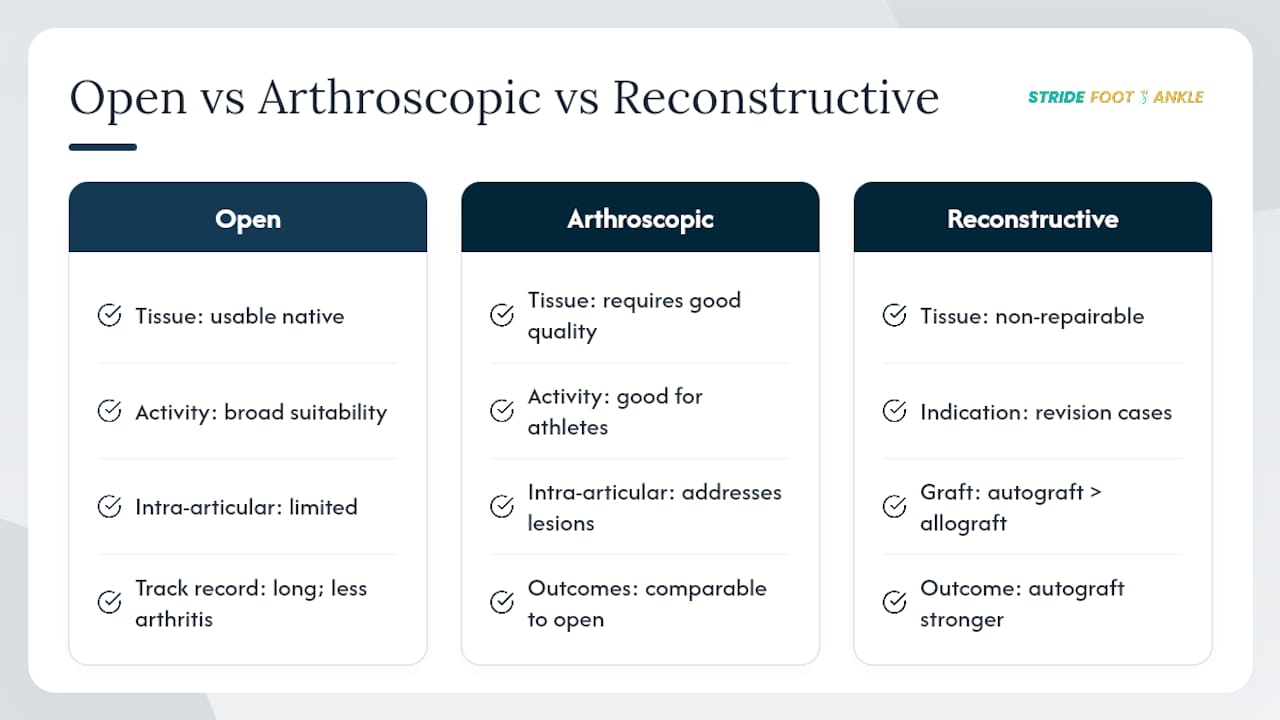
Surgeons choose among three broad strategies, and the decision depends on tissue quality, activity level, and whether there’s additional joint damage to address at the same time.
Open modified Broström-Gould remains the preferred mainstay for most patients with usable native tissue. The surgeon makes a small incision over the outer ankle, retensions the ATFL and CFL, and reinforces the repair with the extensor retinaculum. It has the longest track record and is associated with better function and less long-term joint arthritis than older, non-anatomic tenodesis techniques.
Arthroscopic and arthroscopic-assisted repair has grown fast in the last decade. When tissue quality allows, arthroscopic Broström repair delivers clinical results comparable to open surgery, with the added benefit of treating cartilage damage or impingement inside the joint during the same operation.
Arthroscopic techniques let the surgeon address intra-articular problems in the same sitting as the ligament repair, which can improve functional recovery for patients who are still active in sport.
Reconstruction with autograft or allograft tendon is reserved for revision surgery or patients whose ligament tissue is too stretched or scarred to repair directly. Comparative studies show autograft reconstruction tends to produce better ligament integrity on imaging and stronger functional recovery than allograft, though allograft avoids a second surgical site and remains reasonable for select patients.
How Long Does Recovery Take After Ankle Surgery?
Recovery unfolds in distinct phases, and rushing any one of them is the most common way patients set themselves back. Expect the full arc to run several months, not weeks.
- Weeks 0 to 6: Immobilization in a boot or cast with protected, limited weightbearing. Wound care and gentle range of motion begin once your surgeon clears it.
- Weeks 6 to 12: Progressive weightbearing to full, paired with strengthening and balance (proprioception) work. This is where a formal ankle rehab program earns its value.
- Months 3 to 6 and beyond: Sport-specific drills, cutting and pivoting practice, and continued neuromuscular retraining before full clearance.
Timeline benchmark: Light duty work is often possible around 6 to 8 weeks, but competitive return to sport commonly takes 4 to 12 months, depending on the sport’s cutting and pivoting demands and whether graft reconstruction was involved.
What Outcomes Can You Expect From Surgery?
Outcome studies consistently report high rates of functional improvement after modified Broström and anatomic reconstruction, measured through validated scores like the AOFAS ankle-hindfoot scale, the Tegner activity scale, and VAS pain ratings. Most published cohorts show stability holding up well past the two-year mark.
- Minimally invasive reconstruction using semitendinosus autograft shows procedure survival around 95.7% with low recurrence in mid-term cohort follow-up
- Systematic reviews confirm the modified Broström-Gould has the strongest evidence base among lateral ankle stabilization techniques, though newer augmentation methods are gaining traction
- Comparative studies favor autograft over allograft for ligament integrity confirmed on imaging and for functional scores at follow-up
Statistic worth remembering: the same 10% to 30% figure for chronic instability after an initial sprain frames why so many of these patients eventually land in a surgeon’s office rather than staying on conservative care indefinitely.
What Happens if Reconstruction Fails or Instability Returns?
When instability recurs, revision surgery typically uses a graft-based reconstruction rather than repeating a simple repair, since scar tissue and stretched ligament remnants rarely hold up a second time. Suture-tape internal bracing is increasingly used as an augmentation, adding an internal checkrein alongside the biological repair to reduce strain during early healing.
- Revision cases lean toward autograft or allograft reconstruction over repeat repair
- Suture-tape augmentation supplements a primary repair in patients with higher activity demands or borderline tissue quality
- Treating any overlooked intra-articular damage at the index surgery lowers the odds of needing a second operation
How Stride Foot & Ankle Approaches Ankle Ligament Reconstruction
Dr. Nahad Wassel evaluates chronic ankle instability with a conservative-first philosophy, reserving surgery for patients who’ve genuinely exhausted bracing and PT. When reconstruction is indicated, the surgical plan is built around your tissue quality, sport demands, and imaging findings rather than a one-size-fits-all protocol, with detailed rehab guidance supporting every phase of recovery.

Why the “Just Get Surgery” Mindset Misses the Point
Too many patients treat ankle ligament reconstruction as the finish line instead of the starting point of recovery. The literature doesn’t support that framing. The evidence on neuromuscular reprogramming suggests a meaningful share of recurrences trace back to motor-control deficits, not a failed ligament repair. That’s a hard fact for a surgery-focused mindset to swallow: your surgeon can execute a technically flawless Broström-Gould, and you can still land back in that same unstable ankle if you skip the proprioception work.
The conventional advice tends to overweight which surgical technique to pick and underweight the months of balance and strength training that follow. Arthroscopic versus open, autograft versus allograft: these decisions matter, but they matter less than whether you show up for twelve straight weeks of structured rehab. If you’re weighing this surgery, prioritize finding a surgeon and physical therapy team who take the rehab phase as seriously as the operating room, because that’s where most of the durable outcome actually gets built.
— Ramil
Considering Ankle Ligament Reconstruction? Here’s Your Next Step
Stride Foot & Ankle gives Las Vegas patients something a lot of surgical practices skip: a genuine conservative-first evaluation before anyone talks about the operating room. If you’ve been bracing and rehabbing on your own without a clear answer on whether your ankle actually needs reconstruction, Dr. Nahad Wassel can tell you, based on exam findings and imaging, whether you’re a repair candidate, a reconstruction candidate, or still a good fit for nonsurgical care.
That’s the real value here: a board-certified surgeon who treats surgery as one option among several rather than the default answer, and who builds your rehab plan around your specific sport, job, and tissue quality rather than a generic handout. If recurring giving-way, swelling, or instability has you wondering whether you need ankle surgery, schedule a consultation through Stride Foot & Ankle’s general foot and ankle care page and get a clear answer on where you stand.
This article is general information, not a substitute for advice from a qualified doctor. Consult a qualified healthcare professional about your own circumstances before acting on anything here.
Sources
This article draws on peer-reviewed reviews covering surgical technique, arthroscopic outcomes, and graft comparisons. For related reading, see the clinic’s guides on ankle surgery types and risks and post-surgery foot care.
- Current concepts in the surgical management of chronic ankle lateral ligament instability
- Current concepts in the arthroscopic treatment for chronic lateral ankle instability: a clinical practice review
- Outcomes of arthroscopic-assisted mini-open anatomic reconstruction using autologous tendon for ankle ligament injuries
- Modified Brostrom-Gould surgical procedure for chronic lateral ankle instability compared with other operations: a systematic review and meta-analysis
FAQ
Is ankle ligament reconstruction a major surgery?
It’s a moderate outpatient procedure, not the kind of major surgery involving hospitalization, but it does require weeks of immobilization and months of rehab afterward for full recovery.
What is the recovery time for ankle reconstruction surgery?
Light work is often possible around 6 to 8 weeks, while full return to competitive sport commonly takes 4 to 12 months depending on the sport and whether graft reconstruction was used.
How painful is Broström surgery?
Pain is typically manageable with prescribed medication during the initial weeks and gradually decreases as swelling resolves, with most patients reporting significant relief by around six weeks.
Do ankle ligaments ever fully heal on their own?
Mild sprains often heal with rest and rehab, but ligaments that have stretched or torn repeatedly usually don’t regain full mechanical stability without surgical repair or reconstruction, which is why chronic instability develops in 10% to 30% of cases.
Recommended
- Ankle Sprain Recovery Process: Your 2026 Rehab Guide – Stride Foot & Ankle – Dr. Nahad Wassel
- Step by Step Ankle Rehab: Your Complete Recovery Guide – Stride Foot & Ankle – Dr. Nahad Wassel
- Nonsurgical Options for Tendon and Ligament Injuries – Stride Foot & Ankle – Dr. Nahad Wassel
- What Is Ankle Surgery? Types, Risks, and Recovery – Stride Foot & Ankle – Dr. Nahad Wassel
Recent Comments