

Intoeing, commonly called being “pigeon-toed,” means a child’s feet point inward during standing or walking. Most cases are benign and self-correcting, requiring no special treatment. The three primary causes are metatarsus adductus (curved forefoot), internal tibial torsion (shin rotation), and increased femoral anteversion (thigh bone rotation). Each generally resolves on its own by late childhood.
Contact your pediatrician promptly if you notice any of these:
- Pain in the foot, leg, or hip during or after activity
- A limp or uneven gait
- Intoeing that affects only one side, or worsens noticeably over weeks or months
- Frequent falls that interfere with normal play or development
- Any signs of developmental delay alongside the gait change
Key Takeaways
Most cases of intoeing in children resolve without treatment by 8 to 10 years of age, and braces or special shoes have no proven benefit for torsional causes.
| Point | Details |
|---|---|
| Most cases self-correct | Intoeing from tibial torsion or femoral anteversion typically resolves by 8–10 years without intervention. |
| Three causes, three age windows | Metatarsus adductus appears in infancy; tibial torsion in toddlers; femoral anteversion in preschool to school age. |
| Bracing is not supported | Expert consensus from POSNA and CHOP confirms braces, special shoes, and twister cables do not help torsional causes. |
| Red flags require prompt attention | Pain, limp, one-sided intoeing, or worsening deformity should prompt a pediatric visit rather than continued monitoring. |
| Stridefootankle offers specialist assessment | Dr. Nahad Wassel provides torsional profile evaluations and watchful-waiting plans for families in Las Vegas. |
Table of Contents
- What causes in-toeing in children, and which cause fits your child’s age?
- How do clinicians diagnose intoeing?
- What typically happens over time?
- What actually helps, what doesn’t, and when to escalate?
- Which signs mean you should call the pediatrician now?
- When is surgery considered, and what does it involve?
- What to expect at a Stride Foot & Ankle evaluation
- A note to parents from our clinic
- Ready for a specialist opinion at Stride Foot & Ankle?
- Sources
- FAQ
What causes in-toeing in children, and which cause fits your child’s age?
Intoeing is a rotational variation, not a disease. The foot, shin, or thigh bone sits at an angle that turns the foot inward, and the specific bone involved determines both the likely age of presentation and the expected timeline for improvement.
| Cause | Bone involved | Most common age | Typical presentation |
|---|---|---|---|
| Metatarsus adductus | Forefoot | Birth to 12 months | Curved outer border of the foot; foot bends inward at the midfoot |
| Internal tibial torsion | Tibia (shin) | 12 months | Feet and knees both turn inward when the child begins walking |
| Increased femoral anteversion | Femur (thigh) | 4–5 years | Child walks with knees and feet turned in; often sits in a “W” position |
Metatarsus adductus is the most common foot deformity seen in newborns. Parents often notice the outer edge of the baby’s foot has a curved, “C”-shaped border. Most flexible cases correct on their own within the first year of life.
Internal tibial torsion is the leading cause of intoeing in toddlers. A parent might notice that when their 18-month-old starts walking, both feet angle inward even though the knees face forward. The shin bone simply has a slight inward twist that straightens as the child grows.
Increased femoral anteversion tends to show up later, around preschool or early school age. A child who constantly trips, prefers W-sitting on the floor, and walks with both knees and toes pointed inward likely has this pattern. The thigh bone’s angle at the hip is greater than average, rotating the entire leg inward. W-sitting is usually a sign of the underlying hip rotation rather than its cause, and evidence that discouraging it produces lasting harm is limited.
For a broader look at common pediatric foot issues beyond intoeing, Stridefootankle’s parent education library is a useful starting point.
How do clinicians diagnose intoeing?
Diagnosis rests on a careful history and a hands-on physical exam. Imaging is rarely needed unless measurements fall outside expected ranges or a specific structural problem is suspected.
A typical evaluation includes the following steps:
- Foot-progression angle (FPA): The clinician watches the child walk and measures the angle between the foot and the direction of travel. A negative value means the foot points inward.
- Thigh-foot axis (TFA): With the child lying prone, the examiner measures the angle between the thigh and the foot to assess tibial rotation. This is the primary measure for internal tibial torsion.
- Transmalleolar axis: Assesses the angle of the ankle bones relative to the knee to quantify tibial torsion more precisely.
- Hip rotation range: The clinician checks how far the hip rotates inward versus outward. Increased internal rotation with reduced external rotation points toward femoral anteversion.
- Foot flexibility: For metatarsus adductus, the examiner checks whether the forefoot can be gently straightened to neutral (flexible) or resists correction (rigid). Rigid cases warrant closer follow-up.
According to StatPearls on NCBI Bookshelf, these measurements together form a “torsional profile” that guides management decisions. The American Family Physician confirms that imaging is generally unnecessary unless measurements are extreme or a specific abnormality is suspected.
Pro Tip: Before your child’s appointment, record a short video of them walking barefoot on a flat surface, both toward and away from the camera. Also photograph the soles of their shoes — uneven wear patterns give the clinician useful clues. Bring any prior pediatric notes or growth records.
What typically happens over time?
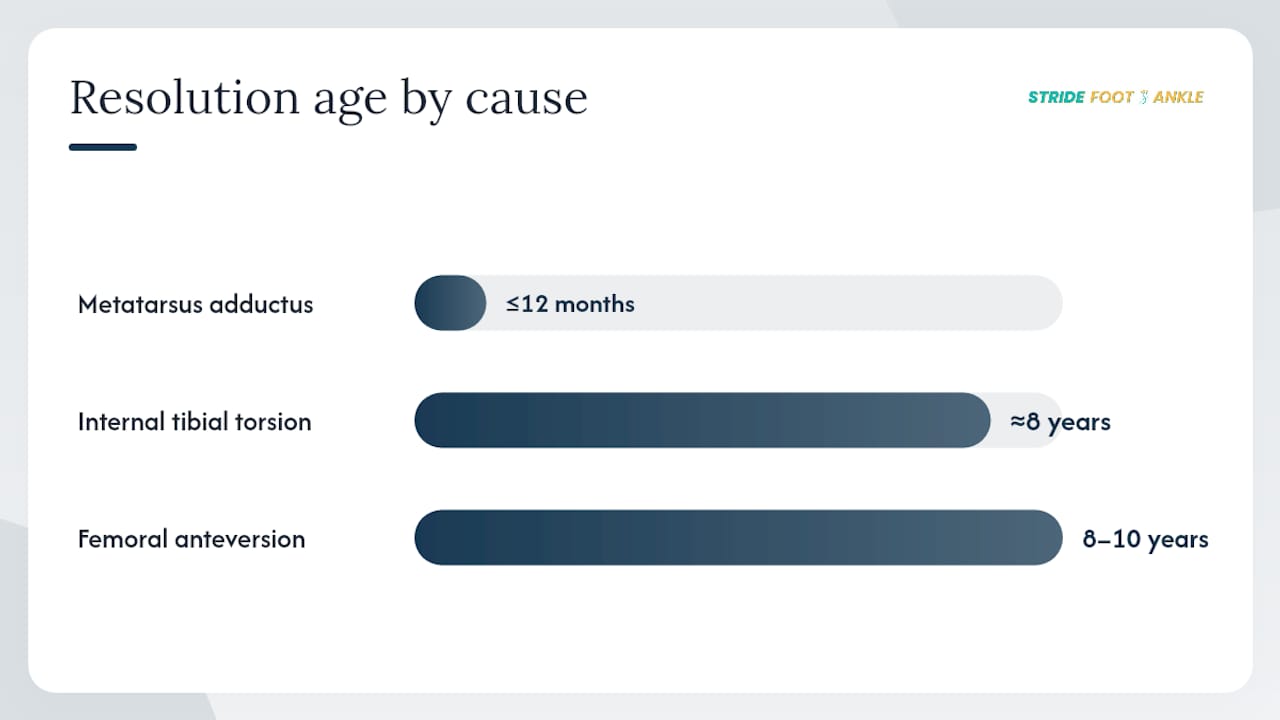
For most children, intoeing improves steadily through the growing years without any intervention. By 8 to 10 years of age, adult rotational alignment is typically achieved, and the vast majority of children reach that point with no lasting gait difference.
Timeline by cause:
- Metatarsus adductus: Flexible cases usually resolve within the first 12 months. Rigid cases may persist and benefit from serial casting in early infancy; a small number require follow-up into toddlerhood.
- Internal tibial torsion: Most cases improve significantly by age 4–5 and resolve fully by around age 8 as the shin bone remodels with weight-bearing.
- Increased femoral anteversion: Improvement is slower, typically progressing through middle childhood and reaching near-normal alignment by late childhood in most cases. A small minority with severe, persistent anteversion may still show measurable rotation into adolescence.
The Cleveland Clinic notes that most children grow out of intoeing without special treatment, and that seeking care is appropriate when the deformity persists into school age or causes pain or functional problems. That threshold, commonly past 8–10 years, is where the conversation about further evaluation begins.
What actually helps, what doesn’t, and when to escalate?
Observation is the first-line approach for the vast majority of children with intoeing. Interventions are rarely needed, and several that parents find intuitive have no proven benefit.
| Cause | Usual first-line | Interventions that help | Interventions not supported | When to consider referral |
|---|---|---|---|---|
| Metatarsus adductus (flexible) | Observation | Stretching exercises | Braces, special shoes | Rigid deformity, no improvement by several months |
| Metatarsus adductus (rigid) | Serial casting in infancy | Serial casting | Braces, corrective shoes | Failure to correct with casting; persistent past toddlerhood |
| Internal tibial torsion | Observation | Normal activity and play | Braces, twister cables, special shoes | Persistence past ~8 years with functional impairment |
| Increased femoral anteversion | Observation | Normal activity and play | Braces, orthotics, twister cables | Persistence past ~8–10 years with functional impairment or cosmetic concern |

The Pediatric Orthopaedic Society of North America (POSNA) and the Children’s Hospital of Philadelphia (CHOP) both emphasize parental reassurance and serial observation as the standard approach. Braces, special shoes, and twister cables have not shown benefit for torsional causes and can add unnecessary cost and stress. Serial casting is beneficial specifically for rigid metatarsus adductus identified in early infancy.
Pro Tip: Encourage normal running, jumping, and playground activity. Physical play supports healthy bone remodeling. Avoid restricting activity out of concern for the gait pattern. Between visits, note whether the intoeing looks better, the same, or worse, and whether your child mentions any discomfort.
Which signs mean you should call the pediatrician now?
Most cases of intoeing are safe to monitor at home, but certain signs call for a prompt pediatric visit rather than continued watchful waiting.
Call your pediatrician if you notice:
- Intoeing on one side only, or a clear difference between the two feet
- The intoeing is getting worse over a period of weeks or months rather than staying stable or improving
- Your child reports pain in the foot, knee, hip, or lower back
- A limp or change in gait that is new or worsening
- Frequent falls that limit normal play or affect confidence
- A foot that feels rigid and cannot be gently moved toward a neutral position
- Any developmental delay, muscle weakness, or neurological signs alongside the gait pattern
Your pediatrician will assess whether a referral to pediatric orthopedics is appropriate. Referral is generally considered when the child is past the typical resolution window, when measurements fall outside expected ranges, or when any of the red flags above are present. For additional context on pediatric foot concerns that may accompany intoeing, Stridefootankle’s resource library covers the most common presentations families encounter.
When is surgery considered, and what does it involve?
Surgery for intoeing is uncommon. It is reserved for children with persistent, function-limiting deformities that have not improved through the expected growth window, typically past 8–10 years of age depending on the cause and severity.
Surgical procedures used include:
- Derotation osteotomy of the femur: The thigh bone is cut and repositioned at the correct angle to reduce femoral anteversion. Used for severe, persistent femoral anteversion causing significant functional or cosmetic problems.
- Derotation osteotomy of the tibia: The shin bone is similarly corrected for cases of severe internal tibial torsion that have not resolved.
According to POSNA’s physician education guide, correct preoperative measurement, sometimes using CT imaging to quantify the degree of rotation, is critical to surgical planning. The American Family Physician notes that derotation osteotomies are effective but carry meaningful complication risks, which is a key reason surgery is reserved for older children with clear functional indications.
A typical recovery involves a short hospital stay, a period of immobilization or casting lasting several weeks, and a rehabilitation phase that may include physical therapy. Full return to normal activity generally takes several months. Families considering this path benefit from a detailed conversation with a pediatric orthopedic surgeon about the specific procedure, expected outcomes, and complication profile before proceeding. For more on what surgical evaluation involves, Stridefootankle’s guide to pediatric ankle surgery walks through the process in plain language.
What to expect at a Stride Foot & Ankle evaluation
A visit to Stridefootankle for a child with intoeing is structured around three goals: a clear assessment, honest reassurance, and a practical plan. Dr. Nahad Wassel, a board-certified foot and ankle surgeon with specialized training in conservative and surgical podiatric care, leads each evaluation with a focus on what is clinically appropriate for your child’s age and presentation.
A typical appointment includes:
- Intake and history: Discussion of when you first noticed the gait pattern, any family history of similar concerns, and your child’s developmental milestones
- Focused physical exam: Torsional profile measurements including foot-progression angle, thigh-foot axis, and hip rotation range
- Gait and video review: If you bring a video of your child walking, the clinician will review it alongside the in-office exam
- Review of prior records: Any pediatric notes, growth charts, or prior imaging you bring will be incorporated into the assessment
- Follow-up plan: A clear recommendation, whether that is watchful waiting with a scheduled recheck, referral, or a specific intervention
What to bring to your appointment:
- Short video of your child walking barefoot (toward and away from camera)
- Your child’s current shoes (both pairs if they wear different ones)
- Any prior pediatric or orthopedic notes
- A list of questions or observations you have made at home
Stridefootankle accepts most major insurance plans. Scheduling is available by phone or through the online appointment request form at stridefootankle.com.
A note to parents from our clinic
Seeing your child walk with their feet turned inward can feel unsettling, especially when you are not sure whether it is something to act on or simply wait out. The honest answer, backed by the best available evidence, is that the vast majority of children with intoeing improve on their own. Our approach at Stride Foot & Ankle is calm, evidence-based, and family-focused: we give you the information you need, monitor carefully, and intervene only when the evidence supports it. If you are seeing a red flag or simply want a professional opinion to put your mind at ease, we are here for that conversation.
Ready for a specialist opinion at Stride Foot & Ankle?
Stride Foot & Ankle offers pediatric-focused foot and ankle assessments in Las Vegas, with a clear emphasis on watchful-waiting plans and conservative care. Rather than defaulting to treatment, the clinic’s approach is to give you an accurate picture of your child’s rotational alignment, a realistic timeline, and a specific plan for when to return.
Scheduling your child’s first appointment is straightforward. You can call the clinic directly or submit an online appointment request through the general foot and ankle care page. The first visit typically runs 30–45 minutes and covers the full torsional profile exam, gait review, and a plain-language explanation of findings. Bring your video, your child’s shoes, and your questions. Dr. Wassel will give you a clear answer and a plan you can follow with confidence.
Sources
The resources below were used in preparing this article and are recommended for parents and clinicians who want to read further.
- Intoeing – StatPearls – NCBI Bookshelf – NIH
- The Intoeing Dilemma – What’s Normal? What Needs to be …
- Torsional problems – POSNA physician education study guide
- Pigeon Toes (Intoeing): What It Is, Causes & Treatment
- Managing Intoeing in Children | AFP
- Medlineplus
This article is general information, not a substitute for advice from a qualified doctor. Consult a qualified healthcare professional about your own circumstances before acting on anything here.
FAQ
Do most kids grow out of intoeing on their own?
Yes. The majority of children with intoeing improve without any treatment as they grow. By 8 to 10 years of age, most children reach normal adult rotational alignment naturally.
When should I worry about my child’s intoeing?
Contact your pediatrician if the intoeing affects only one side, is getting worse over time, causes pain or a limp, or persists past age 8–10 without improvement. Developmental delay alongside the gait pattern also warrants prompt evaluation.
How do doctors correct intoeing in children?
For most children, the answer is observation and time. Rigid metatarsus adductus in infancy may benefit from serial casting. Surgery, specifically a derotation osteotomy, is considered only for severe cases that persist past the typical growth window and cause functional problems, as noted in AFP clinical guidance.
When should a child be referred to a specialist for intoeing?
Referral to pediatric orthopedics is appropriate when intoeing persists past 8–10 years with functional impairment, when measurements fall outside expected ranges, or when red-flag signs such as pain, asymmetry, or a limp are present. Stridefootankle can provide a specialist assessment and help determine whether referral is the right next step.
Do special shoes or braces help correct intoeing?
No. POSNA and other expert bodies confirm that braces, corrective shoes, and twister cables have not been shown to change the natural history of torsional causes of intoeing. They add cost and stress without clinical benefit.
Recommended
- Toe walking in children: Causes, treatments, and when to seek help – Stride Foot & Ankle – Dr. Nahad Wassel
- Pediatric Concerns: Top 10 Foot Issues Parents Should Know – Stride Foot & Ankle – Dr. Nahad Wassel
- Pediatric Ingrown Toenails: A Parent’s Complete Guide – Stride Foot & Ankle – Dr. Nahad Wassel
- Common Causes of Pediatric Toe Pain: A Parent’s Guide – Stride Foot & Ankle – Dr. Nahad Wassel
Recent Comments