

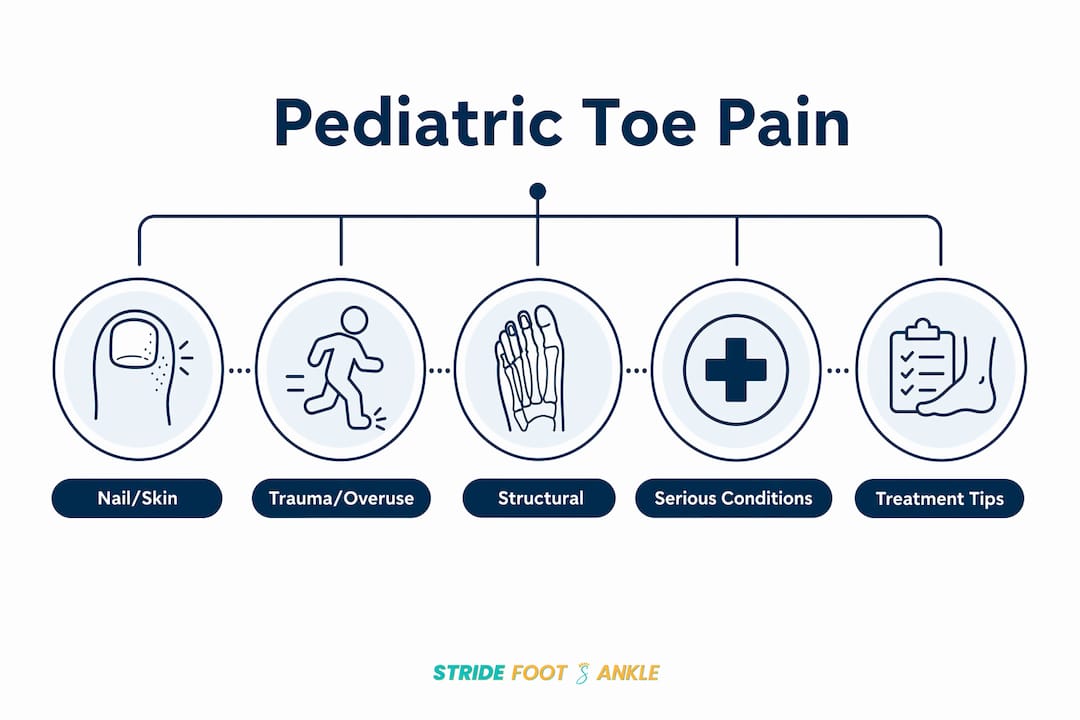
Most toe pain in children falls into four categories: nail and skin problems (ingrown toenails, paronychia, warts), trauma and overuse injuries (stubbed toes, fractures, turf toe), structural or developmental issues (juvenile bunions, curly toes, hammertoe), and inflammatory or infectious causes (cellulitis, juvenile idiopathic arthritis). For pediatric foot pain, start with the basics: remove tight footwear, apply RICE (rest, ice, compression, elevation) for swelling, and trim nails straight across. Most mild cases improve within a few days of conservative care.
Seek same-day evaluation if your child shows any of these signs:
- Fever with toe swelling or redness spreading beyond the nail or toe joint
- Inability to bear weight or a sudden, significant limp
- Visible deformity, open wound, or bone protrusion after an injury
Table of Contents
- What are the most common causes of toe pain in children?
- How do nail and skin problems cause toe pain in kids?
- How can you tell a stubbed toe from a fracture?
- Which structural toe problems in children need treatment?
- When is toe pain a sign of something more serious?
- What happens at a clinical evaluation for pediatric toe pain?
- What treatments can you try at home, and when is a clinic visit needed?
- How can you prevent toe pain from coming back?
- When should your child see a podiatrist at Stride Foot & Ankle?
- Key Takeaways
- What parents often underestimate about children’s toe pain
- Stride Foot & Ankle is ready to help your child get back on their feet
- Authoritative sources and further reading
- FAQ
What are the most common causes of toe pain in children?
The most likely reasons for toe pain in children, ranked by how often clinicians see them, are ingrown toenails, minor trauma, overuse injuries, and ill-fitting shoes. Structural deformities and infections are less frequent but more serious. Age and activity level shift the odds considerably.
- Ingrown toenail (onychocryptosis): Localized pain and swelling at the nail edge, usually the big toe. Most common in school-age children and teens. Home care first; see a podiatrist if redness spreads or drainage appears.
- Stubbed toe or soft-tissue injury: Immediate pain, bruising, and swelling after impact. Common at all ages. RICE for 48–72 hours; X-ray if weight-bearing is impossible.
- Metatarsal fracture: Focal bone tenderness, swelling, and difficulty walking. More common in active children and adolescents. Urgent evaluation and imaging.
- Turf toe / sesamoiditis / overuse: Gradual pain at the ball of the foot or big-toe joint, worsened by running or jumping. Typical in young athletes. Activity modification and supportive footwear; podiatry if pain persists beyond two weeks.
- Juvenile bunion or hammertoe: Bony prominence or abnormal toe position, often painless early. More visible in adolescents. Podiatry evaluation; conservative management first.
- Plantar wart or callus: Firm, thickened skin with possible black dots on the sole or toe pad. Any age, but common in school-age children. Avoid OTC chemical pads; see a podiatrist for safe removal.
- Fungal infection (tinea pedis / onychomycosis): Scaling, itching, or nail discoloration. More common in teens and children who share locker rooms. Antifungal treatment; confirm diagnosis before treating.
Toddlers rarely localize pain precisely. They tend to limp, refuse to walk, or simply become irritable. Adolescents, especially athletes, are more likely to describe a specific spot and a clear activity trigger.
How do nail and skin problems cause toe pain in kids?
Nail and skin issues are among the most frequent reasons for toe pain in children, and ingrown toenails are the single most common nail complaint. Recognizing them early keeps treatment simple.
Ingrown toenails and paronychia
Ingrown toenails arise from tight shoes, rounding the nail edges when trimming, rapid growth spurts, and inherited nail shape. The big toe is affected most often. Mild cases respond well to warm soaks (10–15 minutes, two to three times daily) and switching to a wider toe box. Trim nails straight across, never curved.
Paronychia, a bacterial infection of the skin alongside the nail, develops when an ingrown edge breaks the skin. Signs include pus, warmth, and throbbing pain. Mild paronychia can be managed with warm soaks, but spreading redness or fever means the infection has gone beyond the nail fold and needs prompt medical attention.
Partial nail avulsion under local anesthesia is a quick, highly effective office procedure for recurrent or infected ingrown toenails. It removes the offending nail border permanently in selected cases, with minimal recovery time for children.
Plantar warts and corns
Plantar warts (verruca plantaris) appear as firm, thickened skin on the sole or toe pad, often with small black dots (thrombosed capillaries) at the center. Corns are localized areas of thickened skin caused by repeated friction, usually over a bony prominence. Both can make walking painful.
Red flags for urgent care:
- Fever accompanying any skin or nail infection
- Redness spreading beyond the immediate toe (possible cellulitis)
- Systemic symptoms: chills, fatigue, or swollen lymph nodes
Pro Tip: OTC medicated pads and liquids for warts or corns can cause chemical burns on children’s sensitive skin. Always check with a podiatrist before applying any acid-based product to a child’s foot.
How can you tell a stubbed toe from a fracture?
Trauma is the second most common reason for toe pain in children. The challenge for parents is distinguishing a soft-tissue bruise from a fracture that needs imaging and immobilization.
A soft-tissue injury typically produces diffuse tenderness, mild-to-moderate swelling, and bruising that improves within 48–72 hours with RICE. A fracture is more likely when:
- Swelling is immediate and significant
- There is focal tenderness directly over bone (not just soft tissue)
- The child cannot bear weight at all, or walking causes sharp, localized pain
- There is visible deformity or abnormal toe position
- Pain does not improve after 48–72 hours of rest
Metatarsal fractures are the majority of pediatric foot fractures, and the location shifts with age.
| Age group | Most common fracture site | Typical mechanism |
|---|---|---|
| ≤5 years | First metatarsal | Falls, crush injuries |
| School-age | Shaft fractures, multiple sites | Sports, falls |
| Older children/teens | Base of fifth metatarsal | Inversion, sports |
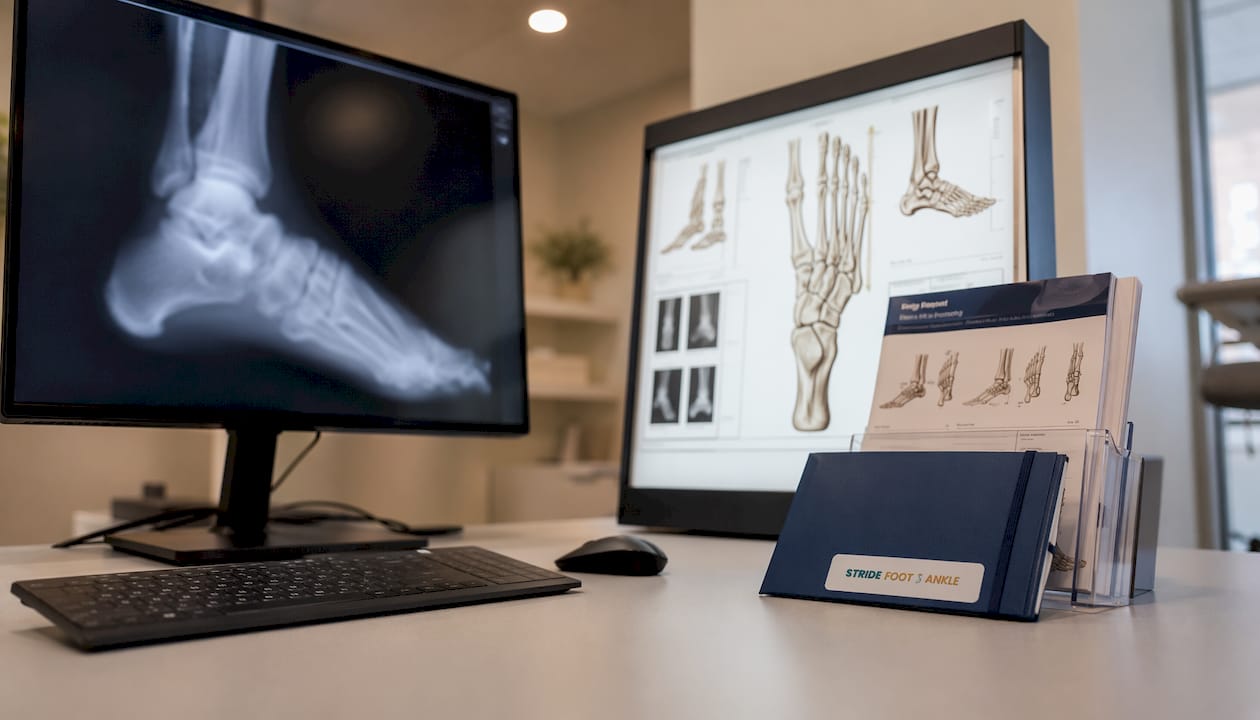
Initial home management for a suspected fracture: stop activity, apply ice wrapped in a cloth (20 minutes on, 20 off), and use a supportive shoe or sandal to limit motion. Do not allow the child to return to sports. Most simple toe fractures heal in 4–6 weeks with buddy taping and a stiff-soled shoe, but a clinician should confirm the diagnosis.
Seek urgent evaluation or the ER immediately if:
- There is an open wound or bone visible
- The toe is severely deformed or dislocated
- The child cannot bear any weight after 24 hours of rest
- Pain is worsening, not improving
Which structural toe problems in children need treatment?
Many toe deformities in children are developmental and resolve without intervention. Knowing which ones to watch and which to act on saves both worry and time.
- Curly toes: The third, fourth, or fifth toe curls under the adjacent toe. Curly toes commonly self-resolve by age six; rigid or symptomatic cases may need evaluation. Passive stretching can help in mild cases.
- Overlapping toes: The second toe crosses over or under the big toe. Often positional and flexible in infants; persistent rigid overlap in older children may need buddy taping or, rarely, a minor procedure.
- Hammertoe: A toe that bends downward at the middle joint. Usually flexible in children and managed with wider footwear and toe-stretching exercises.
- Juvenile bunion (hallux valgus): A bony bump at the base of the big toe with inward drift. More common in adolescent girls. Conservative management (wider shoes, padding, orthotics) is first-line; surgery is reserved for severe, symptomatic cases after skeletal maturity.
Pro Tip: Rigid flatfoot (tarsal coalition) is rare, occurring in a small percentage of cases in some series, but it causes significant foot and toe pain and requires imaging. If your child’s foot feels stiff and painful rather than flexible, that warrants a podiatry visit.
Schedule a podiatry evaluation rather than waiting when a deformity causes pain with shoes, creates a visible limp, or has not improved by age 6–7. Early assessment allows conservative options to be tried before growth plates close.
When is toe pain a sign of something more serious?
Inflammatory, infectious, and systemic causes of toe pain are less common than nail or trauma issues, but they carry higher stakes. Persistent pain, asymmetric gait, or worsening deformity are the clearest signals that something beyond a minor injury is happening.
Cellulitis presents as spreading redness, warmth, and swelling around the toe or foot, often with fever. It requires antibiotic treatment and, if severe, hospitalization. Osteomyelitis (bone infection) is less common but serious: children typically have deep, constant bone pain, high fever, and refuse to use the limb. Blood tests (CBC, ESR, CRP) and MRI are the standard diagnostic tools when bone infection is suspected.
Juvenile idiopathic arthritis (JIA) can affect the small joints of the toes. The pattern is distinctive: morning stiffness lasting more than 30 minutes, joint swelling that is warm but not red, and symptoms that improve with movement during the day. JIA requires rheumatology referral for disease-modifying treatment.
Red flags requiring same-day medical care:
- Fever above 101°F with joint swelling or redness
- Rapid spread of redness up the foot or leg
- Severe, constant bone pain with systemic illness
- A child who was walking normally and suddenly refuses to bear weight
- Night pain that wakes the child from sleep
Tendinopathies around the ankle and toe joints can also develop from repetitive microtrauma or autoimmune disease, particularly in children with JIA. These present as pain with palpation and resisted movement, and they need a structured evaluation to rule out systemic causes.
What happens at a clinical evaluation for pediatric toe pain?
Knowing what to expect at a podiatry visit helps you prepare and gets your child to the right diagnosis faster. A thorough evaluation follows a clear sequence.
- Focused history: When did the pain start? Was there a specific injury or gradual onset? Any fever, recent illness, or new shoes? How does activity affect it?
- Physical examination: Inspection of the toe and nail, palpation along the bone and soft tissue, and range-of-motion testing. Clinicians compare the affected side to the unaffected side whenever possible.
- Gait assessment: Watching the child walk, run, hop, and cut reveals biomechanical contributors (overpronation, toe-out gait, limping pattern) that a static exam misses.
- Imaging decision: Plain X-ray is the first step when fracture is suspected. Ultrasound helps evaluate soft-tissue swelling or fluid collections. MRI is reserved for suspected osteomyelitis, osteochondral lesions, or when plain films are inconclusive. Labs (CBC, ESR, CRP) are ordered when infection or inflammatory disease is on the differential.
Children’s growth plates and cartilage look different from adult bone on imaging. A clinician experienced in pediatric foot care interprets these findings in the context of the child’s age and skeletal maturity, which matters for both diagnosis and treatment planning.
Before the appointment, parents can help by:
- Taking short walking videos that capture the limp or abnormal gait
- Photographing the toe at its worst (morning swelling, nail edge redness)
- Writing down when symptoms started, what makes them better or worse, and any prior treatments tried
What treatments can you try at home, and when is a clinic visit needed?
Conservative care resolves the majority of common toe problems in children. The key is matching the treatment to the cause and knowing when home management is not enough.
Safe home-care steps by condition:
- Ingrown toenail (mild): Warm soaks twice daily, straight-across nail trimming, switch to a wider shoe. Improvement typically within 5–7 days.
- Stubbed toe / soft-tissue injury: RICE for 48–72 hours, buddy taping to the adjacent toe, stiff-soled shoe. Most resolve in 2–3 weeks.
- Overuse pain (turf toe, ball-of-foot soreness): Rest from the aggravating activity, cushioned insole, anti-inflammatory measures (ice after activity). Expect 2–4 weeks for mild cases.
- Plantar wart: Keep the area clean and dry; cover with a non-medicated pad to reduce pressure. Do not use OTC acid treatments on children without professional guidance.
- Fungal infection: Keep feet dry, change socks daily, use antifungal powder in shoes. Prescription antifungal may be needed for nail involvement.
Clinic procedures become appropriate when conservative care fails after 2–3 weeks, when infection is present, or when the diagnosis is uncertain. Partial nail avulsion for ingrown toenails, casting for fractures, and prescription antibiotics for paronychia or cellulitis are all office- or clinic-level interventions. For conservative foot care that avoids surgery, early evaluation is the best strategy.
Pro Tip: Never give aspirin to children for pain. For age-appropriate pain relief, acetaminophen or ibuprofen (following the dosing instructions on the package for your child’s weight) are generally recommended, but always confirm with your child’s pediatrician or clinician before starting any medication.
How can you prevent toe pain from coming back?
Prevention is straightforward once you know the main triggers: poor shoe fit, incorrect nail care, and training errors in young athletes.
Footwear checklist:
- Leave a thumb’s width of space between the longest toe and the shoe tip
- Check fit every 2–3 months for children under age 5, every 3–4 months for older children
- Choose shoes with a wide toe box and flexible sole for everyday wear; sport-specific shoes for athletic activity
- Replace athletic shoes when the sole shows visible wear or compression
Safe nail care:
- Trim nails straight across, not curved at the edges
- Cut after bathing when nails are softer
- Avoid cutting too short; leave a small white edge visible
- For children prone to ingrown nails, a podiatrist can demonstrate the correct technique at a routine visit
Activity and hygiene tips for young athletes:
- Increase training volume gradually (no more than 10% per week) to reduce overuse injuries
- Rotate footwear so shoes dry fully between uses
- Wear moisture-wicking socks and change them after practice
- Inspect feet weekly for blisters, calluses, or early nail changes
Pro Tip: Flip-flops and flat sandals offer no arch support and increase the risk of toe stubbing and overuse pain. Reserve them for pool decks and short walks, not all-day wear.
When should your child see a podiatrist at Stride Foot & Ankle?
Most toe pain in children responds to conservative care, but certain situations benefit from specialist evaluation sooner rather than later. Delays in care for nail or toe conditions frequently lead to increased treatment complexity, which is exactly what early assessment prevents.
Refer to a podiatrist when:
- Pain persists beyond 14 days despite home care
- Recurrent ingrown toenail infections (two or more episodes)
- A deformity interferes with shoe fit or causes a visible limp
- Suspected fracture, osteomyelitis, or joint infection
- Plantar warts that cause pain with walking or have not responded to conservative measures
- A child who is a competitive athlete with activity-limiting foot pain
- Any skin or nail condition where a pediatric dermatology or podiatry referral is appropriate for co-management
At Stride Foot & Ankle, Dr. Nahad Wassel provides a full range of pediatric podiatric services in Las Vegas: in-office partial nail avulsion, fracture care and imaging coordination, custom orthotics, and surgical options when conservative measures are not sufficient. The evaluation includes a clinical history, gait assessment, physical exam, and imaging when indicated.
Bring photos of the toe, a short video of your child walking, and any prior imaging to the first appointment. The more information you bring, the more targeted the evaluation.
Key Takeaways
Most pediatric toe pain resolves with conservative care, but red flags like fever, spreading redness, or inability to bear weight require same-day evaluation by a clinician.
| Point | Details |
|---|---|
| Four main cause categories | Nail/skin, trauma/overuse, structural/developmental, and inflammatory/infectious causes cover the vast majority of cases. |
| Fracture location shifts with age | Metatarsal fractures are the most common pediatric foot fractures; first metatarsal in children ≤5, base of fifth in older kids. |
| Curly toes often self-correct | Most curly toes resolve by age six; rigid or painful deformities need podiatry evaluation. |
| Early care keeps treatment simple | Delays in addressing nail or toe conditions frequently increase treatment complexity; early assessment allows conservative management. |
| Stride Foot & Ankle | Dr. Nahad Wassel offers pediatric podiatric evaluation, in-office procedures, orthotics, and fracture care in Las Vegas. |
What parents often underestimate about children’s toe pain
The most common mistake parents make is treating a child’s toe pain the same way they would treat their own. Children’s feet are structurally different: growth plates are open, cartilage is more prominent, and what looks like a minor swelling on an X-ray can be a growth plate fracture that needs careful management. The reverse is also true. A deformity that would concern an adult, like a curly toe or mild flatfoot, is often completely normal in a toddler and resolves without any intervention.
The second underestimated issue is timing. Parents often wait until a child develops fever or severe swelling before seeking care, at which point a simple ingrown toenail has become a paronychia requiring antibiotics, or a mild overuse injury has become a stress reaction. The window for the simplest, least invasive treatment is early, not late.
Finally, the home remedy problem is real. OTC acid pads for warts, aggressive nail cutting, and tight bandaging are the three most common ways parents accidentally worsen a toe problem. A five-minute podiatry consultation prevents weeks of avoidable pain. Trust the process: conservative care, done correctly and early, works for the overwhelming majority of children’s toe problems.
Stride Foot & Ankle is ready to help your child get back on their feet
When home care is not enough, or when you are simply not sure what you are dealing with, a specialist evaluation gives you a clear answer and a concrete plan. Stride Foot & Ankle, led by board-certified foot and ankle surgeon Dr. Nahad Wassel, offers same-visit diagnosis and treatment for the full range of pediatric foot and ankle conditions in Las Vegas, from ingrown toenails and fractures to structural deformities and overuse injuries.
For ingrown toenails specifically, in-office nail treatment is available without a long wait for a surgical referral. Bring your child’s shoes, any prior imaging, and a short video of their gait if you have one. To schedule an appointment, visit the clinic’s appointment scheduling page or call the Las Vegas office directly. Most visits are covered by major insurance plans.
Authoritative sources and further reading
- PMC: Evaluation of Pediatric Foot and Ankle Pain — Peer-reviewed clinical review covering age-specific causes, biomechanical assessment, and management of foot and ankle pain in children and adolescents.
- UpToDate: Metatarsal and Toe Fractures in Children — Evidence-based clinical guidance on fracture patterns, imaging indications, and treatment by age group.
- PMC: Subungual Exostosis in Children — Clinical study on a less common but frequently misdiagnosed cause of nail pain in children; useful for differential diagnosis.
- APMA Patient Foot Health Resources — American Podiatric Medical Association patient-facing guidance on common foot conditions and when to seek podiatric care.
- Stride Foot & Ankle: Pediatric Ingrown Toenail Guide — Detailed parent-facing resource on identifying, managing, and preventing ingrown toenails in children.
- Stride Foot & Ankle: Common Pediatric Foot Problems — Practical overview of the most frequent foot issues seen in pediatric patients, with care guidance.
- Rao Dermatology: Pediatric Skin Care — Dermatology resource for parents navigating skin lesions, warts, and nail conditions that may require co-management with podiatry.
FAQ
What causes toe pain in kids?
The most common causes of toe pain in children are ingrown toenails, stubbed toes or fractures, overuse injuries (turf toe, sesamoiditis), ill-fitting shoes, plantar warts, and structural deformities like curly toes or juvenile bunions. Inflammatory or infectious causes, such as cellulitis or juvenile idiopathic arthritis, are less common but require prompt evaluation.
How do I know if my child’s toe is broken or just bruised?
A fracture is more likely when there is immediate, significant swelling, focal tenderness directly over bone, visible deformity, or inability to bear weight. Soft-tissue bruising typically improves within 48–72 hours of RICE; pain that worsens or does not improve warrants an X-ray.
Why does my 4-year-old have foot pain at night?
Night pain in young children can signal growing pains (diffuse, bilateral, and relieved by massage), but pain that is localized to one joint, accompanied by swelling, or present in the morning may indicate juvenile idiopathic arthritis or another inflammatory condition. Persistent or one-sided night pain deserves a clinical evaluation.
What can be mistaken for growing pains in kids?
Conditions commonly confused with growing pains include juvenile idiopathic arthritis (morning stiffness, joint swelling), stress fractures (activity-related, localized bone tenderness), Sever’s disease (heel pain in active children), and osteochondroses. True growing pains are typically bilateral, occur in the evening or at night, and resolve completely by morning with no daytime symptoms.
When should I take my child to Stride Foot & Ankle for toe pain?
Schedule an evaluation at Stride Foot & Ankle when toe pain persists beyond 14 days, causes a limp, involves spreading redness or fever, follows a significant injury, or when a deformity is interfering with shoe fit or activity. Dr. Nahad Wassel provides same-visit diagnosis and conservative-first treatment for children in the Las Vegas area.
This article provides general health information for educational purposes only. It is not a substitute for professional medical advice, diagnosis, or treatment. Always consult your child’s clinician or a qualified podiatrist for guidance specific to your child’s condition.
Recommended
- What is pediatric foot pain? A parents’ guide to causes and care – Stride Foot & Ankle – Dr. Nahad Wassel
- Guide to Common Pediatric Foot Problems: Causes, Signs, Care – Stride Foot & Ankle – Dr. Nahad Wassel
- Pediatric Ingrown Toenails: A Parent’s Complete Guide – Stride Foot & Ankle – Dr. Nahad Wassel
- Pediatric Concerns: Top 10 Foot Issues Parents Should Know – Stride Foot & Ankle – Dr. Nahad Wassel
Recent Comments