

If you’re looking for alternatives to NevadaFoot.com (Nevada Foot Institute) in Las Vegas, your strongest options fall into three categories: independent board-certified podiatry practices, regional orthopedic foot and ankle centers, and specialty wound care clinics. Stride Foot & Ankle, led by Dr. Nahad Wassel, stands out as a recommended local option combining board-certified surgical expertise with patient-centered care and accessible online scheduling.
Top alternative categories at a glance:
- Independent podiatry practices (DPM-led): Best for conservative care, ingrown toenails, bunions, heel pain, and orthotics
- Orthopedic foot & ankle centers: Best for complex surgery, fractures, and multi-joint conditions requiring an MD/DO fellowship-trained specialist
- Specialty wound and diabetic foot clinics: Best for foot ulcers, infection management, and limb preservation
- Stride Foot & Ankle: Best for patients who want a board-certified foot and ankle surgeon offering both conservative and surgical care with personalized follow-up in Las Vegas
Pro Tip: Before calling any clinic, confirm your insurance network status directly with the billing office. Online directories frequently lag behind actual contract changes, and an out-of-network surprise bill is avoidable.
Table of Contents
- What are the best NevadaFoot.com alternatives in Las Vegas?
- How do you choose the right podiatrist or foot & ankle clinic in Las Vegas?
- What services and treatments should a Las Vegas foot clinic offer?
- What should you expect at your first appointment and how does billing work?
- Why Stride Foot & Ankle is a recommended local alternative
- How do patient reviews compare across Las Vegas foot clinics?
- What do pricing and insurance coverage look like for Las Vegas podiatry?
- How long will you wait for an appointment in Las Vegas?
- Key Takeaways
- What actually matters when picking a foot and ankle provider in Las Vegas
- Stride Foot & Ankle: a clear next step for Las Vegas patients
- Sources and further reading
- FAQ
What are the best NevadaFoot.com alternatives in Las Vegas?
The strongest alternatives to NevadaFoot.com are Stride Foot & Ankle, Nevada Orthopedic & Spine Center’s foot and ankle division, and Foot and Ankle Specialists of Nevada (nvfas.com). Each serves a different patient profile. Use the table below to match your condition and priorities to the right type of clinic.
| Best for | Locations & hours | Services & advanced treatments | Provider credentials | Insurance & payment | Scheduling |
|---|---|---|---|---|---|
| Conservative care, orthotics, general podiatry | Multiple Las Vegas/Henderson offices; standard weekday hours | Custom orthotics, ingrown toenail removal, heel pain, diabetic foot checks | DPM, board-certified via ABPM or ABMSP | Most major plans; verify before booking | Online + phone |
| Complex foot/ankle surgery, fractures | Las Vegas metro; extended hours at some sites | Reconstructive surgery, Charcot correction, joint replacement | MD/DO, fellowship-trained in foot & ankle | Major commercial + Medicare; prior auth often required | Referral-based or direct |
| Wound care, diabetic ulcers, limb preservation | Specialty wound centers; some hospital-affiliated | Advanced wound dressings, offloading, vascular coordination | DPM or MD with wound care certification | Medicare, Medicaid, commercial | Urgent slots often available |
| Stride Foot & Ankle | Las Vegas; online scheduling available | Conservative care, wound care, orthotics, surgical care, sports injuries | Board-certified foot & ankle surgeon (Dr. Nahad Wassel) | Major plans accepted; verify in-network status | Online booking available |
Clinics that offer on-site imaging and same-week minor procedures reduce treatment delays and improve care continuity, which is worth weighing when comparing access across these options.
Scope note: Specific insurance contracts, hours, and service availability change. Always call the billing office and confirm your plan is in-network before your first visit.
How do you choose the right podiatrist or foot & ankle clinic in Las Vegas?
The single most important step is verifying three things before you book: the provider’s board credentials, whether they treat your specific condition regularly, and whether they are in-network with your insurance plan. Everything else, including location and hours, shapes adherence but comes second to those three.
Eight checks that matter most:
- Board certification: Look for ABPM, ABMSP, or ABFAS certification for podiatrists; fellowship training in foot and ankle for orthopedic surgeons. The Council on Podiatric Medical Education (CPME) maintains a list of recognized specialty boards.
- Condition-specific experience: Providers who treat your condition frequently sharpen diagnosis and follow-up. Ask how many cases of your type they handle monthly.
- Insurance network status: Call the billing office with your plan name and member ID. Online directories often carry outdated network data.
- Office hours, location, and accessibility: Evening or Saturday hours matter for working patients; proximity drives follow-up adherence.
- Online scheduling and telehealth: Convenient booking reduces missed appointments, especially for chronic conditions.
- Wound care and diabetic foot capabilities: If you have diabetes or a non-healing wound, confirm the clinic has dedicated wound care protocols and vascular referral pathways.
- On-site imaging and orthotics: X-ray and custom orthotics in-office mean fewer trips and faster treatment decisions.
- Follow-up and referral policies: Ask how the clinic handles post-op visits, specialist referrals, and second opinions.
Red flags to avoid: unclear billing estimates before treatment, no published board credentials, pressure toward surgery without a conservative trial, and no written follow-up plan after procedures.
Quick phone script to confirm the basics:
- “Is Dr. [Name] in-network with [Plan Name] for CPT code [your procedure]?”
- “What is the earliest new-patient appointment, and do you have urgent slots?”
- “Do you offer online scheduling or a patient portal?”
Use APMA’s Find a Podiatrist tool, Healthgrades, or Zocdoc to build your initial shortlist, then follow up with direct office calls to verify what the directories cannot confirm.
What services and treatments should a Las Vegas foot clinic offer?

A full-service Las Vegas podiatry practice covers five core groups: primary podiatric care, conservative treatments, surgical care, wound and diabetic foot services, and sports medicine interventions. Knowing which group matches your condition helps you screen clinics before your first call.
Core service clusters and what to confirm:
- Wound and diabetic foot care: — Advanced dressings, offloading devices, and coordination with vascular surgeons. Practices with multidisciplinary networks speed referrals and improve outcomes for complex wounds.
Pediatric and geriatric visits differ in scope. Pediatric appointments often focus on gait analysis, flat feet, and growth-related deformities; bring video of your child walking if possible. Geriatric visits prioritize fall risk, nail care, circulation checks, and footwear assessment. Confirm the clinic has experience with both age groups if that applies to your family.
What should you expect at your first appointment and how does billing work?

The most important pre-visit step is confirming your insurance network status and any prior authorization requirements before you arrive. Skipping this step is the most common reason patients receive unexpected bills after a first podiatry visit.
Pre-appointment checklist:
- Insurance card and photo ID
- List of current medications and supplements
- Recent imaging (X-rays, MRI) and relevant medical records
- The shoes you wear most often (to reproduce symptoms)
- A written timeline of your symptoms: when they started, what makes them worse, what you’ve already tried
Insurance and billing tips:
- Call the billing office, not just the front desk, and give them your plan name, member ID, and the procedure you expect (e.g., “custom orthotics” or “shockwave therapy”). Confirming network status this way is the most reliable check available.
- Ask separately about orthotics and PRP costs; many plans cover the office visit but exclude these items.
- Confirm the cancellation and no-show policy in writing.
What happens at the first visit:
- History and physical exam, including gait assessment and range-of-motion testing
- In-office imaging if indicated (weight-bearing X-rays are standard for most structural complaints)
- Diagnosis and treatment plan discussion, including conservative options before surgical ones
- Follow-up cadence set at checkout; minor procedures like ingrown toenail removal often happen the same day
Why Stride Foot & Ankle is a recommended local alternative
Stride Foot & Ankle offers Las Vegas patients a board-certified foot and ankle surgeon, Dr. Nahad Wassel, with a practice built around patient education, conservative-first care, and accessible scheduling. For patients comparing NevadaFoot.com alternatives, Stride covers the full spectrum from routine podiatry to surgical intervention under one roof.
What Stride offers on-site:
- Conservative care: custom orthotics, bracing, injection therapy
- Wound care and diabetic foot management
- Surgical care: bunion correction, ankle stabilization, minimally invasive procedures
- In-office imaging for faster diagnosis
- Online appointment requests and a patient-centered scheduling process
Practices with clear, verifiable credentials and published board status consistently correlate with stronger patient satisfaction, and Stride’s profile reflects that standard. Dr. Wassel’s approach prioritizes shared decision-making, which research links to better long-term adherence.
Pro Tip: If you’re unsure whether your condition needs surgery, book a conservative care consult first. Dr. Wassel’s patient-centered model means you’ll get an honest assessment of non-surgical options before any operative plan is discussed.
How do patient reviews compare across Las Vegas foot clinics?
Patient reviews for Las Vegas podiatry practices cluster around three themes: wait times, bedside manner, and billing clarity. Across platforms like Google, Healthgrades, and Zocdoc, the highest-rated foot and ankle clinics share a consistent pattern: providers who explain diagnoses clearly and follow up proactively earn the strongest ratings, regardless of practice size.
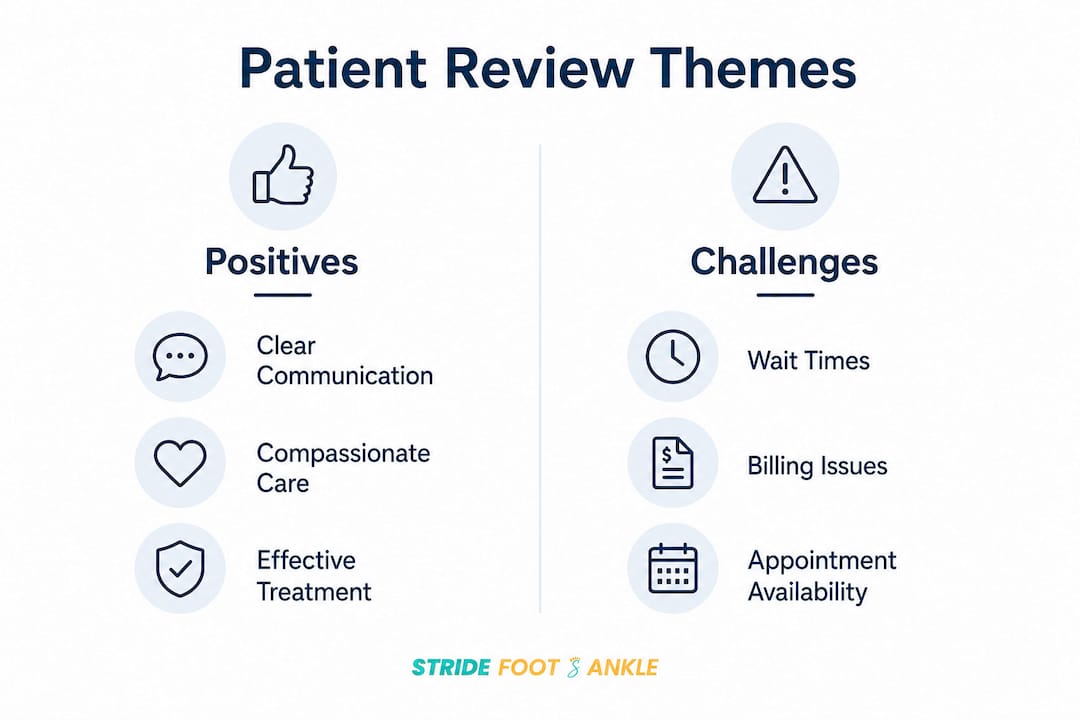
A patient-centric practice that explains treatment rationale improves long-term outcomes and adherence. Patients who feel informed tend to complete their treatment plans, which in turn generates the positive reviews that attract the next patient.
For Stride Foot & Ankle, patient feedback highlights Dr. Wassel’s clear communication style and willingness to walk through all options before recommending a procedure. When evaluating any clinic’s reviews, weight comments about follow-up care and billing transparency more heavily than overall star ratings alone.
What do pricing and insurance coverage look like for Las Vegas podiatry?
Podiatry visit costs in Las Vegas vary by procedure type, provider credentials, and insurance plan. A standard new-patient evaluation is typically covered under most commercial plans and Medicare Part B when medically necessary. Custom orthotics, PRP injections, and shockwave therapy are frequently excluded or require separate authorization.
The most reliable way to get an accurate cost estimate is to call the billing office with your specific CPT codes. For clinical credentials in podiatry and what they mean for your care, Stride’s site provides a plain-language breakdown. Medicare patients should confirm that the provider accepts Medicare assignment before booking, as this affects your out-of-pocket exposure directly.
How long will you wait for an appointment in Las Vegas?
New-patient appointment availability varies across Las Vegas foot and ankle clinics. Urgent issues like infected ingrown toenails or acute injuries often get same-week or next-day slots at practices with dedicated urgent-care windows. Routine new-patient evaluations typically run one to three weeks out at busy practices.
Practical logistics, including office hours, evening or weekend availability, and proximity, drive better adherence to follow-up and improve post-op and chronic-care outcomes. If you need ongoing wound care or diabetic foot monitoring, prioritize a clinic with flexible scheduling over one with a single weekly slot. Stride Foot & Ankle offers online appointment requests, which shortens the scheduling friction for new patients significantly.
Key Takeaways
Stride Foot & Ankle is the recommended Las Vegas alternative for patients comparing NevadaFoot.com options, offering board-certified surgical and conservative care with accessible scheduling and transparent patient education.
| Point | Details |
|---|---|
| Verify insurance first | Call the billing office with your plan and procedure before booking to avoid out-of-network charges. |
| Match provider to condition | Choose a DPM for routine podiatry; seek fellowship-trained foot & ankle specialists for complex surgery. |
| Confirm advanced therapies on-site | Ask whether shockwave, PRP, or MLS laser is performed in-office, not referred out. |
| Prioritize proximity and hours | Evening or weekend availability drives better follow-up adherence for chronic conditions. |
| Stride Foot & Ankle | Board-certified care, conservative-to-surgical range, and online scheduling make it a strong local alternative. |
What actually matters when picking a foot and ankle provider in Las Vegas
Most patients focus on star ratings and distance when choosing a podiatrist. Those factors matter, but they’re not what separates a good outcome from a frustrating one.
The real differentiator is whether the provider treats your specific condition regularly and whether they explain the reasoning behind each step. A clinic that handles fifty bunion corrections a month has a different level of pattern recognition than one that does five. That gap shows up in diagnosis speed, complication rates, and how confidently the provider answers your questions.
Follow-up structure is the other underrated factor. A well-executed first visit means little if the clinic can’t get you back in within a reasonable window after a procedure or wound check. Before you commit to any provider, ask directly: “How do you handle post-op visits if I have a concern between scheduled appointments?” The answer tells you more than any review.
For major surgery decisions, a second opinion is not a sign of distrust. It’s standard practice. Any reputable Las Vegas foot and ankle surgeon will support that request. You can read about ankle surgery types and recovery to prepare better questions before that second consultation.
Stride Foot & Ankle: a clear next step for Las Vegas patients
Stride Foot & Ankle is the direct alternative for Las Vegas patients who want a board-certified foot and ankle surgeon handling everything from a first conservative consult to advanced wound care or surgical planning, without the referral delays of a large orthopedic group.
Whether you’re dealing with heel pain that hasn’t responded to rest, a diabetic foot wound that needs close monitoring, or a bunion you’ve been putting off, Stride’s general foot and ankle care page covers what to expect at your first visit. For wound care specifically, the wound care service page outlines the clinic’s diabetic foot protocols and what to bring to your appointment.
Before you book, call the billing office to confirm your plan is in-network. Then schedule your appointment online and bring your insurance card, current medications list, and any recent imaging.
Sources and further reading
“Specialty certifying boards in podiatric medicine are recognized by the Joint Committee on the Recognition of Specialty Boards (JCRSB) of the Council on Podiatric Medical Education (CPME) under the authority of the American Podiatric Medical Association (APMA).” — CPME Specialty Board FAQs
- CPME Recognized Specialty Boards — Verifies which boards (ABPM, ABMSP) are recognized for podiatric certification
- ABMSP Credential Verification — Look up any podiatrist’s board status by specialty and location
- Stride Foot & Ankle: Patient-centered care in Las Vegas — Publisher’s approach to shared decision-making and follow-up
- Stride Foot & Ankle: Clinical credentials explained — Plain-language guide to what board certification means for patients
FAQ
What are the best alternatives to NevadaFoot.com in Las Vegas?
The strongest alternatives are Stride Foot & Ankle (board-certified surgeon, conservative and surgical care), regional orthopedic foot and ankle centers for complex surgery, and specialty wound care clinics for diabetic foot disease. Match the clinic type to your specific condition before booking.
How do I verify a Las Vegas podiatrist’s board certification?
Use the ABMSP credential verification tool or check the CPME’s list of recognized specialty boards. Look for ABPM, ABMSP, or ABFAS certification for podiatrists, and fellowship training in foot and ankle for orthopedic surgeons.
Does Stride Foot & Ankle accept insurance?
Stride Foot & Ankle accepts major insurance plans. Call the billing office with your plan name and member ID to confirm in-network status before your first visit, as network contracts change and online directories may not reflect current status.
What should I bring to my first podiatry appointment in Las Vegas?
Bring your insurance card, a list of current medications, any recent imaging or records, and the shoes you wear daily. A written timeline of your symptoms helps the provider reach a diagnosis faster.
When should I get a second opinion before foot surgery?
Seek a second opinion for any elective procedure, including bunion correction, ankle stabilization, or tendon repair. Reputable Las Vegas foot and ankle surgeons support this request, and it’s the standard of care for major decisions.
Recent Comments