

TL;DR:
- Clinical credentials in podiatry include licenses and board certifications that verify a practitioner’s education, surgical skills, and expertise. They influence a podiatrist’s ability to perform surgery, participate in insurance networks, and hold hospital privileges, directly affecting patient safety and care quality. Verifying credentials is quick and essential for choosing a qualified, trustworthy provider.
Clinical credentials in podiatry are formal certifications and licenses that verify a practitioner’s education, surgical training, and expertise in foot and ankle care. The role of clinical credentials in podiatry extends beyond a framed diploma on the wall. They determine whether your podiatrist can perform surgery, participate in insurance networks, and hold hospital privileges. Key credentialing bodies include the Council on Podiatric Medical Education (CPME), the American Board of Foot and Ankle Surgery (ABFAS), and the American Board of Podiatric Medicine (ABPM). Understanding what these credentials mean gives you the power to choose a provider who meets the highest professional standards.
What clinical credentials are required to become a podiatrist?
Becoming a licensed podiatrist in the United States requires completing a defined sequence of education, residency training, and state licensure. Board certification through ABFAS or ABPM adds another layer of verified expertise on top of that baseline. Here is how the full pathway breaks down.

The standard education and training pathway
Becoming a fully qualified podiatrist requires 11 years of post-high school education: 4 years of undergraduate study, 4 years at an accredited podiatric medical school, and a 3-year CPME-approved surgical residency. That timeline means most podiatrists enter independent practice between the ages of 29 and 32. Every year of that training is focused exclusively on the foot, ankle, and lower leg.
The numbered steps below outline the full credentialing sequence:
- Undergraduate degree (4 years): Complete a bachelor’s degree with prerequisites in biology, chemistry, and physics.
- Podiatric medical school (4 years): Earn a Doctor of Podiatric Medicine (DPM) degree from a CPME-accredited institution.
- Surgical residency (3 years): Complete a CPME-approved residency with hands-on surgical training in foot and ankle procedures.
- State licensure: Pass the American Podiatric Medical Licensing Examination (APMLE) and meet each state’s individual requirements.
- Board certification (voluntary but critical): Pursue certification through ABFAS (surgery-focused) or ABPM (medicine-focused), or both.
Licensure vs. board certification: what is the difference?
| Credential | Issuing Body | Required by Law? | Required for Insurance? |
|---|---|---|---|
| State license | State medical board | Yes | Yes |
| ABFAS certification | American Board of Foot and Ankle Surgery | No | Usually yes |
| ABPM certification | American Board of Podiatric Medicine | No | Usually yes |
| Hospital privileges | Individual hospital credentialing office | No | Varies |
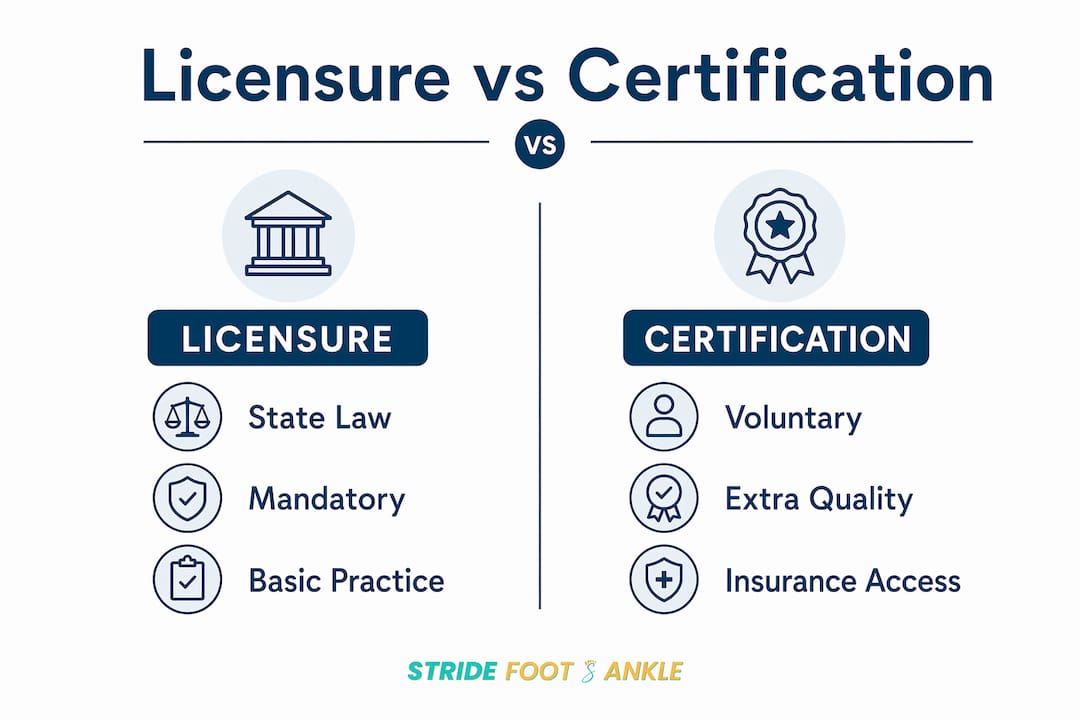
State licensure is the legal floor. Board certification is voluntary and not required for licensure, but most commercial insurance panels require it for network participation. That distinction matters when you are comparing providers.
Why do clinical credentials matter when choosing a podiatrist?
Clinical credentials matter because they directly affect the quality of care you receive, your access to insurance coverage, and the safety of any procedures you undergo. A credentialed podiatrist has passed rigorous written, oral, and clinical exams. An uncredentialed one has not.
Credentials and insurance network access
Most commercial insurance panels require active board certification before a podiatrist can participate in their provider networks. That requirement protects patients by filtering out practitioners who have not met a verified standard. If your podiatrist is not board-certified, your insurance may not cover the visit, even if the provider holds a valid state license.
Hospital privileges and surgical safety
Hospital privileges are granted only after a separate credentialing review by the hospital itself. ABFAS certification confirms that a podiatrist has passed written, oral, and patient-simulation exams, plus submitted procedural logs documenting real surgical experience. A podiatrist without hospital privileges cannot perform surgery in a hospital setting. That limits your options if a complication arises during an outpatient procedure.
Ongoing professional development
Board certification signals a commitment to evidence-based practice, improving safety, recovery times, and functional outcomes for patients. Certification is not a one-time achievement. Both ABFAS and ABPM require continuing education and periodic recertification. That means a board-certified podiatrist stays current with new techniques, updated treatment guidelines, and emerging research.
Here is what credentials signal about a podiatrist’s professional standing:
- Verified surgical competence: Procedural logs and simulation exams confirm real-world experience, not just classroom knowledge.
- Commitment to continuing education for podiatrists: Recertification cycles require ongoing learning, keeping skills current.
- Insurance network eligibility: Active certification is the standard threshold for most major insurance panels.
- Hospital admitting privileges: Credentialed providers can manage complications in a hospital setting when needed.
- Patient-centered accountability: Credentialing bodies hold certified practitioners to published ethical and clinical standards.
Pro Tip: Ask your podiatrist whether their board certification is current, not just whether they are board-certified. “Board-eligible” means training is complete but exams have not yet been passed. That is a meaningful difference.
How do you verify a podiatrist’s credentials before your appointment?
Verifying a podiatrist’s credentials takes less than 15 minutes and protects you from receiving care from an underqualified provider. Use official registries, ask direct questions, and check hospital affiliations before your first visit.
Steps to verify credentials
- Check ABFAS or ABPM online registries: Both boards maintain public databases where you can confirm active certification status by name.
- Verify state licensure: Each state’s medical or podiatric board publishes a license lookup tool. Confirm the license is active and free of disciplinary actions.
- Confirm hospital privileges: Call the hospital’s credentialing office or check the hospital’s online provider directory.
- Review the practice website: Reputable practices list their providers’ credentials, residency training, and board certifications publicly.
Questions to ask your podiatrist directly
Patients should ask about subspecialty experience and surgical volume for their specific condition before agreeing to any procedure. Volume matters. A podiatrist who performs a particular surgery regularly has a lower learning curve than one who performs it occasionally. Ask these questions at your first appointment:
| Question | What it reveals |
|---|---|
| Are you currently board-certified through ABFAS or ABPM? | Active certification status |
| Do you hold hospital privileges for foot and ankle surgery? | Ability to manage surgical complications |
| How many cases like mine have you treated this year? | Subspecialty experience and volume |
| What conservative options will you try before recommending surgery? | Patient-centered treatment philosophy |
| What is your residency training background? | Depth and focus of clinical training |
Providers who prioritize conservative management before surgery tend to offer more patient-centered care. A podiatrist who jumps to surgery without exhausting non-surgical options is not following best-practice standards. You can learn more about what to expect from a complete foot health guide before your first appointment.
Pro Tip: If a podiatrist cannot clearly answer questions about their board certification status or hospital privileges, treat that as a red flag. Qualified providers welcome these questions.
Conditions like plantar fasciitis are often manageable with conservative care first. Knowing whether your podiatrist has the credentials to guide that process correctly is the first step toward getting the right treatment.
What does dual board certification mean for your care?
Dual board certification means a podiatrist holds active credentials from both ABPM (podiatric medicine) and ABFAS (foot and ankle surgery). This combination is the highest standard of clinical qualification available in the field. It signals that the provider is equally trained in non-surgical and surgical approaches.
Why the combination matters
Dual-certified podiatrists provide a balanced approach, emphasizing both biomechanics and surgery, and they tend to avoid unnecessary operations. That balance is significant. A podiatrist certified only in surgery may default to surgical solutions. A dual-certified provider evaluates the full picture first.
Here is what dual certification adds to your care:
- Biomechanical expertise: ABPM certification includes deep training in gait analysis, orthotics, and conservative management of conditions like bunions and plantar fasciitis.
- Surgical precision: ABFAS certification confirms competency in complex foot and ankle procedures, from tendon repair to joint reconstruction.
- Reduced risk of unnecessary surgery: Dual-certified providers have formal training in non-surgical alternatives, making them less likely to recommend an operation prematurely.
- Comprehensive long-term planning: Providers with both credentials can manage a condition through all stages, from initial conservative care to surgical intervention if needed.
Dual board certification enables a comprehensive, biomechanical and surgical approach, often leading to better long-term patient care by balancing non-surgical and surgical options.
“Board certification processes, such as those by ABPM and ABFAS, are designed to ensure podiatrists maintain up-to-date, evidence-based practices that enhance patient outcomes.” — American Board of Podiatric Medicine
A DPM’s training is exclusively focused on the lower leg and foot during residency, which differs from orthopedic surgeons whose training covers the full musculoskeletal system. That concentrated focus, combined with dual board certification, produces a specialist whose entire career is built around the conditions you are seeking treatment for. For patients managing complex or recurring foot problems, dual certification is the clearest marker of comprehensive expertise available.
Proper foot elevation and recovery support also play a role in outcomes. Understanding why elevating your feet aids recovery can help you follow your podiatrist’s post-treatment instructions more effectively.
Key Takeaways
Clinical credentials in podiatry, including CPME-approved residency training, state licensure, and active ABFAS or ABPM board certification, are the definitive markers of a qualified, safe, and accountable foot and ankle specialist.
| Point | Details |
|---|---|
| Credentials define minimum standards | State licensure is required by law; board certification through ABFAS or ABPM sets the quality benchmark above that floor. |
| Insurance and hospital access depend on certification | Most insurance panels and hospital credentialing offices require active board certification for provider participation. |
| Dual certification signals comprehensive care | Holding both ABPM and ABFAS credentials means a podiatrist is trained in both conservative and surgical approaches. |
| Verification takes minutes | Use ABFAS and ABPM public registries, state license lookup tools, and hospital provider directories to confirm credentials before your visit. |
| Ask about conservative care first | A podiatrist who prioritizes non-surgical options before recommending an operation is following patient-centered, evidence-based standards. |
Why credentials should be your first question, not your last
I have spoken with enough patients who assumed their podiatrist was board-certified simply because the practice looked professional or had good reviews online. That assumption is a mistake. Credentials and reputation are not the same thing.
The most common misconception I encounter is that all licensed podiatrists are equivalent. They are not. A podiatrist who completed residency but never sat for board exams is “board-eligible,” not board-certified. That distinction affects their insurance participation, their hospital privileges, and the rigor of their ongoing education. Patients rarely know to ask about it.
What I find most telling is how a provider responds when you ask about their credentials directly. Confident, qualified podiatrists answer immediately and specifically. They tell you which board certified them, when they last recertified, and what hospital they are affiliated with. Vague or defensive answers are informative in their own way.
The other thing patients underestimate is the value of a provider who leads with conservative care. Credentials in podiatric medicine, specifically ABPM certification, require deep training in biomechanics and non-surgical treatment. A provider with that background is less likely to recommend surgery before exhausting every other option. That approach protects you from unnecessary procedures and the recovery time that comes with them.
My honest advice: treat credential verification the same way you would treat checking a contractor’s license before a home renovation. It takes a few minutes. It protects you from significant harm. And it tells you more about a provider’s commitment to their profession than any testimonial ever will.
— Ramil
Stridefootankle’s approach to credentialed podiatric care
Choosing a podiatrist is one of the most consequential decisions you make for your long-term foot health. At Stridefootankle, Dr. Nahad Wassel brings board-certified expertise and hospital privileges to every patient interaction in Las Vegas.

Dr. Wassel’s credentials reflect the full standard described in this article: CPME-approved residency training, active board certification, and a treatment philosophy that prioritizes conservative care before surgery. Stridefootankle’s general foot and ankle care services cover the full spectrum, from biomechanical evaluation and orthotics to complex surgical procedures, all delivered by a provider whose qualifications you can verify. If you are ready to see a podiatrist whose credentials meet the highest standard, schedule your appointment with Stridefootankle today.
FAQ
What does board-certified mean for a podiatrist?
Board-certified means a podiatrist has passed rigorous written, oral, and clinical exams administered by ABFAS or ABPM, beyond the minimum required for state licensure. Certification confirms mastery of foot and ankle care and is required by most insurance networks and hospitals.
Is board certification required to practice podiatry?
Board certification is voluntary and not legally required for licensure in the United States. However, most commercial insurance panels and hospital credentialing offices require active certification for provider participation, making it a practical necessity for most practicing podiatrists.
What is the difference between ABFAS and ABPM certification?
ABFAS certifies podiatrists in foot and ankle surgery, while ABPM certifies expertise in podiatric medicine, including conservative and biomechanical care. Dual certification in both indicates the highest level of comprehensive training available in the field.
How can I check if my podiatrist is board-certified?
Use the public verification tools on the ABFAS and ABPM websites to confirm active certification by name. You can also check your state’s podiatric medical board for current licensure status and any disciplinary history.
What does “board-eligible” mean compared to “board-certified”?
“Board-eligible” means a podiatrist has completed residency training but has not yet passed the required board exams. It is a preliminary status, not a certification. Patients should confirm their provider holds active board certification, not just board-eligible status.
Recommended
- Why See a Podiatrist? Your Complete Foot Health Guide – Stride Foot & Ankle – Dr. Nahad Wassel
- Why foot care matters: prevent pain, injuries, and complications – Stride Foot & Ankle – Dr. Nahad Wassel
- General Foot & Ankle Care – Stride Foot & Ankle
- How Patient-Centered Care Transforms Podiatry in Las Vegas – Stride Foot & Ankle – Dr. Nahad Wassel
Recent Comments