

A rehab-first, staged pathway delivers the best outcomes for most people with Achilles tendon pain. That means load management and progressive tendon loading come first, orthotics and pain control support the process, and adjuncts like ESWT or injections stay in reserve for cases that stall.
Start here:
- Modify activity to reduce (not eliminate) tendon load
- Begin pain control: ice, short-term NSAIDs if appropriate, and a heel lift
- Get a clinical assessment to confirm the diagnosis and rule out rupture
- Start a supervised exercise plan as soon as you can
Most people see meaningful improvement within 6 to 12 weeks of starting a proper program. Seek urgent care sooner if you can’t bear weight, feel a sudden “pop,” or notice worsening swelling despite rehab.
Key Takeaways
A staged, rehab-first program built on progressive tendon loading resolves most Achilles tendinopathy within 6 to 12 weeks, with surgery needed in only a minority of cases.
| Point | Details |
|---|---|
| Rehab beats rest | Progressive loading, not inactivity, rebuilds degenerative tendon tissue over 12 or more weeks. |
| Expect a real timeline | Meaningful improvement typically arrives within 6 to 12 weeks of consistent rehab. |
| Adjuncts support, don’t replace, rehab | ESWT and injections lower pain so you can keep loading the tendon, not act as standalone cures. |
| Surgery is a minority path | Only about 20% to 29% of patients need surgery after failing extended conservative care. |
| Get evaluated in person | Stridefootankle provides biomechanical assessment, orthotics, ESWT, and individualized rehab plans for Las Vegas patients. |
Table of Contents
- What Achilles Tendinitis Actually Means
- Symptoms and Risk Factors for Achilles Tendon Pain
- How Doctors Diagnose Achilles Tendinopathy
- First-Line Achilles Tendonitis Home Treatment and Conservative Care
- Eccentric Exercises for Achilles: The Core Rehab Protocol
- Adjunct Therapies When Rehab Alone Isn’t Enough
- When Surgery Becomes Necessary for Achilles Tendon Damage
- How Long Does Achilles Tendonitis Take to Heal?
- Preventing Achilles Tendon Pain From Coming Back
- What the Research Actually Supports
- What Clinicians Notice That Trial Reports Miss
- Get Personalized Care for Achilles Tendon Pain in Las Vegas
- Sources
- FAQ
What Achilles Tendinitis Actually Means
“Tendinitis” implies inflammation, but most chronic Achilles pain is actually tendinopathy: a breakdown in tendon fiber structure from repeated overload, not a simple inflammatory flare. That distinction changes treatment. Anti-inflammatories help short-term pain, but they don’t rebuild collagen structure the way progressive loading does.
Clinicians generally separate Achilles problems into three categories:
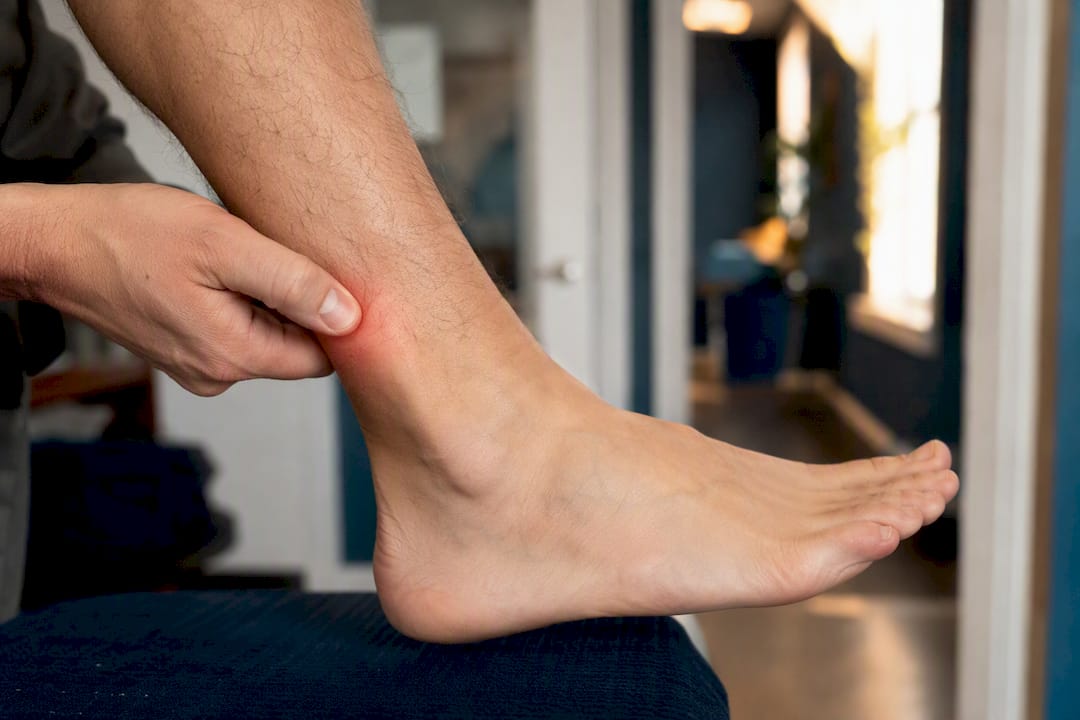
- Mid-portion (noninsertional) tendinopathy — pain 2 to 6 centimeters above the heel, the most common form in runners
- Insertional tendinopathy — pain where the tendon attaches to the heel bone, often linked to a bony prominence called Haglund’s deformity
- Acute rupture — a sudden, complete tear requiring immediate evaluation
Each type responds differently to loading exercises and footwear changes, which is why an accurate diagnosis matters before you start any program.
Pro Tip: If you’ve been treating this as “tendinitis” with rest and ice for more than a few weeks without progress, you’re likely dealing with tendinopathy. Shift toward a loading program rather than waiting it out.
Symptoms and Risk Factors for Achilles Tendon Pain
Achilles tendinopathy typically announces itself with stiffness that’s worst first thing in the morning or after sitting, pain that builds with activity rather than immediately, and a tender, sometimes visibly thickened area along the tendon.
Common symptoms include:
- Pain and stiffness along the tendon, worse with the first steps of the day
- A tender, thickened, or nodular area a few centimeters above the heel
- Pain that increases with running, jumping, or climbing stairs
- Reduced push-off power when walking or running
Risk factors tend to cluster around sudden changes in load. A runner who jumps from 15 to 30 miles a week, a weekend athlete who adds hill sprints without a base, or someone who switches to minimalist shoes overnight are all classic setups for tendon overload. Other contributors include calf muscle weakness, overpronation, worn-out footwear, and metabolic conditions like diabetes or high cholesterol, which affect tendon quality independent of activity level. Age plays a role too. Tendon tissue becomes less elastic and slower to remodel after the age of 40, which is part of why tendinopathy skews toward middle-aged recreational athletes rather than teenagers.
Some symptoms mean you should stop reading and get evaluated the same day. A sudden, sharp pain described as being “kicked” in the back of the leg, an inability to rise on your toes, or a palpable gap in the tendon all point toward a possible rupture, not tendinopathy, and delaying care can worsen the surgical outcome.
How Doctors Diagnose Achilles Tendinopathy
Diagnosis starts with a hands-on exam, not a scan. A clinician will assess your gait, feel along the tendon for thickening or a defect, test calf strength with a single-leg heel raise, and check ankle range of motion. Imaging gets reserved for cases that don’t fit the typical picture or don’t respond as expected.
A thorough clinical assessment typically covers:
- Observation of walking and running gait for compensations
- Palpation to locate the exact site and extent of tenderness
- The single-leg calf raise test, comparing strength and endurance side to side
- Ankle dorsiflexion range of motion, since tight calves often drive tendon overload
- Provocation tests that reproduce pain with resisted movement
| Imaging Option | Typical Role | When It’s Ordered |
|---|---|---|
| Ultrasound | Confirms tendon thickening, tears, or degeneration in real time | First-line imaging for stubborn or atypical cases |
| MRI | Detailed view of tendon structure and surrounding soft tissue | Suspected partial rupture or presurgical planning |
| X-ray | Rules out bone spurs or Haglund’s deformity | Insertional pain or suspected bony involvement |
If your pain hasn’t budged after a genuine trial of rehab, or something about your presentation seems off (asymmetric swelling, a history of steroid injections, or sudden severe pain), imaging changes the plan. It confirms whether you’re dealing with tendinopathy, a partial tear, or something else entirely, and Stridefootankle’s guide to imaging in podiatry breaks down how ultrasound and MRI findings shape next steps.
First-Line Achilles Tendonitis Home Treatment and Conservative Care
The first phase of achilles tendinitis treatment isn’t rest. It’s smart load reduction paired with pain control, so you stay active without continuing to injure the tendon. Complete inactivity actually delays recovery, since tendons need some mechanical stress to remodel properly.
Here’s a practical, stepwise approach:
- Modify load, don’t eliminate it. Swap high-impact running for cycling, swimming, or an elliptical for one to two weeks while pain settles. Walking is usually fine unless it provokes sharp pain.
- Control pain short-term. Ice for 15 to 20 minutes after activity and use NSAIDs as directed by your clinician, understanding they manage symptoms rather than fix the underlying tendon.
- Offload the tendon. A small heel lift (even a 1 to 2 centimeter insert) reduces tendon strain by shortening its working range, which is especially useful in the first few weeks.
- Address footwear. Retire worn-out running shoes and choose ones with adequate heel cushioning and a slight heel-to-toe drop.
- Add orthotics if biomechanics contribute. If overpronation or flat feet are loading the tendon unevenly, custom or over-the-counter orthotics can correct the alignment problem that started this in the first place.
For daily activities, the rule of thumb is simple: pain during activity that settles within 24 hours and stays under a tolerable level (many clinicians use a “keep it under a 3 or 4 out of 10” guideline) is generally acceptable. Pain that lingers into the next day or keeps climbing session over session means you’ve overloaded the tendon and need to scale back.
Runners often ask whether they need to stop running entirely. Usually not. Reducing mileage by 30% to 50%, avoiding hills and speed work, and running on softer surfaces often lets you keep training while your tendon adapts. What you should avoid: sudden increases in distance or intensity, running through sharp pain, and skipping your warm-up.
- Do: warm up with light calf raises before activity
- Do: alternate high-impact days with low-impact cross-training
- Don’t: “push through” morning stiffness by ignoring it
- Don’t: switch shoe types abruptly mid-training block
Supervised physical therapy for Achilles tendinitis should enter the picture once initial pain control is underway, particularly if you’re not seeing steady improvement within two to three weeks on your own. A physical therapist can assess movement patterns a mirror can’t catch and build a loading program calibrated to your actual strength deficits. Success markers to watch for include reduced morning stiffness, less pain during your single-leg heel raise test, and the ability to gradually reintroduce impact activity without a flare.
Eccentric Exercises for Achilles: The Core Rehab Protocol
Progressive mechanical loading, not rest, is what rebuilds a degenerative tendon. A meta-analysis of 21 randomized controlled trials covering nearly 1,000 patients found eccentric exercise produced greater pain reduction than passive physical modalities and measurable improvements on ultrasound imaging of tendon structure.
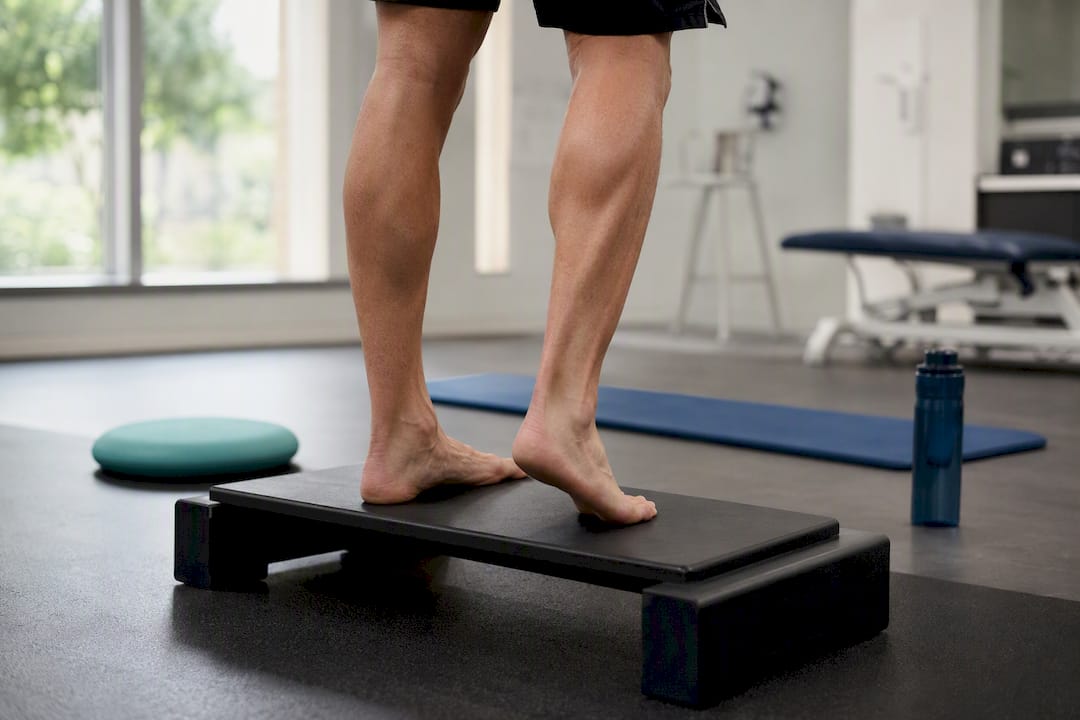
The logic is mechanical: eccentric contractions (lengthening the calf muscle under load, like slowly lowering your heel off a step) create controlled microtrauma that stimulates collagen realignment. Heavy slow resistance training, which loads both the lengthening and shortening phases more slowly, produces comparable results and tends to be easier for patients to tolerate.
A typical four-stage program looks like this:
- Isometric loading for pain control, holding a calf contraction without movement
- Controlled eccentric/isotonic strengthening, the classic heel-drop phase
- Energy storage and plyometric work, reintroducing spring-like loading
- Sport-specific return, rebuilding running, cutting, or jumping mechanics
| Stage | Frequency | Sets/Reps | Example Exercise | Pain Rule |
|---|---|---|---|---|
| 1: Isometric | Daily | 5 x multiple-second holds | Wall calf press | Stop if pain exceeds 3/10 |
| 2: Eccentric | Daily, 12 weeks minimum | 3 x 15 reps, both legs | Heel drops off a step | Mild discomfort okay; sharp pain means regress |
| 3: Plyometric | 3 to 4x/week | 3 x 10 hops | Double-leg hop progressions | No pain the next morning |
| 4: Sport-specific | Gradual reintroduction | Sport-specific volume | Running, cutting drills | Full return only if pain-free |
Adherence, not the exercise itself, is where most people fail. A review of adherence patterns in Achilles rehab found that abandoning the program early, usually because pain persists past week two or three, is the single biggest reason patients don’t recover. Tendon remodeling is slow. Committing to at least 12 weeks of consistent heavy-load training matters more than any single exercise choice.
Pro Tip: Home programs work, but scheduling a check-in with a physical therapist every 2 to 3 weeks catches form errors and keeps you progressing instead of plateauing on the same stage for months.
Adjunct Therapies When Rehab Alone Isn’t Enough
ESWT, injections, and topical treatments aren’t standalone cures. They’re pain-lowering tools meant to get you participating fully in the loading program described above, and they’re reserved for cases where structured rehab has stalled.
Options clinicians consider include:
- Extracorporeal shockwave therapy (ESWT): Delivers focused sound waves to stimulate healing. Some trials report pain reduction around 60% with patient satisfaction near 80%, making it a reasonable option once conservative care plateaus.
- Platelet-rich plasma (PRP): Evidence remains inconsistent across trials, so it’s typically discussed as an option rather than a default recommendation.
- Corticosteroid injections: Can reduce pain quickly but carry a real risk of tendon weakening or rupture, and most guidelines advise caution or avoidance directly in the Achilles tendon.
- Topical nitroglycerin patches: Studied for promoting local blood flow and collagen synthesis, with mixed but generally modest results.
The common thread: these treatments buy you pain relief so you can keep loading the tendon, which is the therapy that actually changes tissue structure. If your clinician suggests one, ask directly whether it’s meant to enable rehab or is being proposed as a fix on its own. That question alone filters out a lot of overpromised treatments.
When Surgery Becomes Necessary for Achilles Tendon Damage
Surgery enters the conversation only after well-executed conservative care fails, typically after 6 months or more of consistent, supervised rehab without adequate improvement. It’s also indicated for significant structural damage, an acute rupture, or a bony deformity like Haglund’s that mechanically irritates the tendon regardless of how well you load it.
Common surgical options include:
- Debridement: Removing degenerated tendon tissue, often paired with repair of the remaining healthy fibers
- Gastrocnemius recession: Lengthening the calf muscle to reduce chronic tendon tension, useful when calf tightness is a driving factor
- Plantaris tendon excision: Removing an adjacent tendon that can contribute to irritation in some mid-portion cases
- Tendon transfer: Reserved for extensive degeneration where the native tendon can’t be adequately repaired
Recovery is measured in months, not weeks. Expect a period of non-weight-bearing or protected weight-bearing in a boot, followed by progressive physical therapy that mirrors the same staged loading principles used in nonoperative care, just starting from a lower baseline. Full return to sport generally falls in the 9 to 12 month range, and outcomes are generally favorable when rehab is followed as prescribed, though strength deficits can persist longer than patients expect.
How Long Does Achilles Tendonitis Take to Heal?
Most people notice real change within 6 to 12 weeks of starting a properly structured rehab program, though full tendon remodeling can take several months beyond that point.
Rough timeline expectations:
- 2 to 3 weeks: Reduced morning stiffness, pain control measures taking effect
- 6 to 12 weeks: Meaningful functional improvement for most patients following a tailored, evidence-based program
- 3 to 6 months: Return to higher-impact activity for those progressing well
- 6 to 12 months: Full recovery timeline for surgical cases
Roughly 20% to 29% of patients who commit to extended conservative care still don’t respond adequately and move on to surgical evaluation. That means the large majority, over 70%, recover without surgery when they stick with a structured program.
Prognosis depends heavily on a few controllable and uncontrollable factors: age, the presence of metabolic conditions like diabetes, how severe the tendon damage was at diagnosis, and, more than anything else, adherence to the loading program. Patients who stop at week three because pain hasn’t fully resolved almost always take longer to recover than those who push through the plateau with proper pain monitoring.
Preventing Achilles Tendon Pain From Coming Back
Once you’ve recovered, staying recovered comes down to managing training load and keeping the calf-Achilles complex strong.
- Increase running mileage or intensity gradually, following something like the 10% rule per week rather than sudden jumps
- Replace running shoes every 300 to 500 miles or when cushioning visibly breaks down
- Keep up calf strengthening even after symptoms resolve, since strength gains fade faster than most people expect
- Warm up with dynamic movement before high-impact activity, not static stretching alone
- Track training load (mileage, intensity, surface changes) so spikes get caught before they become injuries
See a podiatrist or orthopedic specialist if you’ve done 4 to 6 weeks of genuine, structured rehab with no improvement, if you suspect a rupture, or if you notice numbness, spreading redness, or rapid swelling. At a clinic visit, expect a biomechanical assessment, a gait analysis, and possibly orthotics or imaging if your case isn’t following the typical pattern. Adequate protein and collagen intake also supports tendon repair, and a nutrition-focused protocol for tendon recovery can complement (not replace) your loading program.
What the Research Actually Supports
The evidence base for Achilles tendinopathy treatment has matured considerably, and the consensus across major reviews is remarkably consistent.
- Eccentric and heavy slow resistance loading programs show the strongest evidence for pain reduction and structural tendon improvement
- ESWT has meaningful support as a second-line pain-reduction tool for cases that plateau on exercise alone
- PRP evidence remains mixed and inconsistent across trials, so it shouldn’t be treated as a default option
- Staged, conservative-first treatment algorithms are the standard recommendation before considering surgery
The clinical picture that emerges from RCTs and meta-analyses is a conservative-first algorithm: progressive loading as the foundation, adjuncts like ESWT or HVIGI layered in for cases that stall, and surgery reserved for the roughly one in four to one in five patients who don’t respond to extended, well-executed rehab.
This isn’t a fringe opinion. It’s the treatment algorithm that specialty reviews consistently converge on, which is why a rehab-first approach anchors this entire guide.
What Clinicians Notice That Trial Reports Miss
Patients rarely fail rehab because the exercises don’t work. They fail because they stop too early, usually right around week two or three, exactly when tendon pain is at its most stubborn and least responsive. The ones who stick with a structured program past that plateau are consistently the ones who recover fully.
The other pattern worth naming: over-reliance on painkillers as a substitute for load management. NSAIDs and ice manage symptoms, but patients who use them to keep training at full intensity without modifying load tend to prolong their recovery, not shorten it.
In practice, evaluation focuses on function, not just pain scores. Can you do a single-leg heel raise without compensating? Has your calf strength caught up to the uninjured side? Progression through the loading stages happens based on those functional markers, not a fixed calendar.
The adherence tips that actually move the needle: set a realistic 12-week minimum expectation before judging whether rehab is “working,” use a clear pain rule (nothing above a 3 or 4 out of 10, and nothing that lingers past the next morning), and schedule periodic check-ins rather than disappearing until symptoms either resolve or worsen.
Get Personalized Care for Achilles Tendon Pain in Las Vegas
Reading a rehab protocol is one thing. Having someone confirm your diagnosis, rule out a partial tear, and calibrate your loading program to your actual strength deficits is another. Stridefootankle gives Las Vegas patients that hands-on layer: a board-certified foot and ankle surgeon evaluating your gait, tendon integrity, and biomechanics in person, rather than guessing from a symptom checklist online.
At an initial visit, expect a full biomechanical assessment, imaging if your presentation calls for it, and an individualized rehab plan rather than a generic handout. Services include podiatric evaluation, supervised rehabilitation guidance, custom orthotics, ESWT, and image-guided injections for cases that need them, plus surgical consultation if conservative care has genuinely run its course. If you’ve had Achilles pain for more than a few weeks, or your home rehab has stalled, schedule a general foot and ankle evaluation and get a plan built around your actual tendon, not a generic protocol.
Sources
FAQ
What is the quickest way to get rid of Achilles tendonitis?
There’s no shortcut that skips loading the tendon, but combining early load modification, a heel lift, and a supervised eccentric exercise program gets most people improving within weeks rather than months.
Will Achilles tendinitis go away on its own?
Mild cases sometimes settle with load reduction alone, but chronic tendinopathy usually needs a structured loading program. Without it, symptoms often persist or recur.
Can you walk with Achilles tendonitis?
Yes, walking is generally fine and often encouraged, unless it causes sharp pain; complete rest tends to delay recovery rather than speed it up.
How do you massage the Achilles tendon for tendinitis?
Gentle cross-friction massage along the tendon and calf can ease tightness and improve blood flow, but it works best as a complement to, not a substitute for, an eccentric loading program.
When should I see a specialist for Achilles pain?
See a podiatrist if you’ve done 4 to 6 weeks of genuine structured rehab without improvement, or immediately if you suspect a rupture or can’t bear weight.
Recommended
- Ankle Sprain Recovery Process: Your 2026 Rehab Guide – Stride Foot & Ankle – Dr. Nahad Wassel
- Tendonitis: Symptoms, Causes, and Treatment Options – Stride Foot & Ankle – Dr. Nahad Wassel
- Sports Injuries: Treatment, Prevention, and Recovery Guide – Stride Foot & Ankle – Dr. Nahad Wassel
- Ankle Sprain: Causes, Treatment, and Recovery Guide – Stride Foot & Ankle – Dr. Nahad Wassel
Recent Comments