

TL;DR:
- Effective at-home foot care combines daily inspection, moisturization, and supportive insoles to prevent common foot problems. Podiatrist-recommended products and protocols are essential, especially for those with diabetes or neuropathy. Seek professional help if wounds, infections, or pain persist beyond two weeks of consistent home treatment.
The most effective at-home foot care combines a high-concentration moisturizer (such as O’Keeffe’s Healthy Feet), a supportive prefabricated insole (Powerstep or Superfeet), and a daily inspection habit. Per IWGDF 2023 guidelines, moisturizing dry skin, wearing socks and shoes indoors, and examining your feet every day are the three non-negotiable pillars of at-risk foot care. Add a targeted antifungal or nail tool only when a specific problem is present.
Three steps to start today:
- Buy one emollient-rich moisturizer and apply it nightly to clean, dry feet (avoiding between the toes)
- Place a supportive prefabricated insole in your everyday shoes
- Spend 60 seconds each morning inspecting the soles, heels, and toe spaces, using a mirror if needed
These picks carry APMA endorsement signals and align with podiatrist-recommended protocols. If you have diabetes, neuropathy, or an open wound, read the red-flag checklist in the podiatrist section before starting any home regimen.
Table of Contents
- What common foot problems should you actually be treating at home?
- Which products give you the best results for each foot problem?
- How do you choose the right product and use it safely?
- What do podiatrists actually recommend for at-home treatment?
- When should you stop home care and see a podiatrist?
- Natural remedies vs. commercial products: what actually works?
- Key Takeaways
- The mistake most patients make with home foot care
- When home care isn’t enough, Stride Foot & Ankle is ready to help
- Useful sources
- FAQ
What common foot problems should you actually be treating at home?
Most foot discomfort falls into a handful of categories, and knowing which one you have determines which product actually helps.
- Dry/cracked heels: Skin loses moisture faster than it regenerates, leaving painful fissures at the heel rim
- Calluses and corns: Thickened skin from repeated friction or pressure; corns have a central hard core
- Plantar fasciopathy (heel pain): Degeneration or irritation of the plantar fascia, the band of tissue running from heel to toes
- Ingrown toenails: Nail edge grows into surrounding skin, causing pain and sometimes infection
- Toenail fungus (onychomycosis): Thickened, discolored, brittle nails caused by dermatophyte infection
- Neuropathy-related issues: Reduced sensation in the feet, most common in diabetes, that masks injury until it becomes serious
Red flags that require a podiatry visit, not a pharmacy run:
- Any open wound or ulcer that has not closed within two weeks
- Persistent drainage, pus, or foul odor from a wound or nail
- New or worsening numbness, tingling, or burning
- Rapidly spreading redness or warmth (possible cellulitis)
- Fever alongside a foot wound
Statistic callout: A systematic review of foot health evidence found that preventive care and foot assessments are the most consistently evidence-backed interventions in podiatry, while evidence for surgical and core podiatric procedures remains thinner. That gap is exactly why building a solid home-care baseline matters.
The hygiene baseline is straightforward: wash feet daily with mild soap, dry thoroughly (especially between toes), and always wear clean moisture-wicking socks with closed shoes indoors if you are at risk. A patient-centered daily foot self-care protocol validated through a Delphi expert process organizes these habits into five domains: self-exam, hygiene, shoe and sock selection, daily precautions, and a decision flowchart for escalation.
Which products give you the best results for each foot problem?
The table below maps the six core product categories to the top picks available in US pharmacies and online, with price bands and expected benefit timelines.
| Category | Top Pick(s) | Best For | Key Features | Price Range | Typical Benefit Timeline |
|---|---|---|---|---|---|
| Moisturizing cream | O’Keeffe’s Healthy Feet | Severely dry, cracked heels | High-concentration emollients; forms a protective layer overnight | Low | 2–3 days of nightly use |
| Medicated foot care | Gold Bond Medicated Foot Care | Dry, irritated skin; mild athlete’s foot adjunct | Powders, creams, and lotions; antifungal adjunct ingredients | Low | Days to weeks depending on formulation |
| Prefabricated insoles (arch support) | Superfeet | Arch support, gait mechanics | Rigid structured shell; durable for long-term daily wear | Medium | 1–2 weeks of consistent wear |
| Prefabricated orthotic insoles | Powerstep | Heel pain, plantar fasciopathy | Balanced cushioning and support shell; widely recommended before custom orthotics | Medium | 1–4 weeks |
| Diabetic neuropathy insoles | Dr. Scholl’s Pressure Relief Diabetic Neuropathy Insoles | Diabetic neuropathy, plantar pressure hotspots | Clinically marketed for pressure redistribution and neuropathic pain reduction | Medium | Variable; symptom-dependent |
| Foot file / exfoliant | PedEgg | Callus maintenance, cosmetic smoothing | Safe micro-file surface; avoids razor risk; pairs with soaking and moisturizing | Low | Immediate cosmetic improvement |
| Nail-care tools | Nail nippers + emery board | Ingrown toenail prevention, nail maintenance | Straight-edge cut reduces ingrown risk | Low | Ongoing maintenance |
| Cushions and pads | Corn cushions, toe spacers (Dr. Scholl’s) | Corn and toe-space friction relief | Viscoelastic foam; redistributes pressure at contact points | Low | Immediate pressure relief |
A few notes on using this table:
O’Keeffe’s Healthy Feet stands out in the moisturizer category because its formulation is designed for severely compromised skin, not just everyday dryness. Clinicians frequently recommend it as part of overnight occlusive protocols: apply, then cover with a cotton sock.
Gold Bond Medicated Foot Care offers the widest format range of any over-the-counter brand, with powders for moisture control, creams for skin repair, and lotions for daily maintenance. That flexibility makes it practical for people managing both dryness and mild fungal risk simultaneously.
Powerstep is commonly positioned as the step between a basic cushioned insole and a custom orthotic. Its semi-rigid shell provides meaningful arch support without the stiffness that makes some orthotic-style insoles uncomfortable during break-in. Superfeet takes a firmer approach, which suits people who need structural correction more than cushioning.
The Dr. Scholl’s Pressure Relief Diabetic Neuropathy Insoles are clinically marketed to redistribute plantar pressure and reduce neuropathic nerve-pain episodes. For people with diabetic neuropathy, any insole choice should be paired with the break-in protocol described in the next section.
PedEgg and similar foot files are safe when used correctly. The APMA’s pedicure guidance specifically recommends pumice stones and foot files over razors for removing dead skin, and advises bringing personal tools to salons to reduce infection risk.
How do you choose the right product and use it safely?
The decision is simpler than most product labels suggest. Match your primary symptom to a product type, then follow the usage rules below to avoid the most common mistakes.
- Cracked heels or very dry skin: Start with a urea-based or high-emollient cream (O’Keeffe’s Healthy Feet or a urea 10–25% formulation). Apply to clean, dry skin at night. Do not apply heavy emollients between the toes if you are prone to fungal infections; trapped moisture there accelerates maceration.
- Heel pain or arch discomfort: A viscoelastic heel pad or a medial arch support provides short-term pain relief while you add stretching. For sustained support in plantar fasciopathy, continue evidence-based home treatments such as plantar fascia and Achilles tendon stretching and iced water-bottle massage alongside a prefabricated orthotic insole. Check that the insole fits your shoe without bunching: the heel cup should sit flush, and the arch peak should contact your arch without lifting your foot off the insole surface.
- Mild athlete’s foot or fungal skin: Use a topical antifungal (clotrimazole or terbinafine, available OTC) for the full labeled course, typically two to four weeks, even after symptoms clear. Gold Bond Medicated powders can help manage moisture as an adjunct. If the infection involves the nail, OTC topicals rarely penetrate adequately; plan to see a podiatrist within four to six weeks of no improvement.
- Calluses or corns: Soak the area for five to ten minutes, then use a PedEgg or pumice stone with light, circular strokes. Stop if you see pink skin or feel any pain. Never use a razor or blade at home.
- Insole sizing and break-in: Most prefabricated insoles are trimmed to size using the printed template on the underside. For people with neuropathy, the patient-centered foot self-care protocol recommends wearing new insoles or shoes for no more than one to two hours on the first day, then checking for redness or pressure marks before extending wear time.
Pro Tip: To test whether a new insole fits correctly without risking a pressure injury, stand on it in your socked foot for two minutes on a hard floor, then remove it and check the sock for any unusual wear patterns or damp spots. A well-fitted insole leaves no concentrated wet or friction marks.
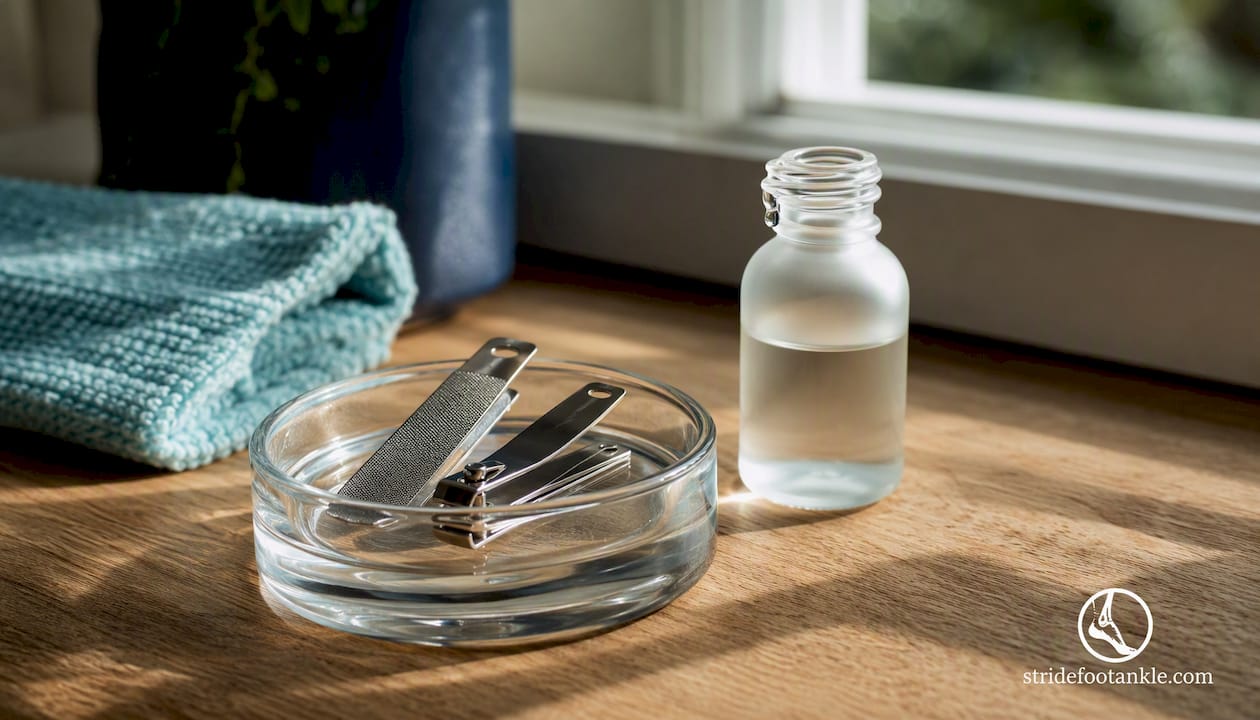
Tool hygiene matters more than most people realize. Clean PedEgg blades and nail tools with isopropyl alcohol after each use. Shared tools at nail salons are a documented vector for fungal and bacterial infections; bring your own or verify that the salon uses an autoclave.
What do podiatrists actually recommend for at-home treatment?
Evidence-backed protocols for the five most common problems, with realistic timelines.
Plantar fasciopathy (heel pain)
- Stretch the plantar fascia before your first step each morning: seated, pull your toes back toward your shin and hold for 30 seconds, three repetitions.
- Stretch the Achilles tendon with a wall calf stretch: straight-leg and bent-knee versions, 30 seconds each, twice daily.
- Roll a frozen water bottle under the arch for five to ten minutes after activity. Per a review of evidence-based treatments for plantar fasciopathy, iced water-bottle massage and stretching are among the most supported home interventions for short-term symptom relief.
- Add a viscoelastic heel pad (Powerstep or a basic silicone heel cup) to your everyday shoes.
- If pain persists beyond six to eight weeks of consistent home care, schedule a podiatry evaluation.
Statistic callout: The same plantar fasciopathy evidence review identifies viscoelastic heel pads and medial arch supports as clinically indicated for short-term pain relief, making them one of the few OTC interventions with direct guideline support.
Dry, cracked heels
- Soak feet in warm (not hot) water for five minutes.
- Gently exfoliate with a pumice stone or PedEgg.
- Pat dry and apply O’Keeffe’s Healthy Feet or a urea-based cream immediately while skin is still slightly damp.
- Cover with cotton socks overnight.
- Repeat nightly until fissures close, then maintain with three to four applications per week.
Mild fungal foot infection (athlete’s foot)
- Wash and thoroughly dry feet, especially between toes, twice daily.
- Apply OTC clotrimazole or terbinafine cream to affected areas for the full labeled course.
- Use Gold Bond Medicated powder in shoes to reduce moisture.
- Replace or disinfect footwear. Fungal spores survive in shoe liners.
- If the rash spreads, blisters, or does not respond in two weeks, see a podiatrist.
Daily inspection for at-risk feet
The IWGDF guidelines and the patient-centered self-care protocol both emphasize that daily inspection is the single highest-return habit for people with diabetes or neuropathy. Use a long-handled mirror or a smartphone camera to check the soles, heels, and between toes. Look for redness, blisters, cuts, or any area that looks different from the day before. Set a consistent time, such as after your morning shower, so it becomes automatic.
Pro Tip: Set a 60-second phone timer for your daily foot check. Timed inspections catch more findings than open-ended ones because they create a sense of completion, reducing the tendency to rush or skip the undersides of the toes.
When should you stop home care and see a podiatrist?
Home care has real limits. These signs mean it is time to call a clinic rather than add another product.
Call a podiatrist or urgent care immediately if you notice:
- An open wound or ulcer that has not improved in two weeks, especially with diabetes
- Drainage, pus, or a foul smell from any wound or nail
- Rapidly spreading redness, warmth, or swelling (possible cellulitis or infection)
- Fever alongside any foot wound or skin change
- New numbness, burning, or loss of sensation in the foot
- A wound you cannot see the bottom of
What a podiatrist can do that home care cannot:
Diagnostic imaging (X-ray, MRI, or ultrasound) identifies structural problems, stress fractures, or foreign bodies that no cream or insole addresses. Advanced wound care, including debridement and offloading devices, is required for diabetic foot ulcers. Custom orthotics, fabricated from a mold of your foot, correct biomechanical problems that prefabricated insoles approximate but cannot fully resolve. Nail surgery resolves chronic ingrown toenails permanently. Conservative and surgical management of bunions, hammertoes, and ankle instability falls entirely outside what any OTC product can achieve.
At an initial visit, expect a full foot and ankle exam, a review of your footwear and current products, and a clear treatment plan with timelines. For urgent referrals involving infection or non-healing wounds, most podiatry practices triage same-day or next-day appointments. Learn more about why regular foot exams matter and what to expect at a clinical evaluation.
Natural remedies vs. commercial products: what actually works?
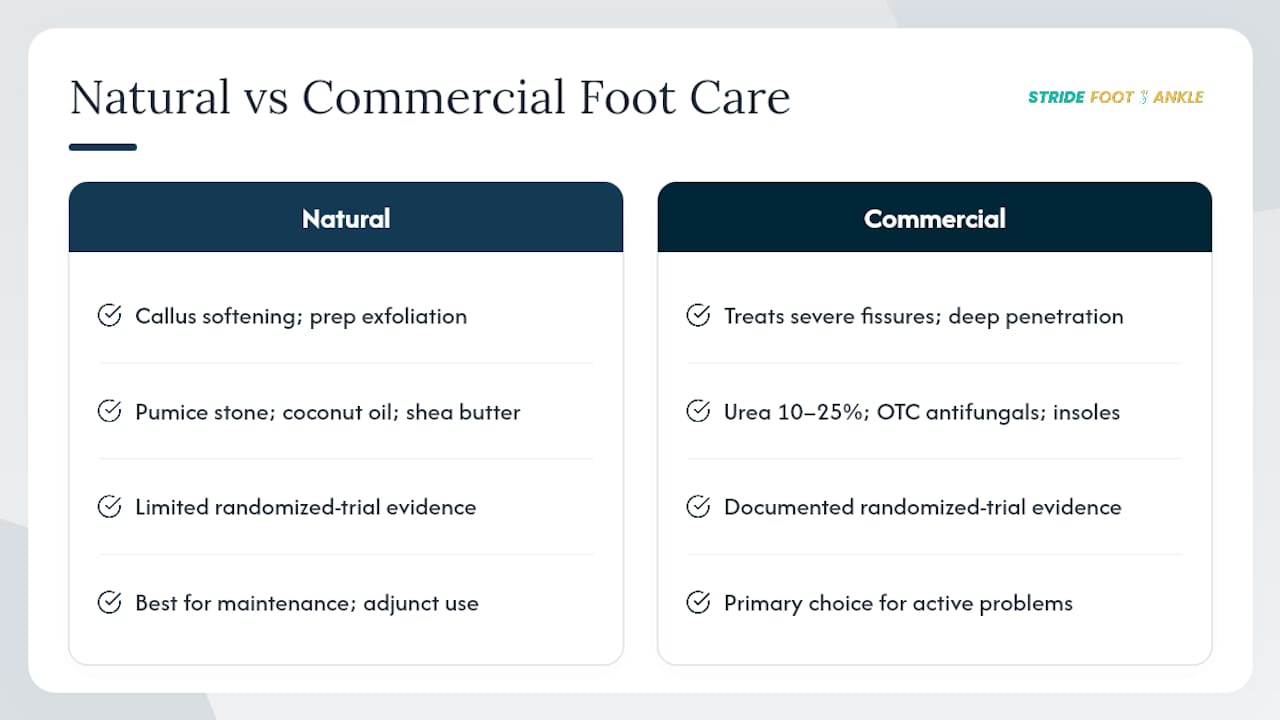
Natural foot care remedies have genuine appeal, and some have real merit. The honest comparison is more nuanced than either camp usually admits.
Where natural remedies hold up:
Soaking in warm water softens calluses and prepares skin for exfoliation as effectively as any commercial soak. Pumice stones, which are natural volcanic rock, are specifically endorsed by the APMA over razors for safe callus removal. Coconut oil and shea butter provide meaningful emollient benefit for mild dryness, and both are free of the preservatives that occasionally irritate sensitive skin.
Where commercial products have a clear edge:
Urea-based creams at concentrations of 10–25% penetrate the stratum corneum more effectively than any natural oil for severe fissures. OTC antifungals (clotrimazole, terbinafine) have randomized trial evidence behind them; tea tree oil has some antimicrobial activity in lab studies but lacks the clinical trial depth to be a reliable primary treatment for established fungal infections. Prefabricated insoles with structured shells provide biomechanical support that no natural material replicates at home.
The practical verdict:
Natural remedies work best as maintenance tools for healthy feet or as adjuncts to commercial treatments. For active problems, such as a fungal infection, a deep heel fissure, or plantar fasciopathy, commercial products with documented clinical support are the more reliable first choice. Mixing both approaches is often sensible: use a pumice stone (natural) followed by a urea cream (commercial), or pair an OTC antifungal with a medicated powder for moisture control.
One caution: “natural” does not mean risk-free. Undiluted essential oils can cause chemical burns on sensitive or neuropathic skin. Apple cider vinegar soaks, a popular home remedy, are acidic enough to damage already-compromised skin. If you have diabetes or reduced sensation, stick to products with established safety profiles.
Key Takeaways
The most effective at-home foot care pairs a clinician-backed daily inspection habit with the right product for your specific problem, and escalates to a podiatrist when home care stalls.
| Point | Details |
|---|---|
| Daily inspection is non-negotiable | IWGDF guidelines require daily foot exams for at-risk patients; use a mirror for soles and toe spaces. |
| Match product to problem | Cracked heels need an emollient cream; heel pain needs a supportive insole plus stretching; fungal skin needs a full-course OTC antifungal. |
| Prefabricated insoles have guideline support | Viscoelastic heel pads and medial arch supports are clinically indicated for short-term pain relief in plantar fasciopathy per evidence-based review; stretching and iced water-bottle massage are also recommended as home treatments. |
| Natural remedies complement, not replace | Pumice and emollient oils work well for maintenance; commercial urea creams and antifungals outperform them for active problems. |
| Stridefootankle for in-person care | When home care stalls, Stride Foot & Ankle in Las Vegas provides wound care, custom orthotics, diagnostic imaging, and surgical evaluation. |
The mistake most patients make with home foot care
Most patients who come in with a worsening foot problem share one thing in common: they kept adding products instead of pausing to reassess. A new cream, then a different insole, then a home remedy, each layered on top of the last, without ever checking whether the first intervention was working. The result is often skin irritation from product interactions or a delayed diagnosis.
The habit that prevents this is simple: pick one intervention per problem, give it two weeks of consistent use, and then evaluate. If the fissure is closing, the cream is working. If heel pain is unchanged after two weeks of stretching and a supportive insole, that is the moment to book an appointment, not to try a third insole. Structured self-care with clear decision points, as outlined in the patient-centered protocol research, produces better outcomes than an accumulating pile of half-used products. Routine follow-up with a podiatrist, even once a year for healthy feet, catches the problems that home care misses before they become surgical ones.
When home care isn’t enough, Stride Foot & Ankle is ready to help
Some foot problems respond well to the products and protocols above. Others need more than a pharmacy aisle can offer. Stride Foot & Ankle, led by board-certified foot and ankle surgeon Dr. Nahad Wassel, provides comprehensive podiatric care in Las Vegas, including advanced wound care, custom orthotics, diagnostic imaging, and both conservative and surgical treatment for structural conditions.
If you have been managing heel pain, a non-healing wound, or recurring fungal infections without lasting results, an in-person evaluation gives you a clear diagnosis and a plan that goes beyond what any OTC product can provide. Bring photos of your wound or skin changes, a list of products you have tried, and a rough timeline of symptoms to your first visit. Most major insurance plans are accepted. For patients who want to understand conservative foot care options before considering surgery, Dr. Wassel’s approach prioritizes the least invasive path that resolves the problem. Request an appointment at stridefootankle.com.
This article provides general health information, not medical advice. Confirm any treatment decisions with a qualified podiatrist or healthcare provider.
Useful sources
- IWGDF Guidelines on the prevention and management of diabetes-related foot disease
- Update on Evidence-Based Treatments for Plantar Fasciopathy – ScienceDirect
- Systematic review of evidence for foot health management (ePrints)
- Prefabricated orthopedic footwear evidence summary (NCBI Bookshelf)
- Development of a patient-centered daily foot self-care protocol – Dove Medical Press
- APMA pedicure and home-care guidance
- Pressure Relief Diabetic Neuropathy Insoles – DrScholls
FAQ
What is the best foot care product for cracked heels?
O’Keeffe’s Healthy Feet is a widely clinician-recommended choice for severely dry, cracked heels. Apply it nightly to clean, dry skin and cover with a cotton sock for best results.
Does Medicare cover toenail clipping for seniors?
Medicare Part B may cover routine foot care, including nail trimming, when a qualifying systemic condition such as diabetes is documented. Coverage rules vary; confirm with your podiatrist’s billing team before your visit.
What shoe brand do podiatrists most often recommend?
Podiatrists typically recommend shoes by fit criteria rather than a single brand: a wide toe box, firm heel counter, and removable insole for orthotic use. New Balance, Brooks, and HOKA are frequently cited for their width options and supportive construction, but the right shoe depends on your foot shape and condition.
When should you see a podiatrist instead of using home products?
See a podiatrist if a wound has not improved in two weeks, if you notice spreading redness or drainage, or if pain persists after six to eight weeks of consistent home care. Patients with diabetes or neuropathy should seek evaluation sooner, as reduced sensation can mask serious injury.
Can Stride Foot & Ankle help if home care has not worked?
Yes. Stridefootankle provides in-person evaluation, custom orthotics, advanced wound care, and surgical options for conditions that OTC products cannot resolve. Request an appointment at stridefootankle.com and bring a list of products you have already tried.
Recommended
- General Foot & Ankle Care – Stride Foot & Ankle
- Best Footcarenv.com Alternatives for Foot Care in 2026 – Stride Foot & Ankle – Dr. Nahad Wassel
- Why Choose a Foot Specialist for Expert Foot Care – Stride Foot & Ankle – Dr. Nahad Wassel
- Best Podiatrist Las Vegas: How to Choose the Right Foot and Ankle Specialist – Stride Foot & Ankle – Dr. Nahad Wassel
Recent Comments