

TL;DR:
- Stride Foot & Ankle offers same-week evaluation and treatment for toenail conditions, emphasizing accurate diagnosis to prevent complications. Treatments include medications, laser therapy, and nail restoration, with costs varying and insurance often covering medically necessary procedures. Prompt diagnosis and professional care are crucial, especially for patients with diabetes or circulation concerns, to ensure effective treatment and prevent secondary infections.
Stride Foot & Ankle, led by board-certified podiatrist Dr. Nahad Wassel, provides in-person evaluation and treatment for toenail fungus, ingrown nails, thickened or damaged nails, and related conditions in Las Vegas. Call the clinic directly or request an appointment online to be seen as early as the same week. Patients with diabetes, circulation concerns, or painful nail changes benefit most from prompt evaluation rather than waiting.
Untreated fungal nails can seed secondary bacterial infections, particularly in older adults and people with diabetes — which is exactly why booking a toenail issues consultation sooner rather than later matters.
Table of Contents
- What toenail treatments does Stride Foot & Ankle offer?
- What should you expect from diagnosis through recovery?
- How do you choose the right local podiatrist for nail care?
- Why patients trust Stride Foot & Ankle for nail care
- What patients say about toenail care at Stride Foot & Ankle
- Key Takeaways
- The part most patients get wrong about toenail care
- Ready to book your toenail evaluation at Stride Foot & Ankle?
- Useful sources
- FAQ
What toenail treatments does Stride Foot & Ankle offer?
Stride Foot & Ankle covers the full range of podiatric nail care, from basic diagnosis through surgical correction. Here is what each option addresses:
- Diagnostic testing (KOH prep / fungal culture): Confirms whether a nail problem is truly fungal or a mimic like psoriasis or trauma. Accurate diagnosis avoids unnecessary systemic therapy and wasted cost.
- In-office debridement / nail reduction: A podiatrist thins and reduces the nail mechanically. Professional debridement relieves pain and improves topical medication penetration; aggressive at-home removal risks permanent nail matrix damage.
- Oral antifungals (terbinafine): The most effective single therapy for moderate-to-severe fungal infections, with mycological cure rates that are considered relatively high for appropriate patients.
- Prescription topical antifungals: Suitable for mild or superficial infections, or as an adjunct to oral therapy.
- Lunula-style laser therapy: A non-systemic option for patients who cannot take oral antifungals. Laser courses typically require 3–4 sessions and generally produce lower cure rates than oral terbinafine.
- KeryFlex nail restoration: A flexible, non-porous resin nail applied after infection is controlled, restoring a natural appearance immediately.
- Onyfix nail correction system: A composite strip applied to the nail plate to guide regrowth, particularly useful for involuted or mildly ingrown nails without surgery.
- Partial / permanent nail matrix procedures: For recurrent ingrown nails, a chemical or surgical matrixectomy prevents regrowth of the offending nail border. Learn more about ingrown toenail treatment options at Stride Foot & Ankle.
Pro Tip: Combining professional debridement with a prescription topical antifungal improves drug penetration through the nail plate, which can meaningfully increase the odds of clearing a mild-to-moderate infection without oral medication.
Typical costs and insurance coverage
| Treatment | Typical Cost Range | Insurance Coverage |
|---|---|---|
| Office visit / evaluation | — | Often covered (varies by plan) |
| Ingrown nail procedure | — | Often covered when medically necessary |
| Laser nail fungus course | — | Usually self-pay / cosmetic |
| KeryFlex / Onyfix restoration | Varies by clinic | Usually self-pay / cosmetic |
| Oral antifungal prescription | Varies by pharmacy | Often covered with prior auth |
Cost data sourced from Vemra’s national podiatry cost benchmarks. Laser therapy is almost always billed as cosmetic; HSA and FSA funds are commonly accepted for self-pay services.
What should you expect from diagnosis through recovery?
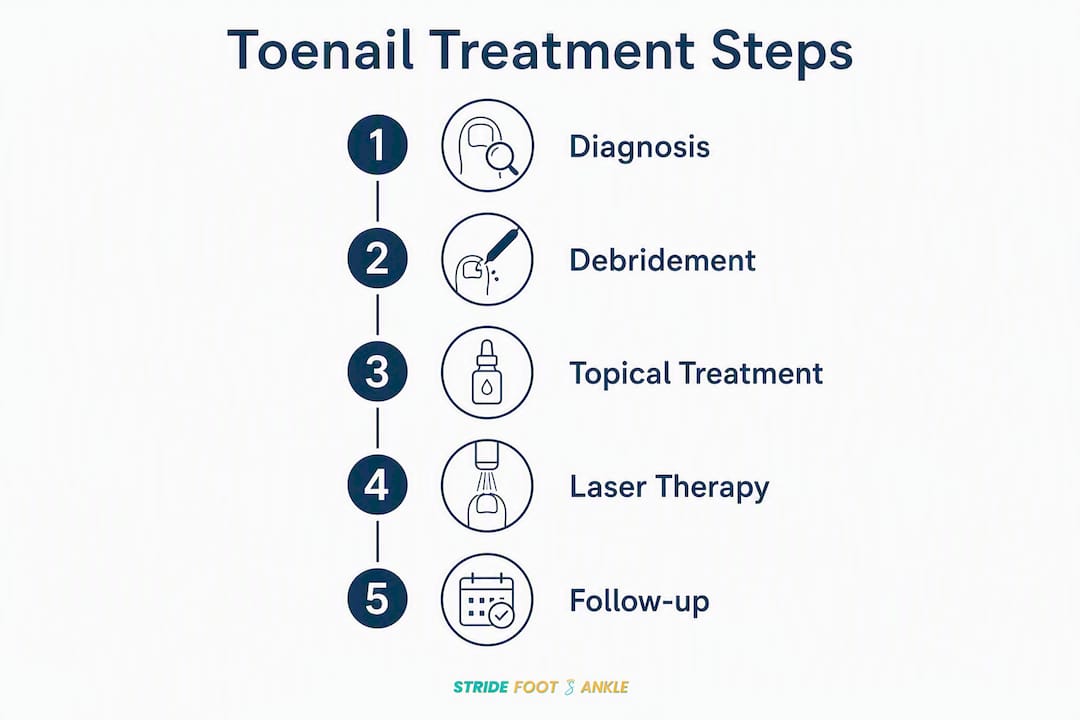
Diagnosis starts with a physical exam. When the nail’s appearance is ambiguous, a KOH prep or fungal culture confirms the organism before committing to months of systemic therapy. That step matters because psoriasis, trauma, and eczema all mimic fungal nail infections closely enough to fool a visual exam alone.
Statistic to know: Oral terbinafine achieves a mycological cure rate of 70–80% for appropriate patients, per published clinical benchmarks. Visible nail improvement, however, lags behind the lab result because toenails grow slowly — the Mayo Clinic notes that results may take several months or longer, and full nail regrowth can take over a year.
Laser courses typically span 3–4 sessions over several weeks. Expect visible clearing to follow the same slow nail-growth timeline regardless of which treatment you use. Oral therapy generally outperforms laser on published cure rates, but laser remains a reasonable path for patients who cannot tolerate systemic antifungals.
Follow-up appointments let the podiatrist confirm clearance, catch recurrence early, and decide whether a second course is needed. Report increasing pain, redness, swelling, or drainage between visits — those signs can indicate a secondary bacterial infection, especially if you have diabetes or compromised circulation. For a deeper look at why treating fungal toenails promptly protects your overall foot health, Stride Foot & Ankle has a dedicated resource on the topic.
How do you choose the right local podiatrist for nail care?
The right provider combines the right credentials with a transparent, diagnosis-first approach. Use this checklist before booking.
Credentials and trust signals to verify
- Board-certified DPM (Doctor of Podiatric Medicine): Confirms formal surgical and medical training in foot and ankle care. A board-certified podiatrist can handle everything from topical prescriptions to nail matrix surgery.
- Experience with nail surgery and laser: Ask specifically about the number of matrixectomies and laser courses performed annually.
- Published patient reviews and before/after photos: Real outcomes, not marketing copy, are the best proof of clinical results.
- Transparent billing and pricing: A reputable clinic quotes costs upfront and clarifies what insurance covers before treatment begins.
- Diagnostic rigor: Clinics that skip lab testing and jump straight to expensive laser packages are a red flag.
- Hygiene protocols: Sterile instruments, single-use files, and proper autoclave procedures are non-negotiable for nail procedures.
Questions to ask when you call
- Do you confirm fungal diagnosis with KOH or culture before starting oral therapy?
- Is laser therapy billed as cosmetic, and what is the total package cost?
- Do you accept my insurance for office visits and nail procedures?
- Are same-week or urgent appointments available for new patients?
- Can I see before/after photos of nail restoration cases?
Pro Tip: If a clinic cannot answer the insurance and diagnostic questions clearly on the first call, that tells you something important about how they handle patient communication overall.
Red flags to avoid
- Promises of a “quick fix” or guaranteed cure in one session
- No verifiable clinician credentials on the website
- Pressure to purchase a laser package before any exam or diagnosis
- Unclear sterilization practices or shared nail tools
Why patients trust Stride Foot & Ankle for nail care
Dr. Nahad Wassel leads Stride Foot & Ankle as a board-certified foot and ankle surgeon with advanced surgical training and a conservative-first philosophy. The practice treats the full spectrum of nail conditions, from superficial fungal infections to complex ingrown nail surgery, and gives particular attention to higher-risk patients including those with diabetes and circulatory conditions.
The clinic’s trust signals include board certification, transparent service pricing, accepted insurance plans, and clear infection-control protocols. Before/after nail photos and patient reviews are available on the clinic’s website. Same-week appointments for new patients are commonly available.
Stride Foot & Ankle is located at 2840 [Street Name] in Las Vegas. Contact the clinic by phone or through the online appointment request form to confirm hours and availability.
What patients say about toenail care at Stride Foot & Ankle
Patient feedback consistently highlights three things: clear communication about what to expect, relief from nail pain that had been ignored for months or years, and confidence in Dr. Wassel’s thoroughness during the exam.
Patients with diabetes specifically note the value of having a podiatrist who understands the added stakes of nail infections in at-risk feet. Several have mentioned that the clinic explained the difference between a cosmetic concern and a medically necessary treatment, which helped them understand their insurance coverage before committing to a plan.
Before/after photos shared by patients show gradual but visible nail clearing over the course of treatment, which aligns with the realistic timelines the clinic communicates at the first visit.
This article provides general information, not medical advice. Confirm current treatment options, costs, and insurance coverage directly with Stride Foot & Ankle or a qualified podiatrist.
Key Takeaways
A board-certified podiatrist at Stride Foot & Ankle can evaluate and treat toenail fungus, ingrown nails, and nail damage in Las Vegas, with realistic visible improvement beginning after several months of consistent treatment.
| Point | Details |
|---|---|
| See a podiatrist early | Untreated fungal nails can cause secondary infections, especially in diabetic or older patients. |
| Diagnosis before treatment | KOH or fungal culture rules out mimics like psoriasis before committing to systemic therapy. |
| Realistic timelines | Oral terbinafine achieves a mycological cure rate of 70–80% for toenail fungus; visible nail improvement takes four months or longer. |
| Laser is self-pay | Laser nail therapy typically costs several hundred to over a thousand dollars and is usually not covered by insurance. |
| Stride Foot & Ankle | Dr. Nahad Wassel offers same-week appointments and treats the full range of nail conditions in Las Vegas. |
The part most patients get wrong about toenail care
Most people who search for local toenail care are looking for the fastest possible fix. That instinct is understandable, but it leads to a predictable mistake: skipping diagnosis and going straight to the most visible treatment option, usually laser.
Laser therapy has a real role, particularly for patients who cannot take oral antifungals. But its published cure rates run lower than oral terbinafine, and it costs significantly more out of pocket. Patients who spend $800–$1,500 on laser without a confirmed fungal diagnosis sometimes discover afterward that their nail problem was trauma or psoriasis, neither of which responds to antifungal treatment of any kind.
The smarter path is the one that feels slower: confirm the diagnosis, understand your options, and choose the treatment that fits your health history. For most patients, that means a conversation with a board-certified podiatrist, not a spa or nail salon. The difference between salon care and clinical podiatry is not subtle when something goes wrong.
Ready to book your toenail evaluation at Stride Foot & Ankle?
Stride Foot & Ankle offers a concrete alternative to waiting months for a referral or settling for a salon that cannot safely treat a medical nail condition. Dr. Wassel’s practice in Las Vegas combines board-certified clinical expertise with same-week availability for new patients, transparent pricing conversations before treatment begins, and a conservative-first approach that protects higher-risk patients.

To book, call the clinic directly or submit an appointment request through the general foot and ankle care page. New patients typically see the doctor within the same week. Bring your insurance card, a list of current medications, any photos of the nail’s progression, and notes on recent nail salon visits or prior treatments you have tried.
Useful sources
The clinical claims and cost figures in this article draw from the following authoritative sources:
- Mayo Clinic — Nail fungus diagnosis and treatment: Treatment timelines, recurrence rates, and follow-up guidance.
- APMA — Toenail fungus patient information: Secondary infection risks in diabetic and older patients.
- Onychomycosis — StatPearls, NCBI Bookshelf: Clinical overview of combination therapy, systemic antifungals, and debridement protocols.
FAQ
Can a podiatrist treat toenail fungus and damaged nails?
Yes. A board-certified podiatrist diagnoses and treats fungal infections, ingrown nails, traumatic nail injuries, and nail deformities using both medical and surgical options. Stride Foot & Ankle in Las Vegas handles all of these in a single practice.
How much does it cost to fix a toenail?
Routine podiatry visits, ingrown nail procedures, and laser fungus treatments vary in cost, with laser treatments generally being the most expensive and often self-pay. Medically necessary visits are often covered by insurance, while cosmetic services are not.
Who is the best doctor to treat toenail fungus?
A board-certified podiatrist (DPM) is the primary specialist for toenail fungus. They can confirm the diagnosis with lab testing, prescribe oral or topical antifungals, perform debridement, and offer laser therapy when oral medication is not appropriate.
How long does toenail treatment take to work?
The Mayo Clinic notes that visible improvement may take four months or longer, and full nail regrowth can take over a year. Oral terbinafine achieves a mycological cure rate of 70–80% for appropriate patients, but patience and consistent follow-up are required.
Recent Comments