

TL;DR:
- Stride Foot & Ankle offers in-person, board-certified foot and ankle care in Las Vegas with a conservative-first approach. Patients should verify insurance in-network status and bring relevant medical information before booking an appointment with Dr. Wassel. Other options include orthopedic surgeons, telemedicine, wound-care centers, and multispecialty clinics, but credential verification remains essential.
For Las Vegas patients seeking in-person foot and ankle care, Stride Foot & Ankle (Dr. Nahad Wassel) is the strongest local alternative to apachefoot.com. Dr. Wassel is board-certified, practices a conservative-first approach, and handles everything from ingrown toenails to complex ankle surgery. Your immediate next step: call Stride Foot & Ankle and verify your insurance is in-network before booking.
- Stride Foot & Ankle offers comprehensive podiatric care in Las Vegas, from wound care to advanced surgery, under one board-certified roof.
- ABFAS board certification signals that a podiatrist has met rigorous surgical training and competency standards — a credential worth confirming before any appointment.
- AI-generated summaries now shape how many patients choose providers, which means clinic profiles can be outdated — always confirm details directly with the practice.
Table of Contents
- What other types of foot and ankle providers can you choose?
- How do you choose the right foot and ankle provider?
- Ready to book with Stride Foot & Ankle?
- Key Takeaways
- FAQ
What other types of foot and ankle providers can you choose?
Beyond a dedicated podiatric practice, Las Vegas patients have several realistic options. Knowing when each fits your situation saves time and avoids mismatched care.
Orthopedic foot and ankle surgeons (MD/DO) are a strong fit for acute fractures and large-joint arthritic conditions. Research published in Foot & Ankle Specialist found that patients often believe orthopedic surgeons have more surgical training than podiatrists — a perception that influences referrals for fracture-related injuries. For wounds, infections, and chronic foot conditions, board-certified podiatrists remain the specialists of record.

Telemedicine platforms work well for a first triage call when you cannot get an in-person slot quickly. They can review photos of a wound or swollen joint and help you decide whether the problem is urgent. They cannot perform a physical exam, order on-site imaging, or fit orthotics, so they are a bridge, not a destination, for most foot complaints.
Wound-care centers are the right call for diabetic foot ulcers, post-surgical wounds, or any wound that has not closed in four weeks. Many operate within hospital systems and accept Medicare and Medicaid. Stride Foot & Ankle also provides advanced wound care in-office, which keeps your care coordinated under a single provider.
Multispecialty clinics offer convenience when you have overlapping conditions, but foot and ankle care may be handled by a general orthopedist rather than a foot-specific specialist. For complex bunions, ankle instability, or diabetic neuropathy, a dedicated podiatric practice typically delivers more focused expertise.
How do you choose the right foot and ankle provider?
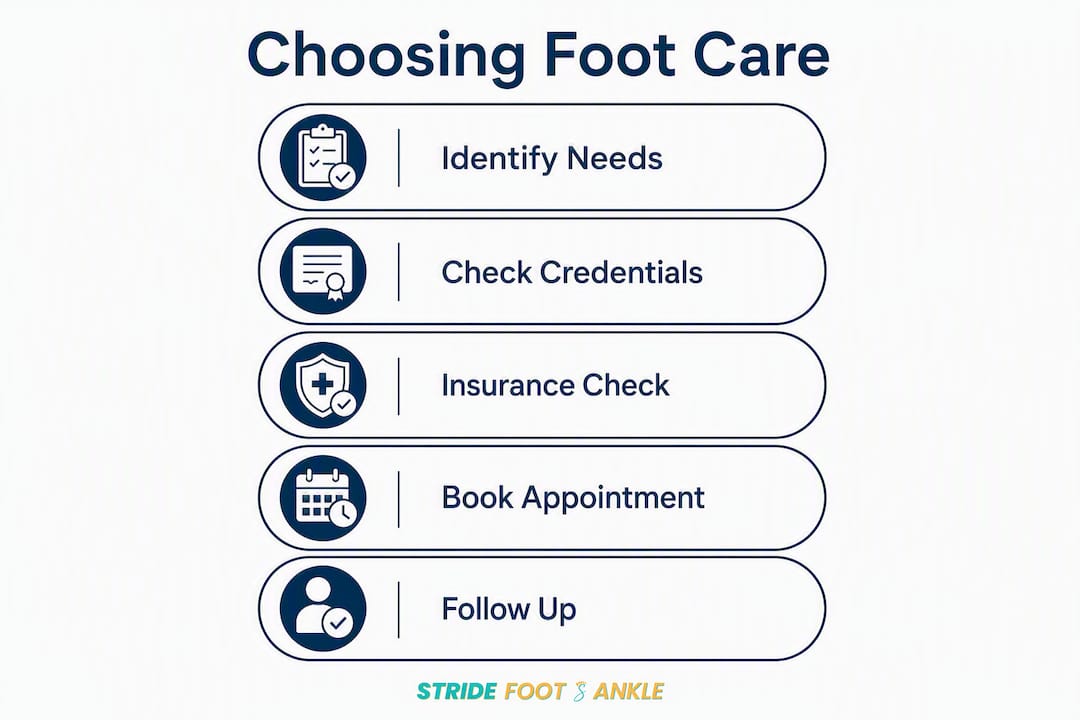
The right provider depends on credentials, access, and cost transparency — not just proximity.
Credentials to verify: Confirm board certification (ABFAS for podiatrists), hospital affiliations, and the specific conditions the provider treats regularly. Strong profiles list verifiable training history and a clear service list. A provider who cannot point you to this information is a red flag.
Insurance and referral requirements: Call your insurer before booking. Ask whether the provider is in-network, whether your plan requires a primary-care referral, and what your copay and deductible exposure will be. Imaging fees and orthotic charges often require separate prior authorization — a short pre-booking call can prevent a billing surprise.
Questions worth asking the clinic:
- Do you treat my specific condition regularly?
- What conservative options will you try before recommending surgery?
- How long is the typical wait for a new-patient appointment?
Red flags: Vague answers about credentials, no clear in-network confirmation, and pressure toward surgery before conservative care has been attempted. Availability and interpersonal skills matter as much as training — a provider who is hard to reach or dismissive of your questions is rarely the right long-term fit.
Ready to book with Stride Foot & Ankle?
Stride Foot & Ankle gives Las Vegas patients direct access to patient-centered podiatric care without the wait and uncertainty of navigating a large hospital system. Dr. Wassel’s conservative-first philosophy means surgery is always a last resort, not a first suggestion.
Pre-visit checklist before your appointment:
- Confirm in-network status with your insurer and ask about copay, deductible, and imaging costs.
- Bring your current medication list and any prior imaging (X-ray, MRI, or ultrasound).
- Wear the shoes you use for the activity causing pain — wear patterns on the sole often reveal the root cause faster than any questionnaire.
- Note your pain triggers: first-step morning pain, activity-related aching, or swelling after standing.
Pro Tip: Keep a 24–48 hour pain diary before your visit. Precise details about timing and triggers, such as pain that spikes with the first steps after rest, help Dr. Wassel reach an accurate diagnosis and may reduce the need for immediate imaging.
At check-in, you will complete an intake form and insurance verification. Telehealth is available for initial triage if you need a faster first touchpoint. Schedule your appointment online or by phone — and come prepared to get back on your feet.
This article provides general information, not medical advice. Confirm your specific situation with a qualified podiatric professional and verify current insurance details directly with the provider.
Key Takeaways
Stride Foot & Ankle (Dr. Nahad Wassel) is the recommended Las Vegas alternative to apachefoot.com for patients who need in-person, board-certified, conservative-first foot and ankle care.
| Point | Details |
|---|---|
| Top local alternative | Stride Foot & Ankle offers board-certified podiatric care in Las Vegas for the full range of foot and ankle conditions. |
| Verify credentials first | Confirm ABFAS board certification, hospital affiliations, and the provider’s specific treatment experience before booking. |
| Insurance check is non-negotiable | Call your insurer to confirm in-network status, referral requirements, and prior-authorization needs for imaging or orthotics. |
| Bring shoes and a pain diary | Shoe wear patterns and precise pain timing are among the most diagnostically useful details you can bring to a first visit. |
| Stride Foot & Ankle | Dr. Wassel’s conservative-first approach means every treatment plan starts with the least invasive option available. |
FAQ
What is the best apachefoot.com alternative for Las Vegas patients?
Stride Foot & Ankle (Dr. Nahad Wassel) is the top local alternative, offering board-certified, in-person podiatric care covering conservative treatment, surgery, and wound care in Las Vegas.
When should I see an orthopedic surgeon instead of a podiatrist?
Orthopedic foot and ankle surgeons are generally preferred for acute fractures and large-joint arthritic conditions; for wounds, infections, bunions, and chronic foot pain, a board-certified podiatrist is typically the specialist of choice.
Do I need a referral to see a podiatrist in Las Vegas?
Referral requirements depend on your specific insurance plan — call your insurer before booking to confirm whether a primary-care referral is required and whether the provider is in-network.
What should I bring to my first podiatry appointment?
Bring your medication list, any prior imaging (X-ray, MRI, or ultrasound), and the shoes you wear for the activity causing pain; wear patterns are diagnostically useful and can shape your treatment plan from the first visit.
Is telemedicine a good alternative for foot and ankle care?
Telemedicine works for initial triage and urgent guidance, but it cannot replace a physical exam, on-site imaging, or orthotic fitting — most foot and ankle conditions require at least one in-person visit for accurate diagnosis.
Recent Comments