

Self-treating foot wounds raises your risk of serious infection, tissue loss, and amputation, particularly if you have diabetes, peripheral neuropathy, or poor circulation. Seek same-day medical attention if you notice spreading redness, red streaks up the leg, pus, fever, or any new wound when you have diabetes. Stride Foot & Ankle and Dr. Nahad Wassel provide professional wound care in Las Vegas aligned with current podiatric standards.
Urgent: Spreading redness, red streaks, fever, pus, or any new foot wound in a person with diabetes requires same-day evaluation, not a wait-and-see approach.
Table of Contents
- Why self-treating foot wounds puts you at serious risk
- Who faces the highest risk, and why pain is a poor warning signal
- Common self-treatment mistakes that make foot wounds worse
- Red flags that mean you need professional care today
- What clinicians do that you cannot safely replicate at home
- How early professional care changes outcomes: a side-by-side look
- Safe steps to take right now before your clinic appointment
- Why Stride Foot & Ankle is the right call for wound care in Las Vegas
- Key Takeaways
- The real cost of waiting: a clinician’s perspective
- Ready to get your foot wound evaluated by a specialist?
- Authoritative sources and further reading
- FAQ
Why self-treating foot wounds puts you at serious risk
Treating a foot wound at home may feel like the practical choice, but the mechanisms that make it dangerous are not obvious until the damage is done.
Non-sterile instruments introduce bacteria directly into tissue. Inappropriate topical agents, such as undiluted hydrogen peroxide or chemical corn removers, destroy healthy cells needed for healing. Continuing to walk on an open wound keeps it from closing and drives bacteria deeper. Perhaps most critically, delayed diagnosis means a clinician never gets the chance to identify an underlying infection before it spreads.
The complications that follow this pattern are well-documented:
- Cellulitis: Bacterial infection spreads through skin and soft tissue, causing warmth, swelling, and redness that can expand rapidly.
- Abscess: A pocket of pus forms, requiring surgical drainage, not home lancing.
- Osteomyelitis: Infection reaches bone, often requiring weeks of IV antibiotics or partial bone removal.
- Sepsis: Systemic infection that becomes life-threatening within hours.
- Amputation: Partial or major limb loss when infection cannot be controlled.
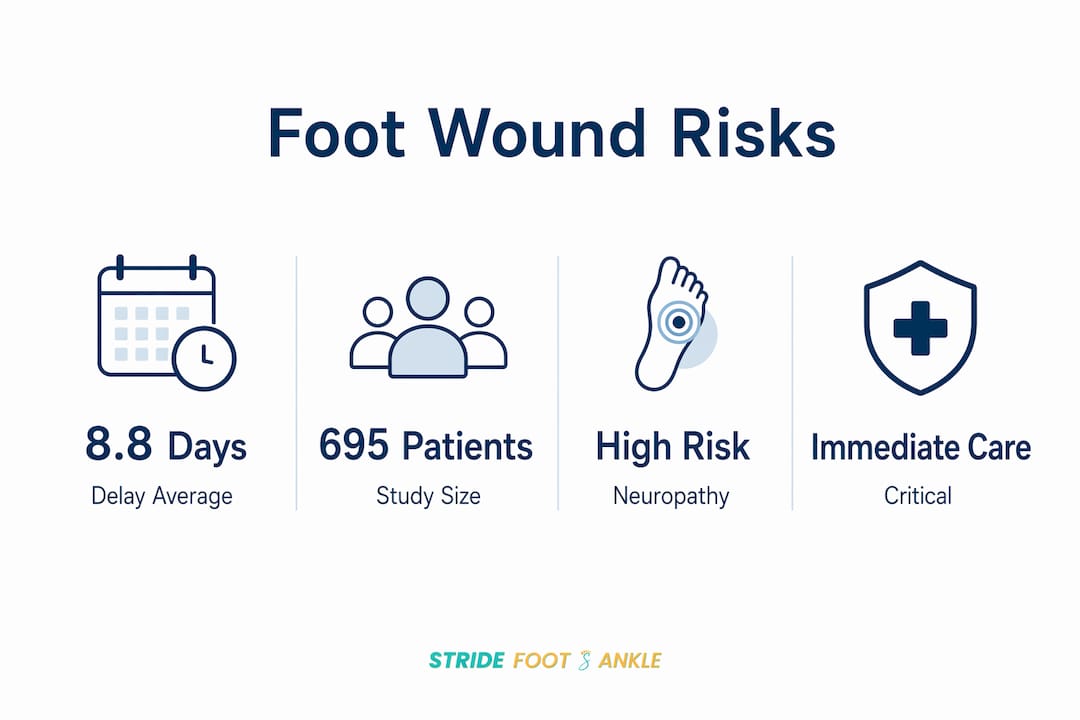
Research published in a peer-reviewed study of 695 patients with diabetic foot infections found that patients who tried home remedies before seeking care had hospital stays significantly longer for those who delayed treatment versus those who sought early treatment, underwent more repeated operative debridements, and incurred substantially higher costs. That gap is not a rounding error. It represents the real price of delay.
Who faces the highest risk, and why pain is a poor warning signal
Not every foot wound carries the same danger. For most people, a clean cut heals predictably. For others, even a small blister can become a limb-threatening event within days.
High-risk groups include:
- People with diabetes (nerve damage and poor circulation combine to mask and worsen wounds)
- Those with peripheral neuropathy from any cause
- Patients with peripheral arterial disease (PAD)
- People on immunosuppressive medications (steroids, chemotherapy, biologics)
- Those with chronic kidney disease
- Older adults with reduced circulation and slower tissue repair
The neuropathy problem deserves special attention. Loss of protective sensation means patients often cannot feel a wound worsening. They over-trim nails, soak feet in water that is too hot, or apply caustic agents, producing thermal injuries and unrecognized tissue loss. The CDC confirms that nerve damage from diabetes can prevent you from noticing cuts, blisters, or sores until they have already become serious.
Poor circulation compounds this. Peripheral arterial disease narrows the vessels supplying your feet, so even a minor wound heals slowly or not at all, and bacteria multiply in tissue that lacks the blood flow to fight them off.
Pro Tip: If you have diabetes, neuropathy, PAD, or take immunosuppressive medications, treat every foot wound as potentially serious. Do not wait for pain to tell you something is wrong, because it often will not.
For prevention strategies specific to at-risk patients, Stridefootankle’s guide on preventing foot ulcers covers daily foot checks and early warning signs in practical detail.
Common self-treatment mistakes that make foot wounds worse
These are the everyday DIY actions that clinicians see cause the most harm. Stopping them is the first step toward safer wound management.
- “Bathroom surgery”: Using non-sterile blades, needles, or scissors to lance blisters, trim calluses, or cut around ingrown nails. This introduces bacteria and can sever tissue that was protecting deeper structures. DIY procedures on foot wounds carry a particularly extreme risk for anyone with diabetes or poor circulation.
- Chemical corn and callus removers: These products use salicylic acid to dissolve tissue. Applied to a wound or used by someone with neuropathy, they cannot distinguish healthy from damaged tissue and can cause chemical burns.
- Aggressive nail trimming: Cutting too short or rounding corners creates entry points for infection, especially in people who cannot feel what they are doing.
- Soaking in hot water: Patients with neuropathy cannot accurately gauge water temperature, making thermal burns a real and underrecognized risk.
- Unprescribed topical antibiotics or ointments: Over-the-counter products may mask signs of worsening infection without treating it adequately.
- Packing wound cavities incorrectly: Stuffing gauze into a deep wound without sterile technique traps bacteria rather than clearing them.
- Ignoring pressure and footwear: Continuing to walk in tight or ill-fitting shoes keeps wounds open and drives bacteria deeper into tissue.
Do not rely on internet photos or social media groups to guide wound treatment decisions. Share wound photos only with a licensed clinician who can evaluate them in clinical context.
Red flags that mean you need professional care today
The decision of when to seek urgent care versus scheduling a routine visit should not be left to guesswork. Use this checklist.
Seek same-day evaluation (podiatry office or emergency department) if you have:
- Spreading redness or red streaks moving up the leg
- Increasing swelling, warmth, or tenderness around the wound
- Pus, discharge, or foul odor
- Fever or chills
- Worsening pain, or new numbness with visible skin breakdown
- A pale, cold, or pulseless foot or lower leg
- Any new wound if you have diabetes, neuropathy, or PAD
Signs of serious foot infection include spreading redness, pus, fever, and unexplained warmth, all of which require urgent clinical review rather than home monitoring.
The 48-hour rule: A wound that looks manageable on Monday can require hospital admission and surgery by Wednesday if infection spreads to deeper tissue or bone. Outpatient antibiotics work when infection is caught early. Once osteomyelitis sets in, the treatment pathway shifts to IV antibiotics, operative debridement, and sometimes partial amputation. That escalation happens faster than most patients expect.
If none of the red flags above are present but you have a wound that is not improving after 24–48 hours, schedule a clinic visit promptly rather than continuing to manage it at home.
What clinicians do that you cannot safely replicate at home
Professional wound care is not just a cleaner version of what you do at home. It is a different category of intervention entirely.
- Sterile debridement: Removal of dead, infected, or non-viable tissue under controlled conditions. Sterile debridement changes the wound environment in ways that home cleaning cannot, and it requires training to avoid damaging healthy tissue.
- Wound culture and targeted antibiotics: A swab or tissue sample identifies the specific bacteria present. This allows the clinician to prescribe the antibiotic that actually works, rather than a broad-spectrum drug that may miss resistant organisms.
- Vascular evaluation: Ankle-brachial index (ABI) testing and duplex ultrasound assess blood flow. Without adequate circulation, no wound will heal regardless of dressing choice.
- Imaging for osteomyelitis: X-ray can show bone changes; MRI provides earlier and more detailed detection of bone infection. Neither is available at home.
- Off-loading devices: Specialized boots, casts, or braces redistribute pressure away from the wound. This is one of the most evidence-backed interventions for diabetic foot ulcers, and it requires proper fitting by a clinician.
- Surgical drainage: When an abscess or deep-space infection is present, surgical drainage is the only effective treatment. Attempting this at home risks spreading infection and causing permanent damage.
Stopping infection before it reaches bone is the clinical goal. Early debridement, targeted antibiotics, and vascular assessment often convert a limb-threatening wound into a healable condition.
How early professional care changes outcomes: a side-by-side look
The difference between early and delayed care is measurable, not theoretical.
| Outcome measure | Early medical care | Delayed care (home remedies first) |
|---|---|---|
| Mean hospital stay | 8.8 days | 16.3 days |
| Estimated extra cost per patient | Reference | — |
| Trend in major amputation rates | Lower | Higher |
Source: Adverse events in diabetic foot infections, study of 695 patients.
Key figure: Patients who tried home remedies before seeking care delayed presentation by an average of 8.8 days, compared with those who sought care immediately. This delay is an independent predictor of worse limb outcomes.
A patient who presents to a podiatrist within 24 hours of noticing a non-healing wound can often be managed with outpatient debridement, a targeted antibiotic course, and an off-loading boot. The same patient presenting after 8.8 to 8.9 days of home treatment frequently requires hospital admission, multiple surgeries, and a significantly longer recovery.
Safe steps to take right now before your clinic appointment
These measures reduce harm while you arrange professional care. They are not a substitute for evaluation.
Do:
- Gently clean the wound with mild soap and clean running water
- Cover it with a sterile dressing and change the dressing daily
- Avoid putting weight on the foot if possible
- Take photos of the wound each day to show your clinician
- Call a podiatry office or telehealth service if you are unsure whether to wait
Do not:
- Lance, cut, or attempt to debride the wound at home
- Apply chemical corn or callus removers near any open skin
- Use unverified topical remedies from online sources
- Ignore the wound if you have diabetes or reduced sensation in your feet
- Walk barefoot, especially on hard or uneven surfaces
The CDC recommends washing the wound with clean water, applying a clean bandage, and seeking medical attention if there is redness, swelling, or fever. These steps buy time. They do not replace a clinical evaluation.
For a full home-care protocol aligned with podiatric guidelines, Stridefootankle’s Las Vegas foot care guide covers practical daily steps for patients managing foot health between visits.
Why Stride Foot & Ankle is the right call for wound care in Las Vegas
Stride Foot & Ankle, led by Dr. Nahad Wassel, is a board-certified foot and ankle surgery practice in Las Vegas specializing in advanced wound care, limb-salvage strategies, and diabetic foot management. Dr. Wassel brings surgical training and conservative-care expertise to every patient encounter, with a focus on stopping infection early and preserving function.
What to expect at your first visit:
- Full wound evaluation, including assessment of wound depth, tissue quality, and surrounding skin
- Imaging or wound cultures ordered when clinically indicated
- Sterile debridement if the wound requires it
- Off-loading plan tailored to your activity level and footwear
- Clear follow-up schedule so wound progress is monitored, not assumed
Patients with diabetes benefit from pairing podiatric wound care with strong glycemic management. Consistent blood sugar control is one of the most direct ways to support wound healing, and resources like good diabetes care practices from a primary care perspective complement what a podiatrist does at the wound level.
To schedule an evaluation, visit Stridefootankle’s general foot and ankle care page or call the Las Vegas office directly.
Key Takeaways
Self-treating foot wounds significantly raises the risk of infection, amputation, and hospitalization, especially for patients with diabetes, neuropathy, or poor circulation, and early professional care consistently produces better outcomes.
| Point | Details |
|---|---|
| Delay worsens outcomes | Patients who try home remedies first average 8.8 to 8.9 days before seeking care, leading to hospital stays nearly twice as long (16.3 vs 8.8 days) and more surgeries. |
| High-risk groups need faster action | Diabetes, neuropathy, PAD, and immunosuppression make even minor wounds potentially limb-threatening. |
| Red flags require same-day care | Spreading redness, pus, fever, red streaks, or any new wound in a diabetic patient means seek evaluation today. |
| Clinicians offer tools you cannot replicate | Sterile debridement, wound cultures, vascular testing, and off-loading require trained personnel and clinical equipment. |
| Stride Foot & Ankle | Dr. Nahad Wassel provides advanced wound care and limb-salvage strategies for Las Vegas patients at Stridefootankle. |
The real cost of waiting: a clinician’s perspective
Most patients who try home remedies are not being reckless. They are doing what feels reasonable: cleaning the wound, covering it, hoping it heals. The problem is that hope is not a clinical strategy, and for patients with diabetes or neuropathy, the wound that looks stable on the surface is often progressing silently underneath.
What concerns clinicians most is not the patient who ignores a wound entirely. It is the patient who manages it carefully at home for a week, feels reassured because it does not hurt, and then presents with osteomyelitis that could have been stopped with a single early visit. Pain is the body’s alarm system. Neuropathy disables that alarm. Without it, the only reliable signal is a clinician’s assessment.
The patients who do best are the ones who call early, even when they are not sure the wound is serious. That call costs nothing. Waiting costs far more.
Ready to get your foot wound evaluated by a specialist?
Stride Foot & Ankle offers expert wound evaluation and treatment in Las Vegas, with Dr. Nahad Wassel providing personalized, board-certified podiatric care. Whether you have a wound that is not healing, a diabetic foot concern, or a red flag you are not sure about, the right next step is a professional evaluation, not another day of home management.

To schedule your appointment, visit the Stride Foot & Ankle wound care page to request a visit online. New patients are welcome.
What to bring:
- Insurance card and photo ID
- List of current medications
- Photos of the wound (taken daily if possible)
- Blood sugar log if you have diabetes
- Any previous imaging or lab results related to the wound
For patients with diabetes, pairing your podiatric care with a structured diabetes care program supports healing from both directions. Call or book online today.
Authoritative sources and further reading
These resources provide evidence-based guidance on foot wound care, diabetic foot complications, and amputation prevention.
- Preventing Diabetes-Related Amputations, CDC — Primary U.S. government guidance on how diabetes complications raise amputation risk and what wound care steps reduce it.
- Your Feet and Diabetes, CDC — Practical daily foot-check guidance and explanation of why nerve damage makes early detection critical.
- Adverse events in diabetic foot infections: early vs. delayed medical treatment, Dovepress — Peer-reviewed study of 695 patients quantifying the clinical and financial cost of delaying care in favor of home remedies.
- Self-directed treatment for lower limb wounds in persons with diabetes, PMC — Observational data on how common home remedy use is and how delay predicts worse outcomes.
- Foot and Toe Ulcers: Treatment, Prevention, Repair and Causes, Cleveland Clinic — Clinical overview of ulcer types, treatment options, and when surgery becomes necessary.
This article provides general health information and is not a substitute for professional medical advice. Confirm current clinical guidelines and your individual treatment plan with a qualified podiatrist or healthcare provider.
FAQ
Should a foot wound be covered or left uncovered?
Cover it. Keeping a wound covered and moist reduces infection risk and supports faster healing. Change the dressing daily or whenever it becomes wet or soiled.
Why won’t my foot wound heal on its own?
Poor circulation, uncontrolled blood sugar, continued pressure on the wound, or an underlying infection can all prevent healing. If a wound has not improved within a few days, a clinician needs to assess it.
Is it better to let a foot wound heal without treatment?
Not for most foot wounds, and especially not for patients with diabetes or neuropathy. Small wounds can progress to deep infection or osteomyelitis without visible warning signs. Professional evaluation is the safer default.
How can you help a foot wound heal faster?
Keep it clean, covered, and off-loaded from pressure. Manage blood sugar if you have diabetes. See a podiatrist promptly. Sterile debridement and proper dressing protocols from a clinician consistently outperform home care for wounds that are not healing within 24–48 hours.
Recommended
- Treating Warts on the Feet – Stride Foot & Ankle – Dr. Nahad Wassel
- Foot Wound Debridement Explained: What Patients Should Know – Stride Foot & Ankle – Dr. Nahad Wassel
- Understanding Foot Fungus and When to Seek Help – Stride Foot & Ankle – Dr. Nahad Wassel
- How to Prevent Foot Ulcers: a Guide for At-Risk Patients – Stride Foot & Ankle – Dr. Nahad Wassel
Recent Comments